Pathology of the haemopoietic and lymphoid systems and clinical pathology of body systems

0.0(0)
Studied by 0 people
call kaiCall Kai
learnLearn
examPractice Test
spaced repetitionSpaced Repetition
heart puzzleMatch
flashcardsFlashcards
GameKnowt Play
Card Sorting

1/22

encourage image

There's no tags or description

Looks like no tags are added yet.

23 Terms

1
New cards

orbiviruses

Orbivirus is a genus in the Sedoreoviridae family of dsRNA [Baltimore Class III] viruses

<p>Orbivirus is a genus in the Sedoreoviridae family of dsRNA [Baltimore Class III] viruses</p>
2
New cards

orbiviruses are trasmitted by how

insect vectors

midges, sandflies, mosquitoes, ticks - they replicate in host and vector

<p>insect vectors</p><p>midges, sandflies, mosquitoes, ticks - they replicate in host and vector</p>
3
New cards

some virology

Some virology on how orbiviruses replicate

• Example of how a dsRNA virus replicates


Clinical aspects of orbiviruses of veterinary importance

• BTV

• EHDV & AHSV


• Vector-mediated virus transmission pathways


• Drivers of virus emergence and changing epidemiology of orbiviruses

<p>Some virology on how orbiviruses replicate</p><p>• Example of how a dsRNA virus replicates</p><p></p><p>Clinical aspects of orbiviruses of veterinary importance</p><p>• BTV</p><p>• EHDV &amp; AHSV</p><p></p><p>• Vector-mediated virus transmission pathways</p><p></p><p>• Drivers of virus emergence and changing epidemiology of orbiviruses</p>
4
New cards

BTV

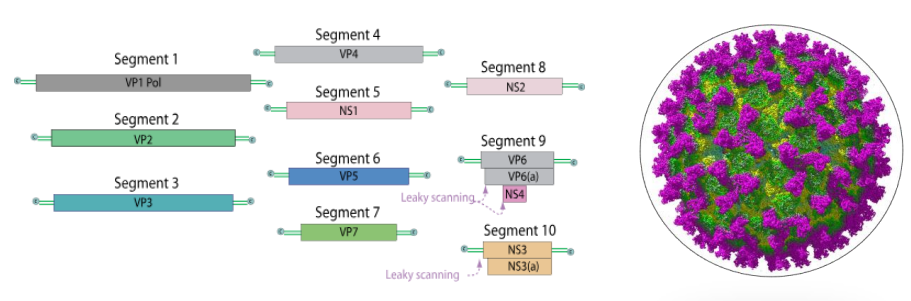
Three-layered virus particle

• Outer capsid VP2 + VP5

• Intermediate capsid VP7

• Inner capsid VP3 + VP1, VP4, VP6


• Genome of 10 segments of dsRNA

• Produces 12 proteins

• Segments size range from 822 to 3,954 bp

• Genome total size is 19,200 bp


purple bit is the part that goes inside the cell - the outer caspid?

<p>Three-layered virus particle</p><p>• Outer capsid VP2 + VP5</p><p>• Intermediate capsid VP7</p><p>• Inner capsid VP3 + VP1, VP4, VP6</p><p></p><p>• Genome of 10 segments of dsRNA</p><p>• Produces 12 proteins</p><p>• Segments size range from 822 to 3,954 bp</p><p>• Genome total size is 19,200 bp</p><p></p><p>purple bit is the part that goes inside the cell - the outer caspid?</p>
5
New cards

orbivirus replication

• Attachment to receptors (sialic acid) [1]

• Mediates endocytosis of virus into host cell. [1]

• Particles are partially uncoated, but not entirely, and penetrate in the cytoplasm.

[2]

• Early transcription of the dsRNA genome by viral polymerase occurs inside this

sub-viral particle, so that dsRNA is never exposed to the cytoplasm. [2]

• Full-length plus-strand transcripts from each of the dsRNA segments are

synthesized. These plus-strand transcripts are used as templates for translation.

[3] / [4]

• Viral proteins and genomic RNAs aggregates in cytoplasmic viral factories. [4]

• (+)RNAs are encapsidated in a sub-viral particle, in which they are transcribed to

give RNA (-) molecules with which they become base-paired to produce dsRNA

genomes. [5]

• The capsid is assembled on the sub-viral particle. [5]

• Mature virions are released following cell death and associated breakdown of

host plasma membrane


double stranded RNA in virus is a PAMP - its detected by cell because RNA is never double stranded

virus can make mRNA in the capsule - the pores big enough to allow single stranded RNA - the core has the genome and transcription - then mRNA leaks out through the pores into the cytosplasm for translation - check this

<p>• Attachment to receptors (sialic acid) [1]</p><p>• Mediates endocytosis of virus into host cell. [1]</p><p>• Particles are partially uncoated, but not entirely, and penetrate in the cytoplasm.</p><p>[2]</p><p>• Early transcription of the dsRNA genome by viral polymerase occurs inside this</p><p>sub-viral particle, so that dsRNA is never exposed to the cytoplasm. [2]</p><p>• Full-length plus-strand transcripts from each of the dsRNA segments are</p><p>synthesized. These plus-strand transcripts are used as templates for translation.</p><p>[3] / [4]</p><p>• Viral proteins and genomic RNAs aggregates in cytoplasmic viral factories. [4]</p><p>• (+)RNAs are encapsidated in a sub-viral particle, in which they are transcribed to</p><p>give RNA (-) molecules with which they become base-paired to produce dsRNA</p><p>genomes. [5]</p><p>• The capsid is assembled on the sub-viral particle. [5]</p><p>• Mature virions are released following cell death and associated breakdown of</p><p>host plasma membrane</p><p></p><p>double stranded RNA in virus is a PAMP - its detected by cell because RNA is never double stranded</p><p>virus can make mRNA in the capsule - the pores big enough to allow single stranded RNA - the core has the genome and transcription - then mRNA leaks out through the pores into the cytosplasm for translation - check this</p>
6
New cards

orbivirus replication cont

• Segmented genome


• Serotypes defined solely on segment 2 (VP2)

— BTV = 29 serotypes

— AHSV = 9 serotypes


• Immunity is homologous (only protected if infecting strain from same serotype for which immunity exists)

• Virulence can be strain specific: BTV-1 can be high or low virulence
<p>• Segmented genome</p><p></p><p>• Serotypes defined solely on segment 2 (VP2)</p><p>— BTV = 29 serotypes</p><p>— AHSV = 9 serotypes</p><p></p><p>• Immunity is homologous (only protected if infecting strain from same serotype for which immunity exists)</p><p>• Virulence can be strain specific: BTV-1 can be high or low virulence</p>
7
New cards


Reassortment – shuffling of gene segments between two distinct viruses when they coinfect the same cell

<p><strong>Reassortment </strong>– shuffling of gene segments between two distinct viruses when they coinfect the same cell</p>
8
New cards

orbivirus pathogenesis in the mammalian host

knowt flashcard image
9
New cards

orbivirus pathogenesis in the mammalian host

Early virus replication in lymph nodes (microvascular endothelia & leukocytes)

Infection of leukocyte moves the virus everywhere in the animal

Effect on immune response


Virus replication in capillaries & in many organs

Direct damage to vascular capillaries through viral replication in endothelial cells

Loosening of tight junction, leads to cell death

Indirect damage to vascular capillaries by the immune response to endothelial cells

10
New cards

haemorrhagic lesions and bluetongue virus

Endothelial cell death

• Viral replication causing cell lysis

• Viral replication causing apoptosis

• Viral replication leads to cell identified by immune system as

infected and killed (CTL response)


Effect on cellular junctions / other effects to increase vascular permeability

• Viral replication affects cellular junctions

• Cytokine release by cell inflammatory response increases vascular

permeability

• Inflammatory mediators being produced (eicosanoids)

• Interference with blood clotting cascade

<p><strong>Endothelial cell death</strong></p><p>• Viral replication causing cell lysis</p><p>• Viral replication causing apoptosis</p><p>• Viral replication leads to cell identified by immune system as</p><p>infected and killed (CTL response)</p><p></p><p><strong>Effect on cellular junctions / other effects to increase vascular permeability</strong></p><p>• Viral replication affects cellular junctions</p><p>• Cytokine release by cell inflammatory response increases vascular</p><p>permeability</p><p>• Inflammatory mediators being produced (eicosanoids)</p><p>• Interference with blood clotting cascade</p>
11
New cards

typical signs of bluetongue in sheep

• Fever (40-42oC)

• Reduced appetite

• Lethargic, depressed

• Reddening of the conjunctiva, increased tear fluid

• Hyperaemia of nasal and oral mucosa

• Oedema of lips, erosive lesions

• Facial oedema

• Clear and stringy (not frothy!) salivation

• Mucopurulent nasal discharge

• Respiratory distress

• Stiff / uncomfortable gait > joint swelling

• Reddening with associated swelling around coronary band – painful on palpitation (severe cases, bleeding)

• Decreased production: weight loss, wool breakage

• Reduced fertility, abortions, weak lambs

<p>• Fever (40-42oC)</p><p>• Reduced appetite</p><p>• Lethargic, depressed</p><p>• Reddening of the conjunctiva, increased tear fluid</p><p>• Hyperaemia of nasal and oral mucosa</p><p>• Oedema of lips, erosive lesions</p><p>• Facial oedema</p><p>• Clear and stringy (not frothy!) salivation</p><p>• Mucopurulent nasal discharge</p><p>• Respiratory distress</p><p>• Stiff / uncomfortable gait &gt; joint swelling</p><p>• Reddening with associated swelling around coronary band – painful on palpitation (severe cases, bleeding)</p><p>• Decreased production: weight loss, wool breakage</p><p>• Reduced fertility, abortions, weak lambs</p>
12
New cards

bluetongue in cattle

• BTV typically does not cause clinical disease

• Cattle remain act as reservoir host of the virus


If symptomatic, similar symptoms

• Crusting around nares

• Reddening

• Mastitis

• Coronary band

• Production loss

— Infertility

— Abortion

— Transplacental infection of offspring

<p>• BTV typically does not cause clinical disease</p><p>• Cattle remain act as reservoir host of the virus</p><p></p><p>If symptomatic, similar symptoms</p><p>• Crusting around nares</p><p>• Reddening</p><p>• Mastitis</p><p>• Coronary band</p><p>• Production loss</p><p>— Infertility</p><p>— Abortion</p><p>— Transplacental infection of offspring</p>
13
New cards

virus transmission routes

Contagious contact

(Direct animal-to-animal)


Contagious aerosol

(Between animals via aerosols)


Sporadic, non-contagious

(Vector-mediated transmission)

<p>Contagious contact</p><p>(Direct animal-to-animal)</p><p></p><p>Contagious aerosol</p><p>(Between animals via aerosols)</p><p></p><p>Sporadic, non-contagious</p><p>(Vector-mediated transmission)</p>
14
New cards

vector-borne viruses

• Vector-borne

• Insect-borne

• Arthropod-borne … arbovirus


Arboviruses are not a defined family, the term has no taxonomic meaning. Just describes a shared biological characteristic

<p>• Vector-borne</p><p>• Insect-borne</p><p>• Arthropod-borne … arbovirus</p><p></p><p>Arboviruses are not a defined family, the term has no taxonomic meaning. Just describes a shared biological characteristic</p>
15
New cards

vector-borne viruses

two mechanisms

<p>two mechanisms</p>
16
New cards

orbiviruses in the midge

• Arthropod can only transmit the virus if it reaches the salivary gland


Extrinsic incubation period (EIP):

• time taken for virus to replicate and reach the salivary gland


• Highly influenced by temperature


• Orbiviruses can only infect a few species of Culicoides

— susceptible vectors

• …and reaches the salivary gland in then only some individual insects


• Vector competence:

• the percentage of individuals that are able to transmit the virus after taking up the virus in a bloodmeal

<p>• Arthropod can only transmit the virus if it reaches the salivary gland</p><p></p><p><strong>Extrinsic incubation period (EIP):</strong></p><p>• time taken for virus to replicate and reach the salivary gland</p><p></p><p>• Highly influenced by temperature</p><p></p><p>• Orbiviruses can only infect a few species of Culicoides</p><p>— susceptible vectors</p><p>• …and reaches the salivary gland in then only some individual insects</p><p></p><p>• <strong>Vector competence:</strong></p><p>• the percentage of individuals that are able to transmit the virus after taking up the virus in a bloodmeal</p>
17
New cards
<p>BTV epidemiology</p>

BTV epidemiology

• Tropical / sub-tropical distribution

• Rarely seen in temperate climates…

• …until 2006/2007

<p>• Tropical / sub-tropical distribution</p><p>• Rarely seen in temperate climates…</p><p>• …until 2006/2007</p>
18
New cards
<p>BTV in europe</p>

BTV in europe

• Control of BTV-8 achieved through vaccination: protection is highly homologous, with little-to-no cross-protection

• Constant transmission around Europe of multiple BTV serotypes since 2008


• August 2023: Emergence of BTV-3 in Netherlands & Germany

• November 2023: BTV-3 detected in UK


August 2024: BTV-3 detected in East of England

• 145 premises affected

• Restriction zone in place: no ruminant movement

• Clinical impact variable


2025/26 season (n = 222 cases)

• 213 BTV-3

• 1 BTV-8

• 8 mixed BTV-3/BTV-8

<p>• Control of BTV-8 achieved through vaccination: protection is highly homologous, with little-to-no cross-protection</p><p>• Constant transmission around Europe of multiple BTV serotypes since 2008</p><p></p><p>• August 2023: Emergence of BTV-3 in Netherlands &amp; Germany</p><p>• November 2023: BTV-3 detected in UK</p><p></p><p>August 2024: BTV-3 detected in East of England</p><p>• 145 premises affected</p><p>• Restriction zone in place: no ruminant movement</p><p>• Clinical impact variable</p><p></p><p>2025/26 season (n = 222 cases)</p><p>• 213 BTV-3</p><p>• 1 BTV-8</p><p>• 8 mixed BTV-3/BTV-8</p>
19
New cards

why are arboviruses on the move?

• Climate change


Warmer temperatures

• Virus replicates faster

• Lifecycle of the insect faster

• Extended distribution of vectors


Can be negative too!

• Too hot = too dry

• Precipitation = wash away

<p>• Climate change</p><p></p><p>Warmer temperatures</p><p>• Virus replicates faster</p><p>• Lifecycle of the insect faster</p><p>• Extended distribution of vectors</p><p></p><p>Can be negative too!</p><p>• Too hot = too dry</p><p>• Precipitation = wash away</p>
20
New cards

why are arboviruses on the move?

• Globalisation


• Annual growth in air traffic passengers

— 9% per year since 1960

• Similar trends in air freight


Volume of shipping traffic increased 30% since 1993

• Refrigerated shipping

• Flowers from Kenya?

21
New cards

AHSV - African horse sickness virus

Horse sickness fever

• Fever, mild oedema of supraorbital fossa

• Immune horses & non-horse equids no mortality


Subacute (cardiac)

• Incubation 7-14 days

• Subcutaneous oedema, congested conjunctivae, colics

• Horses: mortality up to 50%


Acute (mixed)

• Incubation 5-7 days

• Pronounced oedema, mild pulmonary signs

• Horses: mortality up to 80%


Peracute (pulmonary)

• Incubation 3-5 days

• Maked depression, sudden fever, respiratory distress, fluid (frothy) discharged from the nares

• Horses: mortality rate >90%

<p><strong>Horse sickness fever</strong></p><p>• Fever, mild oedema of supraorbital fossa</p><p>• Immune horses &amp; non-horse equids no mortality</p><p></p><p><strong>Subacute (cardiac)</strong></p><p>• Incubation 7-14 days</p><p>• Subcutaneous oedema, congested conjunctivae, colics</p><p>• Horses: mortality up to 50%</p><p></p><p><strong>Acute (mixed)</strong></p><p>• Incubation 5-7 days</p><p>• Pronounced oedema, mild pulmonary signs</p><p>• Horses: mortality up to 80%</p><p></p><p><strong>Peracute (pulmonary)</strong></p><p>• Incubation 3-5 days</p><p>• Maked depression, sudden fever, respiratory distress, fluid (frothy) discharged from the nares</p><p>• Horses: mortality rate &gt;90%</p>
22
New cards

AHSV arrives in thailand, 2020

• Thailand reported an outbreak of AHS on 27 March 2020

• Of 341 horses at incursion sites, 62 were infected, 42 died


Outbreak:

• Cases: 508

• Deaths: 484

— Mortality rate: 95%


• Movement restrictions imposed

• Vaccine rollout


• Thailand declared AHS-free in 2023

<p>• Thailand reported an outbreak of AHS on 27 March 2020</p><p>• Of 341 horses at incursion sites, 62 were infected, 42 died</p><p></p><p>Outbreak:</p><p>• Cases: 508</p><p>• Deaths: 484</p><p>— Mortality rate: 95%</p><p></p><p>• Movement restrictions imposed</p><p>• Vaccine rollout</p><p></p><p>• Thailand declared AHS-free in 2023</p>
23
New cards

orbivirus control: vaccines

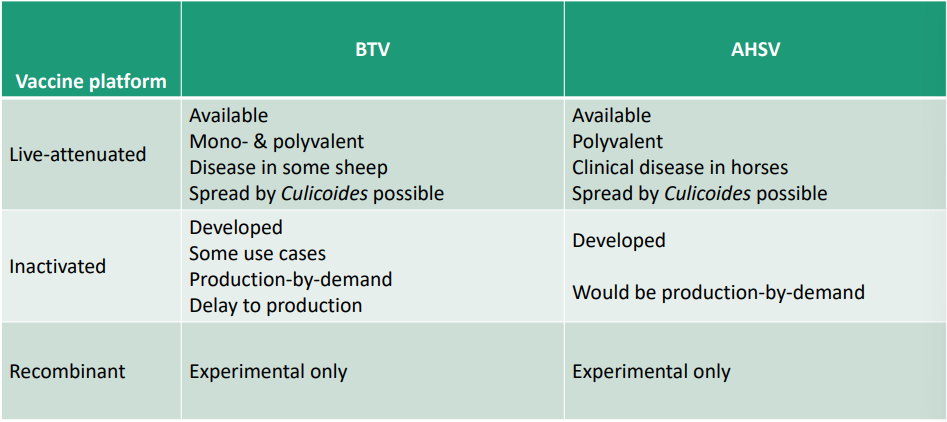
knowt flashcard image