Art of the Spanish World Exam 2
 Call Kai
 Learn
 Practice Test
 Spaced Repetition
 Match
 Flashcards
 Knowt Play
1/33

There's no tags or description
Looks like no tags are added yet.
34 Terms

Giuliano Dari. Lettera dell’isole che ha trovato nuevamente I’ll Re di Spangna ( Letter of the Islands Newly Found by the King of Spain) Florence, 1493. This establishes a specific hierarchy of power that would dominate Spanish art for centuries. Adaptation of Christopher Columbus’s first letter announcing New World discovery, and is one of the first visual depictions of the Americas in European art history.

Christopher Columbus. De insulis inventis. “On the Discovered Islands” Florence, 1495. Visually constructed how Europeans would view, imagine, and artistically represent the “New World” for centuries to come.

Fernández de Oviedo. Natural History of the West Indies Hammock. 1535. First comprehensive encyclopedia of the Americas, represents the moment European print culture shifted from imagining an “Eden” to documenting real indigenous material culture, urban planning, and design.

Fernández de Oviedo Natural History of the West Indies. Pineapple. 1535. Very first depiction of a pineapple, part of the inventory of the Crown’s new assets, linked to prestige/royalty, the best fruit.

Pearl Ship Pin. 16th century, Museum of London. They over mined the oysters in the New World to get pearls, then used these pearls in various art pieces and artworks.
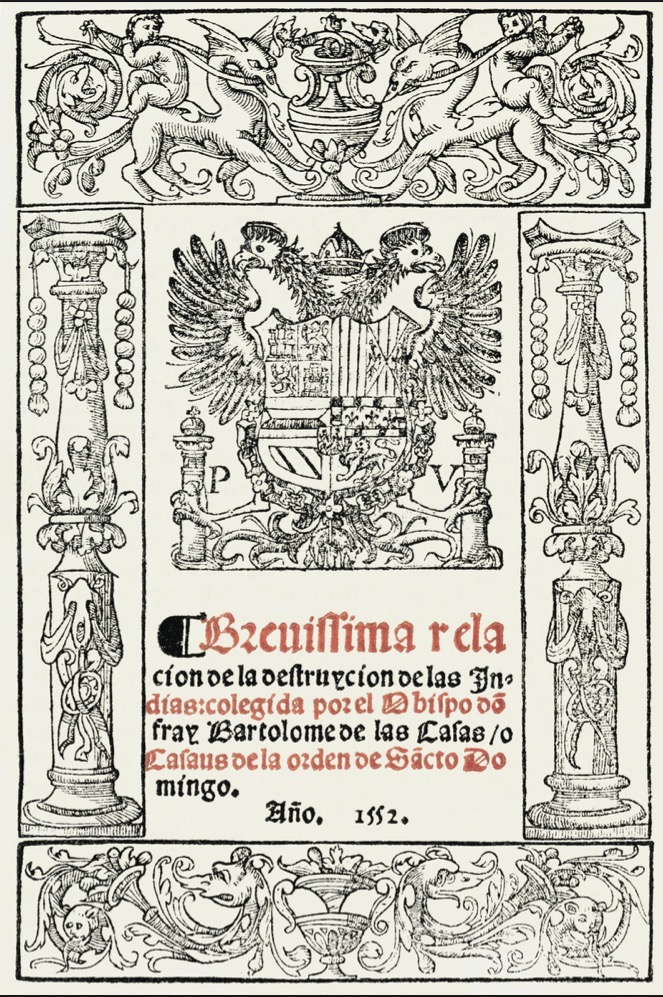
Title page of Bartolomé de las Casas, Brevissima relacion. Seville, 1552.

John White. the town of Secoton, 1585-1593, watercolor. This depicts a well-oriented, peaceful, self-sustaining community (contrasted most of the European depictions, ex: savages, unruled, requiring subjection).

Theodore de Bry, the town of Secoton, 1590, engraving (after John White’s watercolor). Served as a powerful vehicle for the Black Legend propaganda, anti-Spanish.

Unknown artist. Spanish Fury at Antwerp. (Belgium/Flanders) 1576. Supported the Black Legend, anti-Spanish.
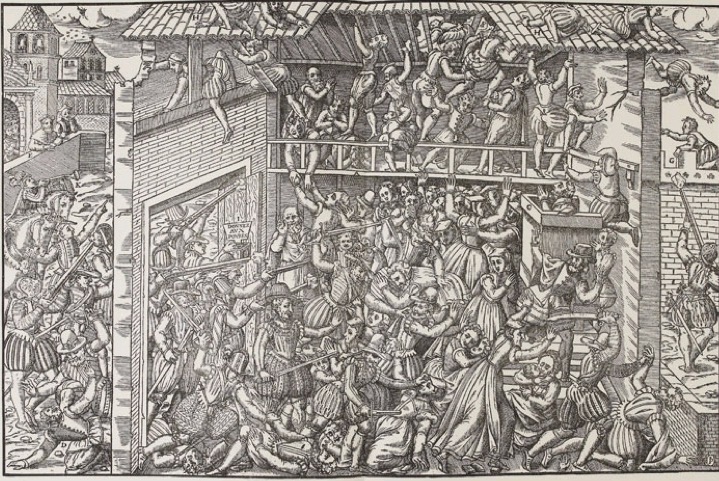
Anonymous. The Massacre of Vessy (1562). Catholic violence against Protestants* Supported Black Legend, anti-spanish settlement.

Theodore de Bry, The Burning of the Indians. V. 4, plate 18 (1594). Catholic violence against indigenous. Supported Black Legend, anti-Spanish Settlement.

Theodore de Bry. Hanging, Burning, and Clubbing of Indians, from Bartolomé de las Casas, 1598. Supports Black Legend, anti-Spanish settlement.

Theodore de Bry. Burning at the Stake with a Catholic Priest from Bartolomé de las Casas, 1598. Supports Black Legend, anti-Spanish settlement.

Aztec feather Mosaic. the Mass of St. Gregory. Commissioned by Diego Huanutzin (ruler of Tenochitilan, i.e. Mexico City) as a gift to Pope Paul III 1539. Made my elite Aztec feather artists (amanteca), this piece embedded a profound Christian subject inside the most sacred, elite luxury medium of the Aztec Empire (feathers).

Bishop’s Miter with Scenes of Christ’s Passion Amanteca (Feather painting/mosaic) 16th century. Shows syncretism, by shaping a sacred feather mosaic into a three-dimensional, wearable liturgical garment for a Catholic bishop, the amanteca physically transformed Aztec imperial luxury into the literal clothing of the Catholic Church

Engraving showing the Crucifixion and Scenes of the Passion contained in the monograms of Jesus and Mary. Italian, ca 1500s. These prints acted as mobile alters and teaching templates. Indigenous artists used them as direct visual blueprints to paint church murals etc.

Juan de la Corte. Festival in Plaza Mayor (Madrid) 1623. Captures the physical centerpiece of imperial power and civic control at the height of the Spanish Golden Age. Shows how architecture was engineered to regulate society and concentrate power.

Francisco Rizi. Auto de Fe en Plaza Mayor, Madrid. 1683. Demonstrates a public trial, operating as a courtroom-theater of spiritual judgement, blueprint for Colonial Control.

Cristóbal de Villalpando, View of the Plaza Mayor (Zócalo) of Mexico City, 1695. Captures the tensions of colonial governance and the complex racial realities of New Spain.

Biombo with the Conquest of Mexico and View of Mexico City (Mexico City side), New Spain, late 17th century. This shows how “orderly” the New Mexico City was.

Biombo showing the Conquest of Mexico and View of Mexico City, (Conquest of Tenochtitlan side) New Spain, late 17th century. Provides a continuous narrative layout, heavily pulls from Spanish chronicals and their POV. Ex: Blames Moctezuma death on his own people.

Battle scene (detail), Biombo. New Spain, late 17th century.

Assasination of Moctezuma II (detail), from the Biombo. New Spain, late 17th century. Used this to push the narrative that he was executed by another indigenous tribe, not by the Spanish.

Matteo di Pacino “Miracle of a Black Leg”. Ca. 1370-1375. The miracle was that the leg turned white again, not that the man was healed with a leg.

José Monte’s de Oca. Polychrome and gilt wood, glass of Saint Benedict of Palermo, c. 1734. Acted as a focal point for black confraternities, demonstrated that the Catholic Church was a universal path to salvation for all races.

Juan Pascual de Mena. Saint Benedict of Palermo, 1770-1780.

Anonymous. portrait of St. Benedict the Moor, called by all “the Black Saint” ca. 1700. “Candido per la grazia” - meaning shining white, bright or pure. Shocked Europe that his soul was white, bright, and pure and yet his skin was black.

Anonymous, Cusco artist. The Virgin of Potosí, ca. 1700. Merge between the Virgin Mary and Pachamama, demonstrates syncretism, “hybrid” image to show that they are similar.

Christ Child of Huanca, circa 1600. Same “hybridization” vibe. Making a point that Jesus is of royal dissent/giving him indigenous royalty.

Marcos Cipac de Aquino. Virgin of Guadalupe. Ca. 1556. Follows the “images not made by human hand” idea from Europe, like the Veronica.

Jose Juarez. Legend of the Virgin of Guadalupe appearing to Juan Diego. 1665. Visually mapped out the sequential timeline, invented a narrative framework that many copied after him.