M2 Coulson- Populations III + IV: Study ecology + Life history with stage structured models: climate change
 Call Kai
 Learn
 Practice Test
 Spaced Repetition
 Match
 Flashcards
 Knowt Play
1/5

There's no tags or description
Looks like no tags are added yet.
6 Terms
how can we create models for age-structured populations?
eg. soay sheep on st kilda, a remote island in scotland- the only large mammal, and it isn’t managed, making it a simple system to study
conduct mark-recapture analysis and use this to estimate survival/reproduction rates for different ages/sexes, and fit this against other environmental factors
eg. lambs most affected by density dependence and the weather
eg. adult males affected by winter weather (due to the rut in autumn, they enter winter in poor condition) adults females affected by spring weather (once pregnancy has progressed)
can create a matrix of survival and reproduction rates with age, and use matrix multiplication by a vector of the population structure, to estimate the age distribution in the following year
how does the climate affect species population dynamics?
climate change can affect the age structure of a population, because different demographics are affected more by weather conditions
to estimate the population dynamics, we need to know: the population size, the age structure (and density) and the climatic conditions
this is further modulated by the fact that density dependence also changes with weather/climate, due to changing the length of winter and growing seasons
what is the euler lotka equation?
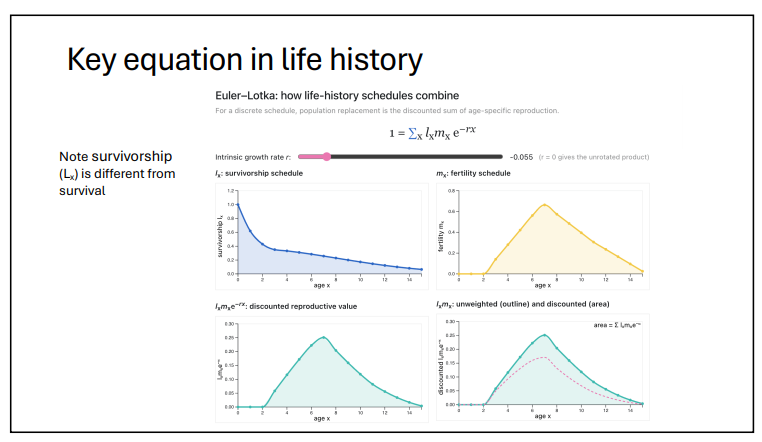
the euler-lotka equation of life histories- addition to the population is the sum of the reproduction from each age class (dependent on fertility, survivorship and the population size)
sum of the ages * survivorship, lx (probability of survival to a certain age within a cohort) * fertility schedule, mx (reproduction rate at a certain age) * discount rate, e^-rx (scales this by the population growth rate)
survivorship doesn’t equal survival, it refers to the proportion of survivors within a cohort (the individuals born in a certain year)
survivorship * fertility schedule will give us the average number of offspring produced at a certain age → the area underneath this function is the average reproductive success (offspring across a lifetime)
this equation assumes no demographic stochasticity, so the fertility and survivorship schedules are fixed, but the population growth rate, r, is variable under certain external conditions
what quantities can we use to summarise life histories (and compare across species)?

what is the fast-slow life history continuum?
bigger individuals tend to have longer life histories

how do life histories evolve?
shifts in environmental conditions can lead to changes in survivorship and fertility schedules, which can evolve over time
increased mortality across all aged leads to selection for increased fertility and a fast life history
increased juvenile mortality selects for slower life histories (and high fertility at sexual maturity)
eg. guppies in native range evolve fast life history strategies when predators are present (good food supply but will be eaten, living in shoals), but slow life histories when they aren’t present (density dependent, food limited, aggressive around food)
