Genetics Lecture Exam 4
 Call Kai
 Learn
 Practice Test
 Spaced Repetition
 Match
 Flashcards
 Knowt Play
1/34

There's no tags or description
Looks like no tags are added yet.
35 Terms
Describe the functions of activators and repressors.
activators - proteins that increase transcription by helping RNA polymerase bind to DNA or initiate transcription (ON)
repressors - proteins that decrease transcription by blocking RNA polymerase or preventing it from starting transcription (OFF)
Explain how small effector molecules affect the functions of activators and repressors.
bind to regulatory proteins and change their shape which changes how those proteins interact with DNA
can activate or inactivate repressor/activator
does NOT bind directly to DNA
ex. in lac operon, allolactose binds to the lac repressor and prevents it from binding DNA, allowing transcription
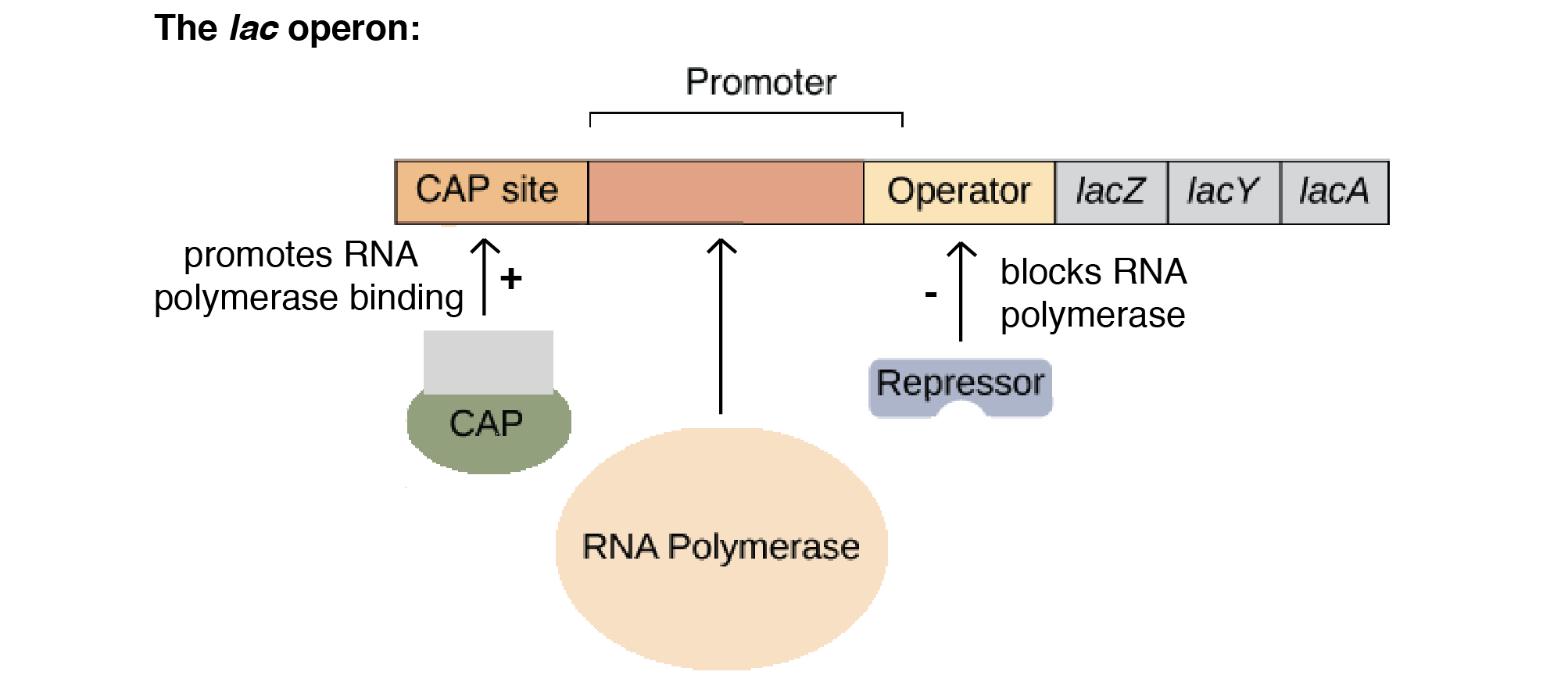
Describe the organization of the lac operon.
lacI - produces the lac repressor protein
promoter - where RNA polymerase binds
operator - where repressor binds
lacZ - makes beta-galactosidase, which breaks down lactose
lacY - makes permease, which helps lactose enter the cell
lacA - makes transacetylase
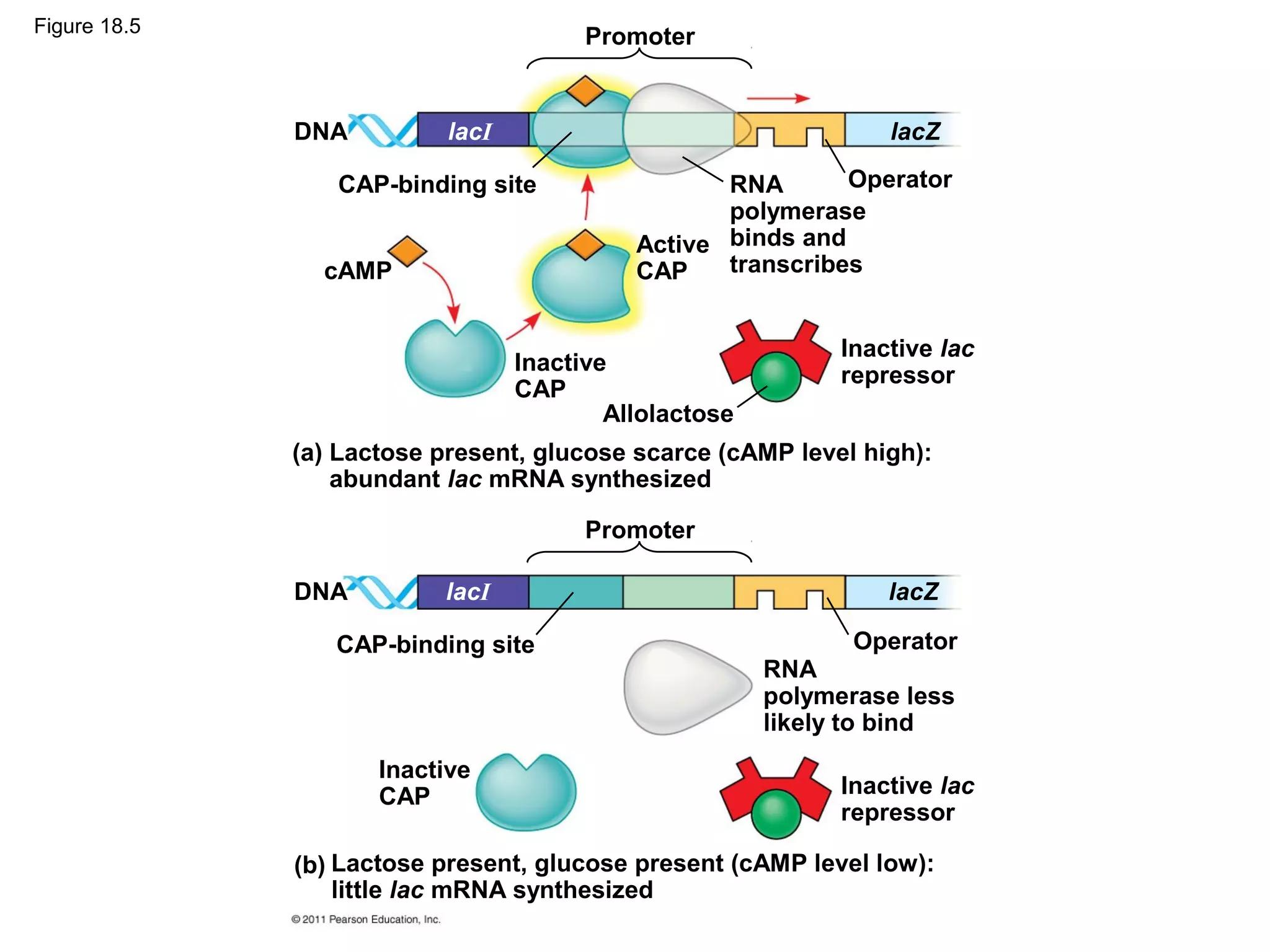
Explain how the lac operon is regulated by lac repressor and by catabolite activator protein.
lac repressor (negative regulation)
no lactose: repressor binds the operator → transcription is OFF
lactose present: some lactose becomes allolactose, which binds the repressor → repressor leaves the operator → transcription can occur
CAP (positive regulation)
helps RNA polymerase bind and increases transcription when glucose is low
low glucose → high cAMP → cAMP binds CAP → CAP binds DNA → transcription increases
high glucose → low cAMP → CAP does not effectively bind DNA → transcription remains low
lac operon is most active when lactose is present and glucose is absent
Analyze the results of Jacob, Monod, and Pardee, and explain how they indicated that the lacI gene codes a diffusible repressor protein.
experiment involved cells with diff lac operon mutations
combined cells with diff mutations
normal lacI gene in one cell could restore regulation in another cell
showed that other lacI gene produces a substance that can move through the cell and act on another DNA molecule
lacI codes for a diffusible repressor protein that can regulate the lac operon even when it is not physically attached to the DNA containing lacI
trans-acting - a regulatory product (ex. protein) can diffuse and act on another DNA molecule
cis-acting - a DNA sequence (ex. operator) only affects genes on the same DNA molecule
Describe the organization of the trp operon.
trp operon contains genes that allow bacteria to make the amino acid tryptophan
genes involved in synthesis - trpE, trpD, trpC, trpB, trpA
promoter - RNA polymerase binds here
operator - repressor binds here
leader sequence - helps regulate transcription through attenuation
Explain how the trp operon is regulated by trp repressor and by attenuation.
trp repressor
trp operon is repressible
low trp: repressor is inactive → cannot bind operator → transcription ON
high trp: tryptophan binds the repressor → activates it → repressor binds operator → transcription OFF
tryptophan acts as corepressor bc helps activate the repressor
attuention
second way to regulate trp operon; uses leader sequence to determine if transcription continues
high trp: ribosome moves quickly through the leader peptide → a terminator hairpin forms → transcription stops early
low trp: ribosome stalls at tryptophan codons → an antiterminator forms → transcription continues
attenuation depends on the speed of translation of the leader peptide
Explain how translational regulatory proteins and antisense RNAs regulate translation.
these mechanisms control whether an mRNA gets translated into protein
translational regulatory proteins
bind to specific regions of mRNA
can block ribosome attachment or movement
can also help translation occur
antisense RNA
small RNA molecule that binds to a complementary mRNA sequence
this can block ribosome binding or cause the mRNA to be degraded
result: less protein is produced
antisense RNA binds to mRNA to prevent or reduce translation
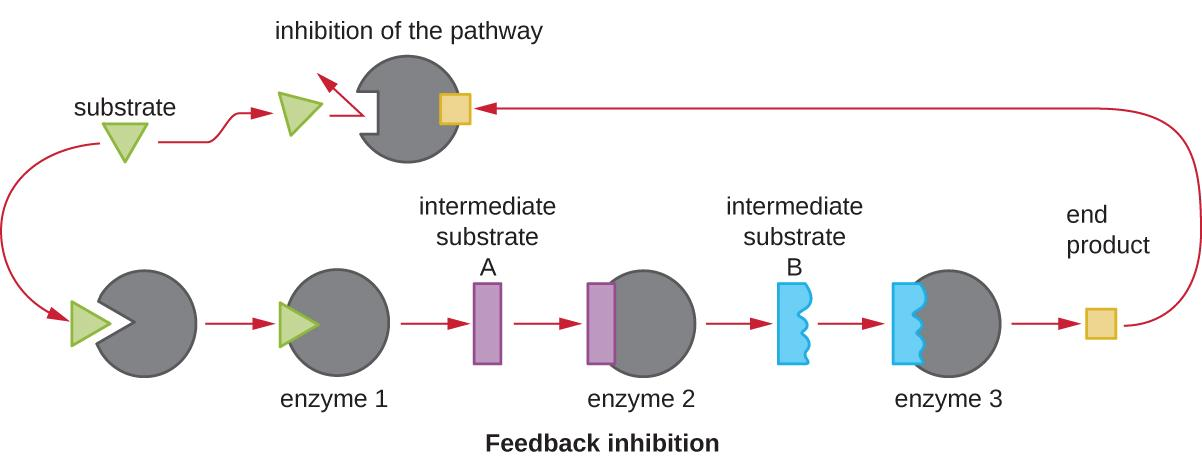
Summarize how feedback inhibition and posttranslational modifications regulate protein function.
feedback inhibition - final product of a metabolic pathway inhibits an enzyme that acts earlier in that pathway
bacteria makes trp, trp builds up
trp binds to an enzyme involved in its production
the enzyme becomes less active
less trp produced
posttranslational modifications - changes made to a protein after it has been produced
phosphorylation - adds a phosphate group and can turn a protein ON or OFF
methylation - adds a methyl group and can affect protein activity
feedback inhibition regulates enzyme activity, while posttranslational modifications change a protein after it’s made

Explain how riboswitches can regulate transcription and translation.
riboswitch = region of mRNA that can bind a small molecule and change its shape (that shape can regulate gene expression)
transcription regulation
small molecule binds to riboswitch → RNA changes shape → terminator structure may form → RNA polymerase stops transcription early
translation regulation
small molecule binds to riboswitch → RNA changes shape → ribosome-binding site becomes hidden or exposed → translation decreases or increases
Distinguish between general and regulatory transcription factors.
general transcription factors
required for binding of the RNA pol to the core promoter and its progression to the elongation stage
necessary for basal transcription
help form the preinitiation complex
regulatory transcription factors
serve to regulate the rate of transcription of target genes
influence the ability of RNA pol to begin transcription of a particular gene
bind to enhancers or other regulatory DNA sequences
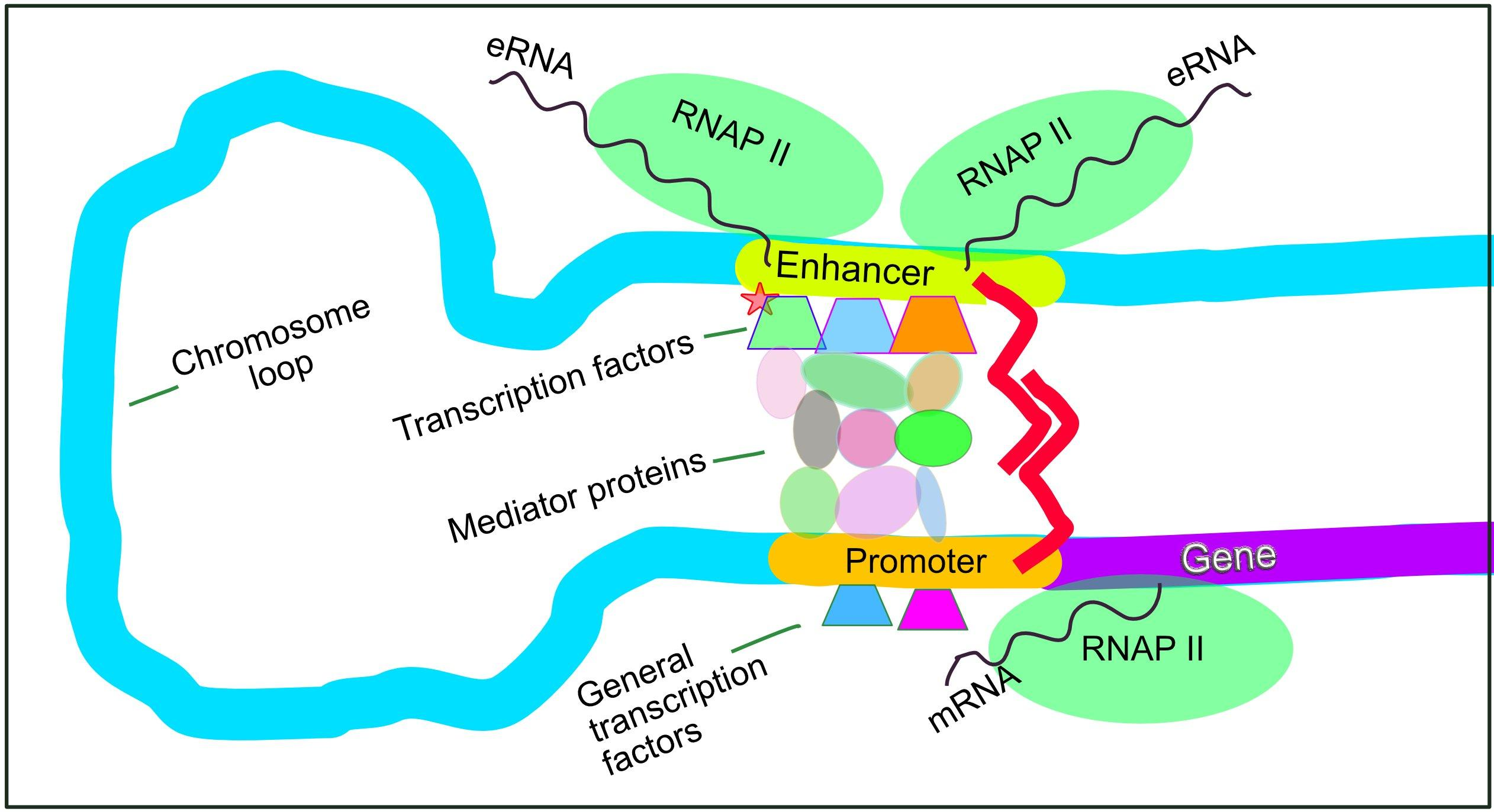
Describe how a regulatory transcription factor binds to an enhancer.
enhancer = DNA sequence that regulatory transcription factors bind to
1. regulatory transcription factor recognizes and binds to a specific enhancer sequence
2. DNA bends or loops, bringing the enhancer close to the promoter
3. regulatory transcription factor interacts with proteins at the promoter
4. can help recruit or stabilize the transcription machinery.
5. transcription increases or decreases depending on the regulatory proteins involved
Describe three ways that the function of a regulatory transcription factor can be modulated.
binding of a small molecule
molecule binds the transcription factor and changes its shape or activity
phosphorylation
phosphate group is added, which can activate or deactivate the transcription factor
protein-protein interactions
another protein binds to the transcription factor and changes its ability to regulate transcription

Describe how chromatin-remodeling complexes alter nucleosomes.
chromatin-remodeling complexes use energy from ATP to change how DNA is packaged around histones
they can:
slide nucleosomes along DNA
remove nucleosomes
replace or rearrange histones
why this matters:
loosely packed DNA → transcription factors can access DNA → transcription is more likely
tightly packed DNA → DNA is harder to access → transcription is less likely
Define histone variant, and explain why histone variants are functionally important.
histone variant = different version of a normal histone protein
H2A.Z can influence transcriptional regulation
CENP-A replaces regular H3 at centromeres and helps form the structure needed for chromosome segregation
histone variants give different regions of chromatin specialized functions

Explain how histone modifications affect transcription.
histones can receive chemical modifications that change chromatin structure. or recruit regulatory proteins
acetylation = usually increases transcription
methylation = can increase or decrease transcription depending on which histone amino acid is modified
phosphorylation = can affect chromatin organization and gene activity
ubiquitination = can influence transcription and chromatin regulation
histone modifications are not all activating or all repressing; their effects depend on the specific modification and its location
Define DNA methylation, and explain how it affects transcription.
DNA methylation - the addition of a methyl group to DNA, commonly to cytosine bases at CpG sites in eukaryotes
high methylation near a promoter → transcription decreases
low methylation near a promoter → transcription is more likely
methylation can prevent transcription factors from binding or attract proteins that promote tightly packed chromatin
(usually turns genes off)
Explain how DNA methylation is heritable.
DNA methylation patterns can be copied when cells divide; allows cells to maintain gene-expression patterns through cell divisions without changing the DNA sequence
1. DNA replicates
2. original strand keeps its methylation marks
3. new strand initially lacks those marks
maintenance DNA methyltransferases recognize the pattern and add methyl groups to the new strand
allows daughter cells to inherit similar gene-expression patterns
Describe the organization of nucleosome-free regions for an active gene.
an actively transcribed gene often has a nucleosome-free region (NFR) near its promoter
the promoter is accessible to transcription factors
nucleosomes are positioned around the NFR
RNA polymerase II and general transcription factors can assemble at promoter
active genes generally have accessible promoters
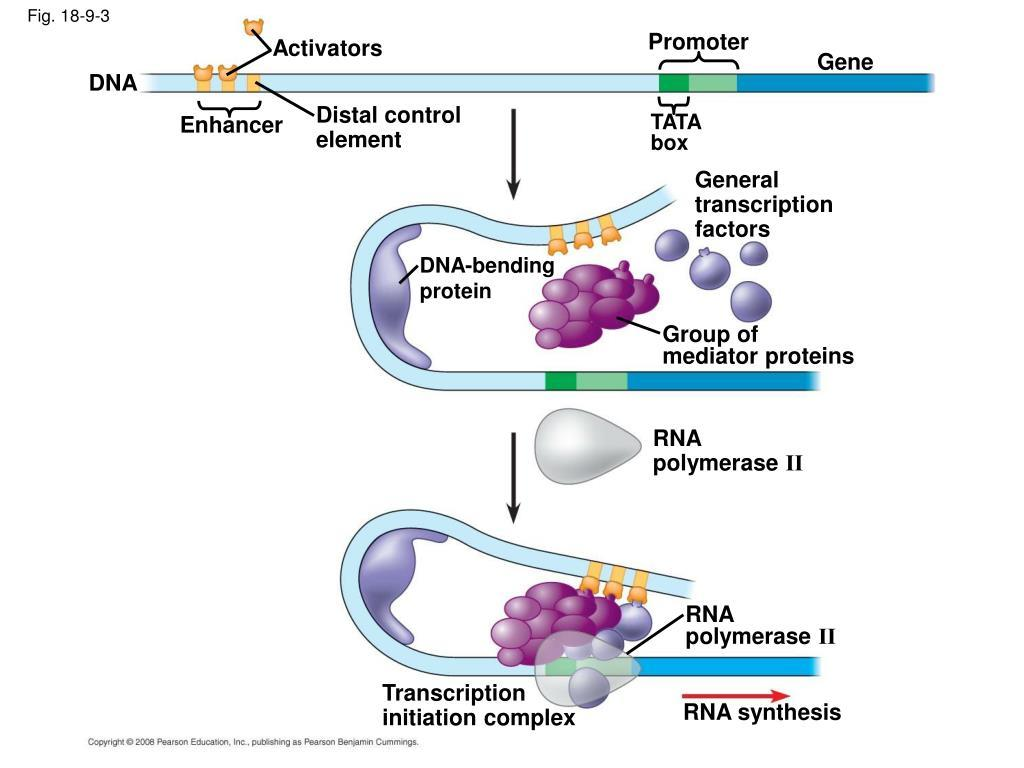
Explain how activators bind to enhancers and facilitate the binding of the preinitiation complex.
the PIC is the collection of proteins that assemble at a promoter before transcription begins
steps:
activators bind to enhancer DNA
DNA loops to bring activators near the promoter
activators interact with mediator and other regulatory proteins
these interactions help recruit general transcription factors and RNA polymerase II
PIC forms, allowing transcription to begin
Describe the key events that occur during the elongation phase of transcription.
elongation happens after transcription initiation
RNA polymerase moves along DNA and makes RNA
1. RNA polymerase II moves along the DNA template strand
2. reads the template in the 3′ to 5′ direction
3. builds RNA in the 5′ to 3′ direction
4. RNA nucleotides are added to the growing RNA molecule
5. as RNA polymerase moves, nucleosomes ahead of it are temporarily disrupted or rearranged and then reassembled behind it

Outline the steps of gene regulation via glucocorticoid receptors and CREB proteins.
two examples of eukaryotic transcriptional regulation
glucocorticoid receptors - steroid hormones that can enter cells
1. glucocorticoid hormone enters the cell
2. binds to a glucocorticoid receptor
3. receptor changes shape and becomes activated
4. activated receptor enters the nucleus if it is not already there
5. binds to specific DNA sequences called glucocorticoid response elements (GREs)
6. recruits regulatory proteins that influence transcription
CREB proteins (stands for cAMP response element-binding protein)
1. signal increases cAMP inside the cell.
2. cAMP activates protein kinase A (PKA).
3. PKA phosphorylates CREB.
4. phosphorylated CREB binds or functions at a DNA sequence called the CRE.
5. CREB recruits coactivators such as CBP.
6. transcription of target genes increases.
Distinguish between short and long-term repression.
short-term repression
usually temporary
involves regulatory proteins blocking transcription
can be reversed relatively quickly
gene may become active again when signals change
ex. repressor temporarily blocks transcription
long-term repression
can persist for many cell divisions
often involves stable chromatin changes
can be more difficult to reverse
gene can remain inactive over long periods
ex. DNA methylation
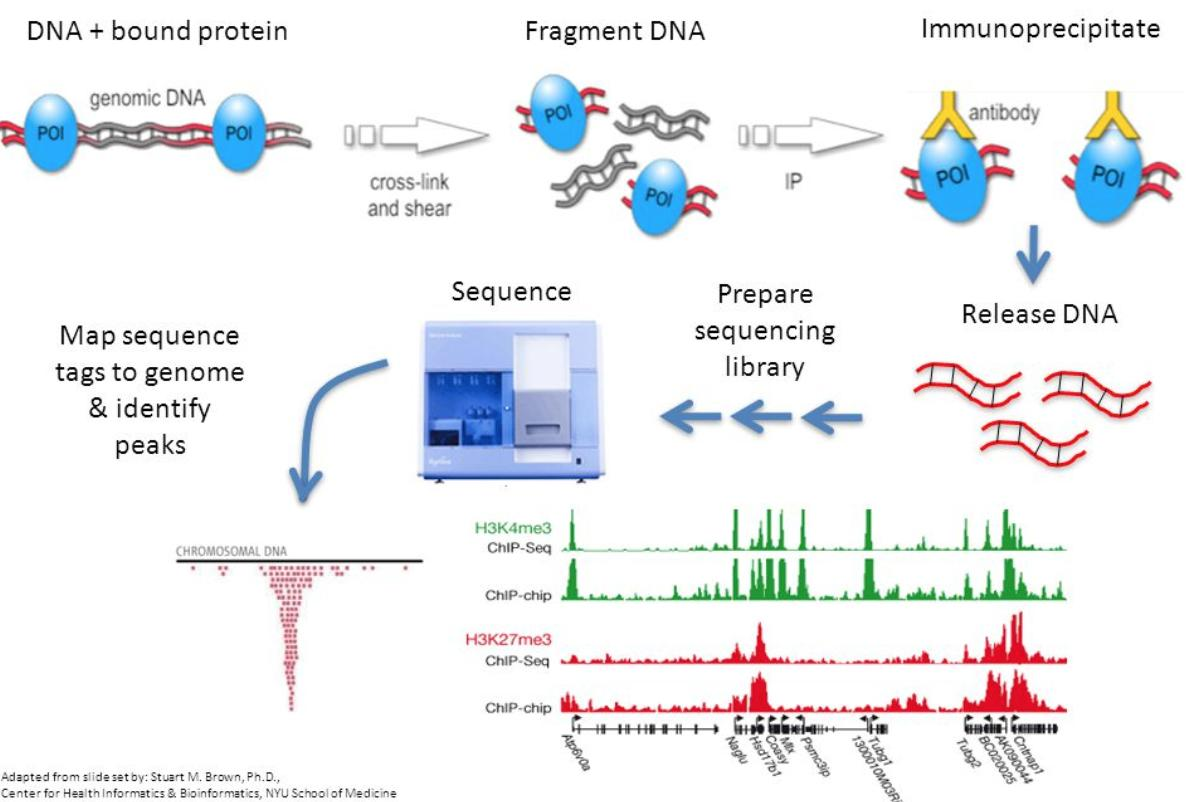
Describe the method of chromatin immunoprecipitation sequencing and explain what it is used for.
ChIP-seq identifies where a particular protein binds to DNA across the genome
1. crosslink proteins to DNA to preserve their interactions
2. break chromatin into smaller DNA fragments
3. use an antibody that recognizes the protein being studied
4. pull down the protein and the DNA attached to it
5. remove the protein and sequence the collected DNA fragments
6. map the sequences to the genome to identify binding locations
used for:
finding where transcription factors bind
identifying histone modifications across the genome
studying which genes may be regulated by particular proteins
Explain the purpose of the GAL system and how it allows yeast to import galactose and convert it into glucose.
allows yeast to use galactose as a food source by importing it into the cell and converting it into glucose-related molecules that can enter metabolism
galactose present = GAL genes activated
galactose absent = GAL genes mostly turned off
Identify the roles of GAL1, GAL2, GAL7, and GAL10 in the galactose-utilization pathway.
GAL2 - produces transporter that brings galactose into the cell
GAL1 - produces an enzyme that adds a phosphate group to galactose
GAL7 - produces an enzyme that helps convert galactose-derived molecules into glucose-related molecules
GAL10 - produces an enzyme that helps convert UDP-galactose into UDP-glucose
Describe the roles of Gal3, Gal4, and Gal80 in regulating the expression of GAL structural genes.
GAL3 - detects galactose and helps turn GAL genes on (sensor)
GAL4 - activates transcription by binding to UAS sequences (activator)
GAL80 - inhibits GAL4 and prevents transcription when galactose is absent (inhibitor)
GAL80 inhibits GAL4, while GAL3 helps remove that inhibition
Explain how Gal4 activates transcription by binding to upstream activating sequences (UASs).
UAS = regulatory DNA sequence located near the genes that need to be activated
GAL4 binds to UAS on DNA
GAL4 activated, its activation domain interacts with other transcription proteins
these interactions help recruit or stabilize the transcription machinery, including RNA pol II
transcription increases, producing more mRNA from the GAL genes
Describe the two functional domains of Gal4 (DNA-binding domain and activation domain) and explain the function of each.
DNA-binding domain
recognizes and binds to the UAS sequence on DNA
attaches Gal4 to DNA
activation domain
interacts with transcription machinery to increase gene expression
turns transcription on
Explain why transcriptional activator proteins are considered modular, including how their DNA-binding and activation domains can function separately.
modular = protein has separate parts that perform different jobs
Gal4 is modular; two domains two diff functions
Gal4’s activation domain can be attached to a different DNA-binding protein and still get transcriptional activity at the DNA sequence recognized by that other protein
Predict how GAL gene expression changes when galactose is present or absent and when GAL3, GAL4, or GAL80 is mutated.
galactose absent, normal genes
OFF, Gal80 inhibits Gal4
galactose present, normal genes
ON, Gal3 inhibits Gal80 allowing Gal4 to activate transcription
GAL4 mutation
OFF, Gal4 cannot activate transcription
GAL3 mutation
OFF, Gal80 continues inhibiting Gal4
GAL80 mutation
ON, even without galactose; Gal4 is no longer inhibited
UAS deletion
OFF, Gal4 cannot bind the missing regulatory sequence
Explain how Gal3 regulates Gal80 and Gal4 in the presence of galactose, including why Gal3 functions as both a sensor and an inducer.
galactose absent
Gal80 binds to Gal4 and inhibits its activation domain
Gal4 cannot activate transcription
galactose present
Gal3 detects galactose
Gal3 binds to Gal80
This causes Gal80 to stop inhibiting Gal4
Gal4 activates transcription by interacting with the transcription machinery
GAL gene expression increases dramatically
Gal3
sensor = detects presence of galactose
inducer = helps trigger GAL gene expression by binding to Gal80 and relieving Gal4 inhibition

Compare and contrast the yeast GAL system with the bacterial lac operon, focusing on how each system activates or represses gene expression.
yeast GAL system
Gal4 is a transcriptional activator
Gal80 inhibits Gal4
Galactose activates Gal3
Gal3 binds Gal80, relieving inhibition
Gal4 activates transcription
bacterial lac operon
lac repressor binds the operator and blocks transcription
allolactose binds the repressor, causing it to release the operator
allows transcription
CAP-cAMP also helps activate transcription when glucose is low
Explain how Gal4 illustrates conserved mechanisms of eukaryotic transcriptional regulation and why this system is important for understanding gene regulation in other eukaryotes.
GAL system shows how many eukaryotic genes are regulated
regulatory transcription factors bind specific DNA sequences
activator proteins interact with other transcription proteins
separate protein domains perform different functions
regulatory proteins control whether genes are expressed
activators help recruit transcription machinery
studying Gal4 in yeast helps scientists understand how transcriptional activators regulate genes in more complex eukaryotes, including animals and humans