Organizational
 Call Kai
 Learn
Learn Practice Test
 Spaced Repetition
 Match
Match Flashcards
 Knowt Play
1/61

There's no tags or description
Looks like no tags are added yet.
Name | Mastery | Learn | Test | Matching | Spaced | Call with Kai | Chat |
|---|
No analytics yet
Send a link to your students to track their progress
62 Terms
Leaders can enhance subordinates' performance and satisfaction by choosing the most appropriate leadership style based on the task and the employees' needs.
Path-Goal Theory (House)
Mentoring (as opposed to coaching)
Career and personal development
Less formal
Longer term
Agenda set by the mentee
“Critical incident”
Job-related behaviour associated with very good or very poor performance
Competency modelling
What competencies make someone effective in the role?
Linking the requirements for successful job performance to organizational values, goals, and strategies
Frame-of-Reference training focuses on
Helping raters recognize the multidimensionality of job performance and what constitute different levels of performance
Giving trainees opportunities to practice assigning ratings and receiving feedbacks on their rating accuracy.
Utility analysis
Monetary value (return on investment) of a selection test, training program, or other employment practice
Cross-Training
On-the-job training
Teaching employees to how to perform essential tasks performed by other employees
Vestibule training
Off-the-job training.
Simulated environment with dedicated trainers teaching how to use specialized machines or tools
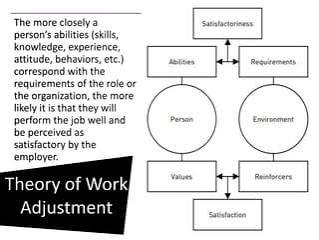
(Dawis and Lofquist) Satisfactoriness definition
Employer’s satisfaction with the employee
How well the employee’s skills matches the skill requirements of the job
McGregor’s Theory Y
Participative approach
Managers have an optimistic view of employees (capable of self-direction and self-control)
McGregor’s Theory X
Authoritarian approach
Employees inherently dislike work, are lazy, lack ambition, work for money and security
Coaching (as opposed to mentoring)
Performance improvement
More formal/structured
Time-limited
Specific goals
Regular meeting
Co-created agenda
Advantages of relative job performance measures (as opposites to Likert-type rating scale)
They are less susceptible to some rater biases
Position Analysis Questionnaire (PAQ)
Worker-oriented job analysis questionnaire
6 categories of work activity: information input, mental processes, work output, relationships with other people, job context, and other characteristics.
Behavioural interview
Past experience
What DID you do (in a specific job situation)?
Main types of integrity tests used to assist with selection decisions
Over and personality-based tests
What are Taylor-Russell tables used for?
Estimate how much a selection test will improve hiring success based on:
* validity coefficient
* selection ratio
* base rate
What is Bandura’s method of training?
Behavioral modeling
observe a model perform the behavior
practice the behavior
receive feedback/reinforcemen
Compressed workweek outcomes
Stronger positive effect on job satisfaction
Weaker effect on productivity
Personality traits most predictive of leader effectiveness
Extraversion
Conscientiouness
(Fiedler’s contingency theory) Low LPC leaders are most effective in which situations?
Very unfavourable and very favourable situations
(Fiedler’s contingency theory) High LPC leaders are most effective in which situations?
Moderately favourable situations
Vroom’s expectancy theory
VIE Theory
Valence
Instrumentality
Expectancy
What does Herzberg’s 2 factor theory say about employees’ satisfaction and motivation?
a) Hygiene factors (pay, benefits, work conditions):
Dissatisfaction when inadequate
Don’t increase satisfaction or motivation when adequate
b) Motivator factors (opportunities for autonomy, responsibility, and advancement):
Don’t cause dissatisfaction when inadequate
Contribute to satisfaction and motivation when adequate
Situational interview
Future/hypothetical
What WOULD you do?
Herzberg two-factor theory
Job satisfaction = motivators + hygiene factors
BARS - Behaviorally Anchored Rating Scales
Graphic rating scale in which each point on a scale is “anchored” with a description of a specific job-related behavior.

BARS disadvantage
Time-consuming to develop
First step in developing a new performance appraisal measure
Conducting a job analisys
Job analisys purpose
Identifying:
What the job involves
How it is performed
Conditions under which it is performed
Worker requirements
Job evaluation
Main purpose = COMPENSATION
Usally being with job analisys
Needs analysis purpose
Identify the gap before designing training
Can involve:
Organizational analisys → does the organization need this?
Task analysis → what skills the job requires?
Person analysis → which employees need training
Best predictor of job performance?
General mental ability tests
80% Rule for adverse impact
Formula: majority rate × .80
Example: men = 50% → women must be ≥ 40%.
Formula: majority rate × .80
.50 × .80 = .40 = 40%.
A test to predict job performance six months after employees are hired must have an adequate […] validity
Criterion-related validity
The degree to which the predictor (selection test) correlate with scores on a criterion (measure of job performance)
Krumboltz's social learning theory: factors that influence career decision-making
Genetic endowment/special abilities
Environmental conditions and events
Learning experiences
Task approach skills
Quality Circles (QCs)
Small groups of employees who meet regurlarly to identify problems and methods for resolving them.
They provide management with recommendations for resolving work-related problems.
Goal-setting theory: supervisees setting their own performance goals will produce goals that are
More difficult than the goals the supervisor would set alone
Technostructural intervention includes
Process reengineering
Downsizing
Job Enrichment
Alternative work schedules
Decision tree / decision matrices to help leaders determine the optimal leadership in a particular situation - which authors/model?
Vroom-Yetton-Jago's leadership model
Gender and leader effectiveness
Female leaders → more effective in feminine work settings
Male leaders → more effective in masculine work settings
Relationship between consideration and initiating structure on job outcomes
High consideration → + important for satisfaction
High initiating structure → + important for performance
Group polarization
Extreme decisions (more than individual ones)
Groupthink
Group sacrifices critical thinking to maintain consensus
Deinvididuation
Anonymity reduces self-control/accountability
Social facilitation
Others present = easy task better, hard task worse
Maslow's needs hierarchy
Physiological
Safety
Social
Esteem
Self-actualization
Type A behaviour pattern
Urgency, competitiveness, hostility
Hostility → heart disease
Stages of Selye's general adaptation syndrome
Alarm reaction, resistance, and exaustion
How the body reacts to chronic or acute stress
Holland's RIASEC

Satisficing concept (Herbert Simon)
Satisfactory + sufficient → good enough
Factors that causes “satisficing”
Cognitive limitations
Time constraints
Imperfect/inadequate information
Leader-member exchange (LMX)
Higher-quality leader-subordinate relationship → Better employee outcomes
Flextime: greatest positive influence on
Absenteism
Anticipation and implementation are phases of which model?
Tiederman's career decision-making model
Equifinality = ?
Same final state, different initial conditions
Multifinality
Different final states, same initial condition
Kirkpatrick training evaluation model
Reaction → did they like the training?
Learning → did they learn something?
Behaviour → did they apply to their work?
Results → were there impacts on the results?
Super - Life-Span, Life-Space Theory

Super vs Holland
Super: career development throughout time + self-concept
Holland: fit between personality/interests and work environment
Dawis & Lofquist Theory of Work Adjustment
Tiedeman Carrer Decision-Making Model
