Transcription and RNA (last exam)
 Call Kai
 Learn
Learn Practice Test
 Spaced Repetition
 Match
Match Flashcards
 Knowt Play
1/20

There's no tags or description
Looks like no tags are added yet.
Name | Mastery | Learn | Test | Matching | Spaced | Call with Kai | Chat |
|---|
No analytics yet
Send a link to your students to track their progress
21 Terms
The genetic information in genes must be ___
expressed
Gene expression occurs through two processes:
-___- converts DNA to RNA. Think about the root work ‘transcribe’, which is to copy the same language (i.e. language of nucleotides)
-__- converts RNA to protein. Think about the root word ‘translate’, which is to convert one language (i.e. nucleotides) into another (i.e. amino acids)
-Transcription
-Translation
___ is the process of converting DNA into RNA
Transcription
RNA is chemically very similar to DNA with the following exceptions:
-Contains __ not deoxyribose
-Contains uracil (U) instead of thymine (T)
-Is typically ___
-ribose
-single-stranded
Transcription Produces RNA __ to DNA
Complementary
Transcription is similar to DNA replication
-A small region of double-stranded DNA is unzipped to expose __ strand (one of the two DNA strands)
-___ builds an RNA strand one nucleotide at a time (A, C, G, U) in the ___ direction, forming a phosphodiester backbone (just like with DNA)
-template
-RNA polymerase : 5’ to 3’
Transcription can be broken down into 3 steps:
- __: How, where, and when to start
-___: Continuation of transcribing DNA into RNA
-___: Stop of making RNA
-Initiation
-Elongation
-Termination
Termination: Stop of making RNA
-Eukaryotes: pre-RNA is __ modified into mRNA
-The pre-RNA often contains non-protein coding sections called __
-__ are regions that code for proteins. —- = Expressed in Protein
- post-transcriptionally
-introns
-Exons
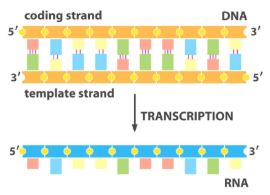
-Note the __ strand (complementary to the RNA) that is used by the RNA polymerase
-The __ strand has a sequence equivalent to the RNA. I.e. 5’AGGTTC3’ in the DNA coding strand = 5’AGGUUC3’ in the RNA
-template
-coding
RNA that will be converted to amino acids (i.e. protein) is called __ RNA (mRNA)
messenger
Other types of RNA are not converted to amino acids, instead they can be regulatory, structural and enzymatic in nature:
-__RNA (___) - a major component of ribosomes (the protein factories)
-__RNA (__) - move amino acids to ribosomes
-__RNA (__) - regulate gene expression
-Ribosomal : rRNA
-Transfer : tRNA
-Micro : miRNA
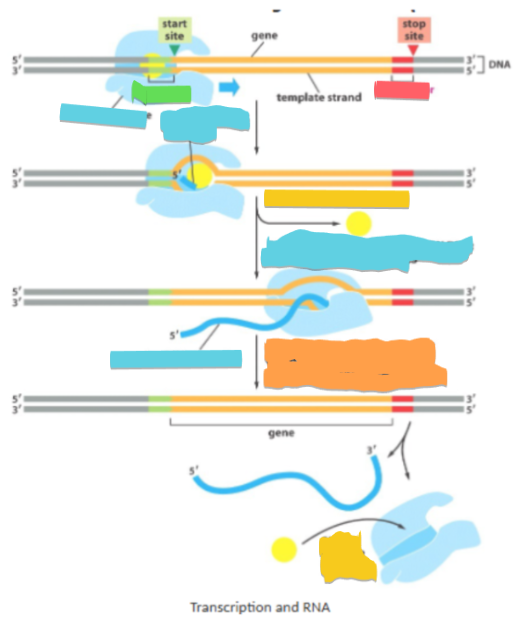
A __ is a specific sequence within DNA that signals the start of a gene
promoter
With the help of __, bacterial RNA polymerase binds tightly to promoted regions and opens up the DNA helix to expose the template
sigma factors
Transcription ends when the polymerase encounters a ___ sequence (region that causes the polymerase to fall off)
terminator


The ___ TTGACA hexamer: found 35 nucleotides before transcriptional start (-35)
The ____ TATAAT hexamer is found at -18 to -9 nucleotides upstream from transcriptional start (-10)
-35 Element
-10 Element
Eukaryotic gene transcription differs from prokaryotic transcription in the following ways:
-___ types of RNA polymerases exist instead of one
-Eukaryotes require ___
-More elaborate control over transcription exists
-DNA packaging (e.g. ___) presents a challenge (no __ in prokaryotes)
-Three
-transcription factors
-nucleosomes : histones
RNA polymerase II requires the help of proteins called __
transcription factors
Transcription factor __ bind to a promoter region known as a TATA box (composed mainly of A and T nucleotides), which is typically ~ 25 nucleotides upstream from the start of a gene
TFIID
Together RNA polymerase II and these factors form the transcription __
initiation complex
__ (in pink) phosphorylates the ‘tail’ of RNA polymerase II, which causes the cluster of transcription factors to fall of
TFIIH
