Muscle Review
 Call Kai
 Learn
 Practice Test
 Spaced Repetition
 Match
 Flashcards
 Knowt Play
1/9

10 Terms
Coracobrachialis
O: Coracoid process of the scapula, I: medial side of the humerus N: Musculocutaneous nerve of the arm. A: flexes and adducts the arm at the shoulder.

Brachialis
O: Distal half of the humerus, I: Coronoid process of the ulna, N: Musculocutaneous nerve, A: flexes the forearm at the elbow.

Biceps Brachii
O: Superior glenoid cavity and coracoid process of the scapula, I: Radial tuberosity, N: Musculocutaneous nerve, A: flexes the forearm at the elbow and supinates the forearm.

Deltoid
O: Lateral third of the clavicle, acromion, and spine of the scapula, I: Deltoid tuberosity of the humerus, N: Axillary nerve, A: Abducts, flexes, and extends the arm.

Subscapularis
O: Subscapular fossa, I: Lesser tubercle of the humerus, N: Upper and lower subscapular nerves, A: Medially rotates the arm.

Supraspinatus
O: Supraspinous fossa of the scapula, I: Greater tubercle of the humerus, N: Suprascapular nerve, A: Abducts the arm.

Infraspinatus
O: Infraspinous fossa of the scapula, I: Greater tubercle of the humerus, N: Suprascapular nerve, A: Laterally rotates the arm.

Pectoralis Minor
O: Ribs 3-5, I: Coracoid Process, N: Medial Pectoral Nerve, A: Assists with protraction and stabalizes the scapula

Pectoralis Major
O: Medial half of the clavicle, sternum, and costal cartilages of ribs 1-6, with the aponeurosis of the external oblique, I: Lateral lip of the intertubercular (bicipital) groove of the humerus, N: Lateral and medial pectoral nerves , A: Flexes, adducts, and medially rotates the arm at the shoulder.

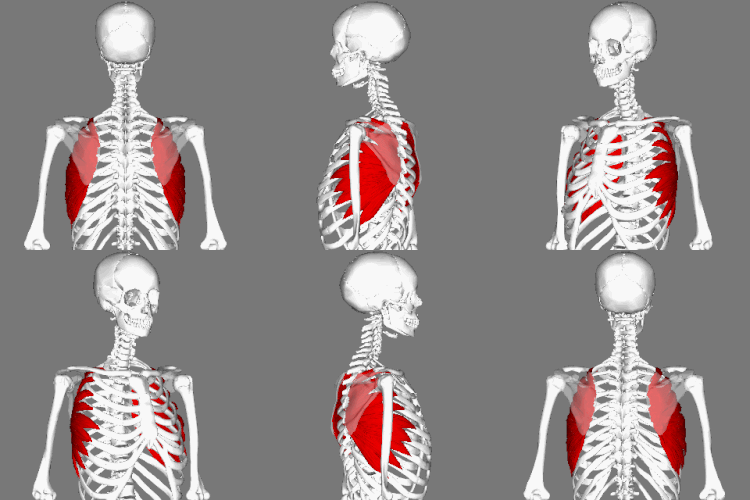
Serratus Anterior
O: Ribs 1-8 I: Medial bordr of the scapula, N: Long Thoracic Nerve, A: Protraction and stabalizes the scapula, and upwardly rotates it to help to help raise the arm