physics chapter 5 part 1
 Call Kai
 Learn
Learn Practice Test
 Spaced Repetition
 Match
Match Flashcards
 Knowt Play
1/107

There's no tags or description
Looks like no tags are added yet.
Name | Mastery | Learn | Test | Matching | Spaced | Call with Kai | Chat |
|---|
No analytics yet
Send a link to your students to track their progress
108 Terms
How is the study of electricity relevant to radiography?
The primary function of an x-ray imaging system is converting electricity into electromagnetic radiation
How is the study of magnetism relevant to radiography?
MRI, magnetic field safety, magnetic field laws, transformers, and induction motors
What are the properties of matter?
Has mass and occupies space, has an energy equivalence (E = mc²), and may have electric charge (electrons −, protons +)
What is electrostatics?
The science of stationary electric charges
What is electrodynamics?
The science of electric charges in motion
What is an electrified object?
An object with too few or too many electrons
What are the 3 ways electrification is created?
Contact, friction, and induction
What is actually happening during electrification?
Movement of negative electric charges (electrons)
who discovered electromagnetic induction, and when?
Michael Faraday, 1830s
What is Faraday's law (electromagnetic induction)?
A changing magnetic field induces an electric current in a circuit
What is the smallest unit of electric charge?
The electron
What unit measures electric charge, and what does 1 unit equal?
Coulomb (C); 1 C = 6.3 × 10¹⁸ electron charges
What is Electrostatic Law #1?
Unlike charges attract; like charges repel
Which direction do electric fields radiate? Do uncharged particles have one?
Outward from a positive charge and inward toward a negative charge; uncharged particles have no electric field
What is associated with each electric charge?
an electric field
What is Electrostatic Law #2 (Coulomb's law)?
Electrostatic force is directly proportional to the product of the charges and inversely proportional to the square of the distance between them
What is the Coulomb's law formula, and what does each variable mean?
F = k(Q_A · Q_B) / d²
-F = electrostatic force (newtons)
-Q_A, Q_B = electrostatic charges (coulombs)
-d = distance between charges (m)
-k = constant of proportionality
What law does Coulomb's law follow for distance, and what is its formula?
: The inverse square law: I₁/I₂ = (d₂/d₁)²
How does electrostatic force change with distance?
Very strong when objects are close, but decreases rapidly as they separate
What is Electrostatic Law #3?
When an object becomes electrified, the electric charges are uniformly distributed throughout the object or on its surface (example: copper conductive wire)
How does wire size relate to how much electricity it can carry? Which is larger, #12 or #14 gauge?
Larger wire can carry more electricity; #12 is larger in diameter than #14 (lower gauge number = thicker wire)
What is Electrostatic Law #4?
The electric charge of a conductor is concentrated along the sharpest curvature of its surface
What are real-world applications of Electrostatic Law #4?
Personal protection devices and police "tools" (like stun guns)
What are all 4 electrostatic laws?
1-Unlike charges attract; like charges repel
2-Coulomb's law: force is very strong when objects are close and obeys the inverse square law
3-Electric charge is uniform throughout or on the surface
4- Electric charge of a conductor is concentrated along the sharpest curvature of the surface
What kind of energy do electric charges have?
Potential (stored) energy
What is the unit of electric potential, and what is it also called?
The volt (V); also called electromotive force (EMF)
What is the relationship between voltage and potential to do work?
Higher voltage = higher potential to do work
What voltage is used in US homes/offices vs. x-ray imaging systems?
110 V in homes/offices; 220 V for x-ray imaging systems and other industrial applications
What is electrodynamics, and what is it called?
The study of electric charges in motion; called current (I)
How does the direction of current compare to electron flow?
Opposite: current flows (+) to (−) (electrical engineers); electron flow is (−) to (+) (physicists)
Give two examples of the range (orders of magnitude) of voltage.
EKG: mV to µV; transmission lines: 440 kV
What is a conductor? Give examples.
Any substance through which electrons flow easily: copper wire, water (human body)
What is an insulator? Give examples.
Any material that does not allow electron flow: rubber, glass, wood, ceramic (earthlike materials)
What is a semiconductor? Give examples.
A material that acts as an insulator under some conditions and as a conductor under others: silicon (Si), germanium (Ge)
What did semiconductors lead to, and who is associated with this?
Microchips and the rise of computer technology; William Shockley (1946)
How does temperature affect resistance?
All materials resist electricity at room temperature; resistance decreases as temperature decreas
What is superconductivity?
The property of some materials to exhibit no resistance below a critical temperature (Tc); Ohm's law does not apply
When do you have an electric circuit?
When resistance is controlled and the conductor is made into a closed path
What happens to electric current when resistance increases?
Current decreases
What are the four electrical states of matter?
Superconductor, conductor, semiconductor, insulator
Superconductor: materials and characteristics?
Niobium, titanium; no resistance to electron flow, no electric potential required, must be very cold
Conductor: materials and characteristics?
Copper, aluminum; variable resistance, obeys Ohm's law, requires an electric potentia
emiconductor: materials and characteristics?
Silicon, germanium; can be conductive or resistive, basis for computer technology
Insulator: materials and characteristics?
Rubber, glass; does not permit electron flow, extremely high resistance, necessary with high voltage
battery
provides electrical potential

switch
turns circuit on and off by providing infinate resistance

transformer
increases or decreases voltage by fixed amount (ac only)

What unit measures electric charge (Q)?
Coulomb (C)
What unit measures electric current (I), and what does 1 unit equal?
Ampere (A); 1 A = 1 C flowing through a conductor per second
What unit measures electric potential?
Volt (V)
What unit measures electric power (P)?
Watt (W)
What unit measures electric resistance?
Ohm (Ω)
What is Ohm's law?
The voltage across the entire circuit or any portion of it equals the current multiplied by the resistance
What is the Ohm's law formula, its rearrangements, and what each variable means?
V = IR
R = V/I
I = V/R
V = volts
I = current (amperes)
R = resistance (ohms)
1 V across a resistance of 1 Ω produces how much current?
1 amp
If voltage doubles (resistance stays the same), what happens to current?
Current doubles
If resistance doubles (voltage stays the same), what happens to current?
Current is cut in half
What is a series circuit?
All circuit elements are connected in a line along the same conductor

Series circuit: how do you find total resistance?
Add the individual resistances: RT = R₁ + R₂ + R₃...
series circuit: what is true about current?
Current through each element is the same and equals the total circuit current
Series circuit: what is true about voltage?
The voltages across each element add up to the total circuit voltage
What is a parallel circuit?
A circuit with elements connected at their ends rather than in a line
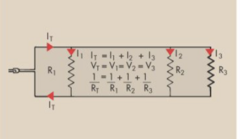
Parallel circuit: what is true about current?
The currents through each element add up to the total circuit current
Parallel circuit: what is true about voltage?
Voltage across each element is the same and equals the total circuit voltage
Parallel circuit: how do you find total resistance?
Total resistance is inversely proportional to the sum of the reciprocals: 1/RT = 1/R₁ + 1/R₂ + 1/R₃...
In a string of lights wired in series, what happens if one bulb burns out?
The whole circuit dies; every device must function (one wire connects each bulb)
In a string of lights wired in parallel, what happens if bulbs burn out?
The others stay lit; each light has its own circuit (two wires connect each bulb)
What is current (electricity)?
The flow of electrons through a conductor
What is direct current (DC)?
Electrons flow in one direction
What is alternating current (AC)?
Electrons oscillate back and forth
In US AC power, how long is 1 sine wave, and what is the frequency?
1 sine wave = 1/60 s; 60 cycles/sec = 60 Hz
What is a watt?
: One ampere of current flowing through an electric potential of 1 volt
What is the typical power of household appliances, light bulbs, and x-ray imagers?
Household appliances: 500-1500 W; light bulbs: 30-150 W; x-ray imager: 20-150 kW
what is the electric power formula, and what does each variable mean?
A: P = IV
P = power (watts)
I = current (amperes)
V = electric potential (volts)
Why are magnetic properties hard to study?
They're difficult to detect and measure; we can't "sense" magnetic fields
How is magnetism relevant to radiography?
Magnetic fields (and the ability to create them artificially) are used to create x-rays and are fundamental to MRI
Who discovered magnets, when, and where?
Farmers in what is now Western Turkey, around 1,000 BC
What is magnetite, and what is it also called?
A naturally occurring magnet that rotates back and forth when suspended; also called lodestone
What were two early uses or beliefs about lodestone?
It allegedly pointed toward water, and it was used as a compass
Where does the word "magnet" come from?
Magnesia, the Western Turkey village where magnetite was discovered
What is spin?
The rotation of an electron, which creates a magnetic field
What is bipolar?
A magnet that has two poles
What shape are magnetic field lines?
Always closed loops
What is a magnetic dipole?
Current flowing in an infinitesimally small loop, or the small magnet created by electron spin
What is a magnetic domain?
An accumulation of many atomic magnets with their dipoles aligned
What happens if an object's magnetic domains are aligned?
The object acts like a magnet
What creates a magnetic field?
Any charged particle in motion
What are diamagnetic materials? Give examples.
Non-magnetic materials unaffected by a magnetic field: wood, glass, plastic
What are ferromagnetic materials? Give examples.
Materials strongly attracted by a magnet that can usually be permanently magnetized: iron, cobalt, nickel
What are paramagnetic materials? Give examples.
Materials between ferromagnetic and non-ferromagnetic; slightly attracted to a magnet and loosely influenced by external fields: aluminum, copper
How are magnets classified?
By the origin of their magnetic property (why the material is magnetic and where the source is)
What are the 3 classifications of magnets?
1) Naturally occurring, 2) Artificial/permanent, 3) Electromagnetic
What is a naturally occurring magnet? Give examples.
A magnet found in nature: the Earth, magnetite
What is an artificial/permanent magnet?
A magnet made by changing the material (e.g. compass); can be changed back by force or temperature change
What is an electromagnet?
Wire wrapped around an iron core; electric current causes alignment proportional to the intensity of the current
How can all matter be classified magnetically?
By the manner in which it interacts with an external magnetic field
What is magnetic susceptibility?
The degree to which various materials can be magnetized (e.g. wood in a strong field does not increase the field's strength)
What determines magnetic susceptibility?
The number of unpaired electrons in the outer shell
Magnetism is similar to what other forces?
Electrostatics and gravity
How do magnets differ from electricity regarding the smallest unit?
Electricity has a smallest unit (the electron); magnets do not, they only get physically smaller