CHEM 1061 Mastery Checkpoint #1
 Call Kai
 Learn
Learn Practice Test
 Spaced Repetition
 Match
Match Flashcards
 Knowt Play
1/66

There's no tags or description
Looks like no tags are added yet.
Name | Mastery | Learn | Test | Matching | Spaced | Call with Kai | Chat |
|---|
No analytics yet
Send a link to your students to track their progress
67 Terms
What is matter made of?
atoms
What is the smallest distinguishable part of an element?
atom
Why do atoms/molecules attract each other?
because of the attractive electrical forces between them
Do attractions or repulsions lower the potential energy?
Attractions
Do attractions or repulsions lower the kinetic energy?
Attractions
Where do stable systems form?
where the attractive forces and the repulsive forces are equal
What did Dalton's model show?
Atoms as solid, indivisible spheres
What did Thomson's Plum Pudding Model show?
A positively charged "soup" with electrons embedded.
What did Rutherford's Nuclear Model show?
A dense nucleus surrounded by orbiting electrons.
What are the key differences between gravitational force and electromagnetic force?
Strength, Type of Charge, Scope of Influence
Is electromagnetic or gravitational force stronger?
Electromagnetic forces are vastly stronger than gravitational forces.
Are electromagnetic/gravitational force attractive or repulsive?
Electromagnetic forces can be attractive or repulsive; gravitational forces are always attractive.
What happens to the potential energy as two helium atoms approach?
Decreases as they are attracted, reaching a minimum when they are at an optimal distance.
What happens to the kinetic energy as two helium atoms approach?
Initially may decrease as they move closer, but if repulsion occurs at very close range, kinetic energy increases.
What happens to the total energy as two helium atoms approach?
A balance where total energy is lowest at the optimal distance, indicating stability.
How does the strength of London dispersion forces relate to the melting and boiling points of atoms and molecules?
Larger atoms or molecules have stronger London dispersion forces, resulting in higher melting and boiling points.
Why does iodine (I₂) have a higher boiling point than neon (Ne)?
Iodine has a higher boiling point than neon due to stronger London dispersion forces.
What is a law?
Describes a phenomenon
What is a theory?
Explains a phenomenon
Scientific Theory
Best available explanation, explains how and/or why, makes testable predictions, can be proven falce, susceptible to change with new evidence
Fact
A statement that can be verified
Hypothesis
Prediction that can be tested
Question
Something that is asked
What is an atom?
Smallest unit of measurement
Element
Contain one type of atom
Compound
Contains more than two types of elements
All compounds are molecules:
But not all molecules are compounds
Molecule
Contains more than 2 atoms
What is Daltons Atomic Theory?
Elements are composed of small, indivisible, indestructible particles called atoms; All etoms of an element are identical and have the same mass and properties; atoms of a given element are different from atoms of other elements; compounds are formed by combinations of atoms of two or more elements; chemical reactions are due to the rearrangements of atoms; atom matter are created nor destroyed during a chemical reaction
Plum Pudding Model
Modeled after Cathode Ray Tube Experiment

Important findings of Cathode Ray Tube Experiment
Particles emerged from the cathode and mooved to the other anode; these particles were deflected by electrical and magnetic fields in a direction that would indicate the were negatively charged
Planetary Model
Modeled after Rutherford Experiment (Gold Foil)

Planetary Model states
Nucleus of a atom is filled with tightly conjoined protons and neutrons
What did the Gold Foil experiment reveal?
Most particles went through, but some were deflected; the plum pudding model would have had all particles go through; Atoms are mostly empty space and the existence of a positive nucleus
Isotope
Same # of protons and electrons but different number of neutrons
Neutrons
Discovered 1932, hard to detect, and cannot be manipulated
An atom of an element

A molecule of an element

A molecule of a compound

Atom of a compound
Not possible
Coulombos Law
Opposite charges attract
What is a force
A push or a pull/ an interaction
Gravity
Responsible for attraction between objects that have mass
Electromagnetic forces
Responsible for attraction AND repulsion between objects that have electric charge
Strong forces
short range force thats between protons and neutrons
Weak forces
short range force between elementary particles
Gravity’s Law (Newtons Law of Universal Gravitation)

Inverse Square Law
As R increases, F decreases by a factor of 1/r2
Between electromagnetism and gravity, which force is stronger?
electromagnetism, it is both attractive and repulsive
What is energy?
Definition is circular: any change in matter is accompanied by a change in energy, which is caused by changes in forces
System
The part of the universe youre looking at
Surroundings
Everything else in the universe
Kinetic Energy
Energy associated with motion
Potential
STORED IN THE FIELD BETWEEN OBJECTS, position of a system of objects in a field (gravity, electromagnetic, etc), requires 2 or more objects,
London Dispersion Forces
Attractive forces that exist between partcles
Thermal energy
A measure of the average kinetic energy of the atoms
Temperature
Directly related to average kinetic energy
What causes London Dispersion Forces?
Fluctuations of electron density in the molecule, inducing a temporary dipole in the other atom
What parts of Daltons Theory is still true?
Atoms of a given element are different from atoms of other elements; Compounds are formed by combinations of atoms of two ore more elements
Where are London Dispersion Forces present?
Between all molecules in neutral spaces
How do atoms know the temperature is increasing?
Energy is being transferred from other atoms that have collided with the walls of the container
How does size affect LDF?
The bigger the surface area of the particles (the electron cloud), the easier LDF happen
Covalent Bond
CHEMICAL link formed between two atoms that share pairs of valance electrons
Pic of Covalent Bonds

Pic of LDF

What happens with like charges repel?
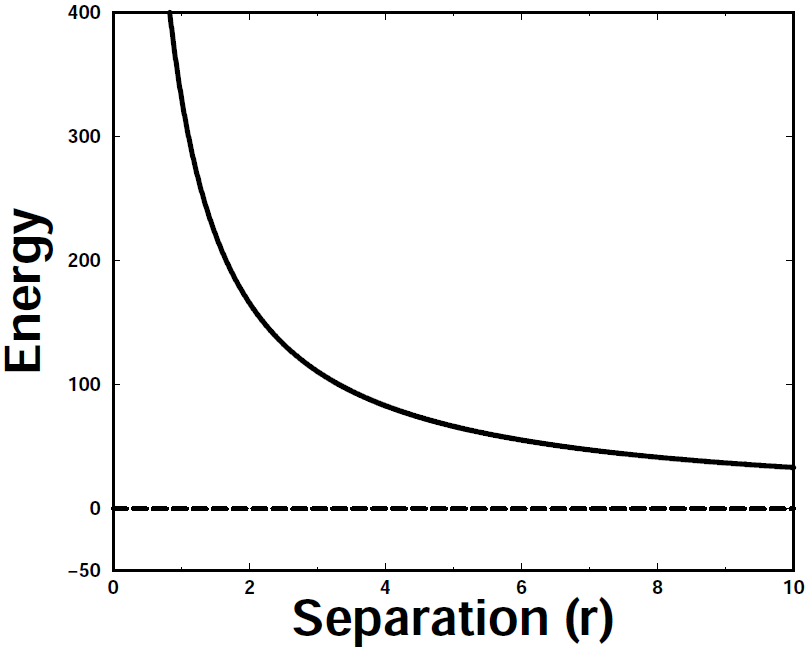
What happens when opposite charges interact?
