CONTRACT
 Call Kai
 Learn
 Practice Test
 Spaced Repetition
 Match
 Flashcards
 Knowt Play
1/66

There's no tags or description
Looks like no tags are added yet.
67 Terms
3 elements needed for a binding contract
offer and acceptance + intention to create legal relations + consideration
what test does the law apply when identifying agreement?
objective (storer v manchester city council) by considering what the reasonable person would say was the intention of the parties having regard to all the circumstances
what does an offer need to be?
clear
certain - words like ‘may’ lack the requisite intention to be legally bound
difference between a unilateral and a bilateral contract?
bilateral - each party assumes an obligation to the other party by making a promise to do something
unilateral - one party makes an offer or proposal of terms which call for an act to be perfomed by one or more parties
difference between and offer and an invitation to treat
offer = undertaking to be contractually bound by the terms of that offer if unconditional acceptance is made by the offeree
invitation to treat = first step in negotiations which may or may not lead to a firm offer by one of the parties. Cannot be accepted to form a binding contract
what are advertisements in the context of offers and acceptance?
invitations to treat (partridge v Crittenden) because the advertiser may have limited supplies of the goods in question and if it was an offer it may be accepted by a larger no of people than advertiser would be able to supply which would result in advertiser breaching one or more contracts
EXCEPTIONS: general rule does not apply when advertisement is a general offer (Carlill v Carbolic Smoke Ball)
what are display of goods in the context of offers and acceptance?
invitation to treat (fisher v bell) because a trader may be obkiged to sell the goods to anyone who accepted the offer before any judgemnt could be made in relation to the customer concerned
this applies to websites too
what are invitations to tender in the context of offers and acceptance?
tender = party wishes to purchase a major item or service and invites tenders from those intrested in supplying the goods or services
this is an invitation to treat (spencer v harding) and the requestor can accept or reject any tender
EXCEPTION: where the invitation to tender expressly contains an undertaking to accept the highest or the lowest bid (Harvela Investments Ltds v Royal Trust Co of Canada). This is an offer to to enter into a contract with the party with the highest/lowest bid + unilateral contract
what are auctions in the context of offers and acceptance?
auctioneer’s request for bid is an invitation to treat (payne v cave). Bidder makes an offer which the auctioneer can accept (fall of hammer) or reject
why are actions without reserve different?
reserved auctions = if no bid above this price is recieved the seller keeps the goods
auctions without reserve = seller promises to sell to the highest bidder whatever that bid turns out to be. the auctioneer may be sued for breach of contract if they refuse to sell to the highest bona fide bidder (warlow v Harrison)
three ways an offer can be terminated
rejection
lapse
revocation
what is the effect of a counter offer?
original offer is rejected and cannot be accepted (hyde v wrench)
how is a request for further info different from a counter offer?
if the offeree responds to the offer seeking clarification of the extent and terms of the offer or to ascertain if the offeror would consnet to cgnaging certain ancillary aspects of the offer, then the offeree’s request may be construed as a request for further information so original offer remains available
how may an offer lapse?
passage of time - e.g. where acceptance is not made within the period prescribed by the offeror or where no period is orescribed but the acceptance is not made within reasonable time
death of one of the parties - if the offeror dies and the offeree knows then offer will lapse otherwise it will not. if offeree dies then offer will lapse
when can an offer be withdrawn?
anytime before acceptance (payne v cave)
this is effective only upon actual notice reaching the offeree - when communicated by post it takes effect from the moment it is recived by the offeree and not from the time of posting (byrne v van tienhoven)
revocation can be communicated even by a 3P (dickinson v dodds)
when can a unilateral offer be revoked?
any time prior to the completion of the required act (great northern railway company v witham) - must take reasonable steps to bring the revocation to the attention of all those who may have read the offer
EXCEPTION: where the offeree has partly perfomed the obligation and is willing and able to complete the offeror has an implied obligation not to revokw
what are the 4 elements of acceptance?
acceptance must be in response to the offer
acceptance must be unqualified
it may be necessary to follow a prescribed mode of acceptance
acceptance must be communicated
what does it mean that acceptance must be in response to the offer?
only the person to whom an offer is made can acceot the offer
what does it mean that the acceptance by prescribed mode of acceptance?
if the offeror makes it clear that they will not be bound unless acceptance is communicated in that precise way and by no other then only acceptance by that means will suffice.
unless the prescribed mode is mandatory, another mode which is no less advantageous to the offeror will bind them (tinnv hoffman)
can silence be acceptance?
the offeror may not stipulate that they will take silence to be acceptance and thus bind the offeree.
can a 3P deliver acceptance on behalf of someone else?
yes as long as they have the authority to do so
what is the basic postal rule?
It held that where post is deemed to be a proper means of communication, the acceptance takes effect from the moment the letter of acceptance is properly posted – not from the moment it is received by the offeror. A letter is properly posted when it is put into an official letter box or into the hands of an employee of the Post Office who is authorised to receive (not deliver) letters (adams v lindsell)
The postal rule applies even where the acceptance is delayed or lost in the post (Household Fire and Carriage Accident Insurance Co. v Grant)
when does the postal rule not apply?
Does not apply if it is not contemplated that post would be used (It has been held to be unreasonable to use the post when there is an implied condition that prompt acceptance is required)
Does not apply to letters revoking offers (evocation of an offer must be received in order to be effective (Byrne v Van Tienhoven)
Does not apply if the acceptance is incorrectly addressed
Does not apply if disapplied by offeror
what is the general rule on acceptance by instantaneous modes of communication?
the general rule is that the acceptance takes place at the moment the acceptance is received by the offeror (Entores v Miles Far East Corporation)
On the other hand, if the acceptor reasonably believes that he has communicated their acceptance but this is not so because of the fault of the offeror (e.g. they do not hear the entirety of the acceptance due to their poor mobile reception but do not ask for it to be repeated) then the offeror may be prevented from saying that they did not receive the acceptance.
when is acceptance by email effective
the postal rule is inapplicable to email communications, therefore an acceptance by email is not effective when sent, but only when received (i.e. when the email arrives on the offeror’s email server).
message is received at the start of business if sent outside business hours
can a contract be formed through informal messaging on online platforms
yes (Jaevee Homes Ltd v Fincham (t/a Fincham Demolition))
In N'Guessan v Bewry [2026] EWCC 9 the court considered whether a thumbs up emoji could bind a party. Although, on the facts, it did not (as it was ambiguous in the context), the court did not rule out that an emoji could have binding effect in other circumstances.
acceptance in unilateral contracts
communication of acceptance is waived (Carlill) - performance of act constitutes acceptance
Difference between executory and executed consideration
Executory consideration: contracting parties make promises to each other to perform something in the future after the contract has been formed
Executed consideration: consideration has been performed
What are the 4 key rules in relation to consideration?
Must not be past
General rule: not possible to use as consideration some act or forbearance which has taken place prior to the promise to pay
Exception: some prior act or service was provided by the promisee at the promisor’s request and it was always understood that payment would be made for that act of service. 3 conditions: 1) act must be done at the promisor’s request, 2) parties must have understood that the act was to be rewarded either by a payment or the conferment of some other benefit (whether expressly agreed or implied, 3) payment or conferment of other benefits must have been legally enforceable had it been promised in advance. Example - taking a car to a garage for repairs and leaving the ultimate price to be decided after completion of the repairs
Must move from the promisee
a party who has not provided consideration may not bring an action to enforce a contract
Need not be adequate
If the agreement is freely reached, the inadequacy of the price is immaterial
Must be sufficient
Must have some value no matter how small
When will a person already be under an obligation to do the same thing before entering into a contract or varying an existing contract?
an existing contractual obligation between the same parties
a public duty
an existing contract with a 3P
If a party has an obligation in an existing contract between the parties, would this be good consideration for a new contract?
NO - if a party is already contractually bound to Party A to do something, then agreeing with Party A again to do that thing, is not generally good consideration for a new contract (Stilk v Myrick)
Captain of ship promised crew that if they shared between them the work of 2 seamen who had deserted, the wages of the deserters would be shared out between them
Promise was not binding because seamen gave no consideration - already contractually bound to do any extra work to complete the voyage
Exception: If the party had agreed to exceed their existing obligations, then there would have been consideration (Hartley v Ponsonby)
Sailors were contractually bound to take all reasonable endeavours’ to get a ship home, but they went beyond when they agreed to make the journey in dangerous conditions and when the ship was seriously undermanned = good consideration (legal consideration)
Exception: if the promise provides a practical benefit (factual consideration) then there would be consideration ( Williams v Roffey)
Roffey Bros had a contract to build a block of flats. They sub-contracted Williams for the carpentry of 27 flats for £20,000. Williams financial difficulty making him unable to finish the flats without more money and thus breaching the contract. Roffey Bros would in turn be liable for substantial penalties under their contract to build the block of flats. Roffey Bros promised Williams an additional £575 per completed flat built did not stick to their promise. Williams sued for the additional sum.
Court held there was consideration on Williams’ behalf in the form of the practical benefit that Roffey bros received = the avoidance of the late completion payment in the main contract, a more efficient working arrangement and avoiding the need to find an alternative contractor to do the work.
This was seen as factual consideration because nothing new is being promised but the party in receipt of the promise is still getting something out of the reshaped deal
see conditions necessary in the pic

If a party has an existing obligation under a public duty, would this be good consideration?
NO - merely carrying out a public duty imposed by the law will not amount to sufficient consideration
Exception - the duty of a police officer is the prevention of crime and they are not under a duty to provide information to a private individual. In doing so they are going beyond his public duty and thus providing consideration for the offer of reward.
Is it possible to have given consideration by doing something one was already bound to do under a pre-existing contract with a 3P?
YES: the performance of the pre-existing duty owed to a 3P will be regarded as sufficient consideration for a promise given by the promisor (the Eurymedon)
C made an offer to D that, if D would unload C’s goods from a ship, then C would treat D as exempt from any liability for damage to the goods despite the fact that D was already bound to do this by a contract with a 3P
Would paying a smaller sum than that owed by sufficient consideration?
NO - part payment of a debt is not sufficient consideration, the debtor remains liable even where the creditor has agreed to release them from further liability (Foakes v Beer)
Beer obtained a judgement against Foakes for £2,090. Foakes requested time to pay and they agreed in writing that if Foakes paid £500 at once and the balance by instalments, Beer would not take any proceedings whatsoever on the judgment. Foakes paid the debt and Beer then claimed the accrued interest.
Court held that Foakes provided no consideration in the written agreement and Beer’s cliam should succeed
Exceptions to Foakes v Beer:
introducing a new element into the payment - if at the creditor’s request some new element is introduced (payment at a different place or at a different time or by providing a different thing in place of money) this will be good consideration and the value is irrelevant
payment of a lesser sum by a 3P - where a 3P enters into an agreement with a creditor, by which the creditor accepts payment by the 3P of a lesser sum than the debt in full satisfaction of the debtor’s obligation, the creditor cannot sue the debtor for the difference
promissory estoppel - allows a contract to be enforced despite not being supported by consideration
Does the concept of practical benefit count as consideration when a creditor agrees to accept a lesser sum in settlement of a debt?
Consider Re Selectmove Ltd, MWB Business Exchange Centres Ltd v rock Advertising Ltd
UNSURE - MIXED CASE LAW
Re Selectmove - Williams v Roffey and practical benefit has no applications to cases where a creditor agrees to accept sum in settlement of a debt
MWB v Rock
A landlord agreed orally to reschedule rental payments under a licence agreement to give a tenant longer to pay thereby varying the licence
Court found that there was sufficient consideration for the variation as the landlord obtained the practical benefit by keeping the tenant in the property (as opposed to leaving the property vacant) going beyond the advantage of receiving prompt payment of a part of the arrears and a promise that it would be paid the balance over the coming months
Rock v MWB (appeal)
Appeal allowed on the basis that the oral variation was invalid for reasons unconnected to consideration. Consideration was not dealt with by the court so the question of whether providing a practical benefit in the absence of duress is sufficient to make a promise to accept less binding went unanswered
what is promissory estoppel?
An equitable doctrine that allows a promise to be enforced despite not being supported by consideration - equity prevents the promisor from going back on their promise in situations where the promisee has relied on it
What case established promissory estoppel?
CLP Trust v High Trees
Denning J concluded that had the landlord sought the full rent from 1940 to 1945 this action would fail due to promissory estoppel
Where a promise was made which was intended to create legal relations and which, to the knowledge of the person making the promise, was going to be acted on by the person to whom it was made and which was in fact so acted on, then the promise would be binding
tenant could rely on the defence of PE to prevent the landlord from going back on their promise to accept reduced rent during the war years when the flats were not fully let

What are the limits to promissory estoppel?
It acts as a shield not a sword
PE is only a defence to an action not a cause of action (does not give a party the right to sue upon a promise
A clear and unequivocal promise that strict legal rights will not be fully enforced
Promise (express or implied) must be intended to affect legal relations and not simply amount to a gratuitous privilege given to the promisee
A change of position in reliance on the promise
The promisee should have relied upon the promise or representation - influenced the conduct of the party to whom it was made. An act which takes place before the promise cannot be in reliance of the promise
usually the promisee has relied to their detriment on the promise = the reliance on the promise is such that, if the promisor were to go back on their promise, the promisee would be in a worse position than if the promise had never been made (although detriment is NOT required for PE, as it is sufficient if the promisee has made a change of position in reliance of the promise)
Inequitable to allow the promisor to go back on their promise
balancing exercise to determine whether it would be inequitable to allow the promisor to go back on their promise
if detrimental reliance is present, this would be a factor making it more likely to be inequitable for the promisor to go back on their promise
Does PE suspend or extinguish legal rights?
general rule: PE suspends the rights concerned and the promisor’s right to resume their strict legal rights may arise in 2 situations:
right to periodic payments may resume once the period over which the PE operates ceases
promisor may resume their full legal rights after giving reasonable notice of their intention to do so
Exception: legal rights may be extinguished if that means the outcome is just and equitable or where it has become impossible for he other party to meet the obligations concerned or it would be inquitable to require them to do so
Meaning of intention to create legal obligations
An intention to enter into an agreement that has legal ramifications - a contract
This is assessed objectively
What presumptions apply in regards to intention to create legal relations in commercial vs domestic contexts?
COMMERCIAL
Presumption: in a commercial agreement, the parties intend that it should be legally binding
Commercial agreements = agreements between 2 businesses, agreements between individuals and businesses, agreements between individuals e.g. buying a car through an online advert
clear words need to be included in the agreement to indicate that the parties do not intend to create legal relations
subject to the contract = creates a strong inference that the parties do not intend to be bound until the formal execution of a contract thus an agreement subject to contract prima facie is not binding
SOCIAL AND DOMESTIC
Presumption: in social, family or other domestic agreements, there is no intention to create legal relations
Presumption can be rebutted and the question whether it is rebutted is resolved by examining the circumstances of each case and the language used by the parties e.g. presumption is usually rebutted in relation to agreements made between spouses who were in the process of separating or are separated when agreement is reached

Do minors have capacity?
General rule: a person is not bound by a contract entered into under the age of 18 even if the other party contracting does not know of this fact or the minor has lied about their age
Exceptions:
necessaries
contract of employment, apprenticeship or education
Effect of entering into a contract with a minor: contract cannot be enforced against the minor although the minor can enforce it against the other party. If the minor ratifies a contract once they reach the age of 18, then the contract will be binding on them

Exception to minor incapacity: necessaries
A minor is bound by a contract to supply necessaries to them if the contract is for their benefit - minor must pay a reasonable price for these rather than the actual cost of the necessaries supplied
Contracts for necessaries = supply of food, medicines, accommodation and clothes. What will be deemed necessary needs to be construed with regard to the minor’s age and their actual requirements
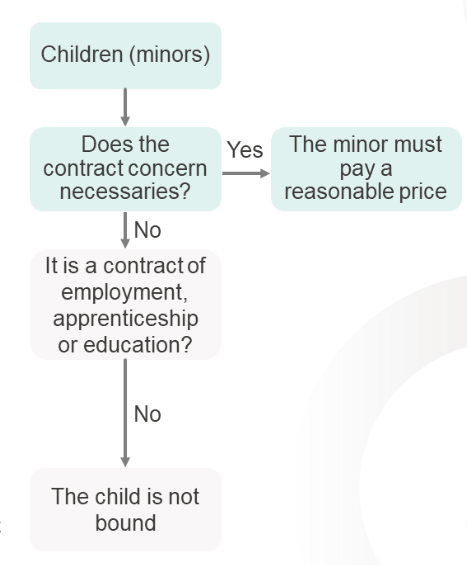
Exception to minor incapacity: contract of employment, apprenticeship or education
A minor is bound by a contract of employment, apprenticeship or education but only if it is for their benefit

when does a person lack mental capacity?
s2 Mental Capacity act 2005 - he is unable to make a decision for himself in relation to the matter at the time the contract is made, whether the impairment is permanent or temporary
Impairment = being unable to:
understand the relevant information
retain the relevant information
use the relevant information
communicate a decision
Relevant information = reasonably foreseeable consequences of deciding one way or another or failing to make a decision
what is the effect of entering into a contract with a person lacking capacity?
A person without capacity remains liable to pay a reasonable price for necessaries = goods or services suitable to a persons’ condition of life and to his actual requirements at the time when the goods or services are supplied
In any other case, the contract is binding unless the person claiming incapacity can establish (1) that they dis not understand what they were doing and (2) that the other party knew that to be the case. If both present = contract is voidable
what is the effect of entering into contracts with intoxicated persons?
The individual who becomes so intoxicated that they do not understand what they are doing will have to pay a reasonable price for necessaries but will not be bound by any other contract they make, provided the other party knew or ought to have known about their intoxication
What is duress and what are the different types?
Duress involves one party coercing another party into a contract: consent is not present or not given freely in the same way
Duress renders a contract or variation voidable - it remains in force unless some action is taken, the party subject to duress may choose to void the contract after the duress has ceased
Remedy for a voidable contract is rescission (returning the parties to the situation each was in prior to the contract being entered into)
Rescission may be lost where the contract is affirmed - if after the duress has ceased, the innocent party fails to challenge the contract in a timely way or acts in compliance with its terms
Types:
duress to the person
duress to property
economic duress
What is duress to the person?
Actual or threatened violence
Test: once it is established that the physical threats contributed to the decision to enter into the contract, duress will be found, so long as the threats were one of the reasons for contracting (easy to overcome).
Burden of proof was on the party who exerted the pressure to show the threats and unlawful pressure contributed nothing to the victim’s decision to contract

what is duress to goods?
Threat to seize the owner’s property or to damage it
Show that the agreement would not have been entered into if there has not been duress

what is economic duress?
Requires:
lack of practical choice for the victim
caused by illegitimate pressure
but for the duress, the agreement would not have been entered into

economic duress: lack of practical choice
Pressure must result in a lack of practical choice for the victim = no practical alternative but to acquiesce to the demand
e.g. in construction if one wants to complete the main project on time and avoid heavy fees for late completion but to agree to sub-contractor demands
e.g. a small organisation heavily reliant on the contract with a store and unable to find another carrier so reluctantly agrees to pay the imposed minimum charge
e.g. agreement to a demand when refusal would cause serious damage to the defendant’s economic interests
e.g. where demands are made that would cause the claimants loss that are backed by coercive and unlawful threats that they would not perform their obligations
economic duress: illegitimate pressure
factors to consider when assessing the legitimacy of the pressure:
whether there has been an actual or threatened breach of contract = a breach of contract is a failure to comply with the terms of the contract and it will lead to a claim of damages
whether the person allegedly exerting the pressure had acted in good or bad faith = bad faith is where there is no legitimate basis for the demand e.g. wishing to extort money from the other contracting party. Even a lawful act might amount to illegitimate pressure e.g. withholding credit (CTN cash & carry ltd v Gallagher ltd)
whether the victim protested at the time = the victim should demonstrate evidence of protest at the time the alleged duress was exerted e.g. writing a letter protesting against a demand
whether the victim affirmed and sought to rely on the contract = victim should not delay in taking action to set aside the contract

economic duress: significant cause
the agreement would not have been entered into if there had not been duress = but for test
What is undue influence and in which case was it established?
RBS v Etridge (No 2)
Undue influence exists where a person’s consent to a transaction was produced in a way such that the consent ought not fairly to be treated as the expression of their free will. There are 2 types:
overt acts of improper pressure or coercion such as unlawful threats
one party has influence or ascendancy over the other, and the first party takes advantage of that influence/ascendancy. There may be no specific or overt act of pressure or coercion, but the underlying relationship is sufficient for the UI to be exercised
UI: over acts of improper pressure or coercion
Rare because many would fall into duress.
If the behaviour constituting UI is of a deceitful/fraudulent nature, it’s necessary only for the innocent party to establish that the UI is a factor in inducing C to enter into the contract.
If the behaviour is not deceitful/fraudulent unclear what the test is - may be the ‘but for test’= but for the behaviour constituting UI would the innocent party have entered into the contract
UI: taking advantage of influence or ascendancy in a relationship
Husband (business owner) wants their spouse to enter into an agreement with the effect that the spouse’s share in the matrimonial home is used as security for a loan to the business owner’s business
If spouse has placed trust and confidence in the business owner and the business owner abuses it in seeking the spouse’s consent to the transaction by misrepresenting the nature of the transaction = UI
Influence can come from either the trust placed in one another or if one party is very vulnerable or dependent thus allowing one person to have significant influence even if one party has not positively placed trust or confidence in the other party
in which relationships is there an irrebuttable presumption that one party has an influence over the other
parent and child
guardian and ward
trustee and beneficiary
solicitor and client
doctor and patient
How does a party prove it has been the victim of UI
Must show:
a relationship of trust and confidence (or one of the relationships with irrebuttable presumption of influence) AND
a transaction which requires and explanation = a transaction which does not fit with what would be expected in the relationship concerned e.g. a suspicious type of transaction or suspiciously high in value
A husband offering their interest in the matrimonial home as security for a loan to their spouse’s business is not a transaction requiring explanation - person alleging UI needs to prove that unfair advantage was taken of the relationship

What happens when UI is proved?
A contract may be set aside
This is an equitable relief = discretionary = court may not allow this relief where the innocent party has delayed making its claim or where C’s conduct has been underhand

1. Relationship between spouses is not one where there is an irrebuttable presumption of a relationship of influence. The spouse must prove such a relationship by showing that they placed trust and confidence in their spouse
2. A spouse offering their interest in the matrimonial home as security for a loan to their spouse’s business is not a transaction which requires explanation - so the party offering security must show explicitly how their spouse’s influence has been used unduly
Only if UI is established is notice to the bank relevant: per Barclays Bank v O’Brien a creditor will be put on notice when:
a wife offers to stand surety for her husband's debts by the combination of two factors: (a) the transaction is on its face not to the financial advantage of the wife; and (b) there is a substantial risk in transactions of that kind that, in procuring the wife to act as surety, the husband has committed a legal or equitable wrong that entitles the wife to set aside the transaction.
It follows that unless the creditor who is put on inquiry takes reasonable steps to satisfy himself that the wife's agreement to stand surety has been properly obtained, the creditor will have constructive notice of the wife's rights.
Thus per RBS v Etridge (No 2) a bank is put on inquiry whenever a spouse offers to stand as surety for the other’s debts unless the transaction is clearly to the spouse’s benefit
CIBC Mortgages plc v Pitt - a bank is put on inquiry whenever one party in a non-commercial setting is standing as surety for the other party.
What are reasonable steps?
(a) There is no obligation on the creditor to have seen the wife itself as it is ordinarily reasonable to rely on a confirmation from a solicitor that they have advised the wife in an appropriate manner, unless the creditor is aware that this has not been done. It is for the solicitor to determine whether there is a conflict of interest if the wife's solicitor also advises the husband.
(b) The creditor must provide the solicitor with sufficient information about the transaction for the solicitor to be able to explain it fully to the wife.
(c) If the creditor is aware, either actually or constructively, that the wife may have been misled, then the creditor must tell the solicitor of this.
The solicitor's position
According to Lord Scott in Etridge, the solicitor should start by warning the wife that his involvement may be relied upon by the bank to counter allegations that she could not properly understand the transaction or had given her consent to it. If the wife then consents to advice being given, the core minimum the advice should contain is:
(a) An explanation of the documents and their practical consequences, including the risk that the wife may lose her home.
(b) The seriousness of the risk, including the duration and terms of the security and the wife's assets and means.
(c) The fact that the wife has a choice.
The solicitor should then obtain any necessary information from the lender/creditor.
If the solicitor fails in his duty to the wife, then she will have an action in negligence against the solicitor, but she will have no recourse to the lender/creditor which is entitled to assume that the solicitor has properly advised the wife.