object perception
 Call Kai
 Learn
Learn Practice Test
 Spaced Repetition
 Match
Match Flashcards
 Knowt Play
1/26

There's no tags or description
Looks like no tags are added yet.
Name | Mastery | Learn | Test | Matching | Spaced | Call with Kai | Chat |
|---|
No analytics yet
Send a link to your students to track their progress
27 Terms
Information required to identify distal stimulus
light sources
Reflectance of surfaces
Surface orientation
Viewing position
Light sources
primary (sun, light bulbs), secondary (moon, walls)
reflectance of surfaces
proportion of light reflected; absorption spectra: surfaces absorb certain wavelengths
Surface orientation
position of surface causes different amount of light to fall on it/reflect off it
viewing position
scene appears different from different viewing angles
Inverse projection problem
how do you go from the proximal stimulus to identifying the distal stimulus?
“uncreate” the image, using reverse geometry?
retinal image is 2-D, real world is 3-D
any 2-D image may have many potential 3-D sources that created it (underdetermination)
but the visual system selects the proper interpretation (most of the time)
how does it do this?
Contour detection
contour
Ganzfeld
Contour
border between light and dark areas in an image
Ganzfeld (“total field”)
sort of sensory deprivation; developed to test for telepathic communication
translucent ping-pong ball halves placed over eyes; headphones deliver white noise
causes some observers to “blank out” or hallucinate
sharp luminance contours must be important to visual system
Dynamic stimuli: microsaccades
minute, involuntary, almost imperceptible eye movements that occur during fixations; purpose seems to be to change the position of the image on the retina
Pritchard (1961):
observers wore contact lenses with attached device
projected constant image onto retina
image disappeared within ~3 seconds
eye responds best to changing stimuli; static pattern will quickly fade from view
Gestalt Psychology: basis
motion could be produced by a succession of stationary stimuli (Max Wertheimer, 1912)
Gestalt Psychology: motto
“the whole is different than the sum of its parts”
Gestalt Psychology: illusory contours
contours not present on retina, but still affect contour perception
e.g., Kanizsa triangle (1979):
(end-stopped cells are activated by illusory contours)

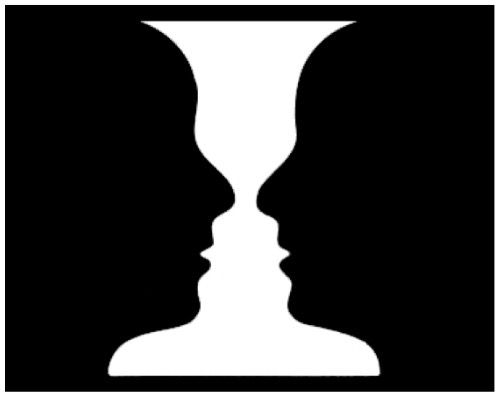
Figure-ground segregation
Generally, figures:
appear to be in front
are smaller
have well-defined shape
are meaningful
have more detail
differ from background in lightness
e.g., Rubin figure (1915)
Laws of Perceptual Organization
proximity/nearness
Similarity
Good continuation
Closure
Common fate
Meaningfulness/familiarity
Law of Prägnanz
Proximity/nearness
things near to each other tend to be grouped together

Similarity
similar things tend to be grouped together

Good continuation
points that, if connected, would result in either straight or smoothly curving lines, tend to be seen as belonging together; and lines tend to follow the smoothest path

Closure
A space enclosed by a contour (real or illusory) tends to appear as a figure

Common fate
things that are moving in the same direction tend to be grouped together
Meaningfulness/familiarity
things that are meaningful or familiar tend to form groups

Law of Prägnanz (“good figure” or “simplicity”)
every stimulus pattern is seen in such a way that the resulting structure is as simple as possible

Gestalt Pros & Cons
holistic approach
Operates post hoc, not good for predictions
Not good at explanations
Vague definitions (“simplicity”)
Recognition
perceiving something as previously experienced
e.g., Have you seen this before?
Identification
naming or classifying an object
e.g., What is it? What is it used for?
Object recognition and identification: Template theories
compare input to a model or “template” stored in memory
stimulus categorized by exact match
Object recognition and identification: pros and cons
successfully used by machines
e.g., MICR numbers at the bottom of a cheque
intolerant to __________ in a stimulus
too many templates required
cannot account for novel stimuli
cannot handle _______: