SHS 643 Swallowing Test #1 (Asa Marie Quizlet)
 Call Kai
 Learn
 Practice Test
 Spaced Repetition
 Match
 Flashcards
 Knowt Play
1/24

There's no tags or description
Looks like no tags are added yet.
25 Terms
Mr. Smith has gone to the dentist to have a filling put in his molar. The dentist was required to deaden his face with Novocain in order to do this. Mr. Smith cannot feel the left side of his face, and he cannot move the muscles in the lower part of his face. Mr. Smith can close his eyes and move his tongue.
Based on this information, answer the following question:
What cranial nerve(s) are not working because of the Novocain (may be more than one answer).
-VII
-V
The dentist has finished with Mr. Smith, so he is now allowed to drink a cup of water. Mr. Smith was able to swallow the water but did spill 1/2 of it out of his mouth when he was drinking.
Based on this information, answer the following question:
Does Mr. Smith have dysphagia?
Yes
If you feel Mr. Smith has dysphagia, please choose which phase (stage) of the swallow is affect?
-Oral prepatory
-Oropharyngeal
Now you are reading a report about your new patient, Bobby. The report says that Bobby is unable to "complete labial closure" during mastication of potato chips.
What does that mean?
He cannot close his lips while he chews
T/F: We do not form a bolus when we consume liquids?
False

Jane fell while playing on the playground at recess. She hit her face and now has a large cut on her lip. Referring to the picture below taking note of the red mark, would Jane's injury be considered on the medial or lateral portion of her lip?
Medial

Is this arrow pointing the anterior or the posterior?
Posterior

Which cartilage is the arrow pointing to?
Thyroid

The Central Pattern Generator in the reticular formation is in which of the following structures?
A
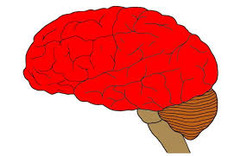
The area colored red is considered which of the following parts of the brain?
Cerebrum
Which of the following is true about the epiglottis?
It is considered part of the pharyngeal cavity
Which of the following is true about the CPG? (Central Pattern Generator)
It is a cycle of afferent and efferent information

Name the structure that the arrow is pointing to.
Mastoid Process

Name the structure the arrow is pointing to.
Styloid Process

The arrow is pointing to which structure
Epiglottis

Match the following related to the diagram.
A: Epiglottis
B: Thyroid Cartilage
C: Cricoid Cartilage
D: Tracheal Rings

What structure of the laryngeal complex is not present in this illustration?
Hyoid Bone
Match the following:
X - Vagus
V - Trigeminal
IX - Glossopharyngeal
VII - Facial
XII - Hypoglossal
I - Olfactory
Which of the following are true about CN I?
(choose more than one answer)
-It only has a sensory component
-It is housed in the cerebrum
Which of the following are true about CN XII?
(choose more than one answer)
-Damage to this will affect the oral preparatory stage of the swallow
-It is bilateral
-It is housed in the brainstem
Which of the following are true about CN X?
(choose more than one answer)
-Damage to this may cause severe deficits to the pharyngeal stage of the swallow
-It has both a sensory and a motor component to the swallow
Match the following action to it's cranial nerve.
CN I -
CN XII -
CN V -
CN X -
CN VII -
(um I don't have the answers to this one idk why)
You are seeing a 12-year-old, Mason, who was hit in face by a baseball traveling at maximal speed. It resulted in fracture of his maxilla and mandible. It required surgery to place hardware to stabilize the fractures in the maxilla and the mandible. The surgeon was required to cut through the skin, move over the nerves and cut through musculature in the area of his right maxilla and mandible in order to place required hardware to the bones in this area (see Figure A below). The surgeon was able to repair those muscles and nerves, but they appeared damaged. In order for the muscles, nerves and bones to properly heal, Mason's mouth must be wired shut (see Figure B below) for 8 weeks. This does not allow for him to open his mouth at all.
We are asked to evaluate Mason's swallow functioning. We begin with our cranial nerve assessment. Based ONLY on the information above answer the following questions.
1. Cranial nerve I. How would you assess the sensory portion? How would you assess the motor portion?
2. Cranial nerve V. How would you assess the sensory portion? How would you assess the motor portion?
3. Cranial nerve VII. How would you assess the sensory portion? How would you assess the motor portion?
4. Cranial nerve IX. How would you assess the sensory portion? How would you assess the motor portion?
5. Cranial nerve X. How would you assess the sensory portion? How would you assess the motor portion?
6. Cranial nerve XII. How would you assess the sensory portion? How would you assess the motor portion?
7. What stages of the swallow might be affected? Explain your answer
8. How do you think Mason will be able to get his nutrition?


The area circled in the blue is considered which of the following:
Structures requited for the pharyngeal phase of the swallow

The blue arrow is pointing to which structure?
Soft palate/velum