Microbiology Exam 3 - Mehari BIOL 3200 Auburn
 Call Kai
 Learn
 Practice Test
 Spaced Repetition
 Match
 Flashcards
 Knowt Play
1/205

There's no tags or description
Looks like no tags are added yet.
206 Terms
What is the central dogma?
The 'Central Dogma' is the process by which the instructions in are converted into a functional product. It was first proposed in 1958 by Francis Crick, discoverer of the structure of DNA.
What did Frederick Griffith study in 1928?
Griffith studied Streptococcus pneumoniae, a bacterium that causes pneumonia in mammals.
He found that one strain was harmless and one was pathogenic, mixed strains and mouse died - DISCOVERED TRANSFORMATION
What did Chargaff discover in 1947?
In all organisms, the number of adenines is approximately equal to the number of thymines and the number of guanines is approximately equal to the number of cytosines.
What did Watson, Crick, Wilkins, and Franklin discover?
DNA is a double helix
Two sugar phosphate backbones are anti-parallel
A binds to T
C binds to G
How big is are prokaryotic genomes typically?
130-14,000 kilo base pairs
How big are eukaryotic genomes typically?
2,400 to 100 million kilo base pairs
What is the functional unit of heredity?
The gene
If a gene operates in tandem with other genes, what is the unit called?
An operon
What are the two kinds of extrachromosomal DNA that interact with bacterial genomes?
Plasmids and bacteriophages (Plasmids carry info that contributes to physiology fo the cell)
What are nucleoid loops anchored to?
Histone like proteins (HU and H-NS)
How many loops does the E Coli nucleoid contain?
Between 30-100
Positive supercoils... DNA is (over or underwound)
Overwound
Negative supercoils... DNA is (over or underwound)
Underwound
Most DNA in nature is (over or underwound)
underwound - negative supercoils (some archaea in acid or high temps is positively supercoiled)
What introduces supercoils in bacterial DNA?
Topoisomerases
What is - made of a single protein, cleaves ONE strand of DNA, and results in relaxed or underwound DNA supercoils?
Topoisomerase I
What is made of two subunits, introduces NEGATIVE supercoils, and is involved in replication and transcription?
Topoisomerase II (Aka DNA Gyrase, has GyrA and GyrB subunits)
How can a supercoil be introduced?
Cleave one strand (Topo I) or cleave both strands (Topo II)
What are the portions of noncoding DNA in eukaryotic genomes called?
Introns and pseudogenes
What are the similarities of prokaryotic genomes and archaeal genomes?
Both have...
- Polygenic operons
- Cells lacking a nuclear membrane
- A single circular chromosome
What are the differences of prokaryotic genomes and archaeal genomes?
DNA replication, transcription, and translation mechanisms are different (archaea closely resemble eukaryotic cells)
When one says DNA replication is semi-conservative and bidirectional, what does that mean?
Semiconservative meaning daughter cell receives one parental and one newly synthesized DNA strand.
Bidirectional meaning that it starts in one fixed origin and progresses in opposite directions.
What is the initiator protein in Escherichia coli?
DnaA
How does DnaA trigger initiation of replication?
DnaA-ATP complex binds to 9-mer repeats upstream of the origin. Binding causes DNA to loop in preparation for opening (melting).
Where does replication begin?
OriC at DNA, forming replication bubble.
What direction is DNA synthesized?
5' to 3'
What enzyme stabilizes the strand in preparation for unzipping?
Topoisomerase I (DNA Gyrase)
What enzyme unzips DNA?
DnaB Helicase
What enzyme adds primer?
DNA Primase (an RNA polymerase)
What enzyme adds to the primer in the 5' to 3' direction?
DNA Polymerase III
What enzyme replaces the RNA primer with DNA?
Polymerase I
What enzyme binds the phsophodiester backbone in the lagging strand?
DNA Ligase
How does replication terminate?
Tus (terminus utilization substance) protein binds to ter (termination sequence) and acts as COUNTER HELICASE
What is the name of the loops formed that lock replicated strands together like interlocked rings?
Catenanes
What separates catenanes after replication?
Toposiomerase IV and XerCD proteins
What physiological functions can plasmids confer?
Antibiotic resistance, pathogenesis, symbiosis, etc.
Where are plasmids found? (Archaea, bacteria, eukaryotes?)
Found in archaea, bacteria, and eukaryotic microbes
How do plasmids replicate?
Rolling Cricle mechanism

High copy number plasmids segregate (randomly or equally) to daughter cells?
Randomly (no need to distribute deliberately)
Low copy number plasmids segregate (randomly or equally) to daughter cells?
Equally (deliberate distribution mechanism)
What is polymerase chain reaction?
Technique used to create millions of copies of a DNA segment

From what bacteria is the enzyme derived?
Thermus aquaticus?
What's the primary enzyme used in PCR?
TaqDNA polymerase
What are the general steps of PCR?
1. DNA heated to 95*C for 30 seconds to separate strands
2. Cooled to 55*C for 30 seconds to allow DNA primers to anneal
3. Temperature raised to 72*C for optimal Taq polymerase activity
4. Cycle repeats
What is the meaning of coupled transcription and translation?
Before RNA polymerase has finished synthesizing RNA, ribosomes bind to 5' end and begin translation
Transcription is the...
synthesis of an RNA strand from a DNA template by RNA polymerase
Where does the sigma factor 'recognize' the promoter region?
Binding to it at the -35 and -10 box upstream from the mRNA start site
Describe the initiation phase of transcription
RNA pol, with help from sigma factor, binds to promoter region
DNA unwinds one turn
RNA polymerase starts transcription
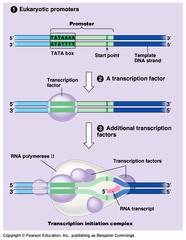
Describe the elongation phase of transcription
DNA unwinding forms 17bp bubble
DNA unwinding results in POSITIVE supercoil (removed by Topo II - which adds NEGATIVE supercoil)
RNA pol moves along template, synthesizing at 35 bp/sec

Describe the termination phase of transcription
Rho dependent (rho protein binds, contact causes termination)
Rho independent (relives on inverted repeat sequence on DNA template, forms loop structure that contacts polymerase)
How does Rifamycin B work?
Selectively binds to bacterial RNA pol, inhibits transcription by blocking exit site
How does actinomycin D work?
Non-selectively binds DNA and prevents RNA polymerase (both eukaryotic and prokaryotc) from moving along template.
How does streptomycin work?
Binds to 16S rRNA of the 30S subunit, preventing translation
How does tetracycline work?
It binds to the 30S ribosomal subunit in the A site and blocks the tRNA's access
How does chloramphenicol work?
Binds to 23S rRNA of 50S subunit and inhibits 50S peptidyltransferase.
How does erythromycin work?
It binds to the 50S subunit to block translocation
Describe initiation of translation
mRNA, first tRNA and ribosomal subunits assemble. Requires help of ribosomal initiaiton factors and input of energy (GTP Hydrolysis)
In bacteria (Prokaryotes)--> mRNA binds to small ribosomal subunit facilitated by ribosomal-binding sequence. Initiator tRNA recognizes start codon in mRNA. Large ribosomal subunit associates. At the end, the initiator tRNA is in the P site.
What is the Shine-Dalgarno sequence?
A short conserved nucleotide sequence upstream of the AUG start codon that serves to align the mRNA on the bacterial small ribosomal subunit
Describe the elongation phase of translation
Second codon of mRNA pairs with a tRNA carrying the second AA to the A site
First AA joins to the second by a peptide bond
Ribosome moves along mRNA until second tRNA is in A site.
First tRNA occupies E site and is released
Second AA joins to third by another peptide bond
Sequence continues until reaching stop codon
Describe termination phase of translation
Ribosome reaches stop codon, polypeptide is released
tRNA is released, ribosome dissociates, polypeptide forms into a new protein
What are chaperones?
they assist in protein folding process
What are GroEL and GroES?
GroEL is a barrel-like, protein cylinder that when combined with GroES caps, can use ATP to drive protein folding in prokaryotes
What is DnaK?
A chaperone that clamps down on polypeptides to assist folding
N-terminal signal sequence
A sequence of 15-30 amino acids that binds to the signal recognition particle and directs the ribosome and growing polypeptide chain to the ER for cotranslational import
signal recognition particle (SRP)
A protein-RNA complex that recognizes a signal peptide as it emerges from a ribosome and helps direct the ribosome to the endoplasmic reticulum (ER) by binding to a receptor protein on the ER.
Sec system
A system found in all domains of life that can transport a protein through or insert it into a membrane
How do gram negative bacteria export proteins completely out of the cell?
7 secretion systems, type I (HlyABC) exports proteins to the outside environment
What is Type I secretion: the HlyABC transporter.
Hemolysin (HlyA) is transported directly from the cytoplasm into the extracellular medium through a multicomponent ABC transport system.
What are the two properties required of all antibiotics?
Must affect target organism
Must NOT affect humans
What microbial physiology should antibiotics affect?
Peptidoglycan
Differences in ribosome structure
Biochemical pathways NOT in humans (aka NOT glycolysis)
What is a side effect of chloramphenicol?
Interferes with RBC development
What is a drug that ONLY works on Mycobacterium tuberculosis?
Isoniazid
Bacteriostatic
inhibits bacterial growth
Bactericidal
Capable of destroying bacteria
What are the natural penicillins?
Penicillin G and Penicillin V

What is the minimum inhibitory concentration (MIC)?
The lowest concentration of an antibiotic that prevents growth
What is the minimum bactericidal concentration?
Lowest concentration of an antibiotic that will prevent growth of a microbe after subculturing onto an antibiotic-free medium. Concentration of antibiotic that kills 99.9% of the bacterial cells
What factors should be considered with prescribing antibiotics?
Relative effectiveness of different antibiotics on organism
Average attainable tissue levels of each drug
MIC
Patient allergies
What is a MIC strip test?
A commercially prepared strip that produces a gradient of antibiotic concentration when placed on an agar plate. MIC corresponds to the intersection of the bacterial growth elipse and the trip
What is the Kirby-Bauer test?
Uses up to 12 antibiotic sensitivity disks to visualize zones of inhibition to see if bacteria are sensitive or resistant to antibiotics. Smaller MIC values should have larger sizes of cleared zones

What are the four steps of peptidoglycan synthesis?
1. UDP-NAG and UDP-NAM-peptide precursors molecules are made in the cytoplasm.
2. They are carried across the cell membrane by a lipid carrier called bactoprenol.
3. The precursors are polymerized to the existing cell wall structure by an enzyme called transglycosylases.
4. The peptide side chains are cross-linked by another enzymes called transpeptidases.
Where do beta-lactams bind?
Directly to the penicillin binding proteins, transpeptidase and transglycosylase
How does bacitracin work?
Binds with bactoprenol to prevent addition of further peptidoglycan monomers
How does vancomycin work?
Binds the D-ala-D-ala complex and bocks peptide connection in peptidoglycan synthesis
How do beta lactams work?
They prevent the transpeptidase reaction (which is the joining of the D-ala with the di-aa bridge)
•Beta lactam antibiotics have a 3-D similarity to the D-Ala-D-Ala dimer
What is the structure of beta lactams?
Penicillanic acid derivatives (derived from cystein and valine) with a structure similar to the beta lactam ring of penicillins
Different beta lactams are just modified penicillanic acids

How can penicillins be modified?
Mold produces main part of molecule, side chains can be changed to broaden spectrum of activity
How does amoxicillin work?
Amoxicillin interferes with
peptidoglycan biosynthesis
by inhibition of D-ala-D-ala
cleavage, and the accompanying
bond formation between the remaining
D-ala and a diamino-acid on the other chain.
How does ampicillin work?
Broadened spectrum, functions similarly to amoxicillin but with activity against gram negative bacteria as well.
What is special about methicillin?
Penicillinase resistant
What is the drug of last resort?
Vancomycin
How is vancomycin administered?
Intravenously only (poor GI absorption)
Is vancomycin effective against gram negative bactera?
No - does not cross LPS outer membrane of Gram negative bacteria
How does cycloserine work?
Inhibits formation of the D-ala-D-ala dipeptide PRECURSOR
How does gramicidin work?
Forms a cation channel through which ions leak. Bactericidal. CELL MEMBRANE disruptor
How does polymyxin work?
Destroys cell membrane like a detergent - used only topically. CELL MEMBRANE disruptor.

How do quinolones work?
1. Inhibits DNA gyrase (main target = Gram +ve), which un-dos DNA supercoils
before replication
2. Inhibits topoisomerase IV (main target = Gram -ve), which shares gyrase's role
in removing supercoils before DNA polymerase comes along and replicates.
Bactericial DNA synthesis inhibitor
How do sulfa drugs work?
Inhibit folic acid synthesis. They act as antimetabolites by mimicking a compound (PABA) needed by bacteria to make folic acid.
Bactericial DNA synthesis inhibitor
What does sulfanilaminde prevent?
Binding of PABA, pteridine, and glutamic acid to form folic acid (PABA analog)
Bactericial DNA synthesis inhibitor
How does rifamycin B work?
Bactericial RNA synthesis inhibitor. Binds to RNA polymerase B subunit, preventing elongation of mRNA