Chapter 2: Supply and Demand
 Call Kai
 Learn
Learn Practice Test
 Spaced Repetition
 Match
Match Flashcards
 Knowt Play
1/132

There's no tags or description
Looks like no tags are added yet.
Name | Mastery | Learn | Test | Matching | Spaced | Call with Kai | Chat |
|---|
No analytics yet
Send a link to your students to track their progress
133 Terms
Market
Consists of the current + potential buyers and sellers of a g/s
Can be confined to a single specific time + location
What determines how a market is defined (market boundaries- broad or narrow)?
The purpose of the analysis
Can be broad or narrow
Eg all bakeries vs specific 1
When might identical products be treated as different?
If they differ in:
Time (when product sold)
Location (where product sold)
Characteristics
Demand
The quantity of a g/s that consumers are willing + able to purchase at a given price
Demand curve
Shows quantity of a product buyers want to purchase at various, ceteris paribus
Willing + able

Real price of a product
The price of a product relative to the prices of other g+s
What does the price on the vertical axis of the demand curve diagram refer to?
Real price of the g/s
Law of demand
The empirical observation that:
As price of a product increases, quantity demanded decreases
What property of the demand curve explains the law of demand?
DC is downward sloping
Explanations for law of demand / downward sloping demand curve
Substitution effect: price ↑ → consumers switch to lower priced substitutes
Income effect: price ↑ → consumer’s not able to buy as much (can afford less bc incomes are fixed)
Can’t buy as much w/o buying less of something else
2 interpretations of demand curve
Horizontal
Vertical
Horizontal interpretation of demand curve
Start with price → read across → find corresponding QD
Shows QD at a given price
Vertical interpretation of demand curve
Start with quantity → read up → find the marginal buyer's reservation price
Inverse demand curve
Marginal buyer's reservation price
The maximum price the last willing buyer would pay

Inverse demand curve
Shows the price at which buyers would demand specific quantities of the product
Reservation price
Max price a buyer is willing to pay
Depends on many things eg income

What does the saw-tooth nature of a demand curve show?
Non integer amounts of the good are not possible in the market
Are all demand curves linear?
No
What does the demand curve show in terms of cost-benefit calculations?

How is a market demand curve obtained?
From summing the demand of individual customers
Supply
Quantity of a g/s that producers are willing + able to offer at various prices during a specific period, ceteris paribus

Supply curve
Quantity of a product that sellers are willing to supply at any possible price, ceteris paribus
Law of supply
The empirical observation that when:
Price of product increases → quantity supplied increases
Firms offer more for sale. (bc firms = profit maximisers, higher price = more profit, so incentive to produce more)
What property of the supply curve explains the law of supply?
SC is upwards sloping
For a supplier to be willing to sell a product its price…
Must cover the marginal cost of producing / acquiring it
+ COP additional units tends to ↑ as more units produced, esp in SR → increased production only profitable at higher prices
Why does supply curve slope upwards?
Rising marginal cost: producing additional units is more exp (in SR) → production only profitable at higher prices
Substitution by producers: higher price makes producers switch resources toward that product
2 interpretations of supply curve
Horizontal
Vertical
Horizontal interpretation of supply curve
Start with price → read across → find quantity supplied.

Vertical interpretation of supply curve
Start with quantity → read up → find the marginal seller's opportunity cost/marginal cost
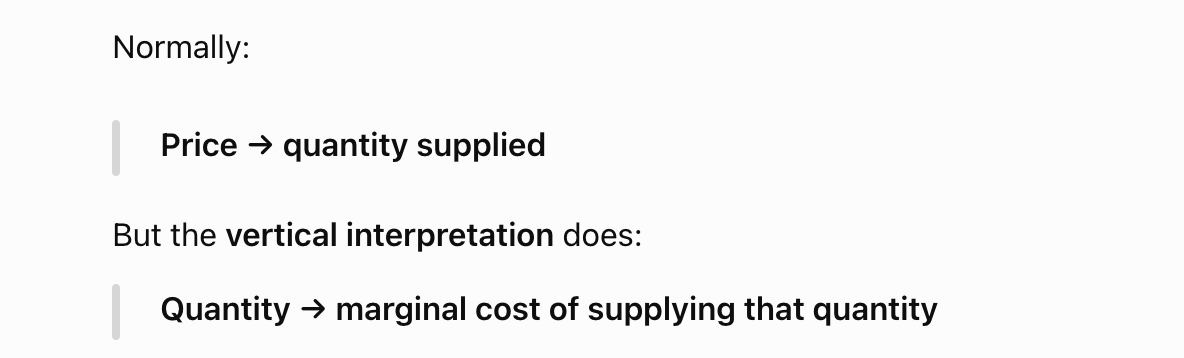
When do buyers purchase a unit and sellers supply a unit?
Buyers: if benefit ≥ price.
Sellers: if price ≥ marginal cost
(cost-benefit)
Explain the substitution effect (LOD)
People derive a certain amount of satisfaction when they consume a product (utility)
Price of a product falls → people gain the same amount of utility as before, but they are paying less → ratio of satisfaction to price will improve → product is more relatively attractive compared to products whose prices remained the same → consumers switch
Explain the income effect (LOD)
Price of a product falls → people will have more real income → more likely to buy more of the product → showing
Equilibrium
Where demand curve + supply curve intersect
Price where QS = QD → no surplus / shortage
Buyers + sellers both satisfied
Community surplus maximised

Explain demand curve, supply curve and equilibrium in terms of price-quantity pairs
DC: set of P-Q pairs where BUYERS are satisfied
ie don’t wanna buy less / more
SC: set of P-Q pairs where SELLERS are satisfied
Equilibrium: a PQ pair where BOTH BUYERS + SELLERS are satisfied

Excess supply (surplus)
When market price is above equilibrium price so QS > QD
Amt by which QS exceeds QD
How to calculate excess supply?
QS - QD
How does market price being above equilibrium lead to a surplus (excess supply)?
Prices above equilibrium
QD decreases (LOD- income effect, substitution effect)
QS increases (LOS- firms want to maximise profitability)
Causes excess supply

Excess demand (shortage)
When market price is below equilibrium price so QD > QS
Amt by which QD exceeds QS
How to calculate excess demand?
QD - QS
How to eliminate a surplus?
Producers should lower prices
How to eliminate a shortage?
Producers should increase prices
What causes the market to move toward equilibrium?
Buyers + sellers respond to shortages + surpluses.
Is a state of disequilibrium temporary or permanent?
Temporary
Free markets are self-correcting
How do markets self-correct to equilibrium when prices are ABOVE equilibrium?
Price above equilibrium → surplus
Sellers dissatisfied- can’t sell as much as they want
QS > QD (buyers not willing + able)
Suppliers lower prices to attract buyers (buyers switch to cheap sellers)
Price decrease
Continue until equilibrium (so all sellers + buyers are satisfied)
How do markets self-correct to equilibrium when prices are BELOW equilibrium?
Price below equilibrium → shortage
Buyers dissatisfied- can’t buy as much as they want
QD > QS (suppliers don’t want to increase supply bc low price = low profitability)
Buyers bid up prices
Prices increase (upward pressure on price)
Continues until equilibrium
Pareto efficiency
An outcome where it isn’t possible to make some person better off without harming another person
There isn’t a reallocation of resources that can improve someones position w/o harming someone elses position
Is equilibrium pareto efficient?
Yes
Why is equilibrium pareto efficient?
Bc no more mutually beneficial trades available
At equilibrium, buyers + sellers are satisfied
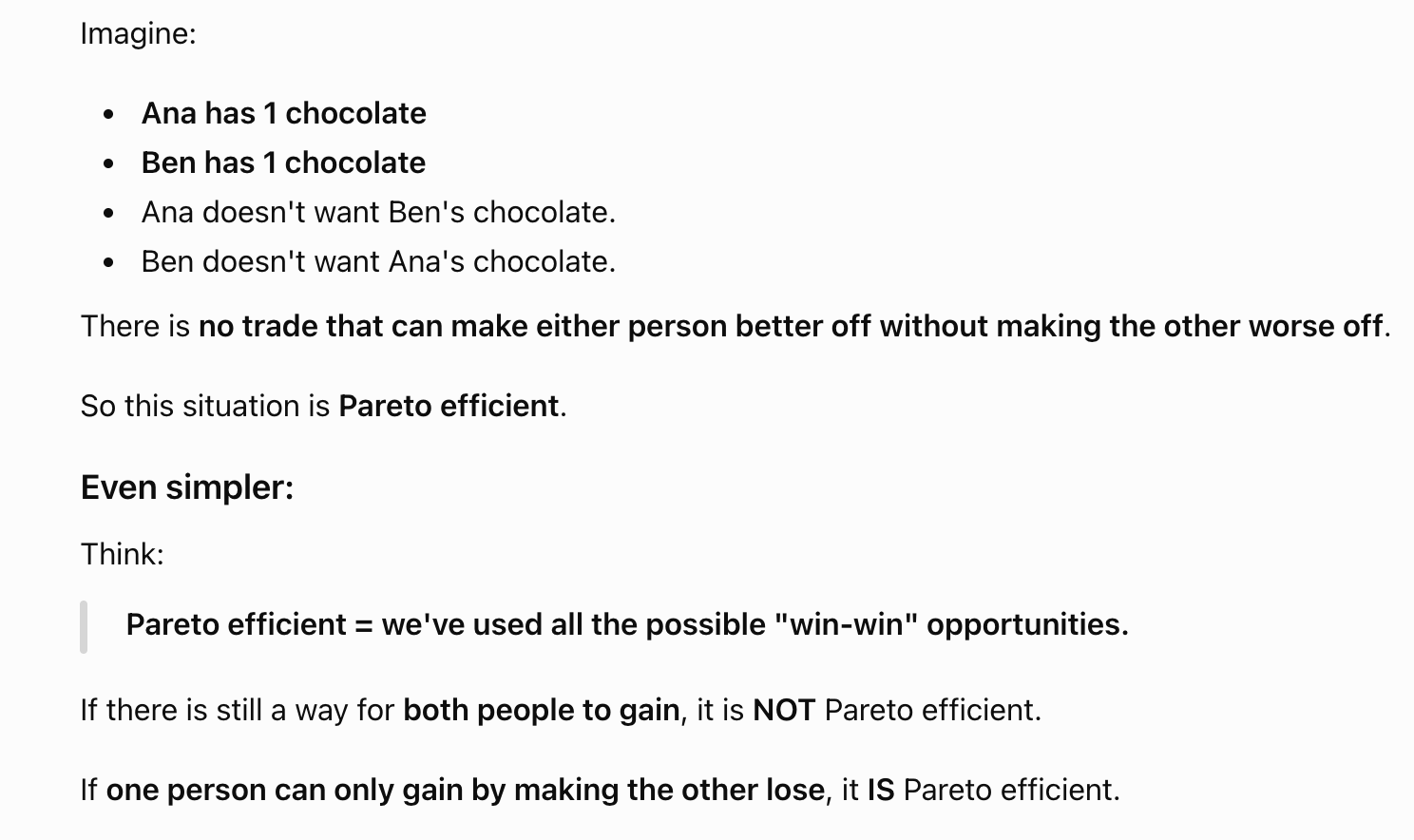

What happens if price / quantity isn’t at its equilibrium position? in terms of pareto efficiency?
Not Pareto efficient
Bc can reallocate resources to make some people better w/o harming others

Is pareto efficiency desirable?
???

Consumer surplus
A monetary measure of the extent to which a consumer benefits from participating in a transaction
Eg the extra satisfaction (utility) gained by consumers from paying a price that is lower than what they are willing to pay (ib definition)

Producer surplus
The monetary amount by which a firm benefits by selling output
The extra satisfaction gained by producers when they sell a given quantity of output at a higher price than what they were ready to accept
Total surplus formula
Consumer surplus + producer surplus
An outcome is Pareto efficient only if it…
Maximizes total surplus in the market
Why might the market fail to achieve pareto efficient outcomes (ie maximise total surplus)?
Monopolies
Externalities
What happens at equilibrium?
Under ideal conditions
Pareto efficient
Total surplus maximised
QD = QS = no surplus / shortage
Calculate consumer and producer surplus if:
Buyer values tulip at 16p
Seller values tulip at 8p
Buyers buys tulip from seller at 14p
Consumer surplus: 16-14=2p
Producer surplus: 14-8=6p
Total surplus: 2+6=8p
Not pareto efficient
How to calculate consumer surplus?
Buyers value - price paid
Or area of triangle
How to calculate producer surplus?
Price received - sellers cost
Or area of triangle
When is a mutually beneficial trade possible?
Buyer value > seller cost
Buyer’s value = max they are willing to pay.
Seller’s cost = cost of supplying the unit

Example- just read

Just because market equilibrium is efficient, does that mean it is desirable?
Not necessarily
Bc need to question fairness of outcome
Is efficiency the same as fairness?
No
A market can be Pareto efficient but still have an unequal/unfair outcome.
Is fairness objective?
No, it is normative
No universally agreed definition of what is fair.
Philosopher John Rawls “veil of ignorance” to conceptualize fairness
Choose a distribution wo knowing your future position in it
Eg: deciding income distribution w/o knowing whether you'd be rich or poor
How can monopolies contribute to income inequality through inefficency
High prices → earn excessive profit at cost of customers
Profit benefits sellers, buyers loose out
Market outcome NOT pareto efficient
Lack of efficiency
What does market efficiency imply for poverty?
Free exchange helps people in poverty
Bc helps poor people make best use of their resources (even if they have low incomes)
What does market efficiency imply for fairness?
Fairness best addressed thru redistribution of wealth rather than market (price) interference (eg rent controls)
Why is redistribution better than market interference to address fairness?
Bc market interference can reduce efficiency, while redistribution can improve fairness w/o disrupting the market.
Eg rent control: lowers rents → shortage + misallocation → less efficient
Redistribution: gives poorer people more income → they can afford market prices → market can remain efficient.
What can help address fairness without distorting markets?
Redistribution of income / wealth
Why do critics argue that it is unfair to ration g+s based on how much people are willing to pay for them?
Overlooks needs / interests of people living in poverty
Impact of price controls below equilibrium (price ceilings)
Pros: can protect people in poverty from high, unaffordable prices
Cons: creates shortages / excess demand, unintended consequences (eg wastage)
Price ceiling
Max price set by gov BELOW equilibrium price (aka market clearing price)
Price level that the price of a good by LAW is not permitted to rise above
Creates excess demand (demand increases, supply decreases)

Example of price ceiling
Rent controls
What does a price ceiling create?
Excess demand (shortage)
Increase demand (bc lower price, LOD)
Decrease supply (bc lower price, lower profitability)
ED undermines positive effects of price ceiling
Purpose of rent controls
Protect houseolds from unafforable rent
Esp low-income citizens (well-being)
Issue with rent control (price ceilings)
Price below equilibrium → excess demand / shortage / misallocation
Reduces availability of apartments (bc less profitability for suppliers)
Eg creates waiting lists for apartments, owners spend less on maintenance, misallocation

What does this diagram show?
Equilibrium: quantity = 60,000 & price = 600
Price ceiling →
Demand increased to 80,000 & supply decreased to 40,000 (excess demand)
At 40,000 buyers willing to pay 800 (vertical interpretation)

At €200/month, buyers would like to rent 100,000 apartments, but suppliers are willing to offer only 20,000. Thus there is an excess demand of 80,000 units. The excess demand is greater than the excess demand of 40,000 units at the €400/month rent control.

If there is a price ceiling in place (or RC), what happens if it is lowered?
Shortage increases
Excess demand increases
Why might cash transfers (giving people additional income) be better than price ceilings?
People can choose how to spend money (additional purchasing power), instead of forcing them to buy a cheap good
Esp for lower income citizens

Price floors (price supports)
A minimum price for a good, established by law
ABOVE market equilibrium
Supported by government's offer to buy the good at that price
Mostly on agricultural products
What does the government need to do to maintain a price floor + why?
Intervene + buy excess supply
Bc increased price → decreased demand, increased supply → surplus
What can government do with the excess supply they bought?
Store it- opp cost
Destroy it- wasteful
Sell abroad- conflict w foreign gov

Explain this diagram
Equilibrium: quantity 300, price 100
Price floor at 100
→ Demand decreases to 200, supply increases to 400
Excess supply of 200, gov needs to intervene + buy
Purpose of price floors (price supports)
Ensure prices are high enough to:
Provide higher incomes to workers (eg farmers families)
Reduce consumption of demerit goods
Why must the government buy the surplus?
To prevent farmers from having to lower their prices
Which would make price floor ineffective
Cons of price floors
Costly to buy surplus- opp cost
Surplus is often destoyed- wasteful (but uses limited FOP to produce)
Most of surplus produced by large corporate forms that don’t need support
Harm low income consumers
Who may benefit disproportionately from price supports? eg in agricultural industries
Large commercial farms rather than needy farmers
2 functions of price
Rationing
Allocative
Rationing function of price
The process whereby price DIRECTS EXISTING supplies of a product to the users who value it most highly (place highest value on them)
Short run function
Eg equilibrium price dictates this
Allocative function of price
The process whereby price acts as a SIGNAL that guides resources away from the production of goods whose prices lie below cost towards the production of goods whose prices exceed cost
Long run function
Direct PRODUCTIVE RESOURCES to diff sectors of the economy
“Signals where resources should move betw industries”
Rationing vs allocative function of price

What can happen in industries w excess demand?
Firms charge v high prices (more than they need to cover CoP) bc of the shortage→ earn higher profits
What happens when there is excess demand in terms of allocative function of price?
Opportunity to earn higher prices/profits attract MORE RESOURCES INTRO the industry
What happens when there is excess supply in terms of allocative function of price?
Losses → push resources OUT of the industry
Summary of allocative function of price?
To move resources from industries w excess supply → industries w excess demand
Do market interventions help or hinder both functions of price mechanism?
Hinder
How do rent controls (price ceiling) undermine the rationing function?
Rationing → direct goods to those who value it the most (will pay the most)
RC → alternate ways to allocate housing based on luck / connections / waiting → NOT by who values it the most
How do rent controls (price ceilings eg low rent) undermine the allocative function?
Rent controls → keep price artificially low → creates a shortage
Low price signals building housing isn’t profitable → reduces incentive to build/invest in housing → worsens shortage (bc fewer new homes built)
(bc investors invest elsewhere)