BIO EXAM: Fifth lecture
 Call Kai
 Learn
Learn Practice Test
 Spaced Repetition
 Match
Match Flashcards
 Knowt Play
1/65

There's no tags or description
Looks like no tags are added yet.
Name | Mastery | Learn | Test | Matching | Spaced | Call with Kai | Chat |
|---|
No analytics yet
Send a link to your students to track their progress
66 Terms

Transmembrane Domains
Hydrophobic amino acids arranged in alpha-helixes

Is this part of a transmembrane domain hydrophobic or hydrophilic?
Hydrophobic

Is this part of a transmembrane domain hydrophobic or hydrophilic?
Hydrophilic
DNA has…
planned information!

Pores
Interior is polar and allows water and small polar molecules to pass through the membrane

What is this?
Beta-Barrel protein
Passive Transport
Movement of molecules through the membrane in which - NO ENERGY IS REQUIRED
What do molecules move in response to?
A concentration gradient
What is diffusion?
Movement of molecules from high concentration to low concentration
• Will continue until the concentration is the same in all regions. until it hits (Equilibrium)
The membrane is selectively permeable because of
The channels and carriers→ specific target solute
Facilitated diffusion?
-Molecules that can’t cross membrane easily will move through proteins
Channel proteins
Hydrophilic channel when open
Carrier proteins
Bind specifically to molecules they assist
What does not need energy?
Facilitated diffusion of ions → It uses a concentration gradient

This is?
Diffusion in!

This is?
Diffusion out

Facilitated Diffusion By Carrier Proteins
Channel proteins→Ion channels
Allow the passage of ions through nonpolar interior of
plasma membrane
Gated channels
open or close in response to stimulus
(chemical or electrical)
Three conditions determine direction:
Relative concentration, voltage differences, and gated channels
Relative concentration
on either side of membrane
Voltage differences
across membrane
Gated channels
is channel open or closed
Carrier Proteins
Can help transport both ions and other solutes, such as some sugars and amino acids→ must bind to the molecule they transport
Saturation
rate of transport limited by number of transporters
Active Transport requires
Requires energy – ATP is used directly or indirectly to fuel
active transport
Active Transport
Moves substances from low to high concentration
• Requires the use of highly selective carrier proteins
Carrier Proteins used in active transport include:
Uniporters, symporters, antiporters
Uniporters
– move one molecule at a time
Symporters
– move two molecules in the same direction
Antiporters
– move two molecules in opposite directions

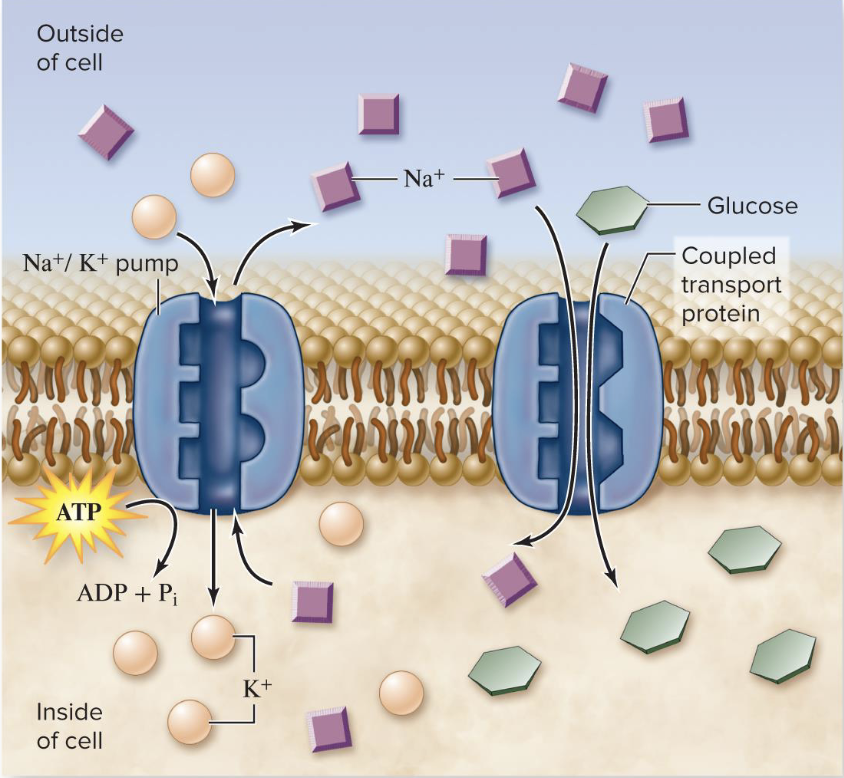
Sodium-Potassium Pump Function
3 Na(+) ions out and 2 K(+) ions in





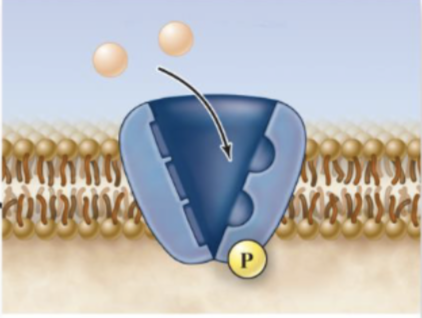


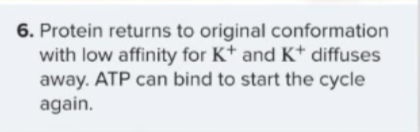
Why does Sodium-Potassium Pump Function use ATP
It goes against our concentration gradient
What can be used instead of ATP for coupled transport?
Glucose
Endocytosis
Movement of substances into the cell→ requires energy

Phagocytosis
– cell takes in particulate matter
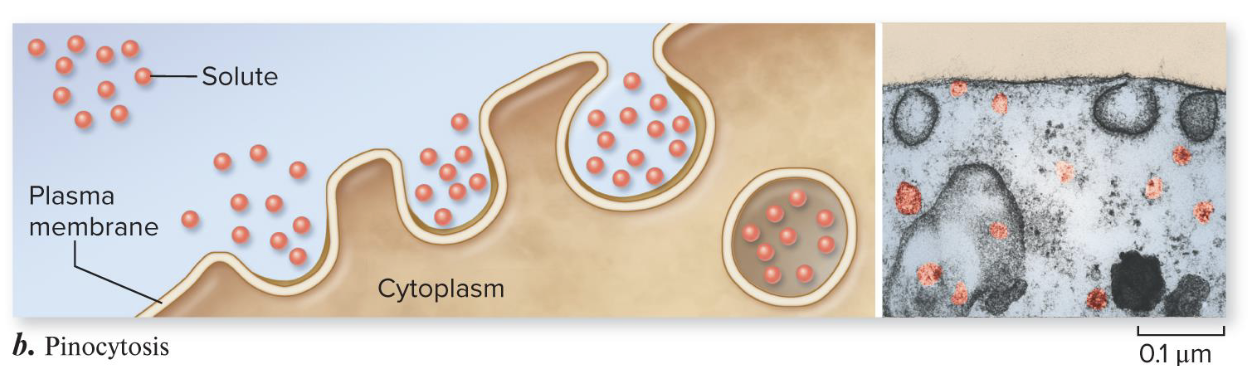
Pinocytosis
– cell takes in only fluid

Receptor-mediated endocytosis
– specific molecules are taken in after they bind to a receptor
What can cause heart attacks?
In the human genetic disease familial hypercholesterolemia, the LDL receptors lack
tails, so they are never fastened in the clathrin-coated pits and as a result, do not
trigger vesicle formation. The cholesterol stays in the bloodstream of affected
individuals, accumulating as plaques inside arteries and leading to heart attacks

Hydration Shells and Osmosis
The hydration shells “trap” some water molecules
The Diffusion of Water
Water tends to move toward areas where more solute is dissolved (where free water
is scarce)
Osmosis
net diffusion of water across a membrane toward a
higher solute concentration (Hypertonic solution)
How does water move?
From higher water potential (lower solute concentration) to lower water potential
(higher solute concentration).

Osmosis Across a Semipermeable Membrane
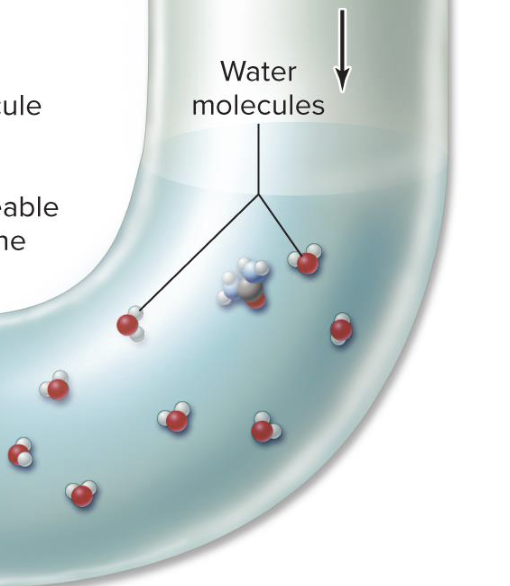
What is going on here?
-More free water potential

What is going on here?
-Less free water
-Low water potential
Hypertonic solution
= higher solute concentration
Hypotonic solution
= lower solute concentration
Isotonic
When two solutions have the same osmotic concentration
Aquaporins
Specialized channels for water in cell membrane, facilitate osmosis

Explain what is the different between the oocytes?
-The control oocyte (without aquaporins) allowed water to diffuse in, but very slowly
-The test oocyte (with aquaporins) rapidly allowed water to diffuse inward through the specialized channels, causing the cell to swell significantly

Water Channel
Water Intoxication
Drinking excess water diluted plasma(hypotonic)
Osmosis- water moves into cells
Endosmosis- Cellular swelling
Brain edema- Increased in cranium pressure
Isotonic drinks
The drinks are designed to replenish fluids, electrolytes, and
carbohydrates during physical activity
Isotonic
Concentration of salt and sugar in the drink is similar to that of human blood
Osmotic pressure
Force needed to stop osmotic flow
Cell walls vs. animal cells
-can reach balance of osmotic pressure driving
water in with hydrostatic pressure driving water out
-animals cells MUST BE ISOTONIC environments

Hypertonic
-EX: Sea water

Hypotonic
EX: Tap water

Isotonic
EX: Gatorade