BSC2011 Exam 3
 Call Kai
 Learn
 Practice Test
 Spaced Repetition
 Match
 Flashcards
 Knowt Play
1/70

Earn XP
Description and Tags
Last one best one
71 Terms
Hadley Cell
The circulation cells between 0˚ (Equator) and 30˚. These circulation cells bring warm air from the tropics to 30˚ latitudes and carry dry air from the 30˚ latitudes back to the tropics.
What drives seasonal changes on a global scale?
Earth’s tilt of 23.5˚
Intertropical Convergence Zone
A band of clouds that can be viewed from outer space
Low-pressure equatorial belt where the trade winds of the Northern and Southern Hemispheres meet
Coriolis Effect
Predictable directional flow of winds and ocean currents due to Earth’s rotation
The Earth is widest at the Equator, meaning a point there travels roughly 1,000 miles per hour to complete a rotation in 24 hours. Near the poles, the rotation speed drops close to zero.
When an object (like air or water) moves long-distance toward the north or south, it keeps the speed of the rotation it started with.
If it moves toward the Equator from a pole, it lags behind the faster-spinning ground.
If it moves toward a pole from the Equator, it races ahead of the slower-spinning ground.
Because of these speed differences, paths curve:
To the right in the Northern Hemisphere.
To the left in the Southern Hemisphere
Greenhouse Effect
When solar energy hits the Earth’s surface, some of it is re-emitted through longer infrared wavelengths with less energy. Greenhouse gases (such as carbon dioxide, water vapor, methane gas, and nitrous oxide) accumulate in the atmosphere, forming a barrier that “traps” longwave net radiation from the Earth. As a result, this radiation does not escape Earth’s atmosphere and Earth is kept warmer than it otherwise would be.
Walter Climate Diagram
A diagram that shows average monthly temperature and precipitation in a particular region or biome throughout the year.
Shallow Currents
Currents found at the surface of the ocean, which are driven by the prevailing winds.
Deep Currents
Currents found deep in the Earth's oceans, driven by density differences in the water.
What are the three physical factors that drive the distribution of organisms globally?
Light, temperature, and precipitation
What are two major factors that determine terrestrial biomes?
1) Climate and (2) The physical environment
What are the key drivers of long-term vegetation patterns that determine terrestrial biomes?
Temperature and precipitation
Apparent competition
an indirect negative interaction between two or more prey (or victim) species that do not compete for resources, but negatively affect each other because they share a common natural enemy, such as a predator, parasite, or pathogen
Resource Partitioning
Occurs when competing species divide limited resources (eg. food, space, water) by time, location, or method so they can coexist
What is sampling effect in terms of biodiversity?
More diverse ecosystems are more productive because they are more likely to contain highly productive species
What is complentarity?
More diverse ecosystems are more productive because species partition resources in ways that collectively increase total resource use, or because positive species interactions allow more resources to be exploited
What is the insurance effect in terms of biodiversity?
More diverse species are more productive because a greater variety of species can maintain ecosystem function when the environment changes and other species fail
What is the correct order of carbon pools from smallest to largest? Fossil fuels, oceans, atmosphere, plant biomass, soils
Plant biomass —> Atmosphere —> Soils —> Ocean —> Fossil Fuels
Which reservoir is the dominant global sink for dissolved inorganic carbon within the active carbon cycle?
The ocean is the primary sink for dissolved inorganic carbon and holds a very large share of actively cycling carbon
Metapopulations
A group of spatially separated local populations of the same species that interact through migration, dispersal, and gene flow across a patchy landscape
Species triage
A framework for prioritizing conservation funding and effort toward species or habitats most likely to benefit when resources are limited
Ecosystem services
The direct and indirect benefits that people get from healthy ecosystems
Provisioning services: Tangible goods harvested from nature, such as food, fresh water, timber, fiber, fuels, and medicinal resources.
Regulating services: Natural processes that control environmental conditions, including carbon storage, climate regulation, air and water purification, flood and erosion control, disease regulation, and pollination.
Cultural services: Non-material benefits that enrich human life, including recreation, tourism, aesthetic enjoyment, education, mental well-being, and spiritual or cultural heritage
Bioprospecting
Process of discovery and commercialization of new products based on biological resources
Mountain lions living in southwestern deserts demonstrate territorial behavior. Creosote plants living in the same southwestern deserts live in arid environments where competition for water and minerals is strong. They also produce chemicals that prevent other plants from living around them. Describe the dispersion of mountain lions and creosote bushes in southwestern deserts.
Mountain lions have a uniform dispersion pattern, and creosote bushes have a uniform dispersion pattern.
Key assumptions of the logistic growth model
Limited resources constrain population growth.
The carrying capacity (K) is constant.
There is no emigration.
There is no immigration.
Suppose you are a game reserve manager interested in promoting grassland growth via top-down control. Which of the following would be your best strategy?
Add lions to the community.
Fertilize the grass so it grows more.
Remove lions from the community.
Add herbivores (such as zebras) to the community.
Feed zebras a special diet that includes vitamins.
Add lions to the community.
Why is net primary productivity in the ocean highest near the coastal zones and upwelling zones?
Because they receive constant input of nutrients.
Which of the following statements about habitat fragmentation is FALSE?
Using dispersal corridors to connect fragments promotes colonization of those patches.
Small, isolated habitat patches tend to lose species at a higher rate than larger, isolated patches.
Human-altered habitat surrounding patches increases colonization of those patches.
Isolated patches tend to lose species at a higher rate than patches of similar size that are near other patches.
Habitat fragmentation reduces species richness, in general.
Human-altered habitat surrounding patches increases colonization of those patches.
Net primary productivity (NPP) is equal to . . .
gross primary productivity (GPP) minus respiration (R).
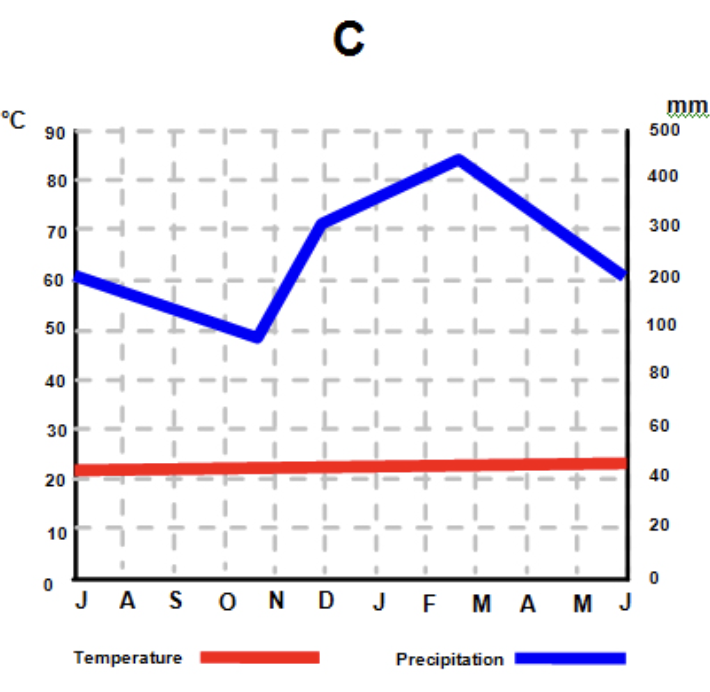
Which biome is represented here?
A biome where the temperature is high and precipitation is high year-round. This occurs near the equator. We can tell that this figure depicts a biome in the Southern Hemisphere because the horizontal axis of the diagram begins with July.
Georgii Frantsevich Gause’s COMPETITIVE EXCLUSION PRINCIPLE
Two species are unable to coexist indefinitely on the same limiting resource
Therefore, one of the species will increase in relative density, and the other species will decline in relative density.
Character Displacement
a phenomenon that occurs when two species living in the same area develop different traits over time
Both the Coriolis effect and Hadley cell formation involve the movements of air masses ________________.
Both north and south
INTERMEDIATE DISTURBANCE HYPOTHESIS
species richness is highest at some intermediate level of disturbance. If there were no disturbances in a community, conditions would not be favorable for the propagation and survival of new species—particularly slow-growing species. If there were constant, dramatic disturbances in a community, the dominant species would exclude less-competitive species. For this reason, some intermediate amount of disturbance favors the existence of the maximum amount of species in a community.
__________________ is generally the key limiting resource for terrestrial ecosystems. __________________ is generally the key limiting resource for aquatic ecosystems.
NITROGEN is generally the key limiting resource for terrestrial ecosystems, and PHOSPHORUS is generally the key limiting resource for aquatic ecosystems.
Suppose you drop a plastic bottle off the east coast of Japan. Where would you expect it to reach land? (Consider only the prevailing ocean surface currents.)
Shallow currents flow in a clockwise direction in the Pacific Ocean. Therefore, you would expect a bottle dropped on the east coast of Japan to ultimately wind up on the west coast of North America.
R-SELECTION
or DENSITY-INDEPENDENT selection, refers to selection for traits that allow organisms to maximize their reproductive success in uncrowded environments. This kind of selection favors such things as rapid reproduction and production of many small offspring that can survive and colonize well without parental care. R-selection is a life history trait similar to semelparous reproduction.
A squirrel ingests 1,000J of energy per day. It uses 807J per day for cellular respiration and 16J per day for growth. It excretes the remaining 177J as feces. What is the squirrel's daily assimilated energy?
Assimilated Energy = Ingested Energy – Excreted Energy. In this case, Assimilated Energy = 1,000J – 177J = 823J.
When surface air flows equatorward from 30° latitude in both hemispheres, which prevailing surface winds are produced at the tropics?
Air moving toward the equator from about 30° is deflected by the Coriolis effect to the west, producing easterly trade winds in both hemispheres.
Which biome is called the "spruce-moose biome"?
Boreal forest
per capita death rate
The average organism’s chance of dying in a given time period.
per capita birth rate
The number of offspring that the average organism produces in a given time period.
positive density dependence
A situation in which an increase in population density increases population growth levels and a decrease in population density decreases population growth levels.
mark-recapture method
A method to determine population density that involves capturing animals, marking or tagging them, letting them go, and recapturing them. Population Size = (# Marked x Total # in Second Capture)/(# Marked in Second Capture)
semelparous
Describes an organism that reproduces only once throughout its life.
species richness
The total number of species in a community.
succession
A process that occurs after a disturbance, in which species replace one another in a relatively predictable sequence.
predator-mediated species coexistence
Occurs when the presence of a predator encourages coexistence and cooperation between species.
habitat corridors
connected areas of natural land or water that link separated habitats so animals and plants can move safely across fragmented landscapes
Summer solstice
Sun is directly overhead the Tropic of Cancer (23.5 degrees North) and the Northern Hemisphere is tilted toward the Sun to its maximum extent

Winter Solstice
Sun is directly overhead the Tropic of Capricorn (25.3 degrees South) and the Northern Hemisphere is tilted away from the sun

Autumnal and Vernal Equinox
Sun is at the equator

Tropical latitudes
Tropic of Cancer and Tropic of Capricorn
Earth's axis is tilted at 23.5°. While this tilt causes dramatic summer and winter shifts at higher latitudes, the tropics stay within the zone where the Sun passes directly overhead at least once a year.
Why is sunlight less intense at the poles?
Sun travels through more atmosphere (so more energy reflected back), and is
spread across larger surface area, at poles.

What happens to air at the tropics?
As sun beats down on the tropics, the molecules move faster and the heated air
expands, becoming less dense and rises
As it rises, it cools adiabatically (ad). As compressed gas expands, it cools,
which is how air conditioners work
What happens to the water in air as air cools?
As you cool vapor, it loses energy and water condenses
Why is the Intertropical Convergence Zone called the Doldrums?
Because the air at the ITCZ is mostly moving straight up rather than sideways, surface winds can become completely calm. Historically, sailing ships would get stuck here for days or weeks with no wind to push their sails.
What is the benefit of the Hadley Cells?
Latitudinal patterns of atmospheric circulation have a powerful effect on
climate patterns by transferring an immense amount of heat energy from the
hot tropics to the cold poles. Without this transfer, the poles would sink toward
absolute zero in winter, and the equator would reach fantastically high
temperatures throughout the year
How are hadley cells and the coriolis effect related?
Hadley cells set air in motion north and south, and the Coriolis effect curves that moving air east and west. Together, they create the trade winds.
Hadley cells drive the surface flow: Warm air rises at the equator, cools, sinks around 30°N and 30°S, and flows back toward the equator along Earth's surface.
The Coriolis effect deflects it: Because Earth rotates eastward—and spins faster at the equator than at 30° latitude—that equator-bound air lags behind and curves west (deflecting to the right in the Northern Hemisphere and to the left in the Southern Hemisphere).
Result: Instead of blowing straight north-to-south, the returning Hadley cell air becomes the Northeast and Southeast Trade Winds blowing from east to west, which meet back at the equator (the ITCZ).
Trade winds and westerlies
Trade winds and westerlies are major global wind belts driven by uneven solar heating and Earth’s rotation (the Coriolis effect). Trade winds blow from east to west toward the equator in the tropics, while westerlies blow from west to east toward the poles in the middle latitudes.
A cosmic catastrophe jolts Earth so that its axis is perpendicular to the orbital plane between Earth and the sun. The LARGEST effect of this change would be
Elimination of seasonal variation
Name the five main subtropical gyres.
North Pacific Subtropical Gyre
South Pacific Subtropical Gyre
North Atlantic Subtropical Gyre
South Atlantic Subtropical Gyre
Indian Ocean Subtropical Gyre
How is global climate modified to produce regional climate?
Landmasses - Water heats and cools more slowly than land, giving coastal areas milder temperatures and smaller seasonal swings than inland areas at the same latitude (monsoons, land-sea breeze)
Mountain Ranges - Temperatures generally drop with higher elevation as air cools and thins. Mountain ranges block air masses and create a rain shadow, leaving windward slopes wetter and leeward sides drier
Ocean - moderates temp and rainfall
Greenhouse Gases
Water vapor
Carbon Dioxide
Methane
Nitrous Oxide
Ozone
Chlorofluorocarbons
Which greenhouse gas has dropped?
CFCs following the 1987 Montreal Protocol ban
What are the impacts of global warming?
Increase in extreme weather events
1/3 summer sea ice in Arctic is gone
Oceans are 30% more acidic (affects organisms that have calcified shells)
Atmosphere over oceans is 5% wetter
Massive coral bleaching
Reciprocal selection
When two or more interacting species exert mutual evolutionary selection pressures on each other’s traits
Drives coevolution
What is an example of reciprocal selection?
The common garter snake
Snakes eat toxic newts → Selection favors higher toxicity in surviving newts.
Newts become more toxic → Selection favors higher resistance in surviving snakes
What are the scales of ecological organization?
Organism → population → community → ecosystem →biosphere
Hypoxic floods + Hippos in the Mara River
When floodwaters wash large amounts of organic matter into bodies of water, they trigger rapid bacterial decomposition that depletes dissolved oxygen levels.
Hippo dung with partially digested plant matter is deposited into the Mara River
During dry periods with low water flow, hippos crowd into shrinking river pools. Their waste settles at the bottom, where microbes consume almost all available oxygen while breaking it down—creating toxic byproducts like ammonium, hydrogen sulfide, and methane.
When heavy rains arrive and river flow surges, the floodwaters scour these stagnant "hippo pools". A sudden pulse of deoxygenated, waste-heavy water is pushed downstream.
As this oxygen-depleted plume moves downriver, dissolved oxygen crashes rapidly, suffocating fish and other aquatic life.