Arth 72 Midterm
 Call Kai
 Learn
Learn Practice Test
 Spaced Repetition
 Match
Match Flashcards
 Knowt Play
1/73

There's no tags or description
Looks like no tags are added yet.
Name | Mastery | Learn | Test | Matching | Spaced | Call with Kai | Chat |
|---|
No analytics yet
Send a link to your students to track their progress
74 Terms
Fig. 5.1a. Pisanello. Medal: Leonello d’Este, Marquess of Ferrara (obverse), Italy, 1444. Bronze; Diam. 3 15/16 in. (10.1 cm). National Gallery of Art, Washington, DC (1957.14.602.a,b)

Fig. 5.1b. Pisanello. Medal: Leonello d’Este, Cupid with lion (reverse), Italy, 1444. Bronze; Diam. 3 15/16 in. (10.1 cm). National Gallery of Art, Washington, DC (1957.14.602.a,b).

Fig. 5.2. Perino del Vaga. Grotesque ornament, Rome, 1532–33. Engraved by Master of the Die. 8⅞ × 5⅞ in. (22.5 × 15 cm). Victoria and Albert Museum, London (E.1384–1897).

Fig. 5.4. Francesco di Giorgio Martini, workshop of Giuliano da Maiano. Study (studiolo; detail) from the ducal palace in Gubbio, Italy, 1479–82. Walnut, beech, rosewood, oak, fruitwoods. The Metropolitan Museum of Art (39.153).

Fig. 5.5. Domenico Ghirlandaio. The Birth of the Virgin, 1486–90. Fresco; W. 14¾ ft. (4.5 m). Cappella Tornabuoni, Santa Maria Novella, Florence.

Fig. 5.6. Biagio d’Antonio, Jacopo del Sellaio, and Zanobi di Domenico. Chest (cassone) and backboard (spalliera), Florence, 1472. Wood, tempera, gesso, gilding; 83½ × 76 × 29⅞ in. (212 × 193 × 76 cm). The Courtauld Gallery, London (F.1947.LF.4).

Fig. 5.9. The Limbourg Brothers. “January,” from the Très Riches Heures of Jean, duc de Berry, 1412–16. Colors on vellum; 11⅜ × 8¼ in. (29 × 21 cm). Musée Condé, Chantilly (Ms 65/1284 f.1v).

Fig. 5.13. Buffet, France, c. 1500; with 19th-century restorations. Walnut, oak; 93¾ × 61 7/16 × 22 in. (238.1 × 156 × 55.8 cm). The Wallace Collection, London (F13).

Fig. 5.17. Attributed to Nikolaus Pfaff. Cup and cover, Prague, 1611. Rhinoceros horn, African warthog tusks, silver gilt, paint; 19⅝ × 10⅞ × 7 in. (49.7 × 27.5 × 17.7 cm). Kunstkammer, Kunsthistorisches Museum, Vienna (KK3709).

Fig. 5.21. Rosso Fiorentino. Gallery of Francis I at the palace of Fontainebleau, France, decorated 1534–39. Stucco by Francesco Primaticcio; wainscoting by Francesco Sibeco da Carpi.

Fig. 5.22. Claude Badouin, after Rosso Fiorentino and Francesco Primaticcio. Tapestry: Danaë, Fontainebleau, probably 1540–50. Woven by Jean and Pierre Le Bries. Wool, silk, gold- and silver-wrapped thread; 10¾ × 20½ ft. (3.3 × 6.2 m). Kunstkammer, Kunsthistorisches Museum, Vienna (KK T CV 1).

Fig. 5.29. Entrance front of Hardwick Hall, Derbyshire, built 1591–97.

Fig. 6.3. Shell cup with Falcon-Man, Caddoan Mississippian, found at Craig Mound, Le Flore County, Oklahoma, 1200–1400. Whelk shell; 13⅜ × 7⅛ × 5⅛ in. (34 × 18 × 13 cm). National Museum of the American Indian, Smithsonian Institution (18/9121).

Fig. 6.5. Seed jar, Protohistoric Hopi Sikyátki, 1400–1625. Ceramic; 8⅝ × 14⅛ × 14⅛ in. (22 × 36 × 36 cm). University of Pennsylvania Museum of Archaeology and Anthropology (29–77-703).

Fig. 6.10. Ceremonial hanging known as “Powhatan’s Mantle,” probably Algonquian, before 1656. Embroidered deer skin, marginella shells; 92½ × 63 in. (235 × 160 cm). Ashmolean Museum, University of Oxford (AN1685.B.205).

Fig. 6.11a. Shield with coyote (obverse), probably Tenochtitlan (Mexico City), c. 1525. Feathers, gold, agave bark, rattan, wood, hide; Diam. 27 9/16 in. (70 cm). Museum für Völkerkunde, Vienna (MVK 43380).

Fig. 6.11b. Shield with coyote (reverse), probably Tenochtitlan (Mexico City), c. 1525. Feathers, gold, agave bark, rattan, wood, hide; Diam. 27 9/16 in. (70 cm). Museum für Völkerkunde, Vienna (MVK 43380).

Fig. 6.12. Mask, Mexico, c. 1500. Human skull, turquoise, lignite, pyrite, pine, deer skin, shell, agave; 7½ × 5½ × 4¾ in. (19 × 13.9 × 12.2 cm). Trustees of the British Museum (Am,St.401).

Fig. 6.16. Portrait of Nezahualpilli in the Codex Ixtlilxochitl, probably Tetzcoco, Mexico, early 17th century. Ink and color on paper; 12 3/16 × 8¼ in. (21 × 31 cm). Bibliothèque nationale de France (Département des Manuscrits, Mexicain 65–71).

Fig. 6.22. School of San José de los Naturales. Mass of Saint Gregory, Mexico, 1539. Feathers, wood; 26 ¾ × 22⅛ in. (68 × 56 cm). Musée des Jacobins, Auch (986.1.1).

Fig. 6.30. Simón Pereyns and others. Principal retablo in the chancel of the Franciscan convent church of San Miguel, Huejotzingo, Puebla, 1584–88.

Pietro Lombardo follower, Ca’ Dario (Palazzo Dario), Venice, 1480s

Palazzo (palace) Davanzati, Florence, 14th century

Slide 25 Hyacinthe Rigaud, Portrait of King Louis XIV, 1701 “The Sun King”

slide 26 charles le brun, louis xiv inspecting the gobelins manufactory, 1662-78, tapestry, palace of versailles

Slide 27Le Brun, Le Vau and Le Notre, Palace of Versailles, Versailles, France 1669-1710
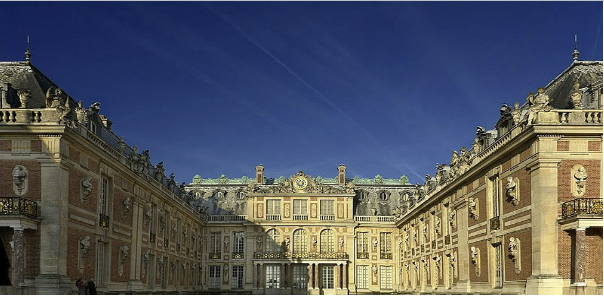
slide 28 Jules Hardouin-Mansart, Interior Hall of Mirrors, Palace of Versailles, begun in 1678
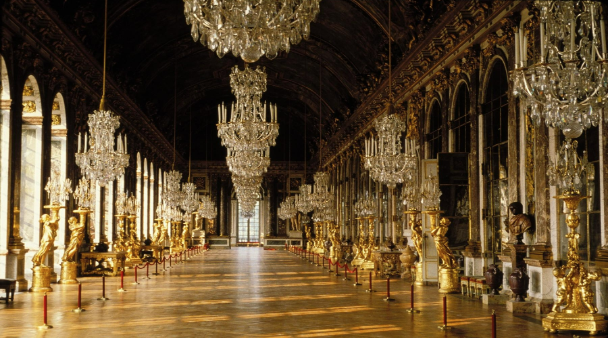
Slide 29 other side are mirror panes fit into an arch-shaped frame The ceiling is painted by Louis XIV’s Charles Le Brun, ‘First Painter to His Majesty,’ depicting scenes from his reign of power

Slide 30 Mirror Detail

Slide 32 Versailles: Landscap e Design c. 1661- 1785

Slide 33, Andre Le Notre & Charles Le Brun, L’Orangerie, Gardens at Versailles,


How did Renaissance values show up in everyday life? Analyze the image and pick out some interesting things you notice
Large canopy bed, Rounded arches (designs of people in everyday life), Polychrome

What visual differences stand out between Gothic and Classical styles? How are we able to differentiate the two?
The pointed arches stand out in the Gothic style, whereas it is more rounded for classical.
Gothic used stained glass windows
horizontal + grounded balance for classical. more vertically intense for gothic
There is Roman scripture and pillars in the classical style that ties in roman architecture.
There are what I believe are angels on top of the buildings which ties in with the Classical style by the clock on the right. There is the appearance of heroic nudity.

How does Brunelleschi’s Duomo reflect both tradition and innovation? What is Duomo?
Duomo is a cathedral. The duomo reflected both tradition and innovation due to the building having exact measurements, it was very neatly designed.
Traditional: It followed the Italian Renaissance design system
Innovation: He couldn’t build a full circle dome, but a semi-circle dome because it would collapse outward and the space was too wide.
Octogonal shape

What does this coin say about what Renaissance artists and humanists were trying to do? Why would someone want to commission this? What are some interesting details?
This coin tells us that the Renaissance artists and humanists were trying to show their highest levels of art and engraving techniques, and to represent a new form of art and cultural renewal. Usually people like rulers, or other wealthy men commissioned these coins because it asserted power, dominance, identity and wealth.

List EVERYTHING you know about the object. Some places to start: Identify it (which indigenous group made it?), social contexts, accompanying terminology, visual design elements & motifs, functionality.
Its accompanying terminology is Hopi Polychrome Seed Jar/Pot and it is made by the Hopi-Tewa people of First Mesa in Arizona
Hopi Seed Jar
stylized language instead of geometric shapes
Broken “roadline”
dragonflies
Circle = sun, sun = life giving force, quadrilaterals = cardinal points
Stylized dragonflies rather than geometric shape
How was indigenous America different pre-colonial times in terms of design, how the indigenous populations interacted with each other, and early contact with Europeans? Think colonialism vs. colonization.
Indigenous American designs were typically more geometric and abstract in comparison to European art. Additionally, pre-colonial art appeared to be much more spiritual and representational whereas post-colonial art turned to more direct depictions (think 6.5, 6.11 vs 6.16, 6.18 )
“Why does design matters in emergency situations?”
People tend to tunnel vision when anxious, so annoying design decisions become actually dangerous and reveals bad design.

List EVERYTHING you know about the object. Some places to start: Identify it (which indigenous group made it?), social contexts, accompanying terminology, visual design elements & motifs, functionality.
The indigenous group/culture is Acolhua/Aztec (Nahua) civilization of central Mexico, created in the early colonial period (1580-1584)
Shows someone who is of higher status. He is indigenous but shown through a European perspective.. The uncut clothes show social status.
The person shown is someone of high status because they illustrate use of sumptuary laws in this period. The laws at this time said that uncut cloth was a symbol of high status. The significance of uncut cloth was that cloth was seen to have a “life” or a spirit and cutting it would remove this spirit. His stance is also seen to be an interpretation from a Eurocentric perspective.

This is a post-colonial illustration. What do we know about how Europeans thought about Indigenous culture? How would they depict said cultures in post-colonial illustrations and materials? Any examples or interesting facts?
They would often depict indigenous culture using a Euro-centric lens
Classical modeling/stances
Blended
Depicted them as uncivilized, Un-Christian
Racial stereotypes
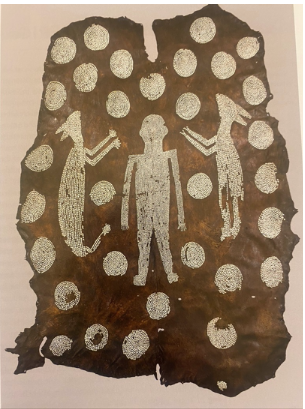
List EVERYTHING you know about the object. Some places to start: Identify it (which indigenous group made it?), social contexts, accompanying terminology, visual design elements & motifs, functionality.
This is known as Powhatan’s Mantle, it was created in the early 17th century. Housed in Ashmolean Museum, Oxford, England
The circles are from shells which have a lot of significance. First the circle represents the sun or seen as the sun, which was perceived as the life giving force. The shells also represent the ocean which was significant in rebirth and regeneration.
Back then people thought it was something to be worn but now it seems that it was meant to be a wall hanging piece.
Why is provenance a repeating word during this week’s lecture? What’s the importance of it in how we are approaching art and design history in Indigenous & Colonial America? Any examples?
Provenance - the history and process of a work
Provenance is important because lots of work was stolen, misplaced, misinterpreted by invading forces, in relation to indigenous Americans. Its important to understand provenance so that we can understand a piece in its most authentic form and see how it was truly made to work and be intended for.
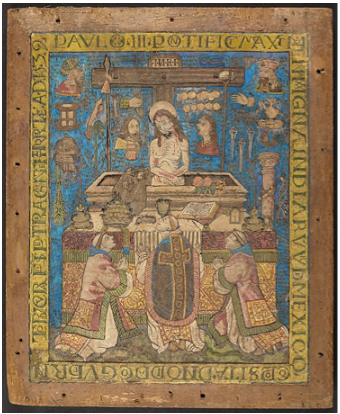
List EVERYTHING you know about the object. Some places to start: Identify it (which indigenous group made it?), social contexts, accompanying terminology, visual design elements & motifs, functionality.
This is “The Mass of Saint Gregory” and made in 1539 by elite Nahua (Aztec) feather-workers known traditionally as amanteca.
The piece was produced under the supervision of Franciscan missionary Fray Pedro de Gante at School of San Jose de los Naturales in Mexico City. Commissioned by the indigenous Aztec governor of Mexico City, Don Diego de Alvarado, who is the nephew & son-in-law of the last Aztec ruler, Moctezuma II
-Scripture was a clear message from the mayor to the pope. Cross-pollination of medium and content.
This picture shows different cultures coming together. We see a feather mosaic being used to depict a Christian event. From this we can interpret that it was intended to be given to Europe back. We know it was a piece that was made as a form of agreement that Indigenous people and Romans.
During colonial times, how did the colonizing countries treat the indigenous populations? What were they made/forced to do? List specific examples and if possible specific objects or stories.
Indigenous populations were often forced to conform to the colonists' ideologies and needs
-Bad confession, Page 590 from Felipe Guaman Poma de Ayala, The First New and Good Government (or El primer nueva coronica y buen gabierno) c.1615
-inhumane cruelty of Spaniard ruler kicking pregnant Indigenous woman
-Felipe making exemplars that Indigenous people are bad Christians
-note of woman’s uncut cape within Sumptuary laws (how we determined she is Indigenous)
Indigenous were forced to convert to Christianity, give up land
In many indigenous cultures what did circles denote?
The sun, which was thought of as the giver of life
What was the purpose of the wampum belt?
Not actually belts; markers of agreement. "Living Treaty" between Dutch and Haudenosaunee

Identify the central figure
Spiro "Birdman impersonator". Life-giving figure from upper world in perpetual struggle with the lower world

What does this colonial illustration tell us?
Euro-centric view of European superiority: natives depicted as savages and backward.
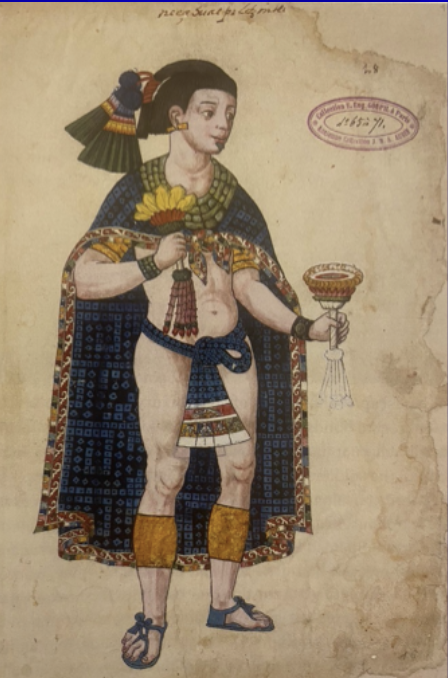
Why did the figure in this piece have uncut clothes?
Cutting meant to destroy the cloth's spirit existence and so was prohibited. Sumptuary laws!

Why were these chests important?
What is a Cassone? A marriage gift with a layered process of creation.

These images are good examples of the values for a particular period.
What are Renaissance values? Bodily pleasures inside and outdoors: Eating, drinking, lovemaking, gardening, music making
What is a Maiolica?
Plates imitating Spanish lusterware
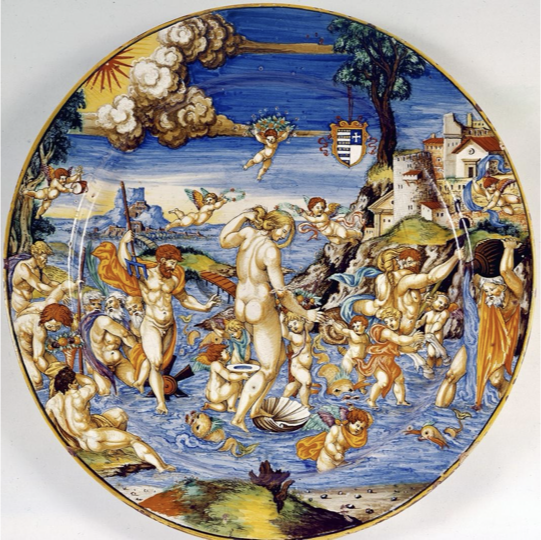

GOOD EXAMPLE OF WHAT?
What is humanism?
Who created the dome for the Duomo of Florence? How?
Who is Filippo Brunelleschi, and what is one-point perspective?

NAME? DATE? MATERIAL?
Two Row Wampum Belt, 1613, 1993 (reproduction by Jacob Ezra Thomas) Plastic imitation shell and sinew
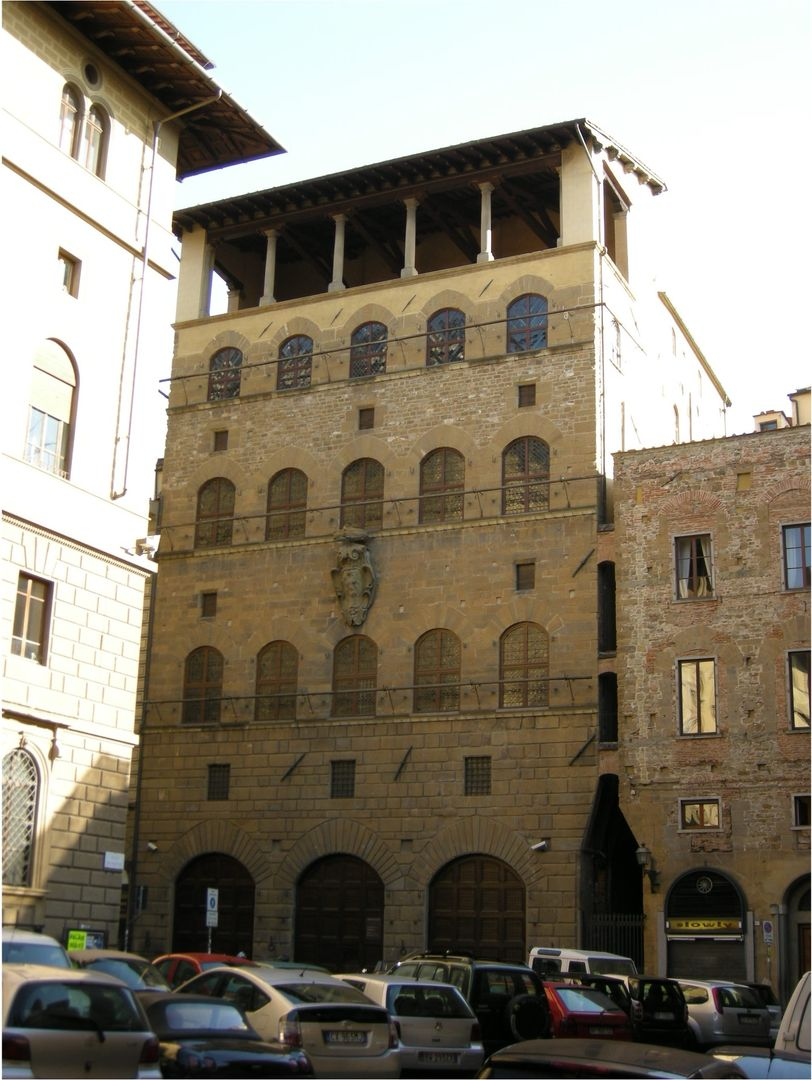
WHAT IS THIS BUILDING CALLED? WHAT CITY?
Palazzo (palace) Davanzati, Florence, 14th century

What report is this from?
Thomas Harriot, A Brief and True Report of the New Found Land of Virginia. Gave visual representations of Indigenous people, in this case tattoos.

What is the Florentine Codex?

Le Brun, Le Vau, and Le Notre, Palace of Versailles, Versailles, France, 1669-1710
Stylized/Archaic human form, pointed arches, big on hierarchy of form
Gothic Form
They revered Rome, and some were rich patrons of the arts
What are Humanists?

Red heels an example of what?
What are Sumptuary laws? Laws that prohibit expenditure on types of clothes, foods, and other goods.
"rebirth" of Ancient Roman and Greek styles
Renaissance
External name of something used by foreigners over the native term
what is the definition of an exonym?

Process?
What is pricking and pouncing the cartoon to prepare
the surface for the painted decoration on maiolica ?

TECHNIQUE?
What is Intarsia, an expensive and labor-intensive wood inlay technique?

Material?
What is feather mosaic which is a labor intensive process—shield is made of tens of thousands of feathers

Material?
What is sealskin and wood used to make kayaks by the Inuits?
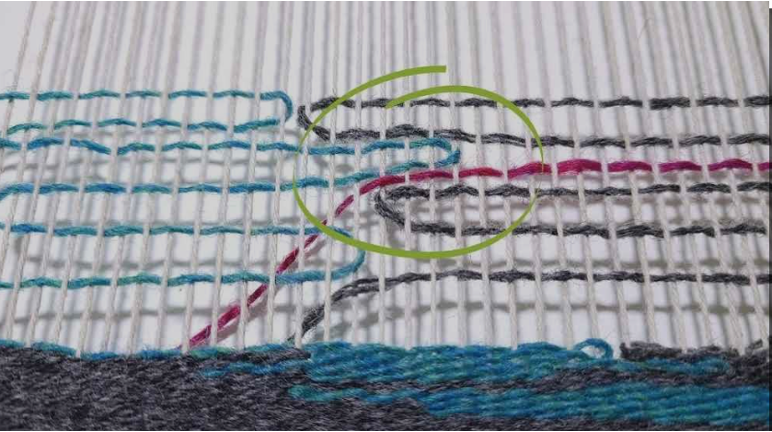
TECHNIQUE?
What is discontinuous warp and weft? Allowed for dynamic color change in warp threads.
lack of empty space...
What is horror vacui?

IT'S A GOOD EXAMPLE OF TAKING FROM THE PAST...
What is Grotesque ornamentation?
Perforated window found in Islamic architecture
What is a jali?

A symbol of royalty, and evokes the trunk of an elephant.
Stool from shrine of Olurogbo, quartz, 12C-15C, 27 in in height, West Africa

Technique used to make this plate was called...
What is Sgraffito? Two layers, one superficial. Scratch the superficial layer to create patterns and colors.