A&P Lab 1 Practical 4: The Appendicular Skeleton & Knee Joint
 Call Kai
 Learn
 Practice Test
 Spaced Repetition
 Match
 Flashcards
 Knowt Play
1/162

Earn XP
Description and Tags
*not done include A&P Lab 1 Practical 4: The Appendicular Skeleton & Knee Joint
163 Terms

Label
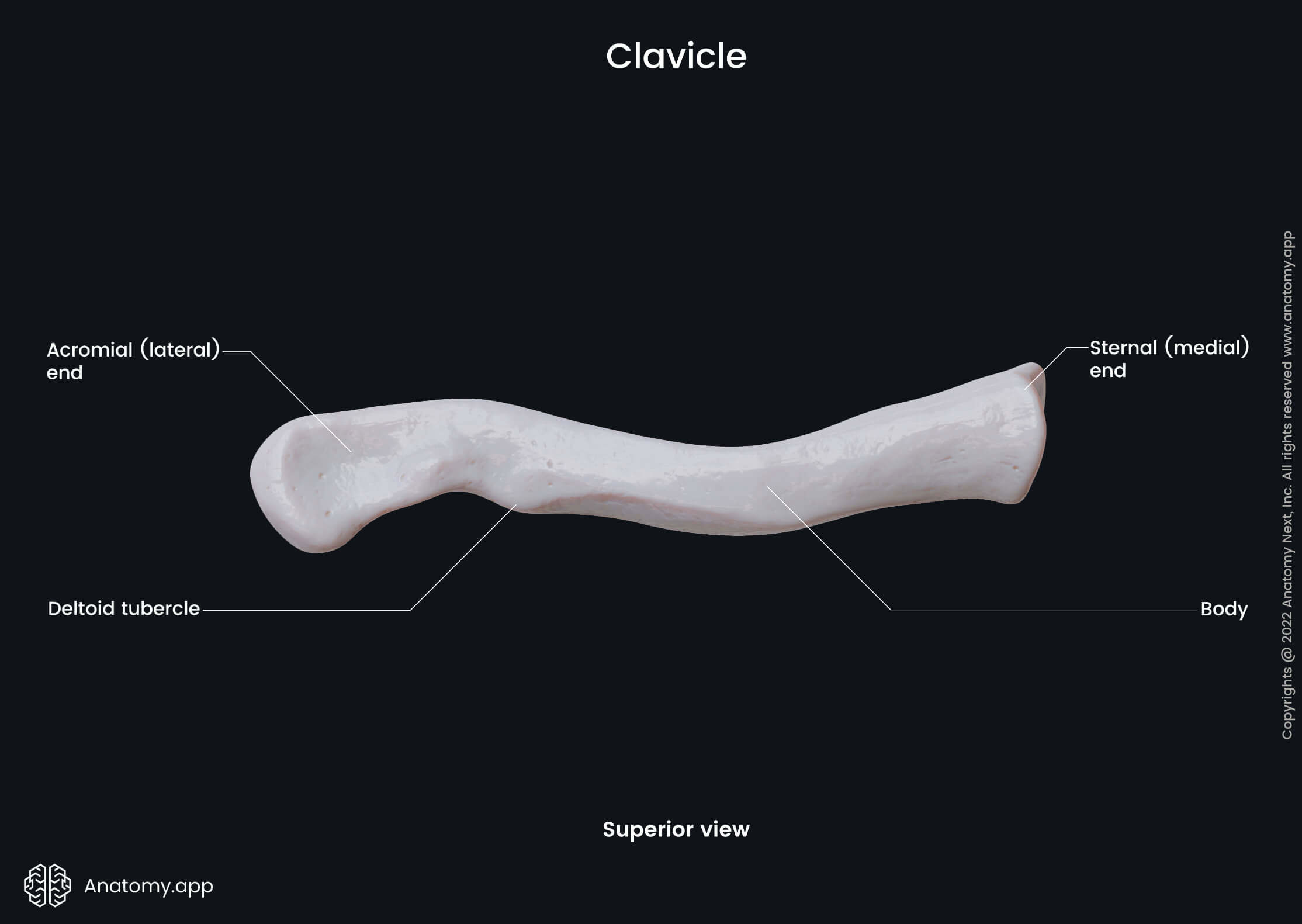
Clavicle (AKA: collarbone)
A long bone that serves as a connection point between the scapula (shoulder blade) and the sternum (AKA: breastbone).
Has two ends: Acromial end and sternal end
Source of support and stability in the shoulder
A long bone; S-shaped → Shock absorber during physical activities
One of the first bones to ossify (grow) in the human body
The conoid tubercle is a prominent feature located on the inferior surface of the clavicle, serving as an attachment point for the conoid ligament, which stabilizes the acromioclavicular joint.
The superior surface of the clavicle is smooth and subcutaneous, while the inferior surface has several features for muscle and ligament attachments.
TO-DO LIST FOR THESE FLASHCARDS PRIOR TO FINISHING THEM & TAKING EXAM:
Finish title and description and save to A&P Lab folder
Edit and finish writing flashcards AND use other study habits I need to
Have labeling flashcards AND include
Include flashcards that are like x picture with highlighted section and give me name based on active recall
Add more info flashcards not just labeling if I need them to prep. for the exam
Share w/ Kadyn when finished :)
Re-order flashcards
Make sure I have everything I need
Edit as I go so more personalized to my needs
Anything else I need / from previous flashcard to-do list to finish them AND go over them a lot to make sure they’re fully done
Include additional (necessary) flashcards ex: Identify the structure. (like I’ll have to do for practical)
ADD INFO FROM LECTURE AND ADDITIONAL LABELS ILL NEED
ALSO DO LABELLING ON IPAD AND EVERYTHING I NEED TO DO
Study quizlets with labelling
DO PAPER OF WRONGS / CONSISTENT WRONGS AND THEN STUDY THAT

Label the highlighted portion
Acromial end of clavicle (AKA: collarbone)
Articulates with the acromion of the scapula
Think: The “handle” of the scapula and looks like a region where you can pick it up (thicker at the top of the bone)

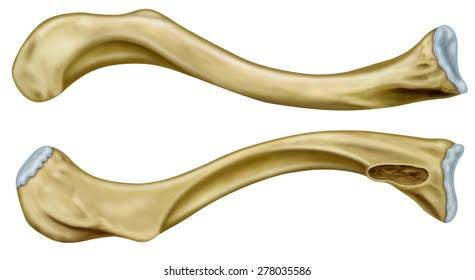
Label: Acromial end of clavicle
Articulates with the acromion of the scapula
Think: Acromial end is rounded / “S” shaped and lifted / raised from rest of the scapula ("has a handle”)


Label
Sternal end of clavicle
The sternal end of the clavicle connects to the sternum
Think: Has a thumb rest


Label: Sternal end of the clavicle

Label
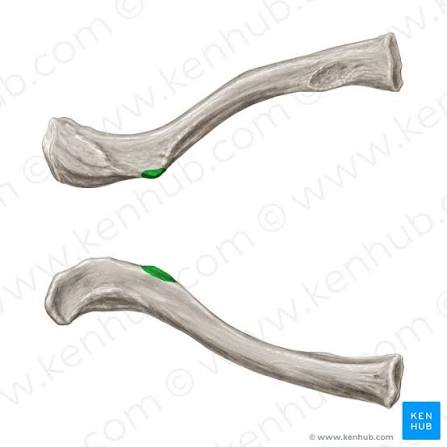
Conoid tubercle
Conoid = Resembles a cone
Tubercle = Small, rounded projection, nodule, or knob
A prominent feature located on the inferior surface of the clavicle
Attachment point for the conoid ligament
Stabilizes the acromioclavicular joint (AC joint)

Label
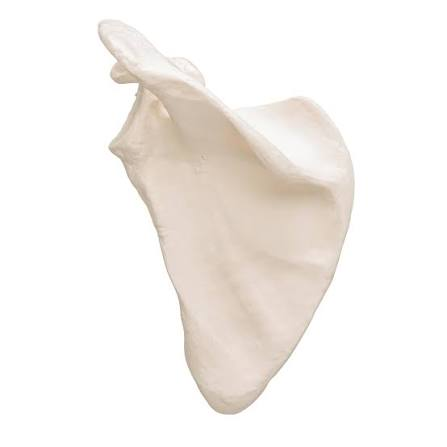
Scapula (AKA: Shoulderblade)
Lies on the posterior (back) surface of upper chest

Label the structure.
Acromion of scapula
A large, flat bony project ion that forms the highest point of the shoulder
A direct continuation of the spine of the scapula (shoulder blade) that arches laterally (to the side) and forward over the shoulder joint.


Label the acromion of the scapula.
A large, flat bony project ion that forms the highest point of the shoulder
A direct continuation of the spine of the scapula (shoulder blade) that arches laterally (to the side) and forward over the shoulder joint.

Label the coracoid process of the scapula.


Label the structure.
Coracoid process of scapula

Label the subscapular notch of the scapula.
Subscapular notch of scapula (AKA: subscapular reference)
A deep, semicircle indentaiton on the scapula located on the superior border near the base of the coracoid process

Label the structure.
Subscapular notch of scapula (AKA: subscapular reference)
A deep, semicircle indentaiton on the scapula located on the superior border near the base of the coracoid process

Label
Supraspinous fossa of the scapula
Supra = Above
Spinous = Relating to spine
Supraspinous = Situated above a spine or thorn-like process
Fossa = Depression (indent)
Supraspinous fossa =
A smooth, concave depression located on the posterior (back) surface of the scapula (shoulder blade) and is positioned directly above the spine of the scapula


Label: Supraspinous fossa
Supraspinous fossa of the scapula
Supra = Above
Spinous = Relating to spine
Supraspinous = Situated above a spine or thorn-like process
Fossa = Depression (indent)
Supraspinous fossa =
A smooth, concave depression located on the posterior (back) surface of the scapula (shoulder blade) and is positioned directly above the spine of the scapula


Label
Spine of scapula (AKA: Scapular spine)
A prominent, shelf-like ridge of bone running diagonally across the upper back of the shoulder blade
Label: Spine of scapula (AKA: Scapular spine)

Label
Infraspinous fossa of scapula
Infra = Below
Spinous = Relating to the spine
Infraspinous = Lying below the spine (of the scapula)
Fossa = A depression (groove / indent)
Infraspinous fossa = A depression (groove) below the spine of the scapula
A broad, shallow concave depression located on the dorsal (posterior) surface of the scapula situated inferior to (directly below) the spine of the scapula
Larger than the supraspinous fossa (groove that sits above the spine)


Label: Infraspinous fossa of scapula
Infra = Below
Spinous = Spine
Fossa = Depression or groove / indent

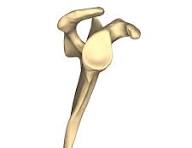
Be able to label the most important structures in this diagram.
*RE-ORDER THIS IN THE CORRECT SPOT


Label: Medial border of scapula
The medial border of the scapula (AKA: vertebral border) is the longest edge of the shoulder blade, running verticially and parallel to the spine of the scapula from the superior angle to the inferior angle

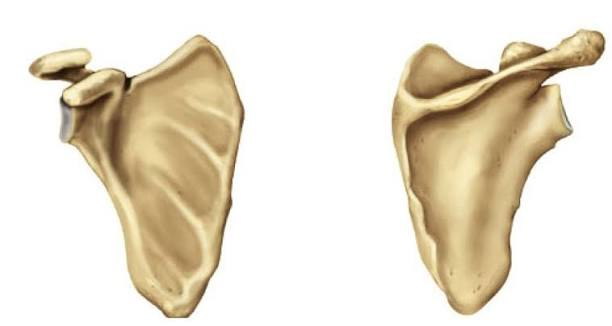
Label: Lateral border of scapula
The lateral border of the scapula (AKA: the axillary border) is the thickest of the three borders of the shoulder blade (superior, lateral, medial borders).
Runs diagonally from the inferior angle up to the lower margin of the glenoid cavity


Label: Superior angle of scapula
The superior angle of scapula (AKA: medial angle) is formed where the superior border and the medial (vertebral) border intersect
Thin, smooth, inclined slightly laterally


Label: Inferior angle of scapula
The inferior angle of the scapula is the lowest, most pointed portion of the scapula (shoulderblade)
Formed where the medial (vertebral) and lateral (axillary) borders of the scapula meet


Label: Glenoid cavity of scapula
Glenoid cavity (AKA: Glenoid fossa)
A shallow, oval-shaped depression (fossa) located on the lateral angle of the scapula (shoulder blade).
Oval // inverted comma-shaped; Retroverted slightly relative to the scapular body
It articulates with the large, rounded head of the humerus (upper arm bone) to form the glenohumeral joint (the main ball-and-socket joint of the shoulder).
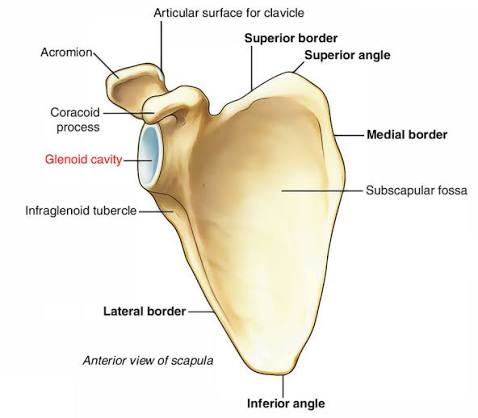

Identify the structure.
Glenoid cavity of scapula

Label: Subscapular fossa
Identify the structure.
Label: Humerus
Humerus = Elbow
*Think: Humerus = ‘Funny bone’ (Elbow)

Identify the structure.
Humerus

Label: Head of humerus
Label: Greater tubercle of humerus
Label: Lesser tubercle of humerus
Label: Intertubercular sulcus
(also known as the bicipital groove or sulcus intertubercularis) is a deep vertical longitudinal depression on the anterolateral proximal part of the humerus that separates the greater tubercle from the lesser tubercle
Extends down the lower third of humeral shaft (?)
Identify the structure.
Intertubercular sulcus
Label: Anatomical neck(s) of humerus
Label: Surgical neck(s) of humerus
Label: Deltoid tuberosity
Label: Capitulum of humerus
Label: Trochlea of humerus
Label: Coronoid fossa of humerus
Label: Olecranon fossa
Label: Radius
Label: Head of radius
Label: Neck of radius
Label: Radial tuberosity
Label: Styloid process of radius
AKA radial styloid process
A blunt, conical projection of bone on the lateral (thumb-side) surface of the distal end (farther from torso/core) of the radius
Extends slightly father distally than the ulnar styloid process, allowing for a greater range of abduction at the wrist
Label: Ulna
Label: Head of ulna
Label: Olecranon of ulna
Label: Coronoid process of ulna
Label: Radial notch of ulna
Label: Trochlear notch of ulna
Label: Styloid process of ulna
Label: Pisiform of hand/wrist bone
Label: Pisiform of hand/wrist bone
Label: Metacarpals I, II, III, IV, and V of the hand
AKA: Metacarpal bones 1 through 5
Label: Proximal phalanges of hand
Label: Middle phalanges of hand
Label: Distal phalanges of hand
Label: Ilium of coxal (hip) bone
Label: Iliac crest of coxal (hip) bone
Label: ASIS of coxal (hip) bone
Label: AIIS of coxal (hip) bone
Label: PSIS of coxal (hip) bone
Label: PIIS of coxal (hip) bone
Label: Greater sciatic notch of coxal (hip) bone
Label: Iliac fossa of coxal (hip) bone
Label: Auricular surface of coxal (hip) bone
Label: Acetabulum of coxal (hip) bone
Label: Sacroiliac joints (SI Joints) (on full pelvis)
Label: Ischium
Label: Ischial tuberosity of ischium
Label: Ischial spine of ischium
Label: Lesser sciatic notch of ischium
Label: Pubis
Label: Pubic tubercle
Label / Locate Pubic Symphysis Joint on full pelvis
Determine if this is a male or female pelvis.
Determine if this is a male or female pelvis.
Determine if this is a male or female pelvis.
Determine if this is a male or female pelvis.
Label: Pelvic brim
Determine if this is a true or false pelvis.
Determine if this is a true or false pelvis.
Determine if this is a true or false pelvis.
Determine if this is a true or false pelvis.
Label: Fermur
Label: Head of femur
Label: Greater trochanter of femur
Label: Lesser trochanter of femur
Label: Fovea capitis of femur
Label: Intertrochanteric line of femur
Label: Intertrochanteric crest of femur
Label: Gluteal tuberosity of femur
Label: Linea aspera of femur
Label: Intercodnylar fossa
Label: Adductor tubercle
Label: Patellar surface of femur