BIOL 104 MASTER
 Call Kai
 Learn
 Practice Test
 Spaced Repetition
 Match
 Flashcards
 Knowt Play
1/272

There's no tags or description
Looks like no tags are added yet.
273 Terms
community
a group of interacting species in the same place; multiple populations
What makes biodiversity change?
community changes
How do communities form?
Regional species pool --> species interactions --> local community structure (disturbance and stress contribute to the local community structure)
primary succession
An ecological succession that begins in an area where no biotic community previously existed; high amount of change with a low frequency (ex. volcanic eruption)

secondary succession
Succession following a disturbance that destroys a community without destroying the soil; medium intensity of disturbance with a medium frequency of disturbance (ex. plowing a field, forest fires)

What are the first organisms in primary succession?
annuals, perennial plants and grasses
r-selected species
-exponential growth
-density independent
-offspring have high mortality
-unstable environment
examples of r-selected species
mosquitoes and dandelions
K-selected species
-logistic growth
-density dependent
-low offspring mortality
-stable environments
examples of K-selected species
elephants, whales, humans
Population size of r-selected species relative to carrying capacity
variable/below K
Population size of K-selected species relative to carrying capacity
stable/at K
How does succession work? (4 steps)
1. Colonizers arrive after a disturbance
2. Other species arrive, possibly see several stages of community development
3. Theoretically reach a "climax community" under a stable environment
4. Disturbance can "reset" succession to early stage of community composition
facilitation
species which arrive earlier make it easier for late successional species to invade
pioneer species
First species to populate an area during primary succession (ex. plants which have nitrogen fixing bacteria in root nodules)
Inhibition
first species make it harder for species to invade later. succession proceeds as short lived species are replaced by longer-lived ones.
Tolerance Theory of Succession
there are no critical interactions; any species arriving on a recently disturbed site will survive. First species have no impact on establishing later-succeeding species.
Intermediate Disturbance Hypothesis
the hypothesis that ecosystems experiencing intermediate levels of disturbance are more diverse than those with high or low disturbance levels

at what frequency of disturbance would K-selected species dominate
lower frequencies
at what frequency of disturbance would r-selected species dominate
higher frequencies
draw a graph describing facilitation (with a control and first species present)
*refer to notes*
draw a graph describing tolerance (with a control and first species present)
*refer to notes*
draw a graph representing inhibition (with a control and first species present)
*refer to notes*
Resilience
(umbrella term) the ability of a community to return back to its original state after a disturbance
resistance
the ability of a community to withstand a disturbance
return time
the time required to return to equilibrium after a disturbance
draw a graph of a resilience landscape
*refer to notes*
What 2 extinctions is the mesozoic era bracketed by?
permian-triassic and cretaceous-paleogene
What was the K-Pg Mass Extinction and what was the consequence of it?
resulted in the extinction of non-avian dinosaurs; caused mammals to quickly diversify and take over ecosystems
Adaptive radiation
occurs when a single lineage produced descendants with a variety of different forms; characterized by rapid diversification, followed by relative stasis; adaptive radiations require ecological opportunity (think about the adaptive radiation of hominids -> homo sapiens were the only survivor)
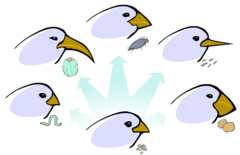
morphological innovation
evolution of new or novel morphological trait could allow descendants to exploit new niches (ex. bipedalism and larger brains/bodies)
Savannah Hypothesis
the now discredited idea that the development of open savannah grassland created conditions leading to the evolution of hominins
The Feeding Hypothesis
more upright posture helped human ancestors feed better in trees
ecological opportunity
the availability of new or novel types of resources; creates adaptive radiation which fills new niches
Out of Africa Hypothesis
The hypothesis that modern humans (Homo sapiens) evolved in Africa and spread to other continents, replacing other Homo species without interbreeding with them.
Where was most Neanderthal DNA in humans found?
Eurasia (has decreased over the years)
In what ways did early human civilizations impact the local & global biodiversity
agriculture
domestication of plants & animals
urbanization
megafungal extinction due to hunting/climate change
How is the tree of life balanced?
speciation and extinction
Describe how the survival of individuals, populations, & species are connected:
loss of individuals ->
smaller population sizes means
-disruption of survival and reproduction
-smaller populations are more at risk for loss due to chance events
- lower genetic diversity
Describe the extinction vortex

What do past mass extinction events have in common?
large loss of biodiversity
result of major change to planetary conditions
ecospace models
body size vs. diet to provide insight on how different eco-factors contribute to the patterns of occupation
Why are amphibians experiencing higher extinction rates?
climate change, habitat alteration, overexploitation, introduced predators & competitors, pollution, disease
How do individuals respond to climate change?
acclimate to change their physiology
behavior
morphology
How do populations respond to climate change?
adaptation
How do species respond to climate change?
shift their range
go extinct
Evidence of extinction due to climate change
- loss of habitat
- sea level rise
- melting ice
- changing reproduction
- sex ratio
Today's major threats to biodiversity
-pollution
-climate change
-habitat loss and degradation
-extinction
-introduced species
-over-exploitation
conservation biology
1) document the full range of biological diversity on Earth
2) investigate human impact on genetic variation
3) develop approaches that prevent species extinction
antidote: what phenomena affect the maintenance, loss, & restoration of biodiversity?
interdisciplinary: needs social science & natural science
what does environmentalism aim to accomplish
- widespread movement of political & educational activism
- goal: protect the natural environment
- efforts in part informed by conservation biology
How is success measured in conservation biology?
Did we prevent extinction?
Have we maintained or increased biodiversity?
Are biological communities and their associated functions persisting through time?
How much global NPP do humans use?
30%
What are the consequences of the human ecological footprint
lower productivity and species richness
warming planet
What type of species evolves the quickest?
r-selected species
What factors limit population adaptation
-how quickly they reproduce
-genetic diversity
-isolation: geographic barriers/fragmentation
What is evolution? (3)
- descent with modification from common ancestor
- change in composition of a population one generation to the next
- change in allele frequencies across generations
What is the scientific definition of a theory?
A well-substantiated explanation of some aspect of the natural world that incorporates facts laws inferences, and tested hypotheses: "Not tentative or with lack of certainty"
What is the current consensus between scientists and theologians?
Science deals with questions answered by measurements in the natural world. Science depends on proof. Religion deals with questions that cannot be answered by the natural world. Rather, it is dependent on belief and faith.
Why is it important that we address misunderstandings of evolution?
1) prevent antibiotic resistance
2) emphasize links between habitat degradation & human health
3) evolutionary relationships guide treatment development
4) address misleading imagery online

Why are false hierarchies dangerous?
manufactured tiers in society uphold white supremacy:
- imperialism/colonialism
- racism
- slavery
- genocide
- eugenics
> phrenology- pseudoscience- cranium size and shape determines characteristics & mental abilities
What was Darwin's mystery of mysteries?
Where do species come from? How have they come to be so well adapted to their environments?
2 components of scientific theory:
1) pattern component- statement of fact (observed)
2) process component- mechanism explains/produces pattern
Young Earth Creationism Hypothesis
- species recently created
- species are unrelated
- species don't change over time
(ALL FALSE!)
Lamarck's Hypothesis
Evolution occurs through inheritance of acquired characteristics. Individuals change in response to changes in the environment and therefore acquire these traits. These acquired traits are passed on to their offspring.

Patterns of Darwinian Evolution (5)
Patterns:
- changes over time
- change over geographic distance
- resemblance to fossils
- homology
- vestigial traits
Conditions for natural selection to occur:
1) variation
2) heritability
3) differential survival or reproductive success
What happens when the conditions for natural selection are met?
Evolution will occur! More successful traits will rise and less successful traits will fall.
Fitness
Reproductive success which reflects how well an organism is adapted to their environment; a metric
What is the raw material for evolution?
Variation
Mutations
A permanent change to a DNA sequence which produces new alleles. Creates variation in the population.
Sexual reproduction
Creation of novel combinations of genetic material during gametogenesis (from independent assortment & crossing over). Random combinations of sperm & egg.
Heritability
a measure of how well an offspring's traits resemble parents
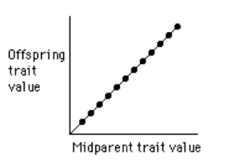
What does the graph look like for a trait that is not heritable
note: traits that aren't heritable don't respond to selection

Where must a mutation occur for it to affect the allele frequency?
Germ line cells
If a mutation was random, we would see:
- mutations arise before external factors are applied
- high variance between test groups
If a mutation wasn't random (induced by external factors), we would see:
- mutations arise when external factors approach group
- low variance between test groups
Main ideas for mutation (4):
- mutations change allele frequencies very slowly
- mutations alone are not responses to selection pressure
- mutations add new alleles to every generation
- mutations tend to work in the opposite direction of selection
Mendelian Genetics
describes the transmission of alleles from individual parents to individual offspring

What are population genetics?
describes transmission of alleles in a population from on generation to the next

How do we know if evolution is happening? (3)
Compare to condition with no evolution!
1) HW model is a null model
2) Mendelian inheritance is not a evolutionary force
3) a population is in HW eq. if:
> genotype frequencies are p^2, 2pq, q^2
> genotype & allele frequencies are not changing
gene pool
a collection of gametes; the set of all alleles that could potentially contribute to the next generation

Frequency of dominant allele
p
Frequency of recessive allele
q
Frequency of homozygous dominant genotype
p^2
Frequency of heterozygous genotype
2pq
Frequency of homozygous recessive genotype
q^2
What is assumed in HW Eq.? (5)
- no mutation
- no selection
- no migration
- random mating
- infinite population size
What is the fundamental difference between sexes?
anisogamy- size of their gametes
Pros of asexual reproduction from egg POV
- 100% of genetic info passed on
- efficient: 10 children = 10 copies of genes
Cons of sexual reproduction from egg POV
- reproduction with sperm reduces fitness by 50%
> 10 offspring = 5 copies of genes
- cost of breaking up good genotype
Pros of sexual reproduction from sperm POV
- you have sex, sperm are small, cheap and plentiful
Cons of sexual reproduction form sperm POV
- energetic cost of competition for egg
- 50% of genetic material passed on
Overall pro of sexual reproduction
helps resist environmental changes
Equation for reproductive success
reproductive success = # offspring x avg. quality of offspring
trade-off: quality vs. quantity
Two hypotheses for the asymmetry of sexes
1) sperm's fitness is limited by the ability to attract mates, so maximize quantity
2) egg's fitness is limited by ability to gain the resources required to produce eggs/rear young, so maximize quality
Consequences of the asy. of sex
1) competition between males for access to females
2) female preference
Ways that males compete for access to females:
1) elaborate mating displays
2) direct combat (before copulation)
3) sperm competition (during/after copulation)
Female preference
Exertion of a preference for males perceived to be of high quality
Direct benefit of female preference
acquisition of resources
Indirect benefits of female preference
- good genes for higher fitness in both sexes
- sexy sons- females with a preference for a trait produce that trait