Inflammatory skin disorders
 Call Kai
 Learn
 Practice Test
 Spaced Repetition
 Match
 Flashcards
 Knowt Play
1/31

Earn XP
Description and Tags
Acne, eczema and atopic dermatitis, and psoriasis.
32 Terms
What is this skin condition called?
Acne vulgaris.

Acne vulgaris
An inflammatory skin disease affecting the pilosebaceous unit. It is clinically characterised (and diagnosed) by the presence of comedones, papules, pustules, nodules, cysts, and/or scarring, primarily on the face and trunk. It ranges from mild to severe.

Types of acne vulgaris lesions
Non-inflammatory lesions:
Open comedones (superficial)
Closed comedones (superficial)
Inflammatory lesions:
Papules (superficial)
Pustules (superficial)
Nodules (deep)
Pseudocysts (deep)

Pathogenesis of acne vulgaris
Excess sebum
Follicular hyperkeratinisation (buildup of excess keratin and dead skin cells in the hair follicle)
Cutibacterium acnes proliferation in the follicle (bacteria that is a normal part of the skin microbiome, though the above factors lead to excess multiplication)
Inflammation (due to byproducts produced by C. acnes)
Acne vulgaris epidemiology
Most common dermatological condition globally
Affects up to 80-90% of adolescents:
Peak is 14-17 for females and 16-19 for males.
Prevalence of adult female acne is increasing.
Risk factors:
Family history
Hormonal factors (PMOS, puberty)
Certain drugs (corticosteroids, lithium, anabolic steroids)
Increased sebum production
Comedogenic product use
Mechanical trauma (scrubbing, tight clothing etc.)
How is acne vulgaris classified from mild to severe?
Mild-moderate - One or more of:
Any number of non-inflammatory lesions.
Up to 34 inflammatory lesions.
Upt to two nodules
Moderate-severe - Either or both of:
35 or more inflammatory lesions
3 or more nodules
What second line investigations might you want to consider in a person who has been diagnosed with acne vulgaris?
Hormonal profile if hyperandrogenism is suspected:
Testosterone
SHBG
DHEA-S
LH/FSH
Management of acne vulgaris
Provide advice on skincare routines (avoiding comedogenic, alkaline, and other irritating skin products, do not pick lesions etc.)
Mild acne:
Multimodal topical therapy with benzoyl peroxide + retinoids/antibiotics (oral or topical)
Clascoterone, salicylic acid, or azelaic acid - combination with above, or as monotherapy
Moderate to severe / resistant acne:
A topical retinoid, benzoyl peroxide, and oral antibiotic.
Hormonal therapy with certain types of combined pill (women)
Oral isotretinoin - specialist
Complications of acne vulgaris
Permanent disfiguration:
Atrophic scars (ice-pick, boxcar, rolling)
Hypertrophic / keloid scars
Psychological and social impacts
Pain
Systemic symptoms may be present with acne fulminans, a rare variant of nodulocystic acne.

What is the criteria for a referral to dermatology for acne vulgaris?
Mild-moderate acne has not responded to at least six months of two completed courses of treatment + topical therapy.
Severe nodular / pseudocystic acne with scarring
Severe psychological upset
What are the conditions for which a patient is prescribed isotretinoin?
>12 years
If under 18, it must be signed off by 2 healthcare professionals that it is a final resort.
Pregnancy test - mandatory before and monthly during isotretinoin due to the high risk of causing birth defects.
Baseline bloods before and monthly during isotretinoin - FBC, LFT, fasting lipids.
MLA tips for acne vulgaris

Eczema (atopic dermatitis)
Chronic relapsing inflammatory skin condition characterised by pruritus (itch), inflammation, a disrupted skin barrier, and dry skin.

Epidemiology of eczema
Affects roughly 20% of children and 10% of adults in the UK.
Onset is often before age 5 in 90% of cases.
60% of cases will resolve before adolescence.
Increasing prevalence.
Risk factors:
Genetic factors (especially filaggrin loss-of-function mutations)
Irritants (soaps, detergents etc.)
Allergens (e.g. house mite dust)
Other atopic conditions (allergic rhinitis, asthma)
Infections
Stress
Climate
Eczema pathophysiology
Skin barrier dysfunction (often with filaggrin mutations)
Immune dysregulation (Th2-dominant)
Environmental triggers (pollen, dust-mites, allergens etc.)
Associated with an IgE-mediated allergic response
Part of the atopic march - many children develop asthma and allergic rhinitis subsequently
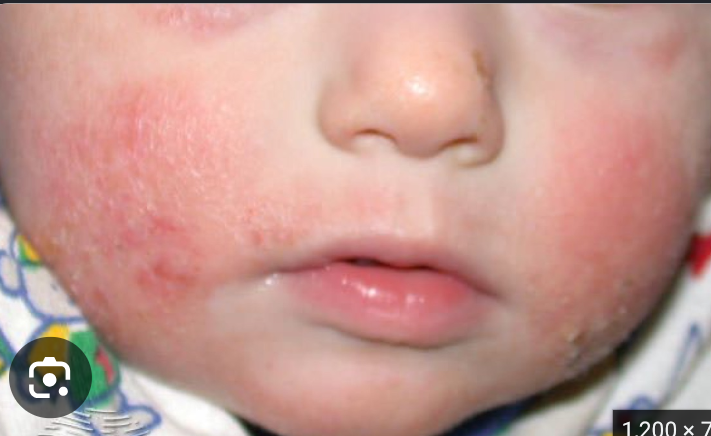
Potential signs and symptoms of eczema
Intense pruritus (hallmark symptom) - often worse at night and disrupts sleep.
Dry, rough skin (xerosis - universal feature)
Relapsing-remitting course with flares
Location in infants - extensor surfaces and face (cheeks)
Location in children / adults - flexural distribution (antecubital fossae, popliteal fossae, wrists, neck)
Perifollicular (around follicles) is more common in patients with darker skin.
Acute features:
Erythema
Papules
Vesicles
Chronic features:
Lichenification (Skin thickening - leathery, rough, bark-like texture. Higher risk of this in patients with darker skin.)
Excoriation (abrasion where skin has been scratched off)
Post-inflammatory hyperpigmentation (key feature in patients with darker skin)
Nodular prurigo - itchy firm lumps (higher risk of this in patients with darker skin)
Secondary infection:
Weeping
Crusting
Golden crust (S.aureus)
Pustules
Signs of eczema herpeticum
How is eczema diagnosed?
It is a clinical diagnosis. Usually no other investigations are required.
When might further investigations be needed for eczema?
Skin swab (MC&S) if infected eczema is suspected. Identifies organism and sensitivities.
Viral swab if eczema herpeticum is suspected (HSV PCR)
Patch testing if contact allergy is suspected (e.g. occupational, localised pattern)
Skin prick testing / specific IgE if food allergy is suspected as a trigger (particularly in severe childhood eczema)
How is eczema managed?
Avoid triggers
Emollients:
ALL patients, ALL the time
Complete emollient therapy - soap substitutes, bath additive, leave-on moisturiser.
Apply liberally and frequently (250-500 g/week for adults)
Thicker is more effective (but less tolerated)
Apply emollient 20-30 mins before topical steroids
Mild topical corticosteroid:
Hydrocortisone 1% for face, flexures, and children
Use for 7-14 days during flares, then stop / step down
Apply thinly to active areas only (FTU dosing guide)
Moderate / potent topical steroid:
Moderate: betamethasone valerate 0.025% (Betnovate-RD), clobetasone butyrate (Eumovate)
Potent: betamethasone valerate 1% (Betnovate), mometasone (Elocon)
Short course during flares using the lowest potency that controls symptoms
Specialist therapies:
Topical calcineurin inhibitors (tacrolimus, pimecrolimus): steroid-sparing, safe for face and flexures
Phototherapy (narrowband UVB)
Systemic immunosuppression: methotrexate, ciclosporin, azathioprine, mycophenolate
Biologic: dupilumab (anti-IL-4/13) for moderate-severe adult atopic eczema
What are the side effects of prolonged potent topical corticosteroids?
Skin thinning
Telangiectasia (spider veins)
Striae
Adrenal suppression
If eczema becomes infected, how is it managed?
Bacterial (S. aureus): flucloxacillin 500 mg QDS for 7 days (clarithromycin if penicillin allergic).
Eczema herpeticum (HSV): DERMATOLOGICAL EMERGENCY - IV aciclovir if systemic/periocular; oral aciclovir if mild and localised.
Eczema herpeticum (HSV): DERMATOLOGICAL EMERGENCY - IV aciclovir if systemic/periocular; oral aciclovir if mild and localised.
Stop topical steroids and calcineurin inhibitors on infected areas until the infection is treated.
Complications of eczema
Secondary bacterial infection (S. aureus in >90% of cases)
Eczema herpeticum
Sleep disturbance
Psychological impact - anxiety, depression, and social isolation.
Steroid side effects
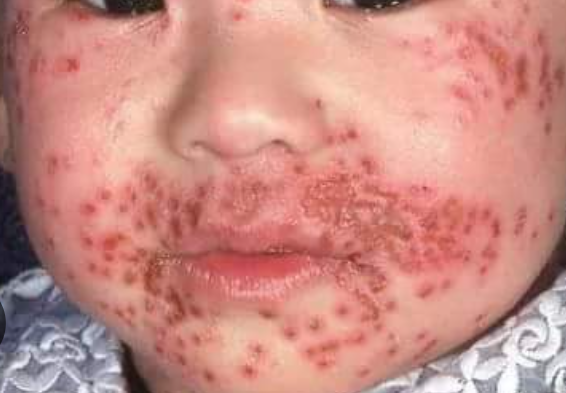
Eczema herpeticum
HSV infection of eczematous skin.
Causes painful punched out erosions.
Medical emergency as the infection can rapidly spread across the damaged skin and cause sight / life threatening complications if left untreated.
In what situations would a GP make a referral for eczema?
Failure to respond to continuing use of appropriate topical moderately potent treatment.
Suspected eczema herpeticum.
MLA tips for eczema

Psoriasis
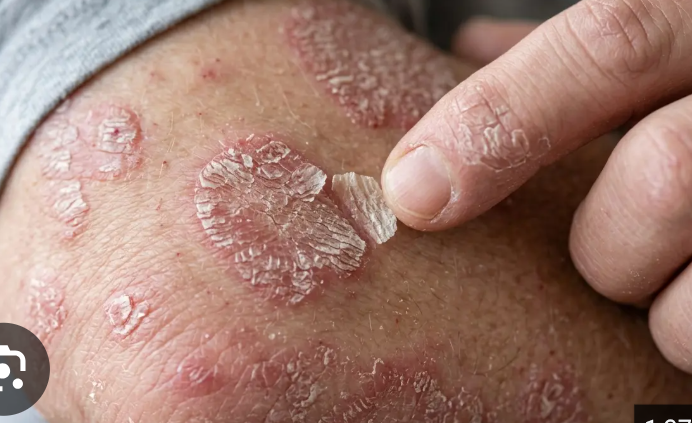
A chronic immune-mediated inflammatory skin disease characterised by well-demarcated, erythematous plaques with silvery scale. It is associated with cardiovascular and metabolic comorbidity
Psoriasis epidemiology
Affects 2-3% of the UK’s population.
Bimodal age of onset:
15-25 years (type I, HLA-Cw6+)
50-60 years (type II)
Equal sex distribution
Risk factors:
Family history in about a third of cases
Obesity and metabolic syndrome
Smoking and alcohol use
Stress infection
Medications: Beta-blockers, lithium, antimalarials, NSAIDs, ACE inhibitors
Psoriasis pathophysiology
Complex - influenced by genetic, immunological, and environmental factors.
Polygenic inheritance, with activation occurring when environmental triggers are present (no clear trigger in most cases, but some examples include strep throat, stress, drugs, alcohol, smoking, and Koebner phenomenon).
Immune mediated process involving inappropriate T-cell activation and cytokine release.
Activated T-cells produce cytokines which stimulate inflammatory cell infiltration (leading to erythema) and the proliferation of keratinocytes (leading to scale as the stratum corneum is shed from the skin)
What are the different subtypes of psoriasis?
Chronic plaque psoriasis (most common at roughly 90% of cases)
Guttate psoriasis (associated trigger is strep throat)
Pustular psoriasis
Erythrodermic psoriasis
Flexural (inverse) psoriasis
Scalp psoriasis

What conditions are associated with psoriasis?
Psoriatic arthritis
Cardiovascular disease
Metabolic syndrome
Depression
Symptoms and signs of psoriasis
Well-demarcated, salmon-pink / red raised plaques with silvery-white scale.
Located on extensor surfaces: elbows, knees, sacrum, scalp.
Variable pruritis
Relapsing-remitting course
Nail changes: pitting, onycholysis, subungual hyperkeratosis, oil-drop sign
Joint pain / stiffness (psoriatic arthritis)
Auspitz sign - pinpoint bleeding when scale is scraped off.
Koebner phenomenon - new plaques at sites of skin trauma.
Widespread sterile pustules on erythematous skin (generalised pustular psoriasis)
Rapid onset widespread erythema >90% BPA, systemic upset (erythrodermic psoriasis)
How is psoriasis diagnosed?
Clinically.