Art History Unit #2 Exam Study
 Call Kai
 Learn
 Practice Test
 Spaced Repetition
 Match
 Flashcards
 Knowt Play
1/77

There's no tags or description
Looks like no tags are added yet.
78 Terms
17th-Century Baroque
A major European art movement characterized by emotional intensity, theatrical lighting, dynamic movement, and regional distinctions between Catholic devotional drama and Protestant realism.
Protestant Reformation
The 16th-century religious movement initiated by Martin Luther that rejected papal authority, resulting in widespread iconoclasm and altered artistic patronage across northern Europe.
Catholic Counter-Reformation
The Catholic Church's 16th- and 17th-century revival campaign that enlisted grand, emotionally stirring visual art to reinforce dogma and combat Protestant influence.
Tenebrism
A dramatic painting technique utilizing violent contrasts of light and dark, in which figures emerge from pitch-black, shadowy backgrounds.
Painterly Technique
A method of applying pigment that leaves visible, textured brushstrokes on the surface, contrasting with a smooth, blended, or linear finish.
Extreme Foreshortening
The dramatic optical compression of an object or figure along the viewer's direct line of sight, creating an illusion of intense spatial depth and projection.
Open Composition
An arrangement where elements, figures, and vectors extend beyond the frame, giving the impression that the scene continues indefinitely outside the canvas.
Protestant Revolt (1568–1648)
The Eighty Years' War in which the northern provinces of the Low Countries fought for and won independence from Catholic Spanish Habsburg rule.
Dutch Republic
The sovereign, trade-dominated 17th-century nation marked by Protestant culture, urban civic identity, and a flourishing middle-class art market.
Landscape (and Sub-Genres)
Depictions of natural scenery, divided into topographic (factual recording), ideal (harmonious and classical balance), and sublime (awe-inspiring and perilous nature).
Camera Obscura
An optical device with a small aperture or lens that projects an inverted external image onto an interior surface, aiding naturalistic rendering.
Genre Painting
Representations of scenes from everyday life, featuring ordinary people engaged in domestic chores, festive celebrations, or tavern activities.
Still Life
A painting focused on arrangements of inanimate items, including food, flowers, household vessels, musical instruments, and dead game.
Memento Mori
An artistic symbol or reminder of human mortality, traditionally depicted through skulls, hour-glasses, extinguished candles, or decaying fruit.
Vanitas Still Life
A specialized category of still life that illustrates the transience of earthly life, the emptiness of worldly wealth, and the inevitability of death.
Trompe L'œil
An illusionistic visual style designed to deceive the viewer into mistaking painted, two-dimensional surfaces for actual three-dimensional objects.
Nature / Scientific Still Life
A subgenre dedicated to the precise, descriptive observation and cataloging of botanical, zoological, and anatomical specimens.
Breakfast Pieces / Dinner Pieces
Dutch still lifes depicting morning meals (ontbijtjes) or lavish banquet tables (banketjes), reflecting middle-class prosperity and temperance.
Absolutism (Age of Absolutism)
A political doctrine and system in which a monarch exercises centralized, total governing power unrestricted by constitutional limits, epitomized by Louis XIV.
The French Royal Academy
The French Royal Academy of Painting and Sculpture, founded in 1648 to codify visual standards, educate artists, and regulate royal patronage.
Academic Style
An aesthetic approach conforming to institutional rules, emphasizing draftsmanship, classical mythology, moralizing subjects, and invisible brushwork.
Classicism
An aesthetic philosophy drawing principles from ancient Greece and Rome, emphasizing rational order, symmetry, proportion, and idealized beauty.
History Painting
The most esteemed academic category, portraying grand narrative subjects from biblical events, classical mythology, or monumental historical occurrences.
Hierarchy of Genres
The academic classification system ranking subject prestige: history painting first, followed by portraiture, genre scenes, landscape, and still life.
Rococo
An 18th-century decorative and pictorial style celebrated for lighthearted themes, asymmetrical curves, pastel palettes, and scenes of courtly pleasure.
Fête Galante
An academic category created for Jean-Antoine Watteau portraying refined aristocrats leisurely socializing, courting, and relaxing in idyllic pastoral settings.
The Enlightenment
An 18th-century intellectual movement promoting rational inquiry, scientific empiricism, individual liberties, and religious tolerance over inherited tradition.
American and French Revolutions
Late 18th-century political upheavals inspired by Enlightenment ideals that overthrew colonial rule and the French monarchy, transforming political art.
The Paris Salon
The official, state-sponsored exhibition held by the French Academy in Paris, serving as the dominant platform for public scrutiny and professional success.
The Public Sphere
An emerging social realm outside state control where private individuals met in coffeehouses, salons, and print publications to discuss art, politics, and culture.
Neoclassicism
A late 18th-century movement that rejected Rococo whimsy in favor of stoic moral virtue, austere linear precision, and subjects from classical antiquity.
Prix de Rome
A prestigious scholarship established by the French Academy granting winners extended residency in Rome to study classical and Renaissance masterpieces.
Romanticism
A late 18th- and 19th-century movement emphasizing deep emotion, individual imagination, heroic rebellion, and the untamed power of the sublime.
Modernity (Baudelaire)
A concept popularized by Charles Baudelaire defining the modern urban experience as the transient, fleeting, and contingent nature of contemporary life.
Modernism
A broad artistic and cultural movement that broke with traditional academic representation to explore new materials, techniques, and abstract realities.
Avant-Garde
Innovative and radical artists who challenge conventional aesthetic boundaries, institutional authority, and bourgeois cultural expectations.
Realism
A mid-19th-century artistic movement led by Gustave Courbet that depicted unidealized, contemporary working-class existence with objective authenticity.
Daguerreotype
The first publicly announced photographic process, invented by Louis Daguerre, which captured detailed positive images on polished, silver-plated copper sheets.
Salon des Refusés
The 1863 exhibition sanctioned by Napoleon III to showcase artworks rejected by the official Salon, initiating a major challenge to academic hegemony.
Impressionism
A 19th-century movement marked by loose brushwork, bright unblended color, modern leisure subjects, and the capture of fleeting optical effects.
En Plein Air
The practice of painting outdoors in direct natural light rather than in a studio, crucial for Impressionist investigations of light and atmosphere.
Ukiyo-e
Japanese woodblock prints and paintings depicting the 'floating world' of urban pleasures, characterized by flat color planes, clear contours, and bold cropping.

Artist: Johannes Vermeer
Title: Officer and a Laughing Girl
Date: c. 1655–1660
Period / Movement: Dutch Baroque
Medium / Details: Oil on canvas; genre scene featuring domestic interior and optical perspective

Artist: Johannes Vermeer
Title: The Milkmaid (Kitchen Maid Pouring Milk)
Date: 1660
Period / Movement: Dutch Baroque
Medium / Details: Oil on canvas; domestic genre scene emphasizing everyday labor, natural light, and quiet dignity

Artist: Johannes Vermeer
Title: View of Delft
Date: c. 1660–1661
Period / Movement: Dutch Baroque
Medium / Details: Oil on canvas; topographic cityscape showcasing naturalistic light, water reflections, and civic pride

Artist: Jacob van Ruisdael
Title: Bleaching Grounds near Haarlem from the Dunes at Overveen
Date: c. 1670
Period / Movement: Dutch Baroque
Medium / Details: Oil on canvas; Dutch landscape (Haarlempje) featuring low horizons, expansive cloudscapes, and local linen industry

Artist: Pieter Claesz
Title: Vanitas Still Life
Date: 1630
Period / Movement: Dutch Baroque
Medium / Details: Oil on panel; vanitas still life incorporating memento mori symbols (skull, timepiece, overturned glass) warning of transience

Artist: Clara Peeters
Title: Still Life with Cheeses, Almonds and Pretzels
Date: 1615
Period / Movement: Dutch / Flemish Baroque
Medium / Details: Oil on panel; breakfast piece (ontbijtje) highlighting tactile food textures and reflective metalwork

Artist: Willem Claesz. Heda
Title: Still Life with a Gilded Beer Tankard
Date: 1634
Period / Movement: Dutch Baroque
Medium / Details: Oil on canvas; monochrome banquet piece (banketje) exploring luxury, temperance, and reflective surfaces

Artist: Rachel Ruysch
Title: Still Life with Fruit, Flowers, and Insects
Date: Early 18th century (c. 1711)
Period / Movement: Dutch Baroque
Medium / Details: Oil on canvas; botanical / scientific still life combining meticulous natural observation with subtle vanitas motifs

Artist: Jan Brueghel the Elder
Title: Small Bouquet of Flowers in a Copper Vase
Date: c. 1600
Period / Movement: Flemish Baroque
Medium / Details: Oil on panel; detailed floral still life featuring rare botanical specimens rendered with scientific precision

Artist: Adriaen van der Spelt & Frans van Mieris
Title: Trompe l'œil Still Life with a Flower Garland and a Curtain
Date: 1658
Period / Movement: Dutch Baroque
Medium / Details: Oil on panel; collaborative trompe l'œil painting (van der Spelt painted garland, van Mieris painted illusionistic silk curtain and rod)

Artist: Hyacinthe Rigaud
Title: Portrait of Louis XIV
Date: 1701
Period / Movement: French Baroque (Age of Absolutism)
Medium / Details: Oil on canvas; monumental official state portrait celebrating divine-right monarchy and royal majesty

Artist: Nicolas Poussin
Title: The Death of Germanicus
Date: 1628
Period / Movement: French Classical Baroque
Medium / Details: Oil on canvas; academic history painting illustrating stoic civic virtue and classical Roman tragedy

Artist: Nicolas Poussin
Title: Landscape with Funeral of Phocion
Date: 1648
Period / Movement: French Classical Baroque
Medium / Details: Oil on canvas; ideal classical landscape framing a moralizing historical narrative of injustice and virtue

Artist: Jean-Antoine Watteau
Title: L'Indifférent
Date: 1716
Period / Movement: Rococo
Medium / Details: Oil on panel (approx. 10 x 7.5 in.); intimate genre painting depicting an elegant, theatrically poised figure

Artist: Jean-Antoine Watteau
Title: A Pilgrimage to Cythera
Date: 1717
Period / Movement: Rococo
Medium / Details: Oil on canvas (approx. 4 x 6 ft.); inaugural fête galante depicting aristocratic lovers in a mythical pastoral realm

Artist: Jacques-Louis David
Title: Oath of the Horatii
Date: 1784
Period / Movement: Neoclassicism
Medium / Details: Oil on canvas; monumental history painting completed five years before the French Revolution preaching civic duty over personal ties

Artist: Pietro Antonio Martini (print after)
Title: The Paris Salon of 1785
Date: 1785
Period / Movement: 18th-Century Academic Art / The Enlightenment
Medium / Details: Etching / print; portrays the public sphere and academic hierarchy inside the biennial Salon in the Louvre

Artist: Jean-Honoré Fragonard
Title: The Swing
Date: 1767
Period / Movement: Rococo
Medium / Details: Oil on canvas; lighthearted scene of aristocratic leisure, illicit romance, and pastel botanical whimsy

Artist: Jean-Siméon Chardin
Title: The Morning Toilette
Date: 1740
Period / Movement: 18th-Century French Genre / Enlightenment
Medium / Details: Oil on canvas; bourgeois domestic genre painting stressing quiet morality, restraint, and familial duty

Artist: François Boucher
Title: The Toilet of Venus
Date: 1751
Period / Movement: Rococo
Medium / Details: Oil on canvas; sensuous mythological depiction commissioned by Madame de Pompadour embodying courtly indulgence

Artist: Jean-Antoine Houdon
Title: Portrait Sculpture of George Washington
Date: 1788–1792
Period / Movement: Neoclassicism
Medium / Details: Carrara marble; civic portrait sculpture located in the Virginia State Capitol rotunda combining contemporary dress with classical fasces

Artist: Francisco de Goya
Title: The Sleep of Reason Produces Monsters
Date: c. 1799–1800
Period / Movement: Romanticism / Enlightenment Satire
Medium / Details: Etching and aquatint (approx. 7.5 x 6 in.); plate #43 from the Los Caprichos series critiquing human folly and irrationality

Artist: Francisco de Goya
Title: The Third of May, 1808
Date: 1814
Period / Movement: Romanticism
Medium / Details: Oil on canvas; raw political protest painting capturing the execution of Spanish civilians by Napoleonic troops

Artist: Joseph Mallord William Turner
Title: The Slave Ship
Date: 1840
Period / Movement: Romanticism
Medium / Details: Oil on canvas; sublime seascape uniting turbulent natural forces with an abolitionist exposé of human brutality

Artist: Caspar David Friedrich
Title: Monk by the Sea
Date: 1809–1810
Period / Movement: Romanticism
Medium / Details: Oil on canvas; sublime, radically open landscape exploring solitary spiritual contemplation before vast nature

Artist: Jean-Auguste-Dominique Ingres
Title: The Grand Odalisque (Grande Odalisque)
Date: 1814
Period / Movement: Neoclassicism / Romantic Orientalism
Medium / Details: Oil on canvas (approx. 3 x 5 ft.); exoticized female nude featuring elongated anatomical proportions and polished academic finish

Artist: Eugène Delacroix
Title: Death of Sardanapalus
Date: 1827
Period / Movement: Romanticism / Orientalism
Medium / Details: Oil on canvas (approx. 12 x 16 ft.); tumultuous, color-saturated narrative depicting violent self-destruction and chaotic decadence

Artist: Louis Daguerre
Title: View of the Boulevard du Temple, Paris
Date: 1838
Period / Movement: Early Photography
Medium / Details: Daguerreotype; landmark photograph representing one of the earliest visible photographic captures of a human being

Artist: Gustave Courbet
Title: A Burial at Ornans
Date: 1849–1850
Period / Movement: Realism
Medium / Details: Oil on canvas (approx. 10 x 22 ft., Musée d'Orsay); monumental history-scale canvas recording an ordinary provincial working-class funeral

Artist: Édouard Manet
Title: Le Déjeuner sur l'herbe (Luncheon on the Grass)
Date: 1863
Period / Movement: Realism / Early Modernism
Medium / Details: Oil on canvas; showcased at the 1863 Salon des Refusés, subverting classical nude conventions in a contemporary Parisian park

Artist: Édouard Manet
Title: Olympia
Date: 1863 (Exhibited 1865)
Period / Movement: Realism / Early Modernism
Medium / Details: Oil on canvas; debuted at the Salon of 1865, directly confronting traditional reclining Venus tropes with a modern sex worker

Artist: Claude Monet
Title: Impression, Sunrise
Date: 1872
Period / Movement: Impressionism
Medium / Details: Oil on canvas (approx. 18.9 x 24.8 in.); harbor view at Le Havre that gave Impressionism its name through fleeting light and visible stroke
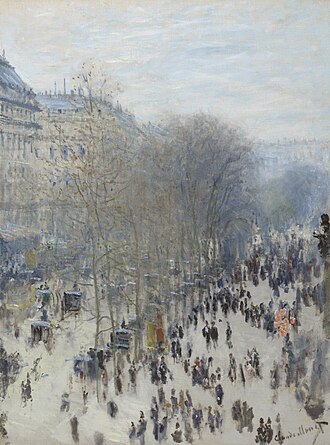
Artist: Claude Monet
Title: Boulevard des Capucines
Date: 1873–1874
Period / Movement: Impressionism
Medium / Details: Oil on canvas; urban streetscape depicting bustling Parisian pedestrian flow and atmospheric modernity from an elevated viewpoint

Artist: Claude Monet
Title: Gare Saint-Lazare (St.-Lazare Train Station)
Date: 1877
Period / Movement: Impressionism
Medium / Details: Oil on canvas (approx. 21 x 29 in.); en plein air study of industrial modernity, locomotive steam, and iron architecture

Artist: Edgar Degas
Title: Place de la Concorde (Count Lepic and His Daughters)
Date: 1875
Period / Movement: Impressionism
Medium / Details: Oil on canvas; modern urban composition using eccentric cropping and negative space inspired by photography and Japanese prints

Artist: Mary Cassatt
Title: In the Loge
Date: 1878
Period / Movement: Impressionism
Medium / Details: Oil on canvas; opera house scene representing an autonomous modern woman as an active spectator rather than a passive object