MEP electrical
 Call Kai
 Learn
 Practice Test
 Spaced Repetition
 Match
 Flashcards
 Knowt Play
1/144

There's no tags or description
Looks like no tags are added yet.
145 Terms
What is AC voltage
(Alternating Current)
-voltage that reverses its direction of flow at regular intervals
-(rises to a positive peak, drops through zero, falls to a negative peak, and comes back, over and over in a smooth sine wave)
-most common type of voltage used to produce work
DC voltage and common sources
Direct Current
-voltage that flows in one direction only
-used in almost all portable equipment
-The most common power sources that directly produce DC voltage are batteries and photocells.
1Φ Single phase AC voltage
-Single-phase AC voltage contains only one alternating voltage waveform
-uses a single alternating sine wave that drops to zero twice per cycle
-uses one AC voltage wave on two wires: a “hot” conductor and a neutral
3φ three-phase AC voltage
-Three-phase AC voltage is a combination of three alternating voltage waveforms, each displaced 120 electrical degrees (one-third of a cycle) apart.
-Three-phase voltage is produced when three coils are simultaneously rotated in a generator.
What is current?
-flows through a circuit when a source of power is connected to a device that uses electricity
-Current (I) is the number of electrons flowing through an electrical circuit.
What is current measured in?
Ampere
-An ampere is the number of electrons passing a given point in one second.
What is Power?
Power (P) is the rate of doing work or using energy.
Power may be expressed as…
true power or apparent power
True Power and what its expressed in
- the actual power used in an electrical circuit.
-expressed in watts (W)

Apparent Power and what its expressed in
Apparent power is the product of the voltage and current in a circuit calculated without considering the phase shift that may be present between the voltage and current in the circuit.
Apparent power is expressed in volt amps (VA).

Conductor
material that has very little resistance and permits electrons to move through it easily.
Most commonly used conductor
Copper (& aluminum due to cost)
Insulator
material that has a very
high resistance and resists the flow of electrons.
Common insulators include
rubber, plastic, air, glass, and paper
BTU in temperature
Btu is the amount of heat required to raise 1 lb of water 1°F
To calculate the amount of electrical energy used by a heating element, apply the formula:
E = P × T
where
E = energy (in Wh)
P = power (in W)
T = time (in hr)
Lumen
A lumen (lm) is the unit used to measure the total amount of light produced by a light source.
Footcandle
A footcandle measures how much light hits a surface, like a desk, floor or countertop.
Formula: footcandles = lumens ÷ area (sq ft)
1 footcandle = 1 lumen spread evenly over 1 square foot
1Φ Power Formula
P = E * I
P=Power (W) (no phase shift, if so, * PF)
E=Energy (Volts)
I=Current (Amps)
3Φ Power Formula
P=√3 × V × I × PF

remember this

What is NEC
NEC = National Electrical Code
to protect people and property from electrical hazards
Lighting symbols are used on electrical floor plans to show the
location and style (recessed or surface) of fixtures
required type of light-fixture mounting (ceiling or wall)

What is a GFCI recepticle?
Ground Fault Circuit Interrupter
usually near water
fat plug - neutral
skinny plug = hot
sad mouth = grounding


what does this arrow indicate

What is a home run?
The wiring that runs from a branch circuit back to the panel
Drawings: A line with an arrow that shows where circuit wiring should return to the service panel.
Typically, hash marks on home-run lines indicate
the number of hot, neutral, and ground wires in cable. Full-hash marks indicate hot and half-marks indicate neutral and ground wires. Dots may be used to indicate ground wires.
What is an electrical circuit?
An electrical circuit is an assembly of conductors (wires), electrical devices (switches & receptacles), and electrical components/loads (lights and motors) through which current flows.
Typical electrical circuits have five main parts:
a source of electricity, loads, a method of control, circuit protection, and a way of connection.
What is a hot wire?
carries voltage from breaker to the load (the “live” one that can shock you)
NECs official term for it is ungrounded conductor
What is a manually controlled circuit?
Any circuit that requires a person to indicate an action for the circuit to operate
line diagrams can be used to illustrate manually controlled circuits
What is an automatically controlled circuit?
any circuit that uses a control device to initiate and action for a circuit to operate.
EX) float switch
what is a 3-way switch?
takes one input and sends it to one of two outputs
single pole, double-throw electrical control device
Throw - how many places the switch can send the wire
commonly used to control lights from two switch locations

Four terminals can be identified on a three-way switch:
the common (hot wire always connected to)
traveler A
traveler B
traveler terminals are the connecting points for wires to connect another three-way switch.
ground terminals

What is a four way switch?
Four-way switches are used between two three-way switches to control a light from three switch locations.
double-pole, double-throw (DPDT) electrical control device
two types of four-way switches are the through-wired type and the cross-wired type.
total of five terminals: traveler 1, traveler 2, traveler 3, traveler 4, and a ground terminal.
what does it mean that a three way switch is single pole and a 4 way is a double pole
Single pole 3-way:
One wire enters the switch on the common terminal.
The switch sends it to one of two travelers.
One wire is being switched, so it’s single-pole.
Double pole 4-way:
Two wires enter the switch: both travelers from the previous switch.
Two wires are being switched at the same time, so it’s double-pole.
It has two positions:
Straight: traveler 1 → traveler 1, traveler 2 → traveler 2
Crossed: traveler 1 → traveler 2, traveler 2 → traveler 1
Why it needs two poles
A four-way switch always sits between two three-way switches, so both traveler wires pass through it.
What is a dimmer switch?
electrical control device that is used to control light brightness by adjusting the voltage level applied to the light.
What is a watt?
Energy per second
What are volts?
how much energy each bit of electric charge carries
What are Amps?
how much charge flows past a point each second
How does the formula P=E*I work?
energy per charge × charge per second = energy per second
What is a timer switch?
programmable electrical control device that automatically turns off after an elapsed amount of time
What is a motion sensor switch?
electrical control device that automatically turns on or off based on the occupancy or vacancy of a room space.
two types of sensors are occupancy sensor and the vacancy sensor
a vacancy sensor can automatically turn a light off, but it must be manually turned on.
What is Romex?
Romex® is a common brand name that is used when referring to NM cable produced by a variety of manufacturers.
(“Romex” is what everyone in the field calls nonmetallic cable)
What is a stranded wire?
A stranded wire is an insulated conductor composed of several smaller wires twisted together
What is a solid wire?
A solid wire is an insulated conductor composed of only one wire
What is AWG?
AWG = American Wire Gauge
AWG is a US standard for copper and aluminum wire diameters.
The larger the AWG number assigned to a wire…
the smaller the physical size of the wire or conductor
Wires that are smaller than No. 8 AWG may be…
either solid or stranded
Wires that are No. 8 AWG or larger are…
Stranded
A smaller AWG wire means…
a physically thicker wire
Large conductors, such as No. 3 and No. 2 AWG wires, are used to
supply power to main service panels
No. 10, No. 8, No. 6, and No. 4 AWG wires are generally used to…
electrical appliances
conductor sizes and ampacities chart

The numbers that are printed on the plastic jacket of NM cable provide information about
the size of the wire and the number of conductors in the cable.
a mark of “14-2” indicates the cable is
No. 14 AWG with two current-carrying conductors, not counting the ground wire.
The letters printed on the NM cable jacket indicate
the designated location
What is a type MC cable?
Metal-clad cable
insulated wires (including a green ground) wrapped in flexible metal armor
Better protection than NM
faster to install than conduit
preinstalled wires
used in commercial

What is an NM wire?
Nonmetallic-sheathed cable
insulated wires plus a bare copper ground, wrapped in a plastic sheath
Commonly referred to as Romex
Used in residential buildings
cheap and easy to install
four conduits we need to know
electrical metallic tubing (EMT),
rigid metal conduit (RMC),
intermediate metal conduit (IMC)
polyvinyl chloride (PVC) conduit

EMT
Electrical Metallic Tubing
“thin wall conduit”
lightest and cheapest metal conduit
bent in the field
360 degrees max of bends between pull points
can act as grounding itself
unthreaded
Trade sizes for conduit range from 1⁄2 ′′
to 4′′ in diameter
How often does EMT need support?
within 3 ft of each box/fitting and at Least every 10 ft
Is EMT threaded or unthreaded?
unthreaded
RMC
Rigid Metal conduit
heavy duty Galvanized metallic tube
Thickest wall of any conduit and is the strongest and heaviest
threaded
heavier and more difficult to bend than EMT
Standard trade sizes are available in 1⁄2′′ to 6′′ diameters at a standard length of 10′
What conduit is the most expensive and most labor intensive?
Rigid Metal Conduit RMC
PVC conduit
Polyvinyl chloride'
strong, lightweight
used indoor, outdoor, and Underground installations
Most insulating bc it doesn’t conduct
available in trade sizes from 1⁄2′′ to 6′′ diameters
Two types of PVC
Schedule 40 (thin wall) and schedule 80 (thick wall)
(schedule 80 has strength properties similar to RMC)
How often should EMT be securely fastened?
e at least every 10′ and within 3′ of each outlet box, junc-tion box, cabinet, or fitting
IMC
Intermediate Metal Conduit
“medium thickness” between EMT and RMC
threaded
threads and fittings same as RMC
galvanized
lighter and cheaper than RMC but still very strong
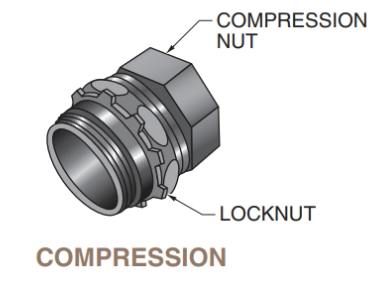
Compression Connector
box fitting securing conduit by using a nut that compresses a tapered metal ring into the conduit.
As the compression nut is tightened, the nut forces the ferrule into the conduit, locking the conduit in position
used for EMT
tighter seal, and are raintight
wet or damp locations and outdoors
cost more than set-screw fittings
keep the ground path continuous when they’re tight
Set screw connector
box fitting that relies on the pressure of a screw against conduit to hold the conduit in place
used for EMT
cheaper and faster to install
indoors, in dry locations only
most common type in typical commercial interiors
keep the ground path continuous when they’re tight

conduit outdoor use ranking
rare - EMT
Suited - PVC
Well suited - IMT
BEST suited - RMC
Which conduits is not allowed underground
EMT
Solder connections
Soldering is the process of joining metals by using filler metal and heat to make a strong electrical and mechanical connection
Flux is used with solder to remove surface oxides
Heat is applied until the materials are hot, allowing solder to be applied

Wire Nut Connectors
small plastic cap with a coiled metal spring inside. It joins, or splices, two or more wires together.
For the most effective use of wire nuts, the wires are twisted together clockwise before the wire nut is twisted on and taped
used to connect both conducting wires and ground wires
faster than tape

Tape connections
wire splice covered with electrical tape instead of being capped with a wire nut
The NEC requires that any splice be covered with insulation equal to the wire’s original insulation
moisture sealing
what is a service enterance?
assembly of the wires installed between the meter fitting (socket) and the disconnecting means (main breaker, fuse box, or breaker panel) inside a building
service lateral entrance is a service entrance where wires are buried underground
service drop entrance is a service entrance that has wires running from a utility pole to a service head

Service Head/Weather Head
weatherproof service point where overhead service drop conductors enter the service entrance riser pipe going to the meter socket
“The rain-proof cap on top of the pipe”

A service head must be how far above and to the side of any platform
must be at least 10′ above and 3′ to the side of any platform
Service wires must be at least how far from the bottom and sides of a window
3’ away
What is a service panel?
A service panel is an electrical box designed to contain fuses or circuit breakers for protecting the individual circuits of a building from the distribution system.

If a circuit tries to draw more current than its wire can handle…
the breaker trips and cuts that circuit off from the big supply/distribution system
Names for service panels
Service panel, electrical panel, breaker panel, breaker box, main panel, distribution panel, Fuse Box
What is used to distribute the power to fuses and circuit breakers inside a service panel?
BusBars / metal conductors
What is a subpanel?
panel supplied by the main service panel and distributes circuits to a specific area of a building
The service panel circuit breaker protects the subpanel from overloading
The main service panel must have a circuit breaker large enough to meet the demands of the subpanel

What is UPS?
uninterruptible Power Supply
An electrical storage service that provides stable and reliable power during fluctuations or failures of the primary power source
used to maintain the operation of critical loads such as computer systems, medical equipment, and sensitive electronics during short interruptions in the primary power source
What is a Generator?
A generator is a machine that makes electricity when the power company can’t supply it.
an electromechanical device that converts mechanical energy into electrical energy by means of electromagnetic induction
A diesel, gasoline, natural gas, or propane engine powers the generator
ATS
automatic transfer switch
a device that switches a load between two different sources of electric power
a device that automatically switches a building’s power source between the utility (normal power) and the generator
continuously monitors utility power for fluctuations or outages and can trigger a command to start a generator and bring it online
ATSs operate using a process called open-transition transfer (OTT)
one power source must be completely disconnected from the electrical load before the other power source is connected
An ATS prevents backfeeding power onto the utility lines
What is a transformer?
an electric device that uses electromagnetism to change voltage from one level to another or to isolate one voltage from another (a device that changes voltage)
step up or step down voltage
Transformer primary coil v. Transformer secondary coil
Transformer primary coil is the input side of a transformer where the voltage is connected
Transformer secondary coil is the output side where the voltage is induced
Step up transformer
a transformer in which the secondary coil has more turns of wire than the primary coil
produces a higher voltage on the secondary coil than the voltage applied to the primary

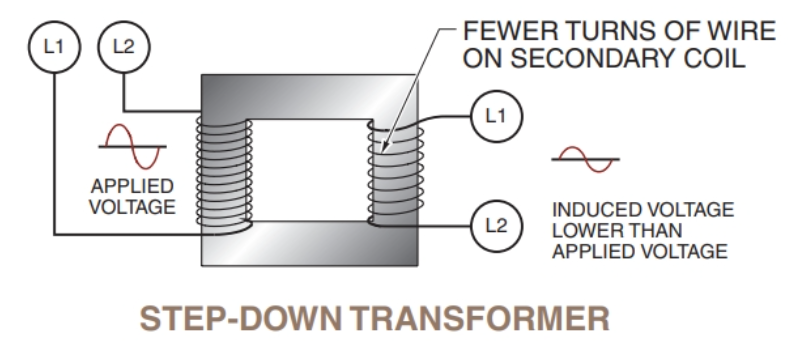
Step down transformer
a transformer in which the secondary coil has fewer turns of wire than the primary coil
produces a lower voltage on the secondary coil than the voltage applied to the primary
What are transformers rated by?
volt-ampere (VA)
kilovolt-ampere (kVA)
(It is standard practice with transformers to use voltage and current ratings and not wattage ratings)
Transformers only work with…
AC - alternating current
(Because AC can be easily stepped up to high voltage for long-distance transmission and stepped back down for buildings)
Distribution Transformers
Distribution transformers are step-down transformers that reduce voltage transmitted at high levels to usable residential, commercial, and industrial voltage levels
high voltage is not safe for use in practical applications
What are distribution transformers normally rated at?
rated from 1.5 kVA to 500 kVA
delivers a secondary voltage of 115 V, 120 V, 208 V, 230 V, 240 V, 460 V, or 480 V
What is a load?
Any device that converts electrical energy to light, heat, motion, or sound.

incandescent lamp
An incandescent lamp is a light bulb that makes light by heating a thin wire filament (usually tungsten) until it glows
low initial cost and are simple to install and service
most energy use
~1500 hr
cheapest

Fluorescent lamp
A fluorescent lamp is a gas-filled glass tube that makes light when electricity passes through mercury vapor inside it. The mercury gives off ultraviolet (UV) light, which hits a phosphor coating on the inside of the tube, and that coating glows as visible light.
The most common size is the 40 W lamp, which is designated T‐12 and has a length of 48′′
~10,000 hr
medium energy use
medium cost
slow strike
LED
light‐emitting diode
a semiconductor (electronic chip) that gives off light when current flows through it. There’s no filament and no gas
~25,000 hr
least energy use
needs a driver (converts AC to DC)
most expensive
lowest operating cost