Biochem Lect 1
 Call Kai
 Learn
Learn Practice Test
 Spaced Repetition
 Match
Match Flashcards
 Knowt Play
1/34

Earn XP
Description and Tags
Introductory concepts
Name | Mastery | Learn | Test | Matching | Spaced | Call with Kai | Chat |
|---|
No analytics yet
Send a link to your students to track their progress
35 Terms
What is vitalism?
Old aristotle way of thinking that separated living & non-living chemistries, requiring a “vital force” that enabled production of organic compounds
What did Fredrich Wohler do?
He was able to synthesize an organic compound found in mammal’s urine, urea, and proved that living and non-living worlds were governed by the same principles
In the universal thermodynamic equation
ΔG = ΔH - TΔS
What do all chemical reactions (rxns) strive to increase and/or decrease?
Decrease ΔG, increase ΔS
Sign of ΔG for endergonic rxn
+ ; consumes E
Sign of ΔG for exergonic rxn
- ; produces E
Sign of ΔG for spontaneous rxn?
- ; Same as exergonic
Ways to make a rxn spontaneous
Add heat or couple rxns to make overall ΔG -
Do enzymes change ΔG?
No
What do enzymes do to speed up rxns?
Change activation energy (Ea) of rxn to make substrates reach transition state faster
What is anabolism
“Building up” of molecules
What is catabolism
“Breaking down” of molecules
What is lysate?
Term for internal parts of a lysed (broken) cell
How can you separate components of lysate
Centrifugation
What are the most commonly found elements in organisms? (hint: SPONCH)
Sulfur, Phosphorus, Oxygen, Nitrogen, Carbon, and Hydrogen

What functional group is this?
Methyl

What functional group is this?
Ethyl

What functional group is this?
Phenyl

What functional group is this?
Aldehyde

What functional group is this?
Ketone

What functional group is this?
Carboxylate

What functional group is this?
Hydroxyl
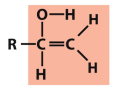
What functional group is this?
Enol

What functional group is this?
Ether

What functional group is this?
Ester

What functional group is this?
Acetyl

What functional group is this?
Anhydride

What functional group is this?
Amine

What functional group is this?
Sulfhydryl

What functional group is this?
Disulfide

What functional group is this?
Thioester

What functional group is this?
Phosphoryl
What are 3 classes of biomolecules
Proteins, nucleic acids, and lipids
What makes single bonded carbons special compared to double bonded carbons?
Their 3D tetrahedral geometry allows free rotation around that carbon, whereas the double bonded carbon is very rigid and flat
Covalent bonds are ________ than ionic interactions, non-covalent bonds, and Van Der Waals forces
stronger
Although covalent is stronger than non-covalent, why are non-covalent interactions more prevelant in biomolecules?
Because their weakness allows molecules to constantly attach and deattach to other molecules