Neural Bases Ch 3-4: Development of the NS & Cells of the NS
 Call Kai
 Learn
 Practice Test
 Spaced Repetition
 Match
 Flashcards
 Knowt Play
1/132

Earn XP
Description and Tags
CSD 4343 Exam 1 - Chapters 3-4 flashcards (chromosomal defects, six phases of neural development, birth defects, Cell City analogy, glial/neuron types, synapses, neurotransmitters, firing mechanism)
133 Terms
How many chromosome pairs does each human cell contain, and how many total chromosomes is that?
23 pairs, totaling 46 chromosomes.
What is mitosis, in the context of chromosomal defects?
Faulty replication that can produce chromosomal disorders.
What is meiosis?
The 'sexual replication' pathway that produces gametes.
What kind of chromosomal defect is Turner syndrome?
A whole chromosome deletion.
What kind of chromosomal defect is Cri du Chat syndrome?
A partial chromosome deletion.
What are the symptoms of Cri du Chat syndrome?
A more round face, micrognathia, wide-spaced eyes, low muscle tone, microcephaly, intellectual impairment, and delayed speech/hearing.
What kind of chromosomal defect is Trisomy 21 (Down syndrome)?
An extra chromosome.
What are the symptoms of Trisomy 21 (Down syndrome)?
A degree of intellectual disability, macroglossia, slanted eyes, and growth failure.
What is the sequence of stages from fertilization onward?
Zygote
Morula
Blastocyte
Embryo
Fetus
What happens during the Germinal stage?
(week 1) a sperm penetrates the ovum to form the zygote, cleavage forms a morula, and the blastocyst differentiates and implants in the uterine wall.
What are the three germ layers formed during the Embryonic stage?
Endoderm
mesoderm
ectoderm
What does the endoderm become?
(inside) becomes gut/liver/lungs
What does the mesoderm become?
(middle) becomes skeleton/muscles/kidneys/blood/heart
What does the ectoderm become?
(outside) becomes skin and the nervous system
What are the six phases of neural development, in order?
Dorsal Induction
Ventral Induction
Neural Proliferation
Neuronal Migration
Cortical Organization & Synapse Formation
Myelination
During Dorsal Induction, what forms, and at what gestational age (GA)?
The neural tube forms, at gestational age (GA) 3-7 weeks.
What happens to the neural tube during Dorsal Induction, by Week 3?
the ectoderm thickens into the neural plate.
What happens to the neural tube during Dorsal Induction, by Week 4?
the plate wraps into the neural tube (neurulation).
What happens to the neural tube during Dorsal Induction, by Week 5?
the tube's ends close.
What defect results if Dorsal Induction fails?
Neural tube defects.
What happens during Ventral Induction, and at what gestational age (GA)?
The face and brain develop from the neural tube's superior end, and the brain cleaves into two hemispheres, at gestational age (GA) 2-3 months.
What defect results if Ventral Induction fails?
Holoprosencephaly.
What happens during Neural Proliferation?
Neurogenesis occurs, producing new neurons that become gray/white matter of the cerebral hemispheres
What defect results if Neural Proliferation fails?
Microcephaly.
What happens during Neuronal Migration?
Neurons move to their proper location, guided by the chemical reelin
What gestational age (GA) does nueronal migration happen?
at gestational age (GA) 3-5 months.
What is reelin's mnemonic role?
The 'GPS of neurons' - it guides neuronal migration.
By approximately what gestational age are the six layers of the cerebral cortex established?
Approximately 20 weeks gestational age (GA).
What defect(s) result if Neuronal Migration fails?
Schizencephaly or lissencephaly.
What happens during Cortical Organization and Synapse Formation?
Dendrites and axons sprout and synapses form (synaptogenesis), with synaptic pruning eliminating unneeded connections
What gestational age (GA) does Cortical Organization and Synapse Formation happen?
from gestational age (GA) 5 months to years postnatal
What defect results if Cortical Organization and Synapse Formation fails?
Polymicrogyria (too many, too-small gyri).
What happens during Myelination, and over what timeframe?
Axons get coated in myelin, peaking around age 1, from birth to years postnatal.
What defect results if Myelination fails?
Hypomyelination, leading to intellectual disability.
What developmental process runs in parallel from gestational age (GA) 2 months to postnatal, and what defects result if it fails?
Cerebellar and brainstem development; failure produces (ponto)cerebellar hypoplasia, Joubert syndrome, or Dandy-Walker malformation.
What does the Prosencephalon (forebrain) contain and become?
Where the cerebrum and face develop; splits into the Telencephalon and Diencephalon.
What structures make up the Telencephalon, and what does it become?
Cerebral cortex, basal ganglia, and olfactory bulbs; becomes the left and right cerebral hemispheres.
What structures make up the Diencephalon?
Thalamus, hypothalamus, epithalamus, and subthalamus - the brain's relay stations.
What is the Mesencephalon (midbrain) sometimes called, informally?
The 'lizard brain,' or gut-reaction structure.
What structures make up the Metencephalon?
The pons and cerebellum.
What structure makes up the Myelencephalon, and what does it become?
The medulla - the neural-tube tail that becomes the spinal cord.
What happens neurologically during the 1st trimester (weeks 1-13)?
Neurons develop, multiply, and migrate.
What happens neurologically during the 2nd trimester (weeks 13-26)?
Neurons branch and form synapses.
What happens neurologically during the 3rd trimester (weeks 26-40)?
Pruning (apoptosis), synapse reorganization, and myelination begins.
What is an encephalocele?
Part of the brain protrudes through the skull; a dorsal induction failure.
What is anencephaly, and what causes it?
The most severe neural tube defect, where brain development ceases at the brainstem and there are no cerebral hemispheres, because the anterior neuropore fails to close.
What proportion of anencephaly cases fail to survive to term, and of those born, what proportion fail to thrive?
About 50% miscarry; of those born, 50% fail to thrive.
What is spina bifida?
A cyst on the back that may or may not involve the spinal cord.
What are the three subtypes of spina bifida, in increasing severity?
Spina bifida occulta, meningocele, myelomeningocele.
What is holoprosencephaly, more precisely described?
A failure of the brain to cleave into two hemispheres (not a failure to 'make' a left and right side).
What are the three severities of holoprosencephaly, from least to most severe?
Lobar, Semilobar, Alobar.
What does Lobar holoprosencephaly look like?
The brain looks normal but has abnormal connections between hemispheres and a missing corpus callosum.
What does Alobar holoprosencephaly look like?
No cleavage at all - no distinct hemispheres and no corpus callosum.
What craniofacial anomaly commonly co-occurs with holoprosencephaly?
Cleft lip/palate (though cleft palate has other causes too).
What is microcephaly?
An abnormally small head/brain, resulting from a neural proliferation failure.
What is schizencephaly?
Clefts or missing tissue in the cerebral hemispheres, from a neuronal migration failure.
What is lissencephaly?
A smooth brain lacking sulci and gyri, from a neuronal migration failure.
What do schizencephaly and lissencephaly have in common, causally?
Both trace to a lack of reelin.
Why do gyri matter functionally?
The grooves let the outer cortical layer curl up to fit more gray matter into a fixed skull size.
What is polymicrogyria?
Too many, abnormally small gyri, from a cortical organization failure.
What is hypomyelination, and what does it lead to?
Reduced ability to form myelin, leading to intellectual disability.
At what gestational age do fetal reflexes like startle begin?
10 weeks gestational age (GA).
When does the adolescent brain begin developing, and when is it complete?
Begins around age 10-11 in girls and 11-12 in boys, and isn't complete until about age 25.
In what direction does synaptic pruning proceed during adolescence, and which region is pruned last?
Back-to-front, with the prefrontal cortex pruned last.
What happens to gray matter and white matter during adolescence?
Gray matter thins while white matter increases.
What is neuroplasticity?
The brain's ability to adapt and form new connections.
What age is used as the reference point for distinguishing normal aging from dementia?
65 years old.
What most reliably distinguishes normal age-related forgetfulness from a dementia warning sign?
The ability to recall and describe one's own forgetfulness
normal aging retains awareness
dementia involves a lack of awareness of forgetfulness
What is a molecule?
Two or more atoms held together by a chemical bond.
What are the four molecule families covered, with examples?
Carbohydrates (simple sugars),
lipids (fatty acids)
proteins (amino acids)
nucleotides (DNA/RNA building blocks)
What is the function of the cell membrane, and what is its Cell City analogy?
A selectively permeable barrier/protector - the city limits.
What is the function of the Golgi apparatus, and what is its Cell City analogy?
Stores and delivers proteins - the post office.
What is the function of the cytoplasm, and what is its Cell City analogy?
The contents of the cell except the nucleus - the landscape/environment.
What is the function of the mitochondrion, and what is its Cell City analogy?
Produces energy for the cell - the power plant.
What is the function of the nucleus, and what is its Cell City analogy?
The genetic control center - the mayor/city hall.
What is the function of the nucleolus, and what is its Cell City analogy?
Produces ribosomes - builds factories.
What is the function of ribosomes, and what is their Cell City analogy?
Produce proteins - construction workers.
What is the function of centrioles, and what is their Cell City analogy?
Cell division and microtubule formation - small factories.
What is the function of the lysosome, and what is its Cell City analogy?
Digests cell debris and bacteria - recycling centers.
What is the function of microtubules, and what is their Cell City analogy?
Cell framework; moves cell parts - infrastructure.
What is the function of the endoplasmic reticulum, and what is its Cell City analogy?
Rough ER makes proteins
smooth ER makes fatty acids, calcium, and enzymes
the highway system.
Which organelle produces the energy (Adenosine Triphosphate, ATP) used for active transport later in the chapter?
The mitochondrion.
MELAS is caused by malfunction of which organelle, and what are its symptoms?
Mitochondria; causes encephalopathy and stroke-like episodes (similar to stroke effects but not caused by blocked arteries).
Leigh Syndrome is caused by malfunction of which organelle, and what are its symptoms?
Mitochondria; causes a progressive neurodegenerative disorder.
Tay-Sachs disease is caused by malfunction of which organelle, and what are its symptoms?
Lysosomes; causes accumulation of fatty substances in the brain.
Mucopolysaccaridoses are caused by malfunction of which organelle, and what are its symptoms?
Lysosomes; causes a buildup of sugars, leading to skeletal and organ damage.
Alzheimer's, Parkinson's, and Huntington's disease are linked to dysfunction of which organelle?
The Endoplasmic Reticulum (ER), affecting protein and lipid modification.
What is the function of neurons, and where are they found?
Communication within the nervous system and with organs, muscles, and glands; found in both the Central Nervous System (CNS) and Peripheral Nervous System (PNS).
What is the function of astrocytes, and where are they found?
Maintain the neural environment, repair/feed neurons, modulate neural transmission and breathing; found in the Central Nervous System (CNS).
What is the function of oligodendroglia, and where are they found?
Produce myelin; found in the Central Nervous System (CNS).
What is the function of microglia, and where are they found?
Scavenge debris and defend against foreign substances; found in the Central Nervous System (CNS).
What is the function of Schwann cells, and where are they found?
Produce myelin; found in the Peripheral Nervous System (PNS).
What is the function of satellite cells, and where are they found?
Maintain the neuronal environment; found in the Peripheral Nervous System (PNS).
What are the two myelin-producing glial cells & their function?
Oligodendroglia (CNS) — (one cell myelinates multiple axons)
Schwann cells (PNS) — (one cell myelinates a single axon segment)
What are the four types of neurons?
Multipolar
bipolar
unipolar
anaxonic.
Approximately how many neurons are in the human brain, and what is their specialized function?
Roughly 100 billion; their specialized function is communication.
What term describes the way neurons communicate?
Electrochemical.
How do neurons differ from ordinary cells, despite sharing a membrane, nucleus, cytoplasm, and mitochondria?
Neurons have specialized projections (dendrites/axons), communicate via an electrochemical process, and can run several feet in length.
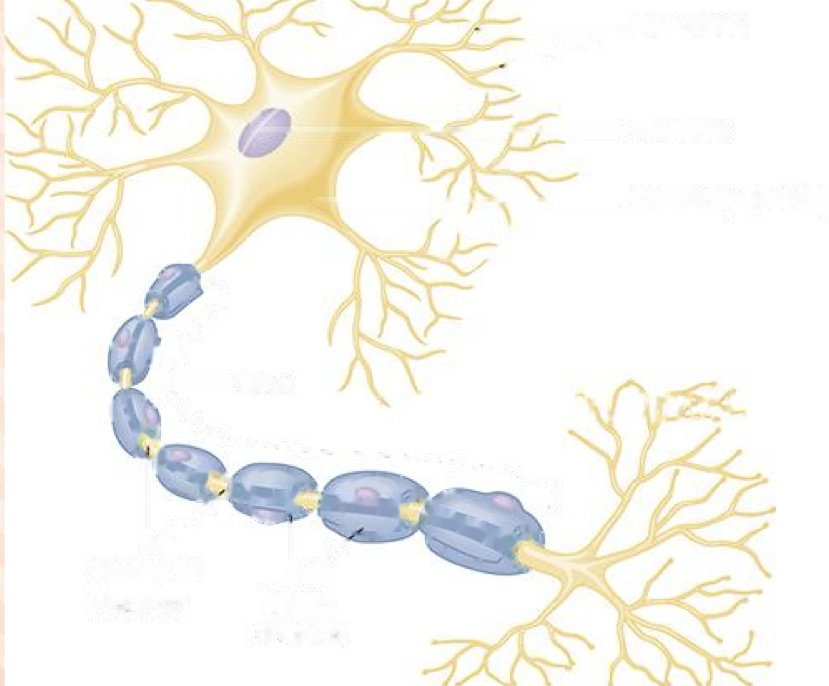
What are the parts of a neuron shown on the labeling diagram?
Cell body/soma, nucleus, dendrites, axon, axon terminal.