Musculoskeletal Assessment & Ambulatory Aid
 Call Kai
 Learn
 Practice Test
 Spaced Repetition
 Match
 Flashcards
 Knowt Play
1/53

Earn XP
Description and Tags
Sports Medicine I
54 Terms
Why is it important to know the mechanism of injury?
Specific information can be gathered concerning the affected area
Initial assessment
Describe how the injury happened & the events leading up to it (e.g. sounds like cracks during injury)
What could sounds tell you during injury?
Snaps, cracks, pops (aka crepitus) = bone, ligament, or tendon injuries
Crepitus
Describes a snapping, crackling, or popping sound that’s produced by friction or a fracture
What visual signs should you look for in the initial assessment?
Inspect both the injured and non-injured areas for gross deformities, swelling, or skin discoloration
Palpation
Examining through tough
How to palpate for assessments
Start away from the site of injury to determine the extent of point tenderness, affected areas, and deformities that may not be visually apparent
SOAP Notes
Subjective, Objective, Assessment, Plan
Subjective
Personal perspective, reported by the patient to describe their current condition
OLD CARTS
Onset
Location
Duration
Character (e.g. sharp, dull)
Alleviating/Aggravating factors
Radiation
Temporal pattern
Severity
What is OLD CARTS for?
To stay consistent in the questions you ask for the Subjective information
Objective
Facts, documents repeatable and traceable facts that can be measured by the clinician
What is included under the Objective?
Vital signs
Findings from physical examination (e.g. posture, bruising, any abnormalities)
Lab results
Measurements
Assessment
Specific medical diagnosis that takes key points and puts them together into a conclusion
What is an example of a conclusion line for Assessment?
“Patient exhibits signs & symptoms consistent with ___. Differential diagnosis may be ___”
Plan
Describes what the health care provider will do to treat the patient
What is included under the Plan?
Lab work orders
Therapeutic treatments
Rehabilitation
Surgery
Medications/prescriptions
Short-term & long-term goals for patient
Why do you need to document?
Provides record of injury & treatment
Provides documentation in legal situations
Allows for inter-provider communication
Billing/insurance/reimbursement
“If you didn’t document it, it didn’t happen”
When was SOAP note developed?
In the 1970s to give health care workers a structured way to document
RICE
Rest, Ice, Compression, Elevation
How to emergency splint a patient?
Split where the patient lies before moving them, splint one joint above and one below the fracture
Vacuum splint
Styrofoam chips sealed in airtight sleeve, the air can be removed to make the splint rigid

Air splint
Clear plastic splint inflated with air, however it applies pressure all around and may move the injury

Structural Aluminum Malleable (SAM) splint
Thin sheet of pliable aluminum covered with padding

Half-ring/Traction splint
Used for femoral fractures

How to splint fractures on the foot and ankle?
Splint the foot and knee
How to splint fractures involving the knee, thigh, or hip?
Splint the whole leg & one side of the trunk/torso
How to splint fractures around the shoulder?
Splinting is difficult but doable with sling & swathe with the upper limb bound to the body
How to splint fractures on the upper arm and elbow?
Splint with the arm straight to lessen bone override
Bone override
A situation where 1 part of a fractured bone slips past another
How to splint fractures on the lower arm & wrist?
Splint with the forearm flexed and supported by a sling
How to splint fractures on the hand and fingers?
Splint with tongue depressors, roller gauze, and/or aluminum splints
Tongue depressors
Wooden sticks that resemble popsicle sticks used for their sturdy & flat design

How to split fractures on the spine & pelvis?
Best to use a spine board w/ the body fully immobilized

Ambulatory Aid
Support/assistance for injured individuals to walk
How to properly provide ambulatory aid?
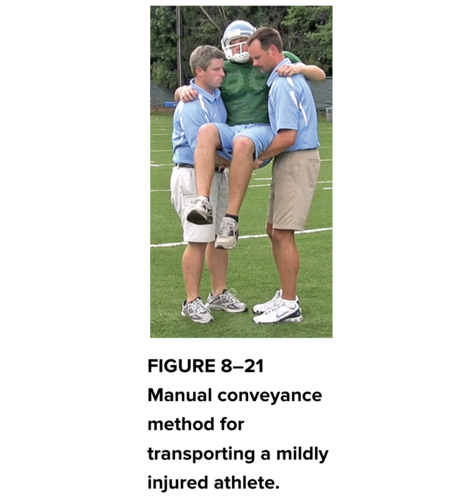
Gradually move the patient from supine → seated → standing with complete and even support on both sides by individuals of equal height

Manual conveyance
Carrying the patient using a device like a wheelchair or stretcher
How to properly fit a crutch?
Crutches should be 6 inches from the outer edge of the shoe & 2 inches in front
Base should fall 1 inch below the anterior fold of axilla
Hand brace should be positioned to place the elbow at 30° flexion
What happens if the crutch is improperly fitted?
It causes decreased stability, increased use of energy, decreased safety for the patient, & may lead to development of bad gait patterns
Types of crutches
Axillary
Forearm/Lofstrand
Platform
Axillary crutches
Used for no weight-bearing on lower extremities but needs good strength in upper extremities & trunk

Forearm/Lofstrand crutches
Used when more stability is needed than a cane but requires superior standing balance & upper body strength

Platform crutches
Used when patients have poor arm strength

What are the 4 progressions that crutch walking follows?
Non-weight bearing (NWB)
Touch down weight bearing (TDWB)
Partial weight bearing (PWB)
Full weight bearing (FWB)
What are the 4 types of gait patterns with crutches?
Four-point
Two-point
Three-point
Swing-through
Four-point gait pattern
Move right crutch → move left foot → move left crutch → move right foot → repeat
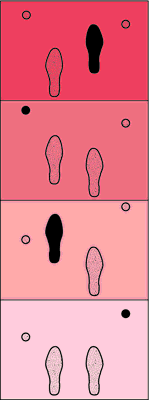
Who is recommended for the four-point gait?
Partial-weight bearing patients
Three-point gait pattern
Move non-injured foot → move both crutches → move non-injured foot

What is the goal of the three-point gait pattern?
To keep the injured leg off of the ground
Two-point gait
Move left foot & right crutch → move right foot & left crutch → repeat

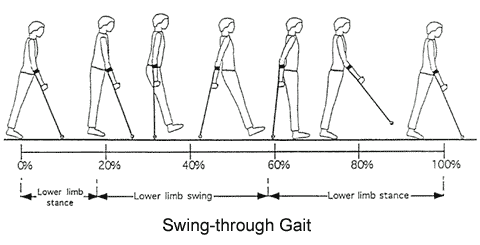
Swing-through gait
Both crutches are placed forward → patient swings both legs forward
Phrase to remember how to walk on stairs with crutches
“Good foot to heaven. Bad foot to hell”
How to go up stairs with crutches?
Unaffected leg moves on step while body weight is supported on crutch → transfer weight to unaffected leg & move affected leg up
How to go down stairs with crutches?
Crutches move on the step below & transfer weight onto them → bring your affected leg down → bring unaffected leg down