Chapter 15 - DNA and the Gene: Syntehsis and Repair
 Call Kai
 Learn
 Practice Test
 Spaced Repetition
 Match
 Flashcards
 Knowt Play
1/29

There's no tags or description
Looks like no tags are added yet.
30 Terms
How do deoxyribonucleotides link together into a polymer?
They do this when a hydroxyl group on the 3’ carbon of one deoxyribose and the phosphate group attached to the 5’ carbon of another deoxyribose are joined by a covalent bond called a phosphodiester bond.
Look at image

Watson and Crick realized that A-T and G-C pairing rules suggested a way for DNA to be copied when chromosomes are replicated. What did they realize/propose?
They realized tha the existing strands of DNA served as a template for the creation of new strands and that deoxyribonucleotides were added to the new strands according to complementary base pairing rules.
EX: If the template strand contained a T, then an A would be added to the new strand to pair with that T. Similarly, a G on the template strnad would dictate the addition of a C on the new strand.
What were the three proposed models of DNA replication (and what did they each entail)?
Semiconservative replication
Stated that if the parental strands of DNA separated, each one could then be used as a template strand for a new daughter strand. Then, each new daughter DNA molecule would have one old and one new strand.
Conservative Replication
Stated that if the bases of both strands were unwound, they could serve as a template for the creation of an entirely new double helix all at once.
Dispersve replication
Stated that the parental double helix was fragmented into small pieces before replication and then each piece was replicated by either a conservative or semiconservative mechanism. Then, these fragments would be joined containing parental and daughter DNA strands.
What is the function of DNA Polymerase? What are the important ones you need to know for eukaryotes and prokaryotes?
The function of DNA polymerase is to polyermize (build up) monomers of DNA by adding deoxyribonucleotides to a growing DNA strand. Most of these DNA polymerases are NOT processive, meaning they don’t funciton for longevity purposes but only help with small portions of DNA polymerization.
Eukaryote includes DNA Pol α, δ, and ε.
Prokaryotes include DNA Pol III and DNA Pol I which removes RNA primers and replaces them with DNA. DNA Pol 1 is only in prokaryotes.
What is the direction of DNA polymerase?
It can only add deoxyribonucleotides to the 3’ end of a growing DNA chain. As a result, DNA synthesis always proceeds from the 5’ to 3’ direction (if we’re looking strictly at the movement of DNA polymerase).
Polymerization reactions are generally endergonic. How does this work with DNA synthesis?
DNA synthesis DOES require energy. It gets this from the hydrolysis of reactions that add TWO phosphate groups to form deoxyribonucleoside triphosphates (dNTPs).
What is the structure of dNTPs? Why is that important?
The structure includes three closely spaced phosphate groups. This is important because it makes the potential energy SUPER HIGH in dNTPs; high enough to make the formation of phosphodiester bonds in a growing DNA strand exergonic as the two phosphate groups are cleaved off.
Where does DNA replication start and what does it look like?
DNA replication starts at specific locations on the DNA called origin of replication. As the DNA replications, it forms a replication bubble with two replication forks on each side.
NOTE: bacterial cells only have one replication bubble! Eukaryotes have many
Look at screenshot

Where does active DNA synthesis take place?
It actively takes place at the replication forks of each replication bubble.
Remember, a replication fork is the Y-shaped region where the parental DNA double helix is separated into single strands and then copied.
How is the double helix structure opened in bacteria?
In bacteria, a specific set of proteins recognizes the origin on a chromosome, which then causes the binding of an enzyme called DNA Helicase onto one of the single strands of DNA near each of the forming replication forks.
How is the doubule helix structure opened in eukaryotes?
In eukaryotes, tons of proteins are regulated by cell-cycle regulatory proteins (checkpoints). After the G1 checkpoint is cleared, DNA helicase is loaded onto a double stranded DNA at the origin. It will then use the energy of ATP hydrolysis (breakdown) to separate the two strands of DNA at the replication forks.
What type of protein attaches to the two strands of DNA at the replication forks? Why?
It is single-strand DNA-binding proteins (SSBPs)m which attach to the strands to prevent them from snapping back into a double helix—the energetically FAVORABLE molecule.
What is the function of topoisomerase?
This is an enzyme that cuts DNA, allows it to unwind, then rejoins it. It does this to prevent the tension from building up as DNA helicase unwins it.
There are two major consequences of the antiparallel nature of DNA in DNA synthesis. What are they?
The first limitation includes DNA polymerases synthesizing DNA only from the 5’ to 3’ direction, and that DNA polymerases cannot start synthesis from scratch on a template strand (they need a hydroxyl group first!)
How does DNA synthesis even happen if we’re missing a starting point?
DNA polymerase is able to bind to an RNA primer, which is laid out by RNA Polymerase on both the leading and lagging strand.
How is the RNA primer added?
It is added by an enzyme called primase, which is a type of RNA polymerase. RNA Polymerase is able to add a primer here beacuse it requires no sort of primer or hydroxyl group to start branching out of (like DNA polymerase).
How does DNA polymerase actually attach to the leading strand?
It does this by binding to that RNA primer that was set by RNA Polymerase. After binding, a sliding clamp will surround the polymerase and bind to it, keeping it from falling off (this is where it gets its processive nature).
The process of DNA synthesis involves tons of enzymes and proteins that are surrounding both the leading and lagging strand. They work together in a large macrmolecular machine called _____
the replisome.
Look at image

What are okazaki fragments?
These are short segments of DNA that are found on the lagging strand. As they form from RNA primers being placed, it’s DNA Polymerase that will then extend these fragments.
Look at image

How are okazaki fragements connected? Talk about bacteria here to explain this!
In bacteria, DNA polymerase III will dissociate from the 3’ end of an okazaki fragment when the polymerase encounters a previous RNA primer. Then, a different polymerase called DNA polymerase I will attach to the 3’ end of the okazaki fragment, moving in the 5’ to 3’ direction to remove the RNA primer ahead of it and replacing the ribonucleotides with deoxyribonucleotides.
What happens after the RNA primers on the lagging strands are removed and then replaced with deoxyribnucleotides thanks to DNA Polymerase I (at least in bacteria)?
An enzyme called DNA ligase will catalyze (break down) the formation of a phosphodiester bond between the 3’ and 5’ ends of two touching okazaki fragments, closing up the backbone.
It simply removes the gaps! Look at image

What is the region at the end of a eukaryotic chromosome called? And, why is replicating at the ends of a linear chromosome such a problem?
It is called a telomere.
There is such a problem at the ends because without a prier, DNA polymerase is unable to add new DNA at the very end of the lagging-strand template. As a result, the single-stranded DNA that is left stays single stranded.
The lagging strand is shorter than the leading!
Look at image (bottom is lagging)
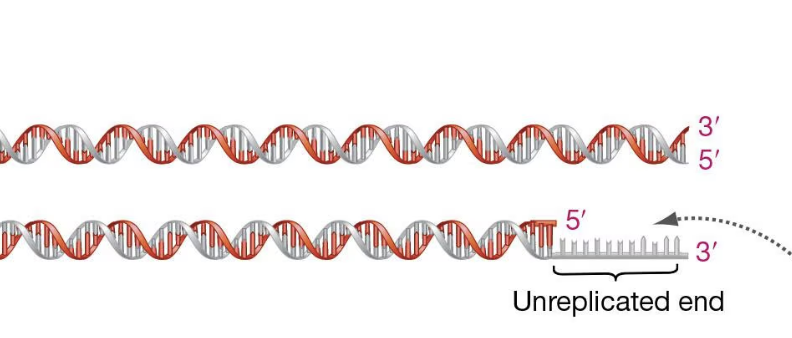
What happens to the end portion of the lagging strand after replication? What is the potential consequence?
The end portion of the lagging strand (unreplicated portion) is eventuall degraded, which shortened the replicated chromosome.
The potential consequence of this means that over time, the linear chromosome could vanish or lose critical genes.
What prevents degration of the lagging strand’s unreplicated portion from causing an issue for the cell? Why?
It’s telomerase that prevents the end-replication error.
Telomeres have short stretches of bases that are repeated over and over: TTAGGG (in humans). These telomeres are added by temomerase to the ends of the unreplicated lagging-strand DNA.
Describe the process of telomerase activity onto a lagging-strand…
A strand of parental DNA remains unreplicated after the RNA primer is removed from the end of the lagging strand.
Telomerase extends the unreplicated end by binding to the 3’ end of the overhand DNA, and using its OWN RNA TEMPLATE, extends the strand.
Telomerase will extend the DNA strand by shifting down the newly synthesized DNA (constantly repeatng that TTAGGG in humans)
The newly extended DNA will act as a template for DNA Polymerase to swoop in with its sliding clamp.
Look at image

How does proofreading work during DNA replication?
Proofreading works after DNA polymerase adds an incorreec nucleotide, causing the mismatched base pair on the 3’ OH group to misalign, pausing DNA synthesis.
The incorrect nucleotide will then moe to the exonuclease active site, where it is removed using 3’ to 5’ exonuclease activity. DNA polymerase then adds the correct nucleotide and resumes the synthesis in 5’ to 3’.
Look at image

What is mismatch repair, and how does it differ from proofreading?
Mismatch repairs works by correcting mismatched base pairs that DNA polymerase failed to catch during proofreading. Unlike proofeading which occurs during DNA synthesis, mismatch repair fixes errors left behind AFTER DNA Polymerase has moved past them.
How does mismatch repair work?
These protines first scan DNA and detect incorrectly paired bases from their abnormal shape.
Then, repair proteins will remove a section that contains the incorrect nucleotide.
DNA Polymerase will go back and fill the gap using the original parental strand as a template
DNA ligase will seal the remaining nick (gap) in the sugar-phosphate backbone and the section of bad DNA is recycled.
How do mismatch repair proteins distinguish the original DNA strand from the newly synthesized strand? Use e.coli here
In E. coli, chemical marks on the parental DNA allow mismatch repair proteins to distinguish the original strand from the newly synthesized daughter strand.
This makes sure that the incorrect nucleotide is removed from the DAUGHTER strand instead of the original.
What is nucleotide excision repair? What is the process of it?
This is the last-ditch effort to correct any abnormalities in the DNA that proofreading and mismatch repair proteins missed. Look at the screenshot to understand its process.
