SL Biology: A1.2.2-A1.2.8 Nucleic Acids
 Call Kai
 Learn
Learn Practice Test
 Spaced Repetition
 Match
Match Flashcards
 Knowt Play
1/37

There's no tags or description
Looks like no tags are added yet.
Name | Mastery | Learn | Test | Matching | Spaced | Call with Kai | Chat |
|---|
No analytics yet
Send a link to your students to track their progress
38 Terms
DNA
Deoxyribonucleic acid, a nucleic acid that stores hereditary information

RNA
Ribonucleic acid, a nucleic acid involved in gene expression and protein synthesis

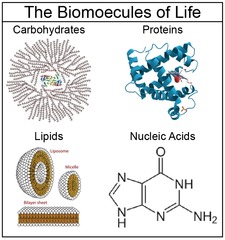
Four Major Biological Molecules
Carbohydrates, lipids, proteins, and nucleic acids
Nucleic Acids
Biological molecules made of nucleotide polymers

Nucleotide
The monomer of nucleic acids, made of a pentose sugar, phosphate group, and nitrogenous base

Deoxyribose
The five-carbon sugar found in DNA

Ribose
The five-carbon sugar found in RNA

Nitrogenous Base
A nitrogen-containing molecule that forms part of a nucleotide

DNA Bases
Adenine, cytosine, guanine, and thymine

RNA Bases
Adenine, cytosine, guanine, and uracil

Purines
Nitrogenous bases with two rings; adenine and guanine

Pyrimidines
Nitrogenous bases with one ring; cytosine, thymine, and uracil

DNA Base Pairing
Adenine pairs with thymine, while guanine pairs with cytosine

RNA Base Pairing
Adenine pairs with uracil, while guanine pairs with cytosine

Hydrogen Bonds
Strong bonds that hold complementary bases together between DNA strands

Covalent Bond
A strong bond formed between atoms by sharing electrons

Condensation Reaction
A reaction that forms a covalent bond while releasing water

Antiparallel
Describes DNA strands running in opposite directions

DNA Stability
Pairing purines with pyrimidines helps maintain a consistent DNA width and stable structure

DNA Replication
The process of making a copy of DNA

Semi-Conservative Replication
DNA replication where each new DNA molecule contains one original strand and one new strand

Template
A strand used to determine the sequence of a new complementary strand

Transcription
The process of making RNA using DNA as a template
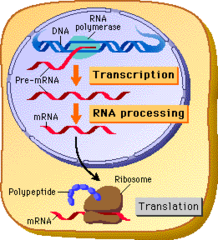
Genetic Information
Information stored in the sequence of bases in DNA
DNA Function
Stores hereditary information
RNA Function
Helps carry and use genetic instructions to make proteins

DNA vs RNA
DNA has deoxyribose, thymine, is usually double-stranded, stores hereditary information, and is more stable; RNA has ribose, uracil, is usually single-stranded, and is involved in gene expression and protein synthesis

mRNA
RNA that carries the genetic code from DNA to the ribosome

tRNA
RNA that carries amino acids to the ribosome

rRNA
RNA that forms part of the structure of ribosomes

Protein Synthesis
The process of using genetic information to make proteins

Codon
A sequence of three RNA bases that codes for an amino acid or stop signal

Genetic Code
The set of rules that determines which amino acid each codon represents

Start Codon
The codon that signals the beginning of protein synthesis, usually AUG

Stop Codons
Three codons that signal the end of protein synthesis: UAA, UAG, and UGA

Universal Genetic Code
The same genetic code is used by almost all living organisms
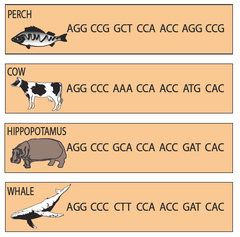
Common Ancestry
The universal genetic code supports the idea that living organisms share evolutionary ancestry

Possible DNA Sequences
For n bases, there are 4ⁿ possible sequences. (e.g 4² = 16 possible sequences)
