Chapter 17 - Gluconeogenisis
 Call Kai
 Learn
 Practice Test
 Spaced Repetition
 Match
 Flashcards
 Knowt Play
1/38

There's no tags or description
Looks like no tags are added yet.
39 Terms
Why is maintaining glucose levels important?
The brain depends on glucose as its primary fuel
RBC’s depend entirely on glucose for fuel
(T/F) — Glycolysis and Gluconeogensis take place at the same time within the cells to great extent
False
Gluconeogensis
The synthesis of glucose from noncarbohydrate precursors
What is the major site of gluconeogensis?
The liver
Smaller amounts take place in the kidney and other tissues
What does gluconeogensis convert?
Pyruvate into glucose-6-phosphate or glucose
What are the major noncarbohydrate precursors of glucose?
Lactate, amino acids, and glycerol
They get converted into pyruvate or later intermediates for glycolysis

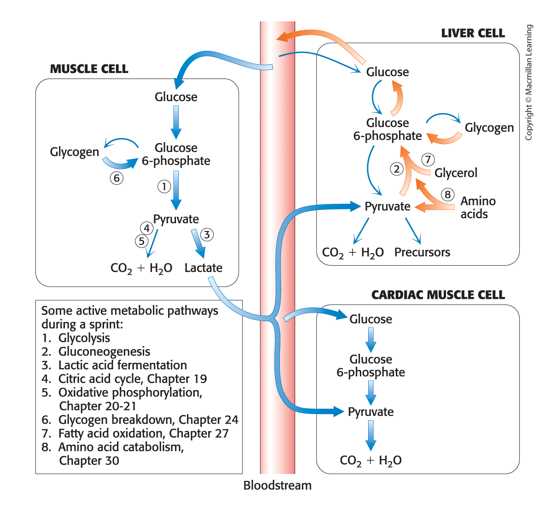
Where does lactate—a precursors of glucose—come from?
Lactic acid fermentation in the muscle

Where do amino acids—precursors of glucose—come from?
Proteins in the diet or, during starvation, breakdown of proteins in skeletal muscle
Where does glycerol—a precursor of glucose—come from?
Hydrolysis of triacylglycerols in fat
Yields fatty acids and glycerol
(T/F) — Gluconeogensis is just reverse glycolysis
False
What must be bypassed in gluconeogensis?
The three irreversible reactions of glycolysis (hexokinase, PFK, pyruvate kinase-catalyzed reactions)
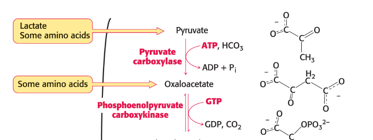
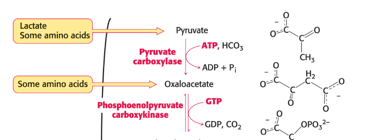
Compared to glycolysis, what steps in gluconeogensis differ (starting from pyruvate)?
Steps 1, 2, 9, 11
First step of Gluconeogensis
What Happens: Pyruvate is converted into oxaloacetate
Enzyme: Pyruvate carboxylase
Reaction: Pyruvate + CO2 + ATP + H2O → Oxaloacetate + ADP + Pi + 2H+
Location: Mitochondria

How many stages does it take to convert pyruvate into PEP?
3
What vitamin does pyruvate carboxylase require?
Biotin (B7)
Used in CO2 transfer and carboxylation reactions
It is a covalently attached prosthetic group
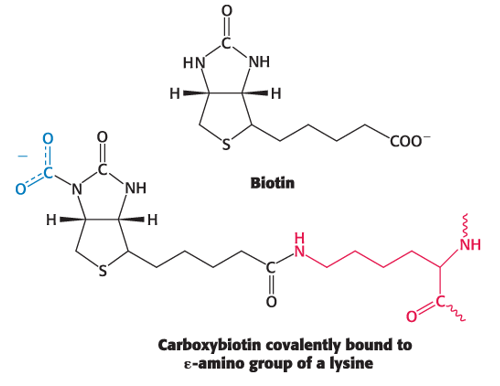
Pyruvate Carboxylase
A tetramer composed of four identical subunits each with four domains
Biotin carboxylase catalyzes the formation of carboxyphosphate and the subsequent attachment of CO2 to biotin carboxyl carrier protein (BCCP)
BCCP leaves biotin carboxylase active site, swings to pyruvate carboxylase domain, and transfers CO2 to pyruvate to form oxaloacetate
Fourth domain facilitates the formation of the tetramer

Where must oxaloacetate go to continue through gluconeogensis?
The cytoplasm (it is originally within the mitochondria)

What is oxaloacetate reduced into (and what reduces it) in order to cross the mitochondrial membrane?
Malate by malate dehydrogenase
Requires NADH + H+ and makes NAD+
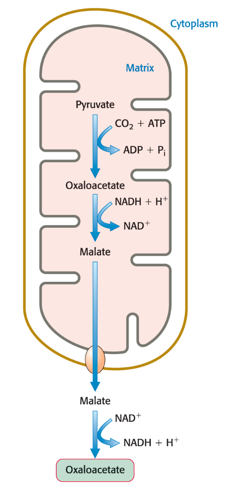
What happens once malate is outside of the mitochondrial membrane and in the cytoplasm?
It is reoxidized into oxaloacetate by a cytoplasmic NAD+-linked malate dehydrogenase

Second step of Gluconeogenisis
What Happens: Oxaloacetate is converted into phosphoenolpyruvate
Enzyme: Phosphoenolpyruvate carboxykinase
Reaction: Oxaloacetate + GTP ←→ PEP + GDP + CO2
Location: Cytoplasm
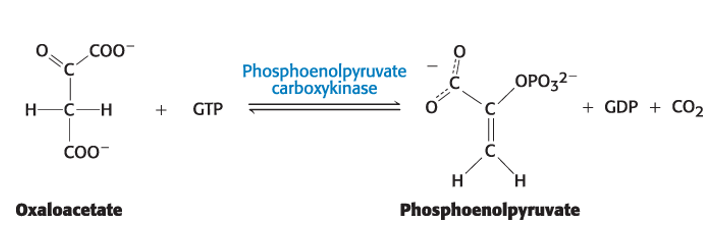
What step of glycolysis do steps 1 and 2 of gluconeogensis bypass?
Step 10; PEP → pyruvate catalyzed by pyruvate kinase
What is the sum of the reactions catalyzed by pyruvate carboxylase and PEP carboxykinase (Steps 1 and 2) of gluconeogenisis?
Pyruvate + ATP + GTP + H2O → PEP + ADP + GDP + Pi + 2 H+
Happens twice

Ninth step of Gluconeogenisis
What Happens: Fructose 1,6-biphopshate is hydrolysized into fructose 6-phosphate and Pi
Enzyme: Fructose 1,6-biphosphatase (FBPase)
Reaction: Fructose 1,6-BP + H2O → F 6-P + Pi
Location: Cytoplasm
What step of glycolysis does step 9 of gluconeogenisis bypass?
Step 3; conversion of Fructose 6-P to F 1,6-BP catalyzed by PFK
Eleventh step of gluconeogenisis
What Happens: Glucose 6-Phosphate is converted into Glucose
Enzyme: Glucose 6-Phosphatase
Reaction: H2O + Glucose 6-Phosphate → Pi + Glucose
Location: ER Lumen

How is free glucose generated in the liver?
F 6-P is readily converted into G 6-P, which is then transported into the ER of liver cells, hydrolyzed into glucose and Pi by G 6 Phosphatase, and shuttled back to the cytoplasm

What does gluconeogensis end with the formation of in most tissues?
Glucose 6-Phosphate
It is commonly converted into glycogen or used in biosynthesis
What is the net reaction of gluconeogenisis?
2 Pyruvate + 4 ATP + 2 GTP + 2 NADH + 2 H+ + 6 H2O → Glucose + 4 ADP + 2 GDP + 6 Pi + 2 NAD+
ΔG°’ = −48 kJ mol−1
How many nucleoside triphosphate molecules are hydrolyzed to synthesize glucose in gluconeogensis?
6, whereas only two molecules of ATP are generated in glycolysis
4 ATP + 2 GTP
(T/F) — Gluconeogenesis and Glycolysis are reciprocally regulated
True—when glucose is high, glycolysis predominates and vice versa
What is gluconeogenisis regulated by?
The concentrations of lactate and other glucose precursors
What is the key regulatory site of gluconeogenesis?
The interconversion of fructose 6-phosphate and fructose 1,6-bisphosphate by FBPase
Glycolysis and gluconeogensis are also reciprocally regulatred at the interconversion of PEP and pyruvate in the liver
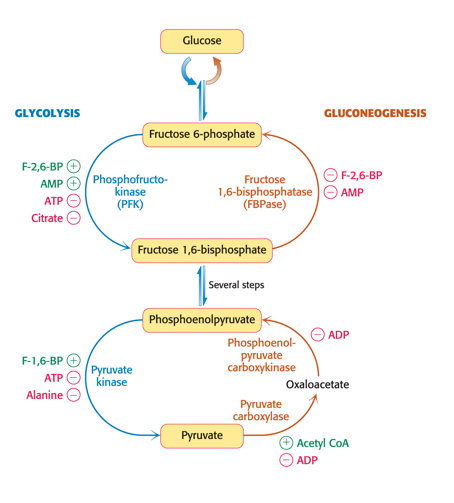
What inhibits gluconeogenesis?
F-2,6-BP
AMP
ADP

What activates gluconeogenesis?
Acetyl CoA
ATP

The concentration of what molecule largely dictates whether glycolysis or gluconeogenesis predominates in the liver?
Fructose 2,6-bisphosphate (F-2,6-BP)
It is an activator of PFK
It is a competitive inhibitor of FBPase
Allosterically increases FBPase’s affinity for AMP, further enhancing its inhibitory affect
When blood-glucose is low, F-2,6-BP becomes F-6P, no longer doing either

What bifunctional enzyme determines F-2,6-BP levels?
PFK2 and FBPase2
Reciprocally controlled by the phosphorylation of a single serine residue

What two fates await lactate in the bloodstream?
It is utilized by some cells to create pyruvate to then be metabolized through CAC and ETC to generate ATP—makes glucose more available to active muscle cells
In excess, it enters the liver to first be converted into pyruvate then into glucose by the gluconeogenic patheay
Cori Cycle
The liver restores the level of glucose necessary for active muscle cells, which dervice ATP from the glycolytic conversion of glucose into lactate
Liver takes pyruvate through gluconeogenesis to make glucose, muscles take glucose through glycolysis to make pyruvate

Interplay between glycolysis and gluconeogenesis