Chapter 5: How The Skeleton is Joined Together
 Call Kai
 Learn
Learn Practice Test
 Spaced Repetition
 Match
Match Flashcards
 Knowt Play
1/49

There's no tags or description
Looks like no tags are added yet.
Name | Mastery | Learn | Test | Matching | Spaced | Call with Kai | Chat |
|---|
No analytics yet
Send a link to your students to track their progress
50 Terms
joints/articulations
Where 2 bones meet
-they hold the skeleton together & allow for body mobility
How are bones classified by function?
The movement of the joint
How are bones classified by structure?
The tissue that joints bones together
What are the functional classification of joints?
synarthroses, amphiarthroses, diarthroses
Synarthroses
Immovable joints
Prefix: Syn-
Together
Prefix: Arthro-
Of a joint, relating to a joint
Amphiarthroses
Slightly movable joints
Prefix: Amphi-
Both, two; on both sides
Diathroses
Freely movable joints
Prefix: Dia-
Passing through
Prefix: Di-
Two, double
What are fibrous joints?
Bones are joined by dense connective tissue.
Most are immovable or slightly movable, depending onfiber length
What are the 3 types of fibrous joints?
sutures, syndesmoses, gomphoses
Fibrous Joint: Sutures
Rigid, interlocking joints of skull
Short connective tissue fibers that do not move
Ex: between skull bones
"short stitch by doctors"
Fibrous Joint: Gomphoses
Peg-in-socket joints
Fibrous connection is the periodontal ligament
Ex: teeth in alveolar sockets
"gom sounds like gum; chew gum in mouth"
syndesmosis
Bones connected by ligaments, bands of fibrous tissue
Fiber length varies, so movement varies
Ex: holds the tibia and fibula + radius and ulna together
"Together; Dense connective tissue"
What are cartilaginous joints?
Bones united by cartilage.
Movement is variable
cartilaginous joints
synchondroses and symphyses
Synchondroses
Hyaline Cartilage that unites bones
Can be immovable or slightly moveable
Ex: epiphyseal plate joints + cartilage of 1st rib with manubrium of sternum
"think of this when you see 'chon' (cartilage) in the word"
Symphyses
Fibrocartilage unites bones in symphysis joint
Strong, slightly moveable joint
Ex: pubic symphysis & intervertebral discs
"think of 'physis' - to grow - just like how bones grow at the diaphysis"
What are synovial joints?
Bones separated by a synovial or fluid-filled cavity
Are diarthroses
Ex: shoulder, elbow, wrist, hip, knee, ankle

distinct features of all synovial joints
1. synovial cavity
2. articular cartilage
3. articular capsule
4. reinforcing ligaments
synovial cavity
Fluid-filled cavity between two bones
Filled with viscous, slippery fluid, synovial fluid that lubricates the joint

What is articular cartilage?
Hyaline cartilage covering the ends of the bones
Helps increase the fitbetween the articulating bones

What is the articular capsule?
Encloses both bones' ends on all sides creates the synovial cavity
-external fibrous layer made of dense CT
-inner synovial membrane that makes the synovial fluid
-capsule is continuous with periosteum

What are reinforcing ligaments?
Helps stabilize joints

What may synovial joints also have?
1. menisci
2. bursae
3. tendon sheath
Menisci
Fibrocartilage discs that improve the fit between bones
Minimize wear and tear on joint surfaces
Bursae
Sacs of synovial fluid located between ligaments, muscles, bones, or tendons to reduce friction.
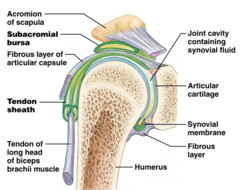
Tendon sheath
Bursa that wraps around a tendon to reduce friction.
-dense CT that goes from a muscle to a bone

What plays a role in the stability and mobility of a joint?
1. muscle tone keeps tendon tight as they cross joints - this is most important feature for strengthening a joint
2. ligament number and location have a limited role
3. the shape of the articular (joint) surface has a minor role
-more mobile something is the less stable and vice versa
Uniaxial Synovial Joints: Pivot Joint
Movements in one plane or a single direction
ex: joints between atlas (C1) and axis (C2) + humerus and radius
Performs rotation: bone turning around its long axis, toward the midline, or away from it

Supination
Turning the palms anterior or ventral
"Holding soup"

Pronation
Turning the palms posterior or dorsal
"Proposal"

Uniaxial Synovial Joints: Hinge Joint
Movements in one planeor a single direction
ex: joint between the humerus and ulna
Performs flexion & extension
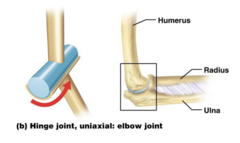
Flexion
Decreases the angle between bones

Extension
Increasing the angle between bones

Biaxial Synovial Joints: Condylar & Saddle Joints
Movements in two planes or directions
ex: wrist joint or between palm and fingers
Performs flexion/extension + abduction/adduction

Abduction
Movement away from the midline of the body

Adduction
Movement toward the midline of the body

Multiaxial Synovial Joints: Ball-&-Socket Joints
Movements in many planes or directions.
ex: hip joint & shoulder joint
Performs many actions (flexion/extension, abduction/adduction, protraction/retraction, elevation/depression, etc.)

Protraction
Moving a part forward laterally

Retraction
Moving a part backward laterally

Elevation
Moving a body part superiorly

Depression
Moving a body part inferiorly

Dorsiflexion
Bending of the foot or the toes upward

Plantar Flexion
Bends the foot downward at the ankle or toes down

Inversion
Turning the sole of the foot inward

Eversion
Turning the sole of the foot outward
