ATI OB practice questions (Part of Exam 2)
 Call Kai
 Learn
 Practice Test
 Spaced Repetition
 Match
 Flashcards
 Knowt Play
1/134

Earn XP
Description and Tags
YyCrownYy on quizlet
135 Terms
Nagaele's rule

The nurse is about to calculate a woman's expected due date and states that her last menstrual period was April 1st. Which of the following is the client's correct EDD?
a. January 8
b. January 15
c. February 8
d. February 15
A. April 1 minus 3 months plus 7 days and 1 year equals an estimated due date of January 8
A nurse in a prenatal care clinic is helping a client who is in the first trimester of pregnancy. The client's health records states: G3 T1 P0 A1 L1. How would the nurse interpret this information (SELECT ALL THAT APPLY).
a. client had delivered one newborn at term
b. client has experienced preterm labor
c. client has been through active labor
d. client has had two prior pregnancies
e. client has one living child
a. client had delivered one newborn at term
d. client has had two prior pregnancies
e. client has one living child
b. She has never been in preterm labor
c. A1 indicates that she has had 1 miscarriage
Signs of Pregnancy
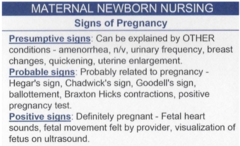
A nurse is caring for a client who states, "I think I'm pregnant." Which of the following findings should the nurse identify as a positive sign of pregnancy?
A. Positive serum pregnancy test
B. Amenorrhea
C. Fetal heart tones auscultated by Doppler
D. Chadwick sign
C. Fetal heart tones auscultated by Doppler
Fetal heart tones heard by Doppler are a positive sign of pregnancy. The only possible explanation for hearing fetal heart tones is the presence of a fetus.
- A: A positive pregnancy test is a probable sign of pregnancy. A hydatidiform mole could also produce a positive serum pregnancy test, and a pelvic infection or tumor could cause a positive urine pregnancy test.
- B: Amenorrhea is a presumptive sign of pregnancy. Amenorrhea may have several other causes besides pregnancy, including early menopause and hormonal abnormalities.
- D: Chadwick sign is a probable indication of pregnancy but can be caused by pelvic congestion due to non-pregnancy circumstances as well.
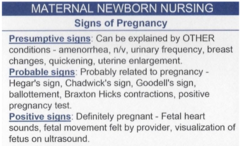
A nurse in the hospital is caring for a patient who suspects she is pregnant. Which of the following signs of pregnancy would be considered presumptive?
a. abdominal enlargement
b. fetal heart sounds
c. positive pregnancy test
d. Amenorrhea
d. Amenorrhea
This is an objective sign that the women is able to observe.

A nurse is looking over the health history of a client who is currently pregnant. The provider indicated that the client showed probable signs of pregnancy. Which of the following findings should the nurse expect? (SELECT ALL THAT APPLY)
a. Montgomery's Glands
b. Goodell's Sign
c. Ballottement
d. Chadwick's sign
e. Quickening
b. Goodell's Sign
c. Ballottement
d. Chadwick's sign
A and E are both presumptive signs of pregnancy

A nurse is caring for a patient who wants to know when the best time to take an accurate home pregnancy test is. The nurse correctly replies by saying:
a. right away when you wake up in the morning
b. drink lots of water and then a hour later take the test
c. right before going to bed
d. it does not matter when you take it, it is always accurate
a. right aways when you wake up in the morning
Home pregnancy test: Urine samples should be first-voided morning specimens and follow the directions for accuracy
A nurse is caring for patient in her third trimester. She comes into the clinic complaining of shortness of breath. The nurse knows that this is not unusual due to.
a. increased blood volume due to pregnancy demand
b. increased cardiac output due to increased blood volume
c. increased body weight due to the enlarged uterus
d. increased pressure on the diaphragm due to enlarged uterus
d. increased pressure on the diaphragm due to enlarged uterus.
A client comes into the clinic with a dark pigmented line extending from the pubic area to the umbilicus. The nurse knows that this is a normal skin change in a pregnant women called:
a. cholasma
b. striae gravidarum
c. linea nigra
d. ballottement
c. linea nigra

A nurse is taking care of a client who comes into the clinic for an ultrasound. The client asks the nurse when the baby will be old enough to survive outside the uterus. The nurse knows that there is not a specific week of gestation, but infants born between ___ to __ weeks are considered viable.
a. 16 to 22
b 22 to 25
c. 15 to 20
d. 16 to 25
c. 22 to 25 weeks, this is considered the threshold of viability.
Weight gain in pregnancy

A nurse is assessing a client who is at 38 weeks of gestation during a weekly prenatal visit. Which of the following findings should the nurse report to the provider?
a. Blood pressure 136/88 mm Hg
b. Report of insomnia
c. Weight gain of 2.2 kg (4.8 lb)
d. Report of Braxton Hicks contractions
c. Weight gain of 2.2 kg (4.8 lb)
A weight gain of 2.2 kg (4.8 lb) in a week is above the expected reference range and could indicate complications. Therefore, this finding should be reported to the provider.
A nurse in a prenatal clinic is caring for a group of clients. Which of the following clients should the nurse be concerned about regarding weight gain?
A. 1.8 kg (4 lb) weight gain and is in her first trimester
B. 3.6 kg (8 lb) weight gain and is in her first trimester
C. 6.8 kg (15 lb) weight gain and is in her second trimester
D. 11.3 kg (25 lb) weight gain and is in her third trimester
B. 3.6 kg (8 lb) weight gain and is in her first trimester
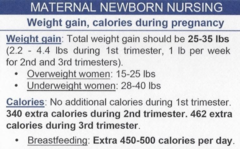
A nurse is working with a pregnant client and providing information about weight gain. Which suggestion should the nurse identify as not being appropriate?
a. Obese women should gain at least 7 kg.
b. Adolescents are encouraged to strive for weight gains at the upper end of the recommended scale.
c. Underweight women should gain 12.5 to 18 kg.
d. In twin gestations, the weight gain recommended for a single fetus pregnancy should simply be doubled.
d. In twin gestations, the weight gain recommended for a single fetus pregnancy should simply be doubled.

A nurse is providing teaching to a client about the physiological changes that occur during pregnancy. The client is at 10 weeks of gestation and has a BMI within the expected reference range. Which of the following client statements indicates an understanding of the teaching?
a. "I will not gain more than 15 to 20 pounds during my pregnancy."
b. "I will likely need to use alternative positions for sexual intercourse."
c. "I'm glad I had a breast reduction years ago, so they will not enlarge with my pregnancy."
d. "I'm glad I have a light complexion and will not get any stretch marks."
b. "I will likely need to use alternative positions for sexual intercourse."
The weight gain of pregnancy will likely require alternative positions for sexual intercourse. This client statement indicates that they understand the nurse's teaching about the physiological changes that occur during pregnancy.
A 22-year-old woman pregnant with a single fetus had a preconception body mass index (BMI) of 24. When she was seen in the clinic at 14 weeks of gestation, she had gained 1.8 kg (4 lbs) since conception. How would the nurse interpret this finding?
a. The woman's weight gain is appropriate for this stage of pregnancy.
b. This weight gain indicates possible gestational hypertension.
c. This weight gain indicates that the woman's infant is at risk for intrauterine growth restriction (IUGR).
d. This weight gain cannot be evaluated until the woman has been observed for several more weeks.
a. The woman's weight gain is appropriate for this stage of pregnancy.
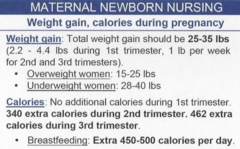
A nurse is reviewing the impact of inadequate weight gain during pregnancy. Which finding should the nurse anticipate as being at highest risk based on inadequate weight gain?
a. Intrauterine growth restriction.
b. Down syndrome.
c. Diabetes mellitus.
d. Spina bifida.
a. Intrauterine growth restriction.
Suspine vena cava syndrome

A nurse is caring for a client at a prenatal clinic. She is experiencing episode of hypotension. The client asks the nurse what could be causing these episodes. which of the following responses by the nurse is MOST correct?
a. this is due to an increase in blood volume
b. this is due to pressure from the uterus on the diaphragm
c. this is due to the weight of the uterus on the vena cava
d. this is due to the increased cardiac output
c. this is due to the weight of the uterus on the vena cava
Maternal hypotension occurs when the client is lying in the supine position and the weight of the uterus places pressure on the vena cava, decreasing blood flow to the heart.
A nurse is taking care of a client who is lightheaded, pale, and clammy. The nurse knows that the patient is likely hypotensive. What should the nurse do first?
a. ask the patient to roll to her left side
b. monitor the fetal heart rate
c. notify the provider
d. place the patient in the supine position
a. Ask the patient to roll to her left side to alleviate pressure on the vena cava.
d. if you are going to place them in the supine position there must be a wedge placed under one hip to alleviate pressure on the vena cava.
Bleeding during pregnancy

A nurse is caring for a client who is pregnant and reviewing signs of complications that should be promptly reported to the provider. Which of the following should be included?
A. Vaginal bleeding
B. Swelling of the ankles
C. Heartburn after eating
D. Lightheadedness when lying on back
A. Vaginal bleeding
*No vaginal bleeding is normal*

A nurse in labor and delivery is planning care for a newly admitted client who reports she is in labor and has been having vaginal bleeding for 2 weeks. Which of the following should the nurse include in the plan of care?
A. Inspect the introitus for a prolapsed cord.
B. Perform a test to identify the ferning pattern.
C. Monitor station of the presenting part.
D. Defer vaginal examinations
D
D. CORRECT: Vaginal examinations should not be performed until placenta previa or placenta abruptio has been ruled out as the cause of vaginal bleeding.
Placenta Previa
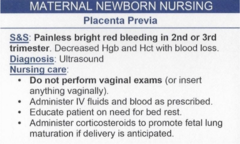
A nurse is caring for a client who is at 35 weeks of gestation and has placenta previa. Which of the following actions should the nurse take?
a. Perform a vaginal exam to determine cervical dilation every 2 hr
b. Instruct the client to ambulate in the hallway once every 4 hr
c. Administer betamethasone to the client via IM injection
d. Initiate continuous external fetal monitoring
d. Initiate continuous external fetal monitoring
the nurse should identify that a client who has a placenta previa and is actively bleeding is at an increased risk for preterm labor and hemorrhage.
The nurse should initiate interventions such as bed rest, pelvic rest, and continuous fetal heart monitoring, which assesses fetal well-being and the presence of contractions. The nurse should obtain IV access and monitor laboratory values. Also, the nurse should implement interventions to prepare for an emergency birth

A nurse is providing care for a client who is at 32 weeks of gestation and who has a placenta previa. The nurse notes that the client is actively bleeding. Which of the following types of medications should the nurse anticipate the provider will prescribe?
A: Betamethasone
B: Indomethacin
C: Nifedipine
D: Methylergonovine
A: Betamethasone
*Methylergonovine* for stoping postpartum bleeding

A nurse is assessing a client who has placenta previa. Which of the following findings should the nurse expect?
A. Painless, bright red bleeding
B. Uterine hypertonicity
C. Uterine tonicity
D. Abdominal tenderness or pain
Correct Answer:
A.
Painless, bright red bleeding
Placenta previa is the placement of the placenta low in the uterus. Depending on the severity, manifestations include bright red vaginal bleeding and a fundal height higher than expected for the gestational age. The presenting part is higher due to the placenta taking up space inside the lower part of the uterus.
Incorrect Answers:
B. Uterine hypertonicity is a manifestation of placental abruption, not placenta previa.
C. Uterine tonicity is normal with placenta previa; it does not cause contractions.
D. Abdominal tenderness or pain is a manifestation of placental abruption, not placenta previa.

Placenta Abruption

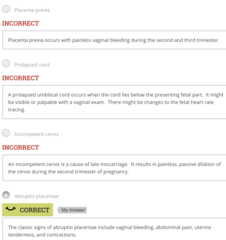
A nurse in the antepartum unit is caring for a client who is at 36 weeks of gestation and has pregnancy-induced hypertension. Suddenly, the client reports continuous abdominal pain and vaginal bleeding. The nurse should suspect which of the following complications?
a. Placenta previa
b. Prolapsed cord
c. Incompetent cervix
d. Abruptio placentae
d. Abruptio placentae
A nurse is assessing a client at 34 weeks gestation who has a mild placental abruption. Which of the following findings should the nurse expect?
A) increased platelet count
B) fetal distress
C) decreased Urinary output
D) dark red vaginal bleeding
D) dark red vaginal bleeding
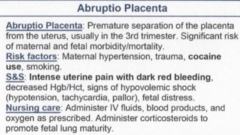
A nurse is providing care for a client who is diagnosed with a marginal abruptio placentae. The nurse is aware that which of the following findings are risk factors for developing the condition?
(Select all that apply)
A: Fetal position
B: Blunt abdominal trauma
C: Cocaine use
D: Maternal age
E: Cigarette smoking
B: Blunt abdominal trauma
C: Cocaine use
E: Cigarette smoking
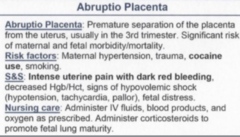
A nurse is caring for a client who is at 24 weeks of gestation and has a suspected placental abruption. Which of the following laboratory tests should the nurse expect the provider to prescribe?
A. Kleihauer-Betke test
B. Progesterone serum level
C. Lecithin/sphingomyelin (L/S) ratio
D. Maternal Alpha-fetoprotein (AFP)
A. Kleihauer-Betke test
The nurse should expect the provider to prescribe a Kleihauer-Betke test for a client who has suspected placental abruption to determine if fetal blood is in maternal circulation. This test is useful to determine if Rho-(D) immune globulin therapy should be administered to a client who is Rh-negative.

A nurse is admitting a client who is in labor. The client admits to recent cocaine use. For which of the following complications should the nurse assess?
A. Abruptio placenta
B. Placenta previa
C. Preeclampsia
D. Maternal bradycardia
A. Abruptio placenta
Cocaine use increases the risk for vasoconstriction and possible abruptio placenta.
Ectopic pregnancy
A nurse in a clinic is caring for a client who is postoperative following a salpingectomy due to an ectopic pregnancy. Which of the following statements by the client requires clarification?
A. "It is good to know that I won't have a tubal pregnancy in the future."
B. "The doctor said that this surgery can affect my ability to get pregnant again."
C. "I understand that one of my fallopian tubes had to be removed."
D. "Ovulation can still occur because my ovaries were not affected."
A. "It is good to know that I won't have a tubal pregnancy in the future."
Rationale:
A. The risk of recurrence of an ectopic pregnancy is increased following an ectopic pregnancy.

A nurse is caring for a client who has a suspected ectopic pregnancy at 8 weeks of gestation. Which of the following manifestations should the nurse expect to identify as consistent with the diagnosis?
A.
Uterine enlargement greater than expected for gestational age
B.
Unilateral, cramp-like abdominal pain
C.
Severe nausea and vomiting
D.
Large amount of vaginal bleeding
B.
Unilateral, cramp-like abdominal pain
A nurse is caring for a client who has a diagnosis of ruptured ectopic pregnancy. Which of the following findings is seen with this condition?
A: No alteration in menses
B: Transvaginal ultrasound indicating a fetus in the uterus
C: Serum progesterone greater than expected reference range
D: Report of severe shoulder pain
D: Report of severe shoulder pain
A nurse in the emergency department is caring for a client who reports abrupt, sharp, right-sided lower quadrant abdominal pain and bright red vaginal bleeding. The client states that she missed one menstrual cycle and cannot be pregnant because she has an intrauterine device. The nurse should suspect which of the following?
A: Missed abortion
B: Ectopic pregnancy
C: Severe preclampsia
D: Hydatidiform mole
B: Ectopic pregnancy
A nurse in a prenatal clinic is assessing a group of clients. Which of the following clients should the nurse see first?
A. A client who is at 11 weeks of gestation and reports abdominal cramping
B. A client who is at 15 weeks of gestation and reports tingling and numbness in right hand
C. A client who is at 20 weeks of gestation and reports constipation for the past 4 days
D. A client who is at 8 weeks of gestation and reports having three bloody noses in the past week
A. A client who is at 11 weeks of gestation and reports abdominal cramping
When using the urgent vs non-urgent approach to client care, the nurse should determine that the priority finding is a client who is at 11 weeks of gestation and reports abdominal cramping. Abdominal cramping can indicate an ectopic pregnancy or manifestations of spontaneous abortion. The nurse should request that the provider see this client first.
NGN question (1)
NGN question (2)

NGN question (3)
NGN question (4)

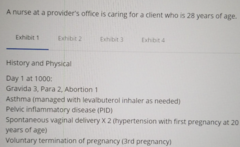
A nurse at a provider's office is caring for a client who is 28 years of age.
Drag 1 condition and 1 client finding to fill in each blank in the following sentence.
After reviewing the client's current assessment findings, the nurse should identify that the client is experiencing
______ as evidenced by ______.
After reviewing the client's current assessment findings, the nurse should identify that the client is experiencing
ectopic pregnancy
as evidenced by
right lower quadrant abdominal tenderness.

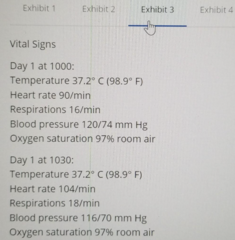
A nurse at a provider's office is caring for a client who is 28 years of age.
Complete the following sentence by using the list of options.
The nurse should first address the client's ______ followed by the client's
______.
The nurse should first address the client's
heart rate
followed by the client's
vaginal spotting.
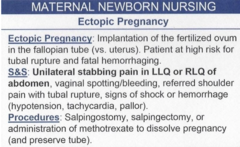
A nurse at a provider's office is caring for a client who is 28 years of age.
The nurse is collaborating with another nurse about the client's plan of care.
For each potential provider's prescription, click to specify if the potential prescription is anticipated or contraindicated for the client.
Transvaginal ultrasound is indicated.
The nurse should anticipate a prescription for a transvaginal ultrasound. A transvaginal ultrasound is useful in determining the location of the ectopic pregnancy.
Meperidine IM is contraindicated.
Clients who receive methotrexate for an ectopic pregnancy should not take analgesics stronger than acetaminophen, because these medications can mask the manifestations of tubal rupture.
Repeat quantitative β-hCG level is anticipated.
The quantitative β-hCG level should be repeated within 48 hr to see if the level has changed from last recording. If increased levels are identified with no intrauterine pregnancy on ultrasound, this is indicative of ectopic pregnancy.
Methotrexate IM is anticipated.
The nurse should anticipate a prescription for methotrexate IM administration to prevent further embryonic cell reproduction.
Blood typing is anticipated.
The nurse should also anticipate potential surgical intervention for the client; therefore, blood typing is indicated.

NGN question (5)

NGN question (6)

A nurse at a provider's office is caring for a client who is 28 years of age.
The nurse is preparing the client for surgery. Which of the following actions should the nurse take?
Select all that apply.
Inform the client to be NPO prior to surgery is correct.
The nurse should inform the client to be NPO prior to surgery. This will prevent aspiration during surgery.
Administer Rho(D) immune globulin prior to surgery is incorrect.
The nurse should administer Rho D immune globulin after surgery. The client is Rh negative and could develop antibody formation if exposed to Rh positive blood.
Prepare to administer AB positive blood products if needed is incorrect.
The nurse should only administer O or B negative blood products if the client requires a blood transfusion. Any other blood types are incompatible and can cause a reaction.
Insert an 18-gauge peripheral IV prior to surgery is correct.
The nurse should provide IV access prior to surgery by inserting a larger bore IV such as an 18- or 20-gauge. An IV is used to administer IV fluids or blood products during surgery.
Explain the surgical procedure to the client is incorrect.
The provider is responsible for explaining the procedure to the client. The nurse is responsible for ensuring that the client is fully informed about the surgery.
Obtain a complete blood count is correct.
The nurse should obtain a complete blood count to establish baseline data prior to surgery.
Verify a consent form is signed by the client is correct.
The nurse should verify that the client has signed a consent form for surgery. This is mandatory prior to any surgical procedure.

Preeclampsia and eclampsia (1)
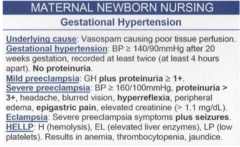
Preeclampsia with severe features

Preeclampsia and eclampsia (2)

A nurse is caring for a group of clients on an intrapartum unit. Which of the following findings should be reported to the provider immediately?
A. A tearful client who is at 32 weeks of gestation and is experiencing irregular, frequent contractions
B. A client who is at 28 weeks of gestation and receiving terbutaline reports fine tremors
C. A client who has a diagnosis of preeclampsia has 2+ proteinuria and 2+ patellar reflexes
D. A client who has a diagnosis of preeclampsia reports epigastric pain and unresolved headache
D. A client who has a diagnosis of preeclampsia reports epigastric pain and unresolved headache

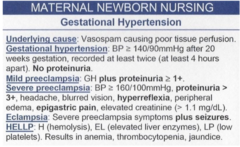
A nurse is caring for an adolescent client who is gravida 1 and para 0. The client was admitted to the hospital at 38 weeks of gestation with a diagnosis of preeclampsia. Which of the following findings should the nurse identify as inconsistent with preeclampsia?
A.
Blood pressure 160/115
B.
1+ pitting sacral edema
C.
Proteinuria 3+
D.
Deep tendon reflexes +1
D.
Deep tendon reflexes +1
Case Study 1a

Case Study 1b
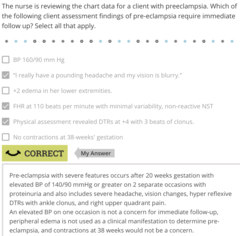
A nurse is assessing a client who is pregnant for preeclampsia. Which of the following findings should indicate to the nurse that the client requires further evaluation for this disorder?
A.
Elevated blood pressure
B.
Increased urine output
C.
Joint pain
D.
Vaginal discharge
A.
Elevated blood pressure

A nurse is reviewing the medical record of a client who is postpartum and has preeclampsia. Which of the following findings indicate that the client has progressed to preeclampsia with severe features?
a. Blood pressure 152/98 mm Hg
b. Elevated liver enzymes
c. Epigastric pain relieved with ambulating
d. Pulmonary edema
d. Pulmonary edema
The nurse should identify that a client who has preeclampsia and is experiencing pulmonary edema has progressed to preeclampsia with severe features.
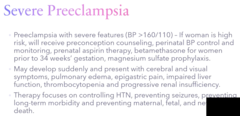
A nurse is assessing a client who has preeclampsia with severe features. Which of the following manifestations should the nurse expect?
a. 2+ deep tendon reflexes
b. Hypotension
c. Polyuria
d. Blurred vision
d. Blurred vision
The nurse should identify that a client who has preeclampsia with severe features can have arteriolar vasospasms and decreased blood flow to the retina which can lead to visual disturbances, such as blurred vision, double vision, or dark spots in the visual field.

A nurse is teaching a client who is at 35 weeks of gestation about manifestations of potential pregnancy complications to report to the provider. Which of the following manifestations should the nurse include?
a. Shortness of breath when climbing stairs
b. Swelling of feet and ankles at the end of the day
c. Headache that is unrelieved by analgesia
d. Braxton Hicks contractions
c. Headache that is unrelieved by analgesia
Rationale:
A headache that is unrelieved by analgesia can indicate preeclampsia and should be reported to the provider.
Expected manifestation at 35 weeks of gestation:
- Shortness of breath when climbing stairs. Shortness of breath is related to the enlarging uterus interfering with the expansion of the diaphragm
- Swelling of feet and ankles at the end of the day. Swelling of feet and ankles is due to the enlarging uterus sitting at the pelvic area and interfering with blood return to the heart.
- Braxton Hicks contractions.
Braxton Hicks contractions are an indication that the uterus is preparing for labor

A nurse is developing a plan of care for a client who has preeclampsia and is receiving magnesium sulfate via a continuous IV infusion. Which of the following interventions should the nurse include in the plan?
a. Monitor the client's blood pressure every hour
b. Restrict the total hourly intake to 200 ml.
c. Monitor the FHR continuously.
d. Administer protamine sulfate for manifestations of toxicity.
c. Monitor the FHR continuously.
Magnesium sulfate, which is used to prevent seizures in clients who have preeclampsia, is a high-alert medication that requires close monitoring.
The FHR and uterine contractions should be monitored continuously while the client is receiving magnesium sulfate.

When preparing the room for admission of a multigravid client at 36 weeks' gestation diagnosed with severe preeclampsia, which item is most important for the nurse to obtain?
a) portable ultrasound machine
b) oxytocin infusion solution
c) disposable tongue blades
d) padding for the side rails
d) padding for the side rails
A nurse is caring for a client who has developed eclampsia. Which of the following actions should the nurse implement after the client experiences a convulsion?
A. Administer oxygen to the client via a face mask at 10 L/min.
B. Place the client in a Trendelenburg position.
C. Assist the client to void.
D. Give calcium gluconate to the client.
A. Administer oxygen to the client via a face mask at 10 L/min.

A nurse is assessing a client who has preeclampsia during a prenatal visit. Which of the following findings should the nurse report to the provider?
A. Deep tendon reflexes of 2+.
B. Blood glucose 110 mg/dL.
C. Urine protein of 3+.
D. Hemoglobin 13 g/dL.
C. Urine protein of 3+.
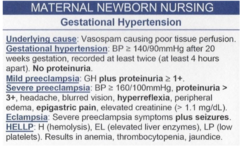
Macrosomia

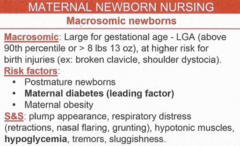
a nurse is caring for a newborn who has macrosomia and whose mother has diabetes mellitus. the nurse should recognize which of the following newborn complications as the priority focus of care?
A.
Hypocalcemia
B.
Hyperbilirubinemia
C.
Hypomagnesemia
D.
Hypoglycemia
D. Hypoglycemia
Newborns of mothers who have diabetes are at high risk for hypoglycemia due to the loss of high levels of glucose after the umbilical cord is cut.
This results in fetal hyperinsulinemia. It can take several days for the newborn to adjust to secreting appropriate amounts of insulin for the lower level of blood glucose.
Because severe hypoglycemia can lead to cyanosis and seizures, prevention of hypoglycemia becomes the nurse's priority focus of care.

A nurse is caring for a term macrosomic newborn whose mother has poorly controlled type 2 diabetes. The newborn has respiratory distress syndrome. The nurse should be aware that the most likely cause of the respiratory distress is which of the following?
A.
Increased risk of anemia
B.
Hyperinsulinemia
C.
Increased blood viscosity
D.
Brachial plexus injury
B. Hyperinsulinemia
Choice B reason: Hyperinsulinemia is a likely cause of respiratory distress in a term macrosomic newborn, as it results from the fetal exposure to high maternal glucose levels and the subsequent overproduction of insulin. Hyperinsulinemia can impair the synthesis of surfactant, which is a substance that prevents the alveoli from collapsing and facilitates gas exchange. Hyperinsulinemia can also cause hypoglycemia, which can affect the respiratory center and cause apnea.
Hyperbilirubinemia (1)

A nurse is caring for a client who has just delivered her first newborn. The nurse anticipates hyperbilirubinemia due to Rh incompatibility. The nurse should understand that hyperbilirubinemia occurs with Rh incompatibility for which of the following reasons?
A.
The client's blood does not contain the Rh factor, so she produces anti-Rh antibodies that cross the placental barrier and cause hemolysis of red blood cells in newborns.
B.
The client's blood contains the Rh factor, and the newborn's does not, and antibodies that destroy red blood cells are formed in the fetus.
C.
The client has a history of receiving a transfusion with Rh-negative blood.
D.
The client's anti-A and anti-B antibodies cross the placenta and cause the destruction of the fetal red blood cells.
A.
The client's blood does not contain the Rh factor, so she produces anti-Rh antibodies that cross the placental barrier and cause hemolysis of red blood cells in newborns.
If the Rh-negative client has been exposed to Rh-positive fetal blood, she will produce antibodies against Rh factor. These antibodies can cross the placenta and destroy the red blood cells of the Rh-positive fetus. This accelerated rate of red blood cell destruction results in the increased release of bilirubin. The newborn's serum bilirubin level can rise quickly.

Hyperbilirubinemia (2) (Phototherapy)
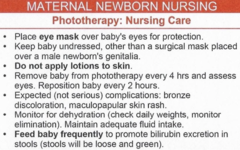
A nurse is initiating phototherapy for a newborn who has hyperbilirubinemia. Which of the following actions should the nurse take?
A. Place an opaque mask over the newborn's eyes
B. Apply lotion to the newborn's skin twice daily
C. Dress the newborn in a diaper and t-shirt
D. Check the newborn's temperature daily
A. Place an opaque mask over the newborn's eyes
The nurse should cover the newborn's eyes with an opaque mask to prevent retinal damage from the ultraviolet light used in phototherapy.
- B: The nurse should not apply lotions, creams, or ointments to the newborn's skin because they can absorb heat and cause burns.
- C: The nurse should dress the newborn in a diaper only to maximize skin exposure to phototherapy light.
- D: The nurse should check the newborn's temperature frequently while receiving phototherapy.

A nurse is developing a plan of care for a newborn who has hyperbilirubinemia and is to undergo phototherapy. Which of the following actions should the nurse include in the plan of care?
A. Reposition the newborn every 4 hours
B. Lotion the newborn's skin twice per day
C. Check the newborn's temperature every 8 hours
D. Remove the newborn's eye mask during feedings
D. Remove the newborn's eye mask during feedings

Gestational Diabetes (1)
Gestational Diabetes (2)

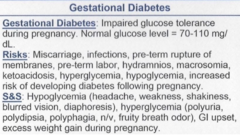
A nurse is assessing a client who has gestational diabetes mellitus and is experiencing hyperglycemia. Which of the following findings should the nurse expect?
a. Reports blurred vision
b. Diaphoresis
c. Shallow respirations
d. Reports increased urinary output
d. Reports increased urinary output
Increased urinary output, nausea and vomiting, reports of thirst, abdominal pain, constipation, drowsiness, and headaches are manifestations of hyperglycemia. Other manifestations include weak rapid pulse, fruity breath odor, urine positive for sugar and acetone, and a blood glucose level greater than 200 mg/dL.
A nurse in a provider's office is reviewing the medical record of a client who is in the first trimester of pregnancy. Which of the following findings should the nurse identify as a risk factor for the development of preeclampsia?
a. Singleton pregnancy
b. BMI of 20
c. Maternal age 32 years
d. Pregestational diabetes mellitus
d. Pregestational diabetes mellitus
Pregestational diabetes mellitus increases a client's risk for the development of preeclampsia. Other risk factors include preexisting hypertension, renal disease, systemic lupus erythematosus, and rheumatoid arthritis.
A nurse is teaching a client who has pregestational type 1 diabetes mellitus about management during pregnancy. Which of the following statements by the client indicates an understanding of the teaching?
A.
"I should have a goal of maintaining my fasting blood glucose between 100 and 120."
B.
"I should engage in moderate exercise for 30 minutes if my blood glucose is 250 or greater."
C.
"I will continue taking my insulin if I experience nausea and vomiting
D.
"I will ensure that my bedtime snack is high in refined sugar."
Choice C Reason:
"I will continue taking my insulin if I experience nausea and vomiting."
This statement reflects an awareness of the importance of continuing insulin administration even if the client is experiencing nausea and vomiting. Consistent insulin management is crucial for maintaining blood glucose levels within the target range during pregnancy.
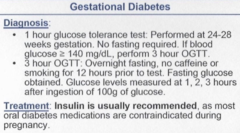
A nurse is discussing with a newly licensed nurse two conditions, gestational diabetes mellitus and gestational hypertension. Sort the following risk factors the nurse should include in the teaching for each condition:
Gestational Diabetes Mellitus or Gestational Hypertension
A. Maternal age older than 25 years
B. Maternal age older than 40 years
C. Previous birth of an infant that was large or stillborn
D. Chronic renal disease
Gestational Diabetes Mellitus: A, C
Gestational Hypertension: B, D

A nurse in the prenatal clinic is reinforcing teaching to a client who is in her second trimester and has a new diagnosis of gestational diabetes. Which statement by the client indicates a need for further teaching?
A.
"I should limit my carbohydrates to 50% of caloric intake."
B.
"I will take my glyburide daily with breakfast."
C.
"I will reduce my exercise schedule to 3 days a week."
D.
"I know I am at increased risk to develop type 2 diabetes."
C.
"I will reduce my exercise schedule to 3 days a week."
HELLP syndrome (1)
hemolysis, elevated liver enzymes, low platelets

HELLP syndrome (2)
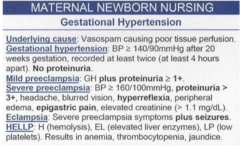
The labor of a pregnant woman with preeclampsia is going to be induced. Before initiating the Pitocin infusion, the nurse reviews the woman's latest laboratory test findings, which reveal a platelet count of 90,000, an elevated aspartate transaminase (AST) level, and a falling hematocrit. The nurse notifies the physician because the laboratory results are indicative of:
A) Disseminated intravascular coagulation (DIC).
B) HELLP syndrome.
C) Eclampsia.
D) Idiopathic thrombocytopenia.
B) HELLP syndrome.

A nurse is reviewing the laboratory report for a client with suspected HELLP syndrome. Which of the following findings should the nurse report to the provider as an indication of this disorder?
A. Elevated hemoglobin
B. Elevated creatinine clearance
C. Elevated liver enzymes
D. Elevated platelet count
C. Elevated liver enzymes
The nurse should expect a client who has HELLP syndrome to have elevated liver enzymes.
- HELLP refers to: Hemolysis, Elevated Liver enzymes, and Low Platelet count
- This syndrome is a severe form of preeclampsia
- A: A client who has HELLP syndrome is expected to have a decreased hemoglobin level.
- B: A client who has HELLP syndrome is expected to have a decreased creatinine clearance.
- D: A client who has HELLP syndrome is expected to have a decreased platelet count.

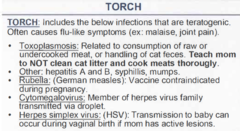
TORCH infections
T - toxoplasmosis
O - other (syphilis)
R - rubella
C - cytomegalovirus
H - herpes

A nurse in an antepartum clinic is assessing a client who has a TORCH infection. Which of the following findings should the nurse expect? Select all that apply.
a. Joint pain.
b. Malaise.
c. Rash.
d. Urinary frequency.
e. Tender lymph nodes.
A, B, C, E
A. CORRECT: TORCH infections are flulike in presentation, such as joint pain.
B. CORRECT: TORCH infections are flulike in presentation, such as malaise.
C. CORRECT: TORCH infections may include findings such as a rash.
D. INCORRECT:Urinary frequency is not a symptom associated with a TORCH infection.
E. CORRECT: TORCH infections are fIulike in presentation, such as tender lymph nodes
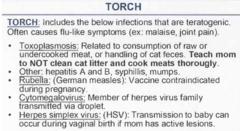
A nurse manager in a prenatal clinic is reviewing ways to prevent a TORCH infection during pregnancy with a group of newly licensed nurses during an education program. Which of the following statements by a nurse indicates understanding of the teaching?
A. "Obtain a vaccination against rubella early in pregnancy."
B. "Seek prophylactic treatment if cytomegalovirus is detected."
C. "A woman should avoid handling dog feces."
D. "A woman should avoid consuming undercooked meat."
A. INCORRECT:
Vaccination against rubella is contraindicated during pregnancy due to the risk of fetal congenital anomalies.
B. INCORRECT:
There is no treatment for cytomegalovirus.
C. INCORRECT:
Toxoplasmosis, a TORCH infection, is contracted by handling cat feces.
D. CORRECT: Toxoplasmosis, a TORCH infection, is contracted by consuming undercooked meat.
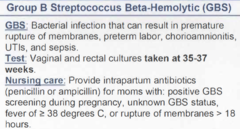
Group B Streptococcus Beta-Hemolytic (GBS) (1)

Group B Streptococcus Beta-Hemolytic (GBS) (2)

A nurse is reviewing the laboratory report for a client who is in active labor. The client tested positive for Group B Streptococcus β-hemolytic. Which of the following medications should the nurse plan to administer to the client?
A. Cefotetan.
B. Fluconazole.
C. Ampicillin.
D. Doxycycline.
C. Ampicillin.

A nurse is planning care for a client who is at 35 weeks of gestation. Which of the following laboratory tests should the nurse obtain?
a. Rubella titer
b. Blood type
c. Group B streptococcus B-hemolytic
d. 1-hour glucose tolerance test
c. Group B streptococcus B-hemolytic
Rationale:A vaginal/anal group B streptococcus B-hemolytic (GBS) culture should be done @ 35-37 weeks gestation to screen for infections. Prophylactic antibiotics should be given during labor to clients who are + for GBS
Incorrect Answers:
Rubella titer is obtained at 1st prenatal visit;
Maternal blood type & Rh factor should be obtained at 1st prenatal visit to determine if client will need Rho(D) immune globulin at 28 wks.;
1-hr. glucose tolerance test should be obtained at 24 - 28 weeks

A nurse is caring for a client who is in labor. The nurse should identify that which of the following infections can be treated during labor or immediately following birth? (Select all that apply.)
A. Gonorrhea.
B. Chlamydia.
C. HIV.
D. Group B streptococcus beta-hemolytic.
E. TORCH infection.
A. Gonorrhea.
B. Chlamydia.
C. HIV.
D. Group B streptococcus beta-hemolytic.
Rationale:
A. Erythromycin is administered to the infant immediately following delivery to prevent Neisseria gonorrhea.
B. Erythromycin is administered to the infant immediately following delivery to prevent Chlamydia trachomatis.
C. Retrovir is prescribed to a client in labor who is HIV-positive.
D. Penicillin G or ampicillin may be prescribed to treat positive GBS.
Nursing Assessment and interventions of Newborn after delivery
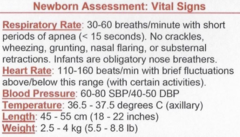
A nurse is assessing a newborn who is 12 hr old. Which of the following findings should the nurse report to the provider?
a. Subconjunctival hemorrhages
b. Petechia on the trunk and face
c. Central cyanosis
d. Respiratory rate of 40/min
c. Central cyanosis
Central cyanosis or mottling can indicate a potential complication and ineffective breathing or circulation and should be reported to the provider.

A nurse is assessing a full-term newborn. Which of the following findings should the nurse report to the provider?
A. Respiratory rate 55/min.
B. Blood pressure 80/50 mm Hg.
C. Temperature 36.5°C (97.7°F).
D. Heart rate 72/min.
D. Heart rate 72/min.
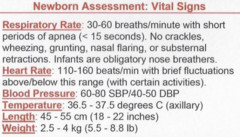
A nurse is assessing a newborn. Which of the following findings should the nurse immediately report to the provider?
A. Milia
B. Epstein pearls
C. Nasal flaring
D. Meconium stools
C. Nasal flaring
Nasal flaring, grunting, and respiratory muscular retractions signal serious breathing problems that should be reported to the provider.
- A: Milia are whiteheads on the face and forehead and are a normal variation.
- B: Epstein pearls are white nodules on the gums and are a normal variation.
- D: Meconium stools are an expected finding within the first 12 to 48 hours after birth.

A nurse is assessing a newborn 1 hr after birth. Which of the following findings should the nurse report to the provider?
A. Jaundice of the sclera
B. Respiratory rate 50/min
C. Acrocyanosis
D. Blood glucose 60 mg/dL
A. Jaundice of the sclera
If the newborn has jaundice within the first 24 hours of life, this can indicate a potentially pathological process such as hemolytic disease. Pathological jaundice can result in high levels of bilirubin, which can damage the neonatal brain.
- B, C, & D: These are expected findings.

A nurse is performing a newborn assessment. Which of the following images should the nurse identify as an indication of spina bifida occulta?

A nurse is caring for a newborn who is 72 hr old.
The nurse is planning to contact the provider regarding the newborn's status.
Which of the following prescriptions regarding the newborn should the nurse anticipate?
Select all that apply.
a. Instruct the mother to discontinue breastfeeding.
b. Administer scheduled doses of oral morphine.
c. Give a one-time dose of naloxone IM.
d. Maintain a low-stimulus environment.
e. Initiate neonatal abstinence syndrome (NAS) scoring
Instruct the mother to discontinue breastfeeding is incorrect.
The nurse should encourage the mother to continue to breastfeed on demand. Breastfeeding will assist to decrease manifestations of NAS in the newborn.
Administer scheduled doses of oral morphine is correct.
The nurse should administer scheduled doses of oral morphine to the newborn to decrease manifestations of withdrawal. The dosage of the medication is adjusted based on the NAS score of the newborn.
Give a one-time dose of naloxone IM is incorrect.
The nurse should not administer naloxone to a newborn who has NAS. It is contraindicated in newborns who are born with opioid dependence because it can increase the severity of withdrawal manifestations and result in seizures.
Maintain a low-stimulus environment is correct.
Supportive care for a newborn who has NAS includes maintaining a low-stimulus environment to help prevent exacerbation of withdrawal manifestations.
Initiate neonatal abstinence syndrome (NAS) scoring is correct.
The nurse should initiate NAS scoring to evaluate the severity of the newborn's withdrawal manifestations. The score obtained will be used to evaluate the need to titrate the prescription for the morphine dosage.

Nursing Intervention for a Nonstress Test
