Lecture 14
 Call Kai
 Learn
 Practice Test
 Spaced Repetition
 Match
 Flashcards
 Knowt Play
1/85

There's no tags or description
Looks like no tags are added yet.
86 Terms

why did the pictographs increasingly become more abstract?
to increase efficiency: if every symbol were super logographic, it would become more like decoding than reading. an abstract system that requires mapping onto meanings is faster to read than decoding each symbol one by one
true or false: Chinese symbol each represent a picture/element
false: some combine meaning and sounds

true or false: Japanese can mix many scripts in a single sentence
true: which is complex cognitively

why do we say Korean is an invented language?
because the letters of the Korean language reflect speech in syllable blocks: each symbol represents how people articulate and how they produce the sound in the articulatory system

how do we produce sounds?
by exhaling and using the articulator of our mouth and throat
define “abigida”
Inuktitut language created by westerners to provide them with a script
in abugida, the [consonant/vowel] determines the rotation of the symbol while the [consonant/vowel] determines the shape of the symbol
vowel = rotation
consonant = shape of the symbol
why was Esperanto created?
some people were tired o the lack of consistency found in English, so they developed a script and language that is perfect and rational (1 letter = 1 sound)
what would be the purpose to study bilingualism with an existing language and a made up lab language?
it would allow to control for external confounds
what makes exceptions difficult when learning a new language?
remembering them and knowing when to apply them
reading, Vaid 2022: what was the purpose of the study?
we have a lot of research done on bilinguals who read alphabetic script (ex: English/French, Italian/Vietnamese) → WEIRD samples
this led to an assumption that these findings are universally applicable while they probably aren’t
we should focus on biscriptal research to become more inclusive
reading, Vaid 2022: what are the practical implications of studying biscriptuality? (3)
being able to develop treatments for biscriptal bilinguals adapted to them (aphasia, stroke)
what a letter is and tasks such as the lexical decision and priming may be affected by knowing many scripts
there aren’t enough databases and corpora for non-alphabetic languages
reading, Vaid 2022: across which measures did biscriptality show an advantage? (5)
lexical decision task: is this this a word or not
semantic category judgment: is this stimulus (object, word) part of this semantic category
morphological awareness: ability to recognize, understand and modify morphemes (smallest units of language)
word proprieties
eye-tracking measures of reading
reading, Vaid 2022: define “semantic category judgement”
task where the participant determines if this stimulus (object, word) part of this semantic category
reading, Vaid 2022: define “morphological awareness”
ability to recognize, understand and modify morphemes (smallest units of language)
reading, Vaid 2022: what were the methods?
created reading comprehension tasks with 7338 participants across 19 countries and 70 languages
compare language experience in English for L2 English readers
participants had to complete a language background questionnaire
reading, Vaid 2022: what were the factors obtained after the data reduction? (3)
single word accuracy
single word measures that detected the speed at processing a single word
extended word measures: how people read sentence

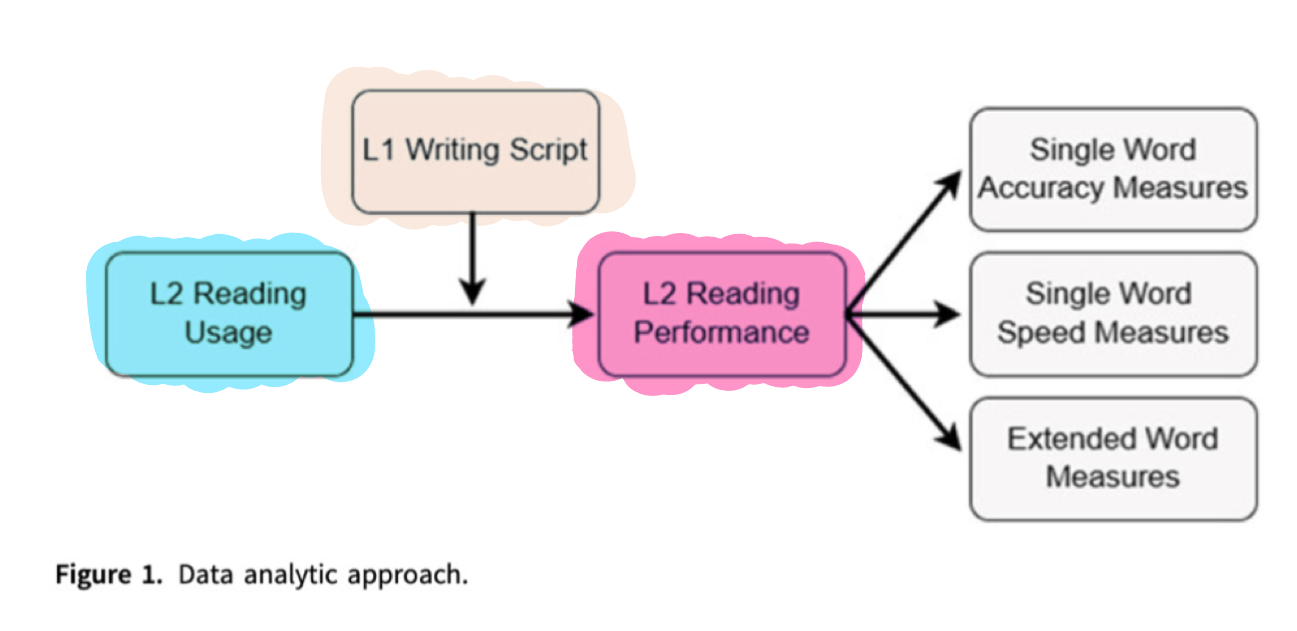
reading, Vaid 2022: what did the experiment predict?
if you read more in L2, you’ll be better at your L2
but the experiment wanted to see to what extent is the relationship between L2 usage and reading performance impacted by L1 script difference
reading, Vaid 2022: the experiment started with 7339 participants, but only the data of 1073 were included. why? (6)
removed all missing data
removed monolinguals (since we wanted to see how L1 script affected L2)
removed trilingual and multilingual
removed English L1 speakers and speakers with no L1 before the age of 4
removed data collected from prolific: the experiment was put online and anyone could access it, but we don’t always know who were are testing and some answers can be dubious
removed L1 Korean or Japanese: not enough of participants in those languages
reading, Vaid 2022: what are the DVs (3) and the IV?
DVs: the 3 factors
L2 English single word accuracy
L2 English single word speed
L2 English other measures
IV:
writing script x % L2 reading usage

reading, Vaid 2022: explain the results found for the factor L2 English single word accuracy
main effect, but no interaction with L1 script (all the lines are going in the same direction)
positive relation: as L2 reading usage increases, the performance on L2 single word accurate increases
note: participants with an alphabetic L1 tend to outperform alpha syllabic and logographic (but it makes sense since English is also an alphabetic word)

reading, Vaid 2022: explain the results found for the factor L2 English single word speed
interaction of L1 script: logographic is different (because it’s the only line that goes up)
positive relation for logographic: as L1 logographic read more L2 English, their reaction times would increase
negative relation for alphabetic and alphasyllabic: as L1 alphasyllabic read more L2 English, their reaction times would decrease (expected)

reading, Vaid 2022: explain the results found for the factor L2 English other measures
interaction of L1 script: logographic is different (because it’s the only line that goes down)
new slides? recording? le y veut rien dire tbrnk
reading, Vaid 2022: what is the conclusion of the study?
bilingual adults’ L1 script experience impacts their L2 English reading speed and comprehension for logographic but not alphasyllabic L1 scripts (factors 2 and 3)
reading, Vaid 2022: true or false: according to the results of the study, you would need tailored literacy instruction when people L1’s script mismatches their L2 script
true
what are the steps for word recognition? (2)
match printed word with orthographic word-form stored in lexicon
lexical assess: further processing of knowledge stored with word-form (syntax, morphology, phonology, semantics)
what are the signatures of lexical access? (2)
word frequency
high frequency words (home) are processed faster and more accurately than low frequency words (kelp)
define “home” (not house)
high frequency words
define “kelp”
low frequency words
reading: what causes us to have accents in some languages?
it shows that we know many languages and those languages are active, co-exist and interact together
reading: define “cross-linguistic influence” (CLI)
how the knowledge and usage of one language affects the production, comprehension and acquisition of other languages
*previously called “transfer” or “interference”
reading: true or false: salient differences often make target-language structures easier to acquire
true: if you know English and are learning Chinese, it will be easier to acquire the structure
reading: true or false: cross-linguistic influence (CLI) decreases as proficiency in the less dominant language increases
false: it doesn’t, it’s only when you become more proficient in your weaker language that you start to recognize similarities and differences between two languages
reading: define “forward transfer”
knowledge transferring from L1 to L2
reading: defne “lateral transfer”
knowledge transferring from L2 to L3
reading: define “reverse transfer”
knowledge transferring from L2 to L1
reading: what’s the difference between forward, lateral and reverse transfer?
forward: L1 → L2
lateral: L2 → L3
reverse: L2 → L1
reading: what are the factors that determine the likelihood of transfer? (2)
age
relatedness of the two languages
reading: what can be transferred across languages? (6)
structure and language form
phonological
morphological
syntactic transfer
meaning
pragmatics
reading: true or false: individual differences don’t cross-linguistic influence (CLI)
false: individual differences can impact the different types and extents of CLI
reading: what have studies in phonological transfer looked at? (3)
syllables
suprasegmental levels (tone, intonation)
individual differences
reading: knowledge transfer is more frequent for [perception/production] than for [perception/production] because […]
production more than perception: you can produce an incorrect but similar sound by transferring you L1 knowledge to L2 (that’s what makes us have accents)
reading: true or false: we have one phonological system for every language
false: we have many for different languages
reading: true or false: different phonological systems (one system for one language) are independent from each other
false: they aren’t entirely autonomous (that’s Paradis’s “international dual systems model”)
reading: define Paradis’s “interactional dual systems model”
bilingual children have 2 phonological systems that can influence each other (so the systems aren’t entirely independent)
reading: according to Fabiano-Smith and Goldstein, how frequent is the cross-linguistic influence (CLI) in bilingual children?
low, but they can still differentiate sound and transfer knowledge from one language to the other
*confirms Paradis’s interactional dual system model that says that kids have 2 phonological systems that influence each other
reading: true or false: Fabiano-Smith and Goldenstein found that cross-linguistic influence (CLI) decreases as children get older
false: they weren’t able to find if the effects change or stay stable as kids grow up
reading: define “word choice transfer”
how knowledge in one language affects how your choice of words in another language
reading: define “inflectional morphology”
changing the word’s meaning by adding a prefix or suffix (ex: “ed” or “ing” at the end of a verb, adding s for plurals)
reading: define “overt morphology”
visible, orthographic, phonetic markings (ex: “read” in the present tense VS in the past tense)
reading: what’s the difference between inflectional and overt morphology?
inflectional: changing a word’s meaning by adding a prefix or a suffix (ex: verbs with “ed” and “ing”, adding s for plurals)
overt: visible, orthographic, phonetic markings (ex: “read” in the present VS the past tense)
reading: [inflectional/overt] morphology doesn’t transfer across languages
overt
*inflectional: prefixes and suffixes; overt: phonetics, visible changes
reading: true or false: it is impossible to reverse transfer morphological information, only forward transfer is possible
true and false:
false: both are possible, but forward (L1 → L2) is more frequent than reverse (L2 → L1)
true: reverse is only possible if you are highly proficient
reading: define “morphological awareness”
using morphemes and changing how words are built
reading: define “transfer facilitation model”
the skills you have in one language can transfer to another language → top-down assistance
reading: cross-linguistic influence (CLI) is more frequent for [sounds/words] than for [sounds/words]
more frequent for sounds than words
reading: when can inflectional morphemes transfer across languages more easily?
when both languages are similar lexically and morphologically
*inflectional morphology: changing a word’s meaning by adding a prefix or suffix
reading: true or false: morphological transfers between L1 and L2 and between L2 and L1 are both possible, but proficiency and other factors determine if the effects from L2 and L1 can be seen
true
reading: true or false: L3 can only be influence by L1
false: it can be influenced by L2
reading: true or false: L1 syntax and morphology are not transferable
false: they can be transferred
reading: L1 [grammar/syntax] affects L2 [grammar/syntax]
L1 syntax affects L2 grammar
reading: knowing [more/less] languages will make you more likely to reject ungrammatical sentences because […]
knowing less languages will make you more likely to reject ungrammatical sentences:
when you know less languages, you will be more careful of the grammatical judgements you’ll make by basing on existing knowledge
reading: what causes increased left anterior negativity?
phrase-structure violation (ex: placing a verb where a noun should be)
reading: define “competition model”
differences when processing dissimilar elements in L1 and L2
reading: explain how syntactic transfer can be done from L1 to L2 and from L2 to L1
interpret L2 sentences by using L1 knowledge, but you’ll stop doing that when your L2 knowledge increases
interpret L1 sentences by using L2 knowledge, but only when L2 proficiency increases
reading: define “discursive transfer”
during oral or written discourse, our thoughts are organized according to how we converse → this will affect writing in another language
reading: define “pragmatism”
language use in different contexts (meaning of words in different situations)
reading: define “pragmatic transfer”
illocutionary (language usage to communicate) and sociolinguistic competences when transferring to other languages
reading: define “sociolinguistic transfer”
how social contexts for one language influence usage and knowledge for another language
reading: what are the factors that can influence sociolinguistic transfer? (3)
social distance
gender
status relationship
*sociolinguistic transfer: how social contexts for one language influence the usage and knowledge for another language
reading: what are the factors that interact with cross-linguistic influence (CLI)? (5)
linguistic and psycholinguistic factors: cross-linguistic similarity/cognate, linguistic domain and use, markedness and prototypicality
cognitive, attentional and developmental factors: cognitive maturity, development of language acquisition, learning abilities, attention and awareness of language
cumulative language experience and knowledge; age, frequency of input, intensity and length of language exposure, length of residence, dominance and proficiency, number and order of acquired languages
learning environment: formal/naturalistic exposure, form/meaning, communication
language use: level of formality, language task
reading: what are the aspects of the linguistic and psycholinguistic factor? (4)
*no need to remember, just know
cross-linguistic similarity and cognate status
linguistic domain and use
markedness and prototypicality
linguistic context
reading: what are the aspects of the cognitive, attention and developmental factor? (4)
*no need to remember, just know
level of cognitive maturity
developmental and universal processes of language acquisition
cognitive language learning abilities
attention to and awareness of language
reading: what are the aspects of the cumulative language experience and knowledge factor? (6)
*no need to remember, just know
age
frequency of language input
intensity and length of language exposure
length of residence
language dominance and proficiency
number and order of acquired languages
reading: what are the aspects of the factor related to the learning environment? (3)
*no need to remember, just know
formal VS naturalistic exposure
learner is focused on form VS meaning
communication
reading: what are the aspects of the factor related to language use? (2)
*no need to remember, just know
level of formality
language task
reading: true or false: proficiency doesn’t affect the nature and occurrence of cross-linguistic influence (CLI)
false: it does
reading: in cross-linguistic influence (CLI), why do we know more about the affecting/target language rather than the affected/recipient language?
because the affected/recipient language is often the L1 (I know, weird), so we are unsure if effects are due to the L2 or if L1 proficiency decreases
reading: what are the issues explored by Arguri and Sorace? (3)
if language dominance affects occurrence and magnitude of cross-linguistic influence (CLI)/transfer
direction of the cross-linguistic influence (CLI) (L1 to L2, L2 to L1?)
through which syntactic structures can we see effects
reading: when does the cross-linguistic influence (CLI) persists over time with an unidirectional effect on syntax and pragmatics?
this only happened in English-dominant bilinguals
reading: true or false: the number of inputs doesn’t impact the effects of the cross-linguistic influence (CLI)
false: it does
reading: what does transfer effects (CLI) of vocabulary depend on?
proficiency (it impacts basically all CLI)
what’s the difference between phonetics and phonology?
phonetics: how sounds are produced
phonology: how sounds are organized
reading: true or false: proficiency is the main predictor of CLI
true (I hope you got that with the amount of cards on that)
reading: why has there been less research on phonology and how it’s transferred? (2)
sounds that aren’t used often or that aren’t important are harder to acquire
sounds might transfer from one language to another differently
reading: define “contact variety approach”
frequency of L1 input affect L2 acquisition for simultaneous bilingual kids (before 3 years old)
*incorrect hypothesis: it cannot explain the influence of other languages this early and CLI depends on language complexity and fluency