BIOL 1711- Tissues
 Call Kai
 Learn
 Practice Test
 Spaced Repetition
 Match
 Flashcards
 Knowt Play
1/72

There's no tags or description
Looks like no tags are added yet.
73 Terms
What are the main characteristics of epithelial tissue
1) Composed almost entirely of tightly packed cells, minimal extracellular matrix
2) Polarity- has distinct apical, lateral, and basal surfaces
3) Attached to a basement membrane
4) Avascular
5) Extensive innervation
6) High regeneration capacity
What are the main functions of epithelial tissue
1) Physical protection
2) Selective permeability/filtration
3) Absorption
4) Secretion (some cells are specialized to form glands)
5) Sensory reception
How is epithelial tissue classified?
1) By number of cell layers (i.e., simple, stratified)
2) By cell shape (i.e., squamous, cuboidal, and columnar)
What is simple squamous epithelium
One layer of flattened cells with a single nucleus that bulges at its centre
What is the typical function of simple squamous epithelium?
Rapid diffusion, filtration and secretion in serous membranes due to thin layer

Name this type of epithelial tissue and where it is likely to be found
Simple squamous epithelium
Found in the air sacs of lungs (alveoli) , lining of heart chambers, lining of lumen of blood vessels and lymph vessels (endothelium), serous membranes of body cavities (mesothelium)
What is simple cuboidal epithelium?
Single layer of cells that are as tall as they are wide, with a spherically and centrally located nucleus
What is the typical function of simple cuboidal epithelium?
Secretion and absorption (e.g., compose the structural components of glands)
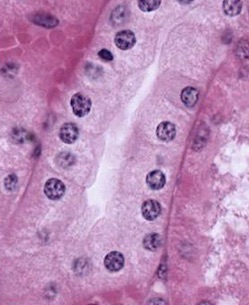
Name this type of epithelial tissue and where it is likely to be found
Simple cuboidal epithelium
Found in the lining of kidney tubules, thyroid gland follicles, surface of the ovary, some secretory regions and the ducts of most exocrine glands
What is simple columnar epithelium
One layer of cells that are taller than they are wide, with an oval shaped nucleus oriented lengthwise that is closer to the basal region of the cell
What is the function of simple columnar epithelium?
Absorption and secretion, has goblet cells that secrete mucin (when hydrated forms mucus)
What are the 2 different kinds of simple columnar epithelium
Non-ciliated and ciliated

Name this type of epithelial tissue and where it is likely to be found
Simple columnar epithelium
Non-ciliated: found in the lining of most of the GI tract (stomach, small and large intestines)
Ciliated: found in the lining of the larger bronchioles of the lung and the uterine tubes
What is pseudostratified epithelium?
Single layer of cells with varying heights, appears as stratified but all cells connect to the basement membrane and not all cells reach the apical surface
What is the function of pseudostratified epithelium?
Provides protection via secretion. Can be ciliated or non-ciliated

Name this type of epithelial tissue and where it is likely to be found
Pseudostratified epithelium
Ciliated: found in the lining of larger airways of respiratory tract, including nasal cavity, part of pharynx, trachea and bronchi
Non-ciliated: very rare, found in the lining of the male urethra and epididymis.
What is stratified squamous epithelium
Multiple cell layers, apical cells are flattened in shape.
2 types: keratinized (superficial layers of dead cells filled with keratin) & non-keratinized (cells lack keratin)
What is the function of stratified squamous epithelium?
Physical protection- protect underlying tissue from abrasion

Name this type of epithelial tissue and where it is likely to be found
Stratified squamous epithelium
Keratinized: found in the epidermis
Non-keratinized: found in the lining of the oral cavity, part of the pharynx, esophagus, lining of the vagina and anus
What is stratified cuboidal epithelium?
multiple cell layers, apical cells are as tall as they are wide,
What is the function of stratified cuboidal epithelium and stratified columnar epithelium?
Protection and secretion

Name this type of epithelial tissue and where it is likely to be found
Stratified cuboidal epithelium
Found in the ducts of most exocrine glands and ovarian follicles
What is stratified columnar epithelium
Two of more layers of cells, cells at the apical surface are taller than they are wide

Name this type of epithelial tissue and where it is likely to be found
Stratified columnar epithelium
Rare- can be found in the ducts of salivary glands, conjunctiva covering the eye, and lining of the membranous part of the male urethra
What is transitional epithelium
has a varying appearance depending on whether the tissue is relaxed or distended
relax = cells are cuboidal or polyhedral in shape with large round apical cells
distended= apical cells are flattened and some are binucleated.

Name this type of epithelial tissue and where it is likely to be found
Transitional Epithelium
Accommodates urine volume changes (by distending or relaxing) in the urinary bladder, ureters and part of the urethra
What are the functions/characteristics of connective tissue?
Most diverse, abundant, widely distributed of tissues
Functions to bind, support, and protect organs
Vascularized
High regenerative capacity
What are the basic components of connective tissue?
cells + protein fibres + ground substance
What does the extracellular matrix consist of?
Protein fibres + ground substance
What are the different types of connective tissue?
Connective tissue proper, supporting connective tissue, and fluid connective tissue
What are collagen fibres?
Protein fibre in connective tissue that appears un-branched and cable-like, is strong, flexible, and resistant to stretching
Stain pink in histological sample, but look white in tissues
Makes up 25% of our bodies protein, numerous in our tendons and ligaments
What are reticular fibres?
Protein fibre in connective tissue, is thinner than collagen and forms a branching interwoven framework that is tough but flexible.
Abundant in the stroma of organs such as the lymph nodes, spleen and liver
What are elastic fibres?
Protein fibre in connective tissue, fibres branch and rejoin and appear wavy
They stretch and recoil easy
Have a yellow-ish colour in tissue, but when stained look black
Abundant in the skin, arteries and lungs so they can return to their original shape after being stretched.
What 2 groups can connective tissue proper be divided into? Explain what they are.
1) Loose connective tissue (has fewer fibres and more ground substance, well vascularized, act’s as packing material by supporting and surrounding structures and organs)
2) Dense connective tissue (has more fibres and less ground tissue, collagen is usually the dominant fibre type)
What are the subcategories in loose connective tissue?
Areolar, Adipose and Reticular
What is areolar connective tissue?
Has an unconfined organization (fibres run in all different directions) of collagen and some elastic proteins. Predominant cell type is fibroblasts, with an abundant and viscous ground substance.
Where is areolar connective tissue found in the body?
Nearly everywhere in the body!
In the skin (papillary layer of the dermis), major component of subcutaneous layer deep to the skin, surrounds organs, nerve cells, some muscle cells, and blood vessel walls
What is adipose connective tissue?
Primarily consisting of adipocytes, has lipid droplets that cause the nucleus to be pushed to the inside of the plasma membrane.
White adipose functions as a long term energy source, acts as a insulator and provides packaging around structures/cushions against shock.
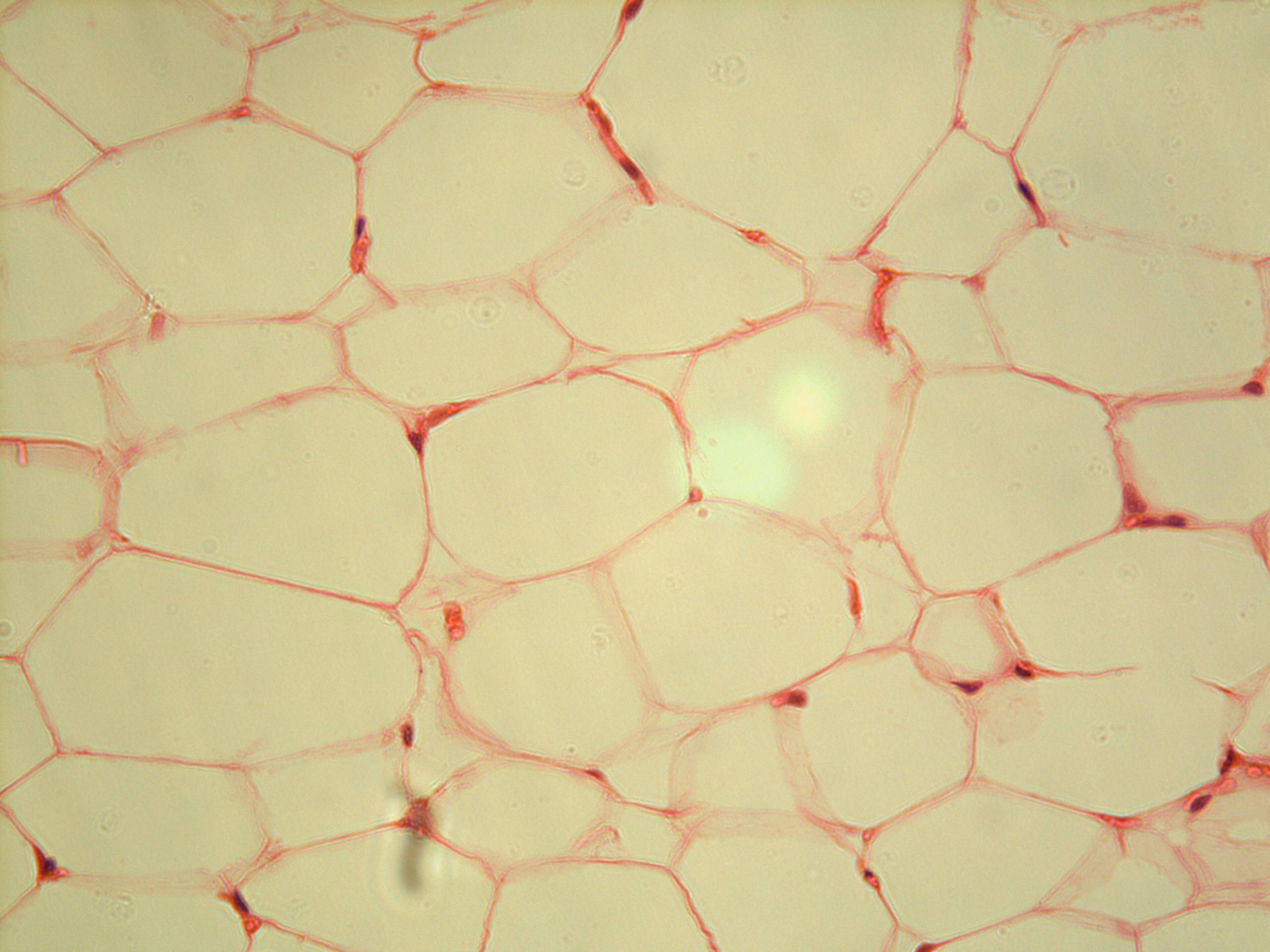
What is the name for this type of connective tissue and where is it found in the body?
Adipose connective tissue
Found in the subcutaneous layer, surrounds and covers some organs

What is the name for this type of connective tissue and where is it found in the body?
Areolar connective tissue
What is reticular connective tissue?
Houses abundant leukocytes and some fibroblasts within a meshwork of reticular fibres and viscous ground substance

What is the name for this type of connective tissue and where is it found in the body?
Reticular connective tissue
Located in the spleen, lymph nodes and red bone marrow forming the stroma (structural framework)
What are the subcategories in dense connective tissue?
Dense regular, dense irregular, and elastic connective tissue
What is dense regular connective tissue?
Has abundant collagen that is tightly packed and aligned parallel (in the same plane) to one another. Has few fibroblasts and limited ground substance. Few blood vessels.

What is the name for this type of connective tissue and where is it found in the body?
Dense regular connective tissue
It is found in most ligaments (attach bone to bone) and tendon (attach muscle to bone), resists stress applied in one direction
What is dense irregular connective tissue?
Densely packed but randomly arranged and clumped collagen fibres, more fibroblasts and ground substance than “dense regular”, has extensive blood vessels.
It withstands stresses applied in all directions and is durable.

What is the name for this type of connective tissue and where is it found in the body?
Dense irregular connective tissue
Found in the reticular layer of the dermis, epimysium covering skeletal muscle, epineurium covering nerves, periosteum covering bone, perichondrium covering cartilage, and some organ capsules
What is elastic connective tissue?
Composed of densely packed elastic fibres with fibroblasts and ground substance. Looks like dense squiggly lines.
Provide the ability for tissue to stretch and recoil

What is the name for this type of connective tissue and where is it found in the body?
Elastic connective tissue
Found in the walls of the large arteries (e.g., aorta), trachea, and the vocal cords
What are the two different types of supporting connective tissue?
Bone and cartilage
What are the characteristics of cartilage?
Has a firm semisolid extracellular matrix with variable amounts of collagen and elastic protein fibres
More strong and resilient than connective tissue proper tissues types, and more flexible than bone
Present in areas of the body that need support and must withstand deformation
Once it is mature, it is avascular
Mature cells are called chondrocytes and are housed in lacunae in the extracellular matrix.
What are the three different types of cartilage?
Hyaline cartilage, fibrocartilage, and elastic cartilage
What is hyaline cartilage?
Most common type of cartilage, has a clear/glassy appearing ground substance
Functions to provide flexible support to structures

What is this type of supporting connective tissue and where is it found in the body?
Hyaline cartilage
Found at the tip of the nose, bronchi, most of the larynx, costal cartilage, both the epiphyseal growth plates and articular ends of long bones, most of the fetal skeleton
What is fibrocartilage?
Is a weight bearing cartilage with numerous coarse readily visible and parallel protein fibres arranged between large chondrocytes. Has a sparse amount of ground substance.
Resists compression and acts as a good shock absorber
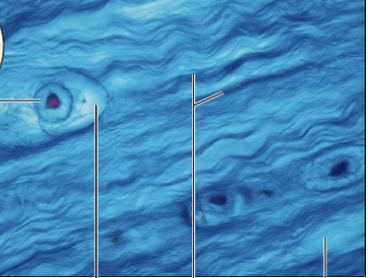
What is this type of supporting connective tissue and where is it found in the body?
Fibrocartilage
Found in the intervertebral discs, pubic symphysis, and the menisci of knee joints
What is elastic cartilage?
Flexible springy cartilage that has numerous densely packed elastic fibres arranged in a web-like mesh. Chondrocytes are closely packed with small amount of ground substance.
This tissue is both resilient and very flexible

What is this type of supporting connective tissue and where is it found in the body?
Elastic cartilage.
Found in the external ear and epiglottis of the larynx.
What are the characteristics of bone?
More solid and provides greater support than cartilage, but not as flexible.
Is extensively vascularized.
Extracellular matrix consists of organic components (collagen fibres and glycoproteins) and inorganic components (calcium salts like calcium phosphate)
Mature bone cells are called osteocytes and are housed in lacunae in the extracellular matrix.
What are the two types of bone?
Compact bone and spongy bone
What is compact bone?
Is the hard outer layer of bone, makes up 80% of bone
Bone that appears solid/smooth but is perforated by a number of neurovascular canals
Formed by cylindrical structures called osteons, which display concentric rings of bone connective tissue called lamellae
What is spongy bone?
Located within the interior of a bone and contains latticework structure (trabeculae) of bone connective tissue that is very strong yet light weight
Has hematopoetic cells that form a type of reticular connective tissue that makes blood cells via hematopoesis
Makes up 20% of bone and appears porous
What is fluid connective tissue and its function?
Blood.
Transports nutrients, gases and waste via heart and blood vessels
Contains formed elements (cells; erythrocytes and leukocytes & platelets) and blood plasma (which is the liquid ground substance)
What are the main characteristics of muscle tissue?
Is contractile, conductive, elastic, extensible, and excitable (may be stimulated by nerve impulses)
When stimulated to contract, it produces movement
Well-vascularized
What are the three types of muscle tissue?
Skeletal, cardiac and smooth
What is skeletal muscle tissue
Also called striated or voluntary muscle tissue
Is responsible for the movement of the skeleton and functions in thermoregulation
Composed of long cyclindrical skeletal muscle fibres that are arranged in parallel and unbranched
Myocytes (muscle cells) are multinucleated and peripherally located
Has striations
Considered voluntary (generally does not contract unless stimulated by somatic nervous system)
Reduced ability to repair itself through cell division
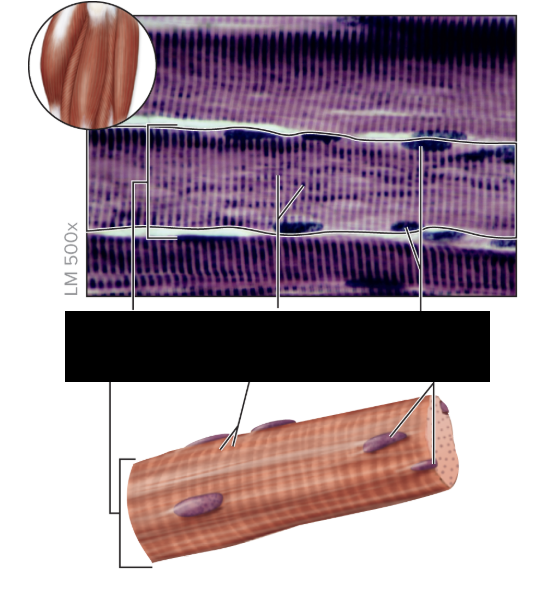
What type of muscle tissue is this and where is it found?
Skeletal muscle tissue.
Attaches to bones or sometimes to the skin (e.g., facial muscle), forms external urethral and anal sphincters
What is cardiac muscle tissue?
Myocytes are branched (Y-shaped)
Moderately striated
Under involuntary control
1-2 centrally located nuclei
Has intercalated discs that allow for the rapid passage of electrical current so it beats/contracts as a unit
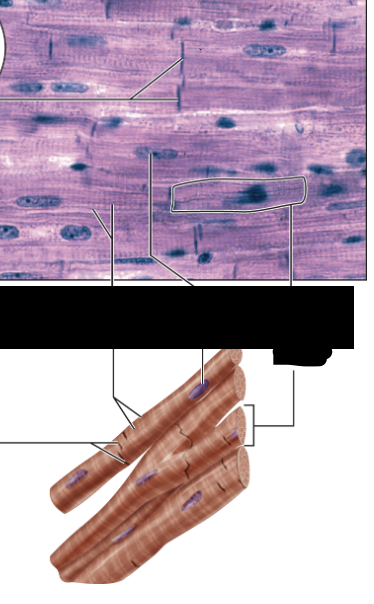
What type of muscle tissue is this and where is it found?
Cardiac muscle tissue.
Found in the heart wall (myocardium).
What is smooth muscle tissue?
Myocytes are short, wide, and has tapered ends (fusiform shaped)
Single, central nucleus
No striations
Involuntary control only

What type of muscle tissue is this and where is it found?
Smooth muscle tissue.
Found in the walls of hollow internal organs, such as intestines, stomach, airways, urinary bladder, uterus, blood vessels and the iris of the eye
What is nervous tissue?
Located within the brain, spinal cord, and nerves that traverse the body
Is well vascularized
What types of cells are in nervous tissue and what is their function?
Contains 2 types of cells:
1) Neurons (that respond to stimuli and initiate/conduct electrical activity throughout the body)
2) Neuroglia (small cells that support neurons, there are 50x more neuroglia than neurons)