Lecture 20: Fat Metabolism
 Call Kai
 Learn
 Practice Test
 Spaced Repetition
 Match
 Flashcards
 Knowt Play
1/26

There's no tags or description
Looks like no tags are added yet.
27 Terms
Triacylglycerol (Triglyceride, TG)
• Extra carbons are stored in triacylglycerol molecules, primarily in fat cells but also in muscle and other tissues.
• Acyl chains are connected to a glycerol backbone via ester bonds.
• Fatty acyl chains are saturated to allow for close packing.
• Chains must be hydrolyzed off for use.

Epinephrine and glucagon
Epinephrine and glucagon signal via GPCRs to activate lipases.
• Lipases hydrolyze ester bonds to produce free fatty acids (FFAs) and glycerol.
• FFAs are transported in the blood via albumin for cellular use.

Fat Mobilization via GPCR signalling
Epinephrine and glucagon bind to G-protein coupled receptors (GPCRs) on adipose cells (and other tissues).
• The signalling response involves the release of Gα-GTP, activation of adenylyl cyclase and cAMP production, leading to Protein Kinase A (PKA) activation.
• PKA phosphorylates and activates triacylglycerol lipase, also known as hormone sensitive lipase (HSL).
• TAGs are hydrolyzed to 3 fatty acids (+ glycerol) that are released in the blood and transported via albumin.

Difference between acrylic CoA and Acetyl CoA
Acetyl CoA has 2 carbons attached to CoA while Acyl CoA is a longer chain.
Fatty Acid Activation in the Cytoplasm
Acyl chains are trapped in the cell by the covalent addition of coenzyme A.
• Acyl CoA Synthetase (t = using a side group) catalyzes a reversible reaction that uses ATP (→ AMP) to form the Acyl CoA molecule.
• How can this reaction be favourable in the cell?
Going to the right
ATP helps with the favourability in this reaction because PPi will be hydrolyzed with H20 to form 2Pi and becoming very favourable when combined
However use of ATp is unusual

Problem: ATP → AMP is Energetically Inefficient
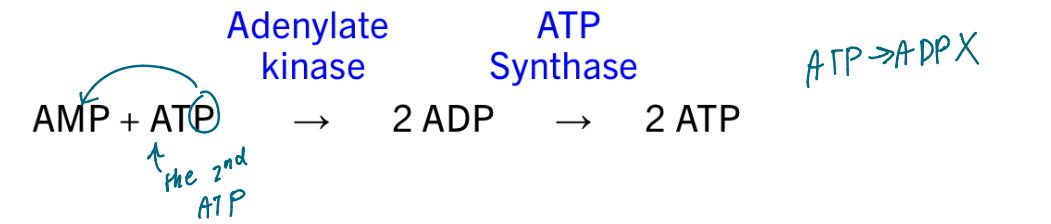
95% of the ATP is made in oxidative phosphorylation using ADP as a substrate.
• In order for ATP to be made from AMP, AMP must be converted to ADP by sacrificing a 2nd ATP (while there is no loss of energy, ADPs cannot be used by the body):
∴ Fatty acid activation by CoA requires 2 ATP (1 for activation and 1 for the production of ADP) and 1 H2O to hydrolyze PPi.
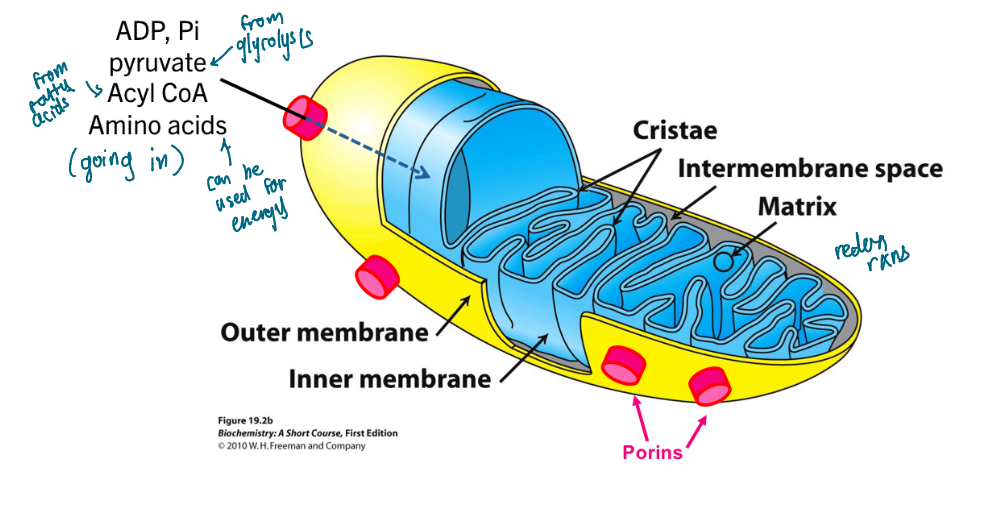
Mitochondria Structure
Acyl CoA and β-oxidation
Acyl CoA is made in the cytoplasm, but β-oxidation occurs inside the matrix.
• Acyl CoA can pass through outer membrane into the intermembrane space via porins, but it cannot cross the inner membrane since there is no transport mechanism (very impermeable).
• CoA is too large and water soluble making it unable to cross membranes.
• What’s the point of making Acyl CoA outside the matrix if it’s only used in the matrix?
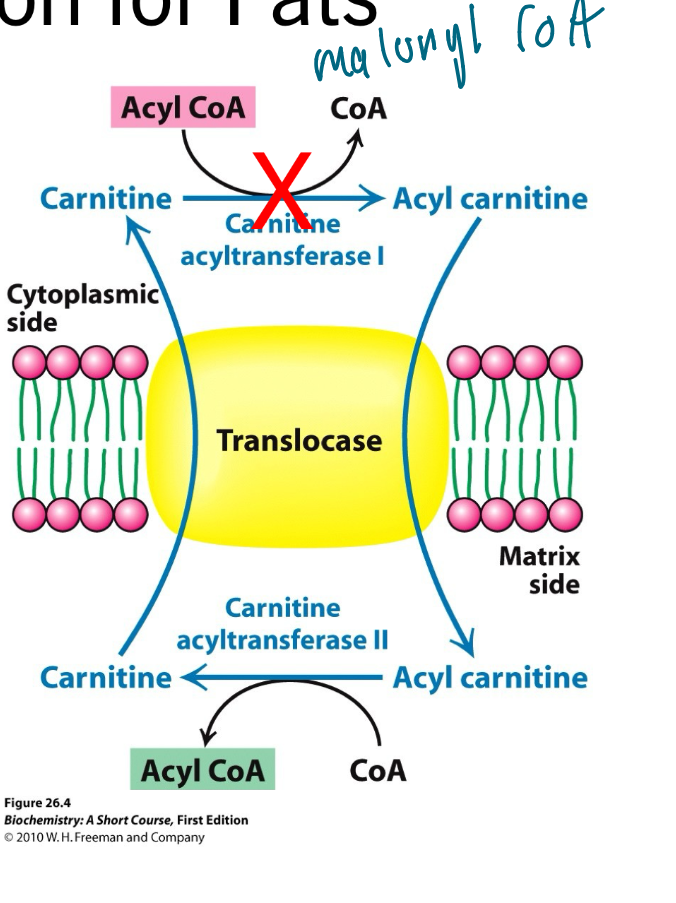
Carnitine Shuttle
The carnitine shuttle regulates what comes into the mitochondria.
• Carnitine Acyltransferase I (CAT I) moves the acyl chain onto carnitine from CoA.
• The translocase is an antiporter, moving FA chains in and carnitine out.
• Carnitine Acyltransferase II (CAT II) moves the acyl chain back onto CoA.
• Acyl CoA can then be catabolized in β-oxidation.

Could carnitine supplment act as a pull for weight loss
needs to be in a catabolic state so you need to use the energy
Less molecules coming in to break it down
Then fatty acid stores will be used to break it down for energy
Regulation of hormones to break down TAGs into FA chains and carnitine
balance of the proteins in and out, these proteins bindings might get saturated
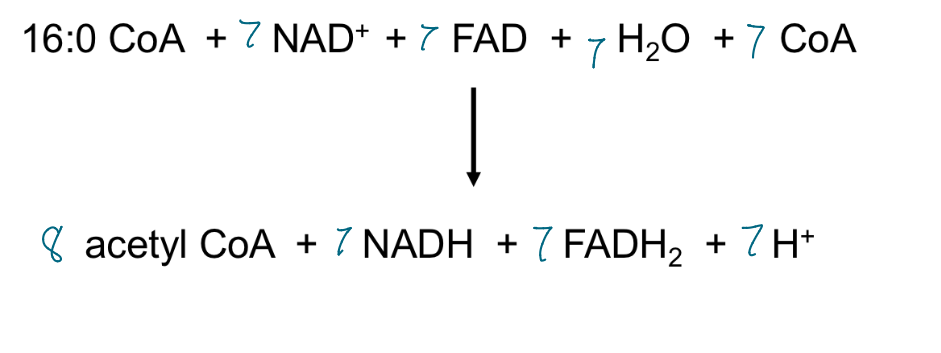
Overall β-oxidation of 16:0 CoA in the mitochondria
Using the Acetylene CoA to produce ATP and H20
CAC
ETC
ATP synthase
Fatty acid activation
Total
rules
1:1 ratio for the

Summary - Fatty Acid Breakdown
Epinephrine and/or glucagon are required for TAG breakdown.
• Fatty acids travel in blood stream bound to serum albumin and enter the tissues.
• Fatty acids are activated in the cytoplasm by acyl CoA synthetase, requiring (2) ATP.
• The carnitine shuttle controls fatty acid entry into matrix.
• Acyl chains are broken down in β oxidation producing Acetyl CoA, NADH and FADH2.
• β oxidation can* produce a huge amount of ATP using the Citric Acid Cycle and oxidative phosphorylation.
Dependent on the CAC, and phosphorylation
Using Fats as Fuel
In order to generate ATP in the mitochondria, Acetyl CoA from fat degradation needs to be processed via TCA.
• TCA is dependent on the amount of oxaloacetate present.
• In order to efficiently make ATP from fat, cells need oxaloacetate. (Acetyl CoA)
• Oxaloacetate can be made from amino acids or pyruvate by an enzyme called pyruvate carboxylase (GNG).
• You need a blend of fuels, both glucose, amino acids and fats, for efficient energy production.

Localization of Fat Metabolism Differs….

Hormonal Response and Fat Synthesis
Hormone needed for the cellular uptake of fuel: insulin
• Pathways that are on (initially) (making ATP and NADHs): Glycolysis (breakdown of carbs), PDC (making acetylene CoA), beat oxidation (making more acetyl CoA)
• Pathways that are turned off:
CAC slows down for acetyl CoA export
Glycolysis also shows down for glycogen synthesis
• Molecules responsible for regulation:
ATP and NADH, rising intermediate metabolites
Steps in Fatty Acid Synthesis
Fatty Acid Processing Steps:
1. Export of mitochondrial Acetyl CoA to the cytoplasm for fat synthesis.
2. Carboxylation of acetyl CoA to malonyl CoA by Acetyl CoA Carboxylase (ACC). (Adding CO2)
3. Use of malonyl CoA to form 16:0 fatty acid chains by Fatty Acid Synthase (FAS).
Step 1 – Export differs from Import
CoA goes through the cytoplasm again by being citrate, then converts back into acetyl CoA

Step 1: Acetyl CoA is exported as Citrate
Recall Coenzyme A cannot cross the inner mitochondrial membrane.
• Citrate synthase makes citrate in the Citric Acid Cycle, which can cross the inner membrane.
• Citrate is broken down by different enzymes to recreate Acetyl CoA, regenerating a pyruvate molecule.
• The pyruvate can then return to the mitochondria while Acetyl CoA is used for the synthesis of fatty acyl chains in the cytoplasm.
Fatty Acid Synthesis is an Anabolic Process
Acyl chain synthesis occurs in the cytoplasm.
• 2 enzymes are needed – Acetyl CoA Carboxylase and Fatty Acid Synthase.
• Acetyl CoA Carboxylase converts Acetyl CoA to malonyl CoA, an activated 2-carbon carrying precursor for fatty acid synthesis.
• Acetyl CoA Carboxylase is the committed and regulated step for fatty acid synthesis.
• Acetyl CoA Carboxylase uses ATP, while Fatty Acid Synthase uses NADPH as reducing power.
Step 2: Acetyl CoA Carboxylase (ACC)
Acetyl CoA is carboxylated using ATP to produce Malonyl CoA.
• The presence of the CO2 group on malonyl CoA will be used to drive fatty acid synthesis by fatty acid synthase (step 3).

Reciprocal Regulation for Fats
• When fat synthesis is ON, fat degradation is OFF.
• This prevents the futile cycle of synthesizing chains, then breaking them down.
• The product of Acetyl CoA Carboxylase (ACC) - malonyl CoA, inhibits CATI and shuts down the carnitine shuttle for the import of chains.
• ACC is also regulated for fat metabolism…
ACC Regulation via Phosphorylation
low ATP = no synthesis of fats
Catabolic
Acetyl CoA Carboxylase is the committed step for FA synthesis.
• ACC is inhibited by phosphorylation with rising glucagon/epinephrine and AMP.
• Insulin and protein phosphatase activate ACC via dephosphorylation.
• Citrate can also stimulate ACC, while palmitoyl CoA (16:0 CoA) inhibits active ACC.
• The product, malonyl CoA also shuts down fat breakdown by inhibiting Carnitine Acyltransferase 1 (don’t forget your competing pathways!).

Step 3: Use of malonyl CoA to form fatty acid chains by Fatty Acid Synthase (FAS).
The Acyl Carrier Protein (ACP) moves the
intermediates between the different reaction sites.
Fatty Acid Synthase (FAS)
what is being used
Don’t need to know the reactions that occur
Step 1 - A condensation reaction occurs with the release of CO2, adding 2 carbons to the chain.
Step 2 - redox reaction using NADPH
Step 3 – dehydration
Step 4 – 2nd redox reaction using NADPH
→ Repeat with another malonyl CoA

Fat Synthesis
The synthesis of fatty acids requires the actions of both Acetyl CoA carboxylase (ACC) and Fatty Acid Synthase (FAS).
• 7 cycles of FAS are required to generate 16:0. This involves 1 acetyl CoA and 1 malonyl CoA in the first cycle, followed by 6 malonyl CoA molecules for the next 6 rounds of reactions.
• Lots of energy is required for this anabolic pathway to proceed: ACC needs 7 ATPs to make 7 malonyl CoAs, and FAS needs 14 NADPHs.
• Elongation of the 16:0 chain (18, 20, 22, 24) occurs in the ER, also using malonyl CoA and NADPH.
• Desaturases can introduce cis bonds, also requiring NADPH and oxygen.
Triglyceride (TAG) formation
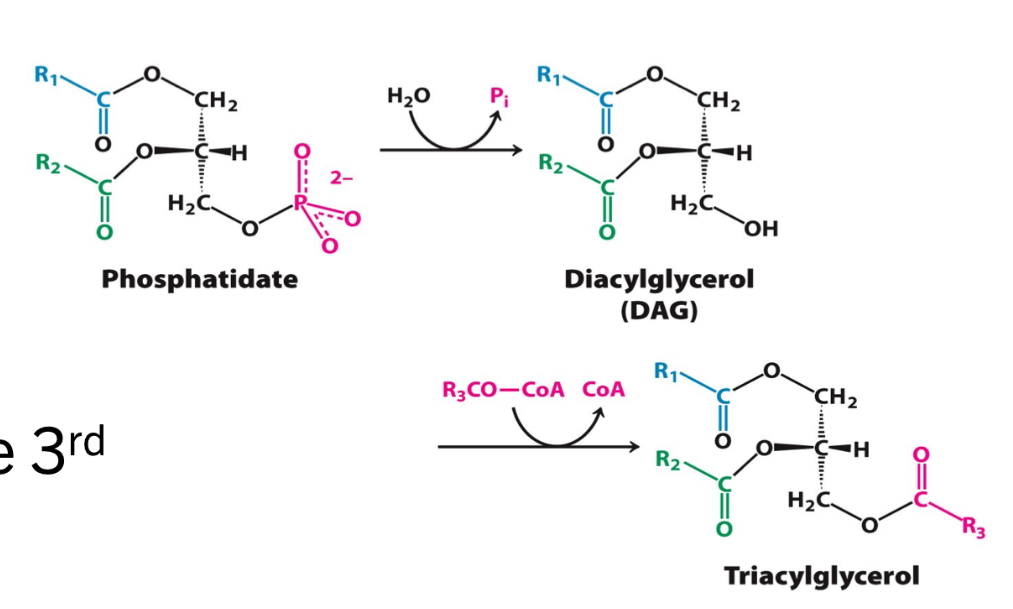
Triglycerides are made starting with phosphatidate.
• The phosphate is first removed by a phosphatase producing diacylglycerol.
• Diacylglycerol acyltransferase adds the 3rd fatty acyl tail to make tri-acyl-glycerol.
• Elevated insulin promotes the activation of all the enzymes involved - ACC, FAS and acyltransferases.
• TAGs produced in the liver can be released in the blood stream as lipoproteins for storage or use (next lecture).