Lab Practical EX. 12
 Call Kai
 Learn
 Practice Test
 Spaced Repetition
 Match
 Flashcards
 Knowt Play
1/46

There's no tags or description
Looks like no tags are added yet.
47 Terms
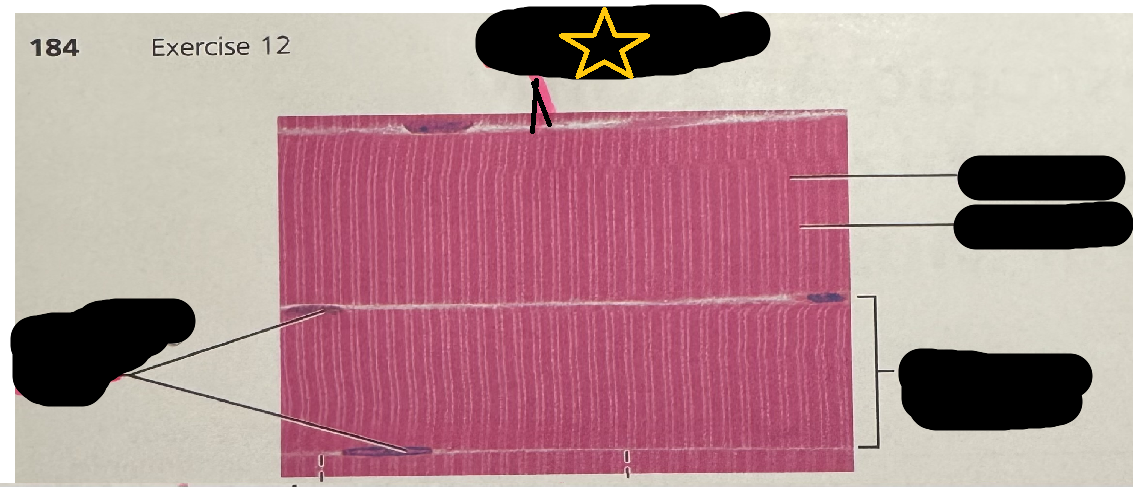
striations

dark A band

light I band

muscle fiber/cell (singular cynlinder)

multiple nuclei
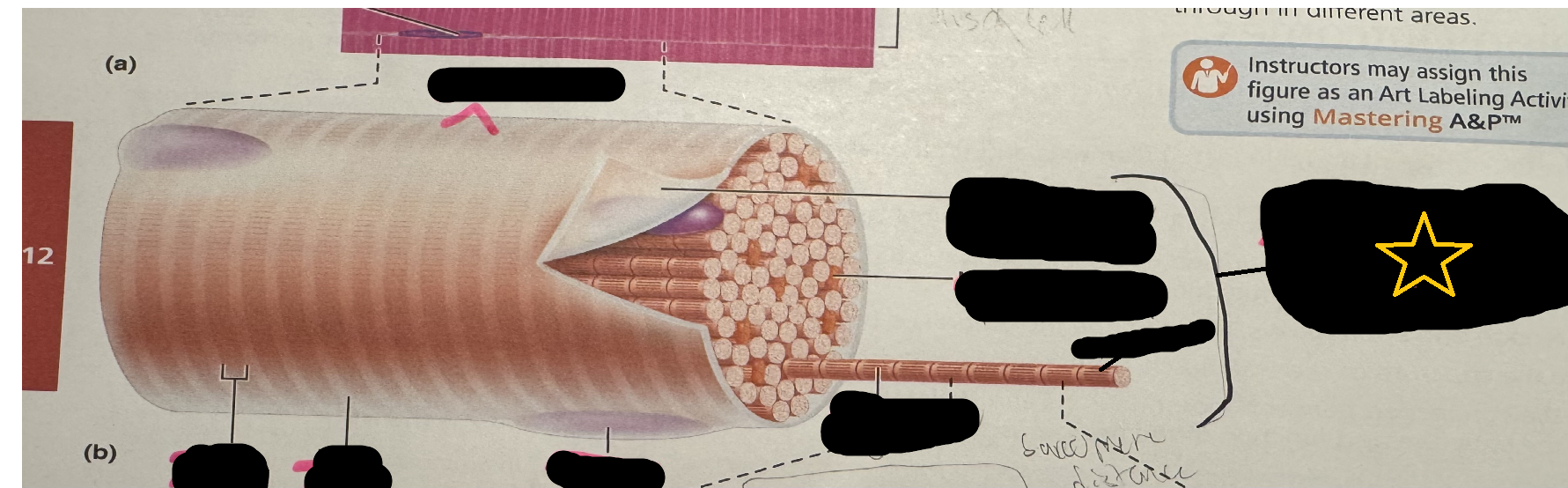
muscle fiber/cell (whole thing)

nucleus

dark A band (in whole muscle fiber)

light I band
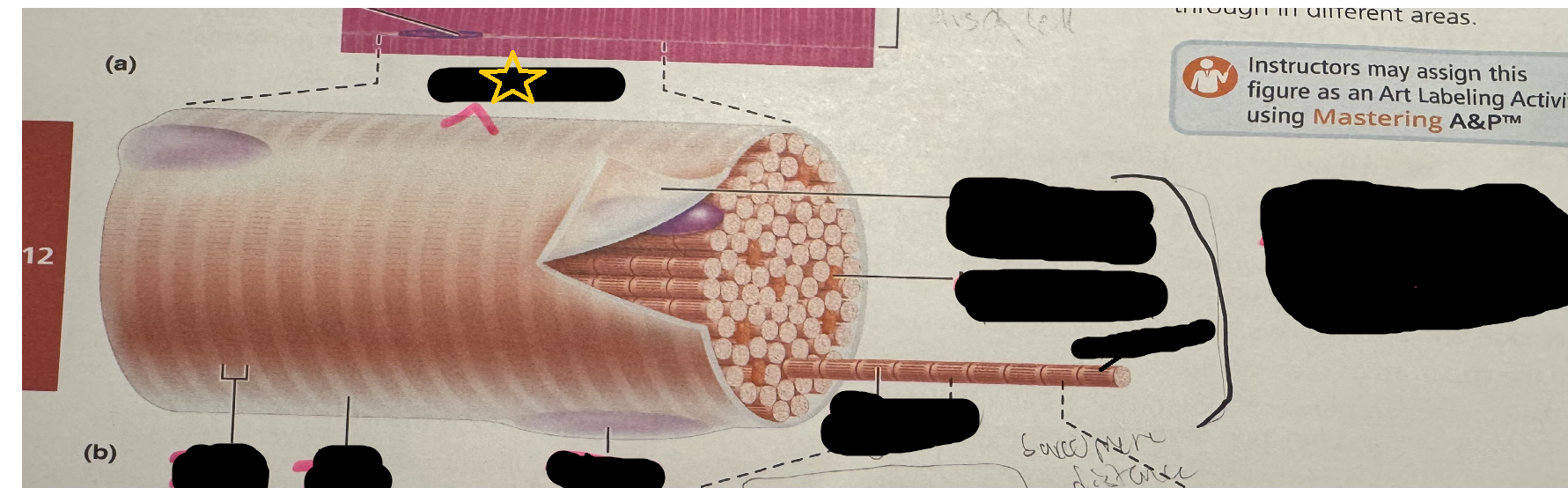
striations

sarcolemma (plasma membrane)

mitochondrion (makes ATP)

myofibril (organelle)
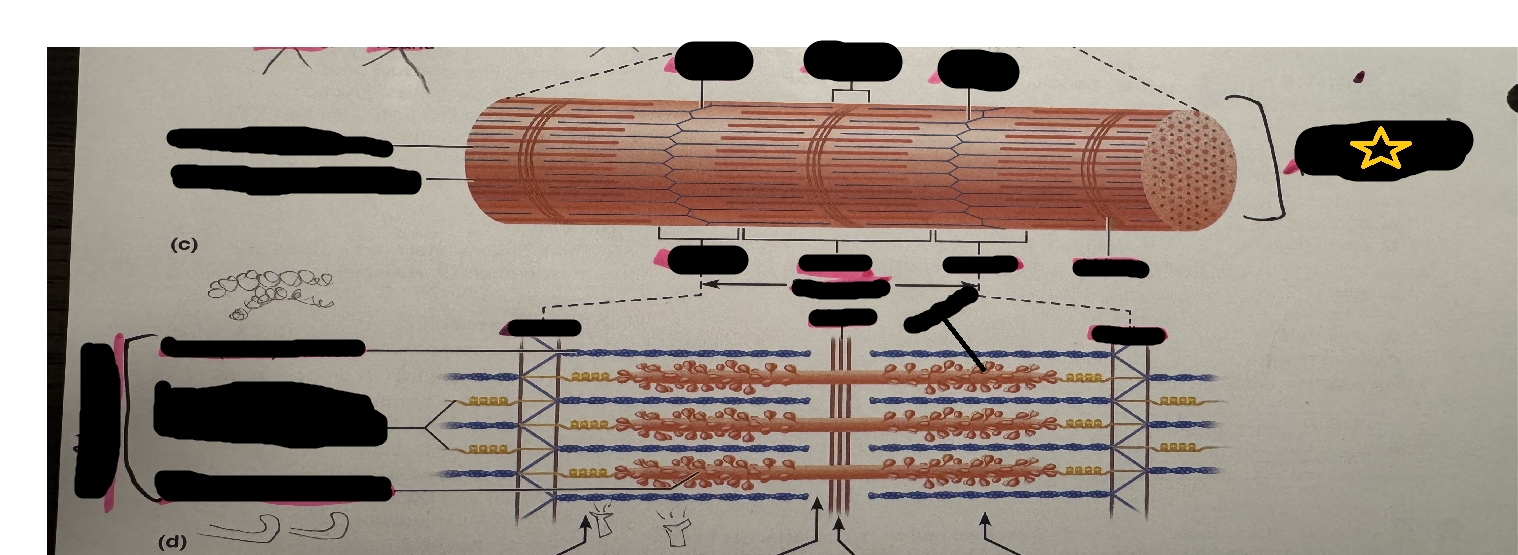
myofibril (whole thing)

sarcomere

z discs

H zone

I band (light on myofibril)
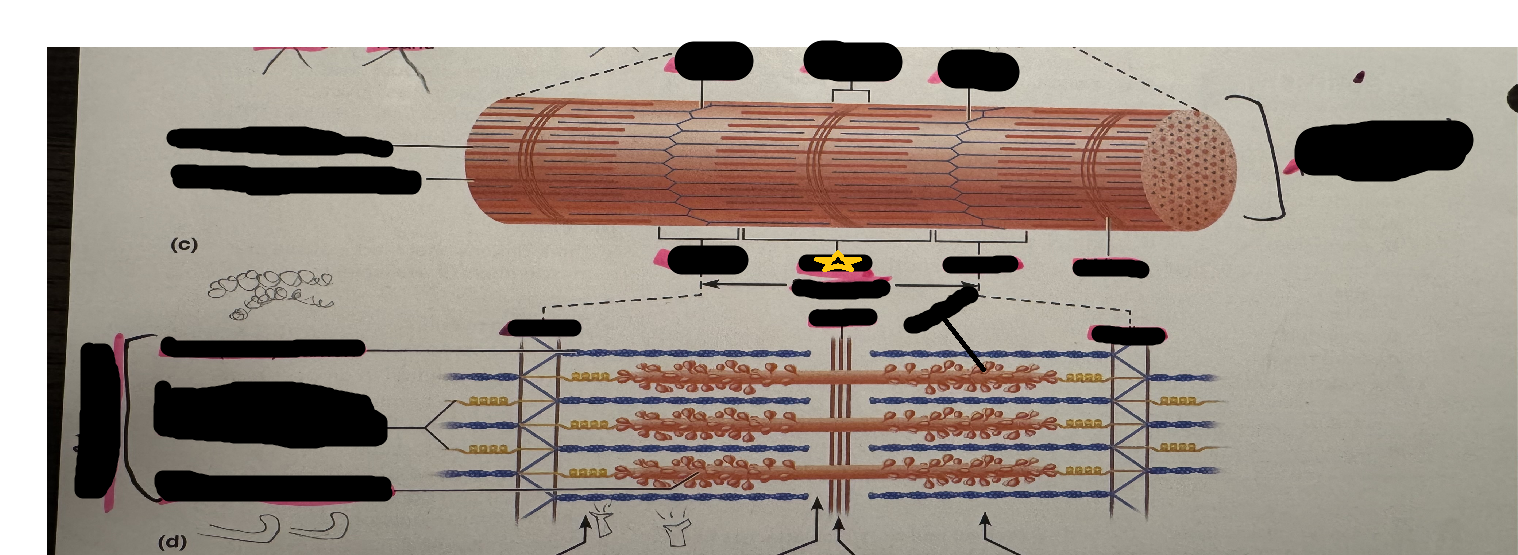
A band (dark on myofibril)

M line
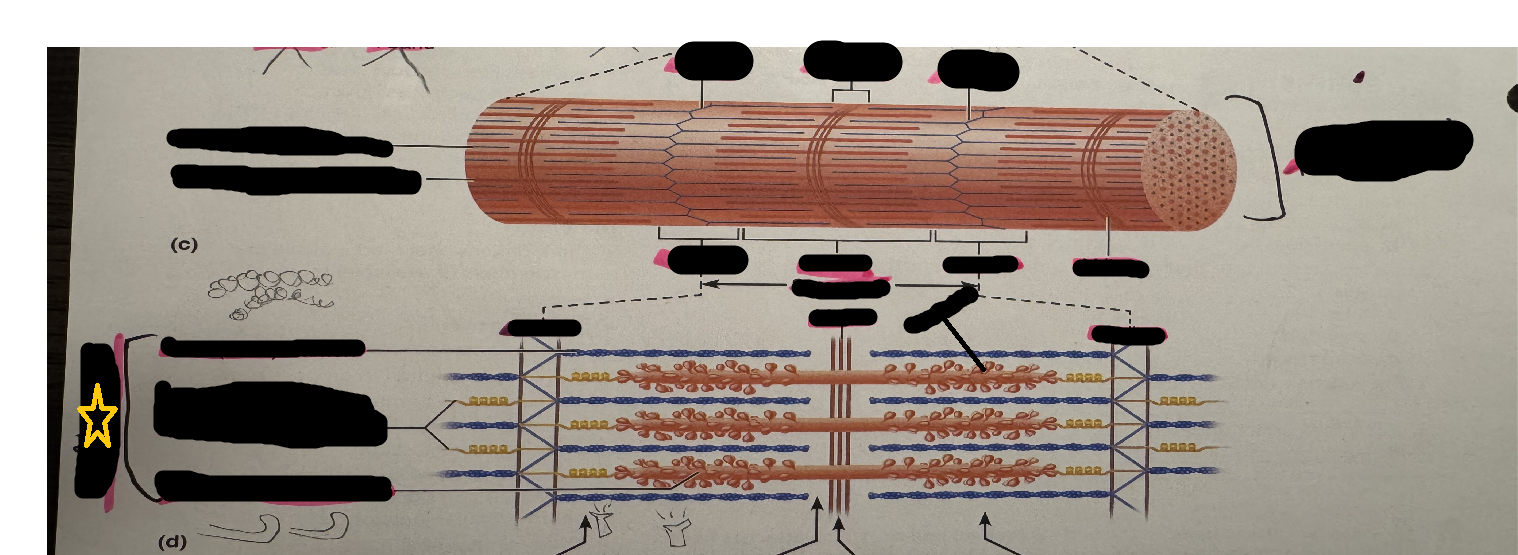
myofilaments

thin (actin) filaments

elastic (titan) filament (recoil)

thick (myosin) filament

sarcomere (in group of myofibrils)- between one I band to the middle of the next)

triad

transvere (T) tubule

2 terminal cisterns of the SR
dense fibrous irregular CT sheath that covers entire skeletal muscle
epimysium
dense irregular CT, wraps fasicles (bundles of muscle fibers/cells)
perimysium
delicate areolar CT, wraps individual muscle fibers/cells
endomysium
bundle of skeletal muscle fibers
fasicle (wrapped by perimysium)
all sheaths converege to form a broad flat sheet of dense fibrous CT to attach muscle to bone, cartilage, or other muscles
aponeuroses
sheaths come together to from cord-like bands of dense regular CT to attach muscles to bones
tendons
a muscle’s more movable attachment
insertion
fixed (immovable) muscle attachment
origin
each axon of the neuron divides into many branches
terminal branches (this is a singular axon terminal)

each terminal branch ends with
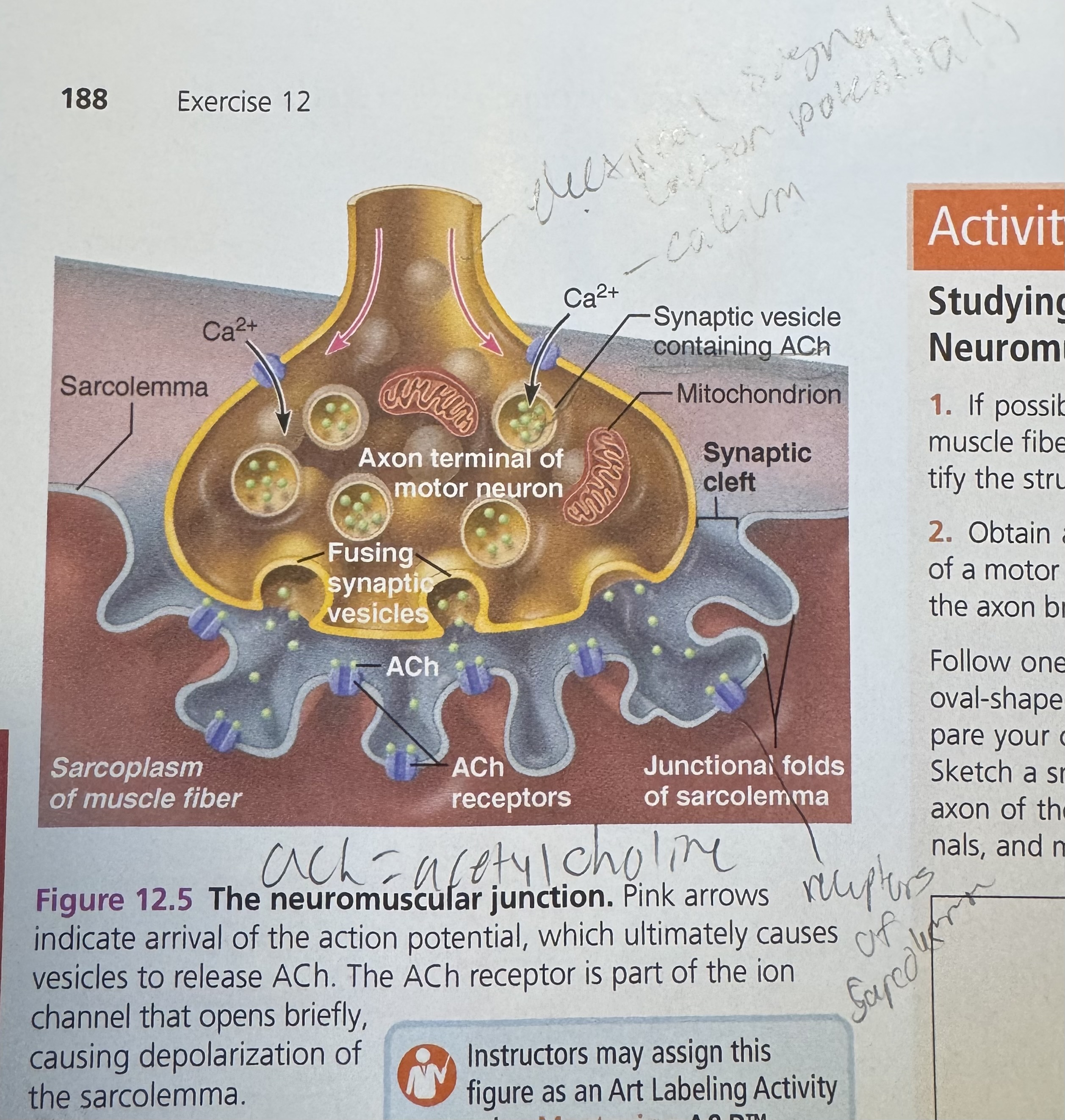
axon terminal (where branch meets a muscle fiber/cell, forms neuromuscular junction)
a neuron and all the muscle fibers it stimulates make up a
motor unit

fluid filled gap between axon terminal and muscle fiber
synaptic cleft
within the mitochondria and vesicles in the axon terminal, a neurotransmitter
acetylcholine (Ach)

process of Ach
when action potential reaches the axon terminal, voltage gated Ca2+ channels open
Ca2+ enters the axon terminal and causes Ach to be released by exocytosis
Ach rapidly diffuses across the synaptic cleft and combines with receptors of the sarcolemma
when receptors bind Ach, a change in the permeability of the sarcolemma occurs
ion channels open briefly, depolarizing the sarcolemma, contracting the muscle
when action potential reaches the axon terminal, voltage gated Ca2+ channels open, Ca2+ enters the axon terminal and causes Ach to be released by _____
exocytosis
after Ach is released by exocytosis, it rapidly diffuses across the synaptic cleft and combines with
sarcolemma receptors
when receptors bind Ach, a change in the permeability of the sarcolemma occurs
ion channels open briefly, depolarizing the sarcolemma, contracting the muscle
ends contraction; eats Ach
AchE
blocks the release of Ach from the axon terminal, so muscles cannot contract
botulism
binds to AchE (stop contractor) and inhibits it, so muscle remain contracted
sarin nerve gas