Exam 3
 Call Kai
 Learn
 Practice Test
 Spaced Repetition
 Match
 Flashcards
 Knowt Play
1/23

Earn XP
Description and Tags
purple = previous mistake; red = protocol/problem-solving tips, yellow = relatively new or important
24 Terms
ionic bond
two atoms, one atom which is more electronegative than the other, exchange electrons and the charges hold the atoms together.
most ionic character is between a metal and a non-metal
ionic compounds arrange themselves in 3-dimensional lattices to maximize interaction between opposite charges
covalent bond
mutual attraction of atoms for a “shared” pair of electrons.
bond length: internuclear distance at which the lowest potential energy is achieved.
two kinds:
pure covalent bond (equal sharing of electrons); “nonpolar”
most common when the bond is between identical atoms
Electrons shared in pure covalent bonds have an equal probability of being near each nucleus
In order to be nonpolar, the two atoms in the chemical bond need to have an electronegativity difference of 0.0-0.4.
polar covalent bonds (bonding electrons are shared, but no longer equally)
polar bonds occur between two nonmetals and have a difference in electronegativities of the atoms of approximately 0.5-2.0.In order to be nonpolar, the two atoms in the chemical bond need to have an electronegativity difference of 0.0-0.4
Bonding electrons are more attracted to one atom than the other, giving rise to a shift of electron density.
Symbols δ+ and δ– indicate the polarity of the bond.

energy and bonds
endothermic = energy requires to break bonds - positive enthalpy
exothermic = formation of bond releases energy - negative enthalpy
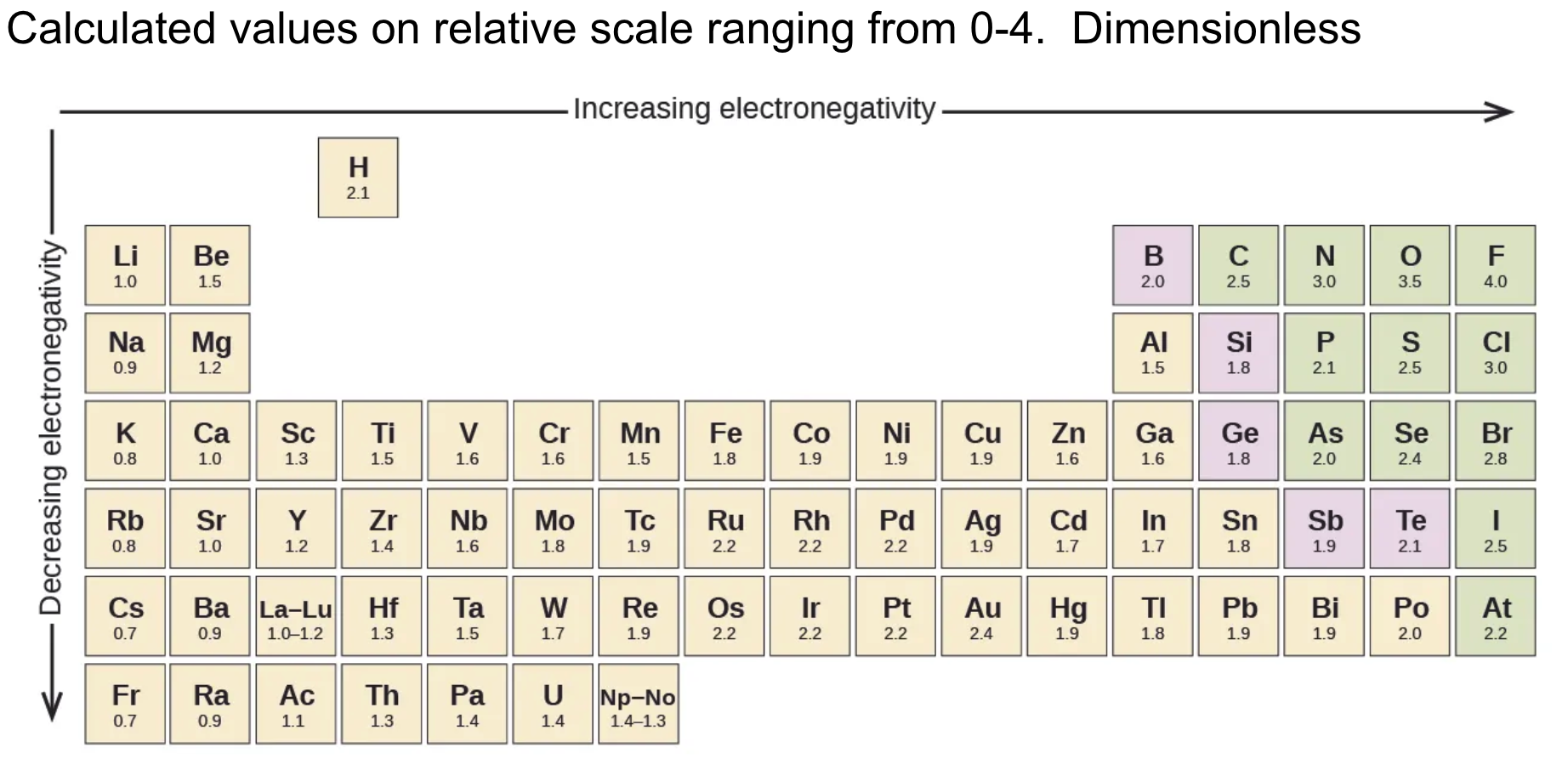
electronegativity
measure of the tendency of an atom to attract electrons (or electron density) towards itself
increases across a period (larger Z); decreases down a group (b/c of shielding by outer electrons)
absolute value of the difference in electronegativity of two bonded atoms provides a rough measure of the bond and, thus, the bond type.
0-0.4 = pure covalent
0.4-1.8 = polar covalent
>1.8 = ionic
partial charges
partial charges are determined by the relative electronegativities of the atoms in a bond; the more electronegative atom, Br, has a partial negative charge and the less electronegative atom, C, has a partial positive charge.
models for understanding molecular structure
BASIC models fall short in being able to explain experiment evidence:
lewis dot structures predict how atoms share electrons to form molecules
VSEPR predicts three-dimensional molecular shapes
ADDITIONAL CONCEPTS help explain molecular properties:
valence bond theory (8.1)
orbital hybridization (8.2)
molecular orbital theory (8.4)
lewis dot diagrams depict valence shell electrons and chemical bonds
atomic symbol is used to represent the nucleus + core e-
up to 4 valence e- are placed around a symbol ;
if more than 4 valence e-, pair the e- one at a time
can be used to illustrate formation of ions
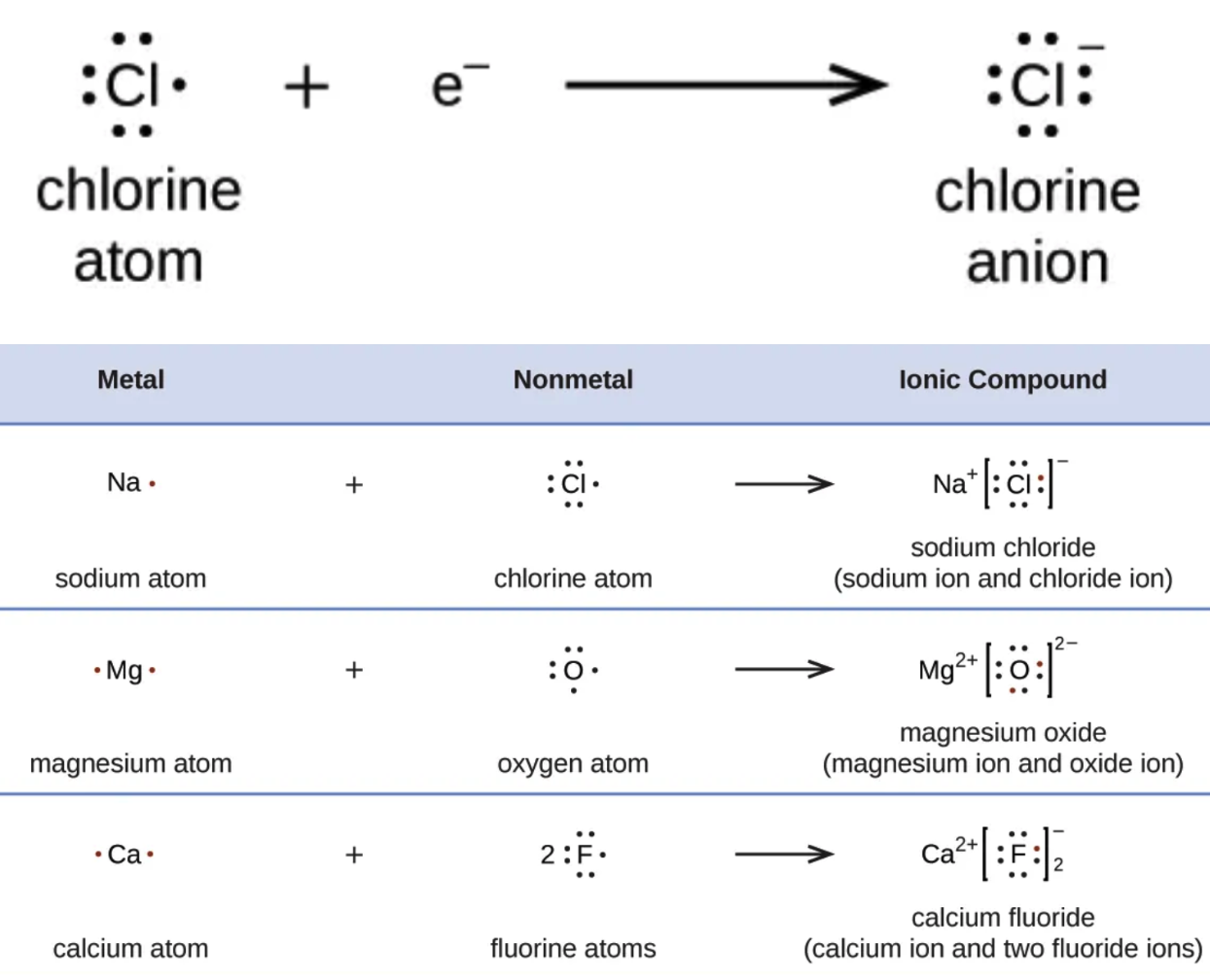
lewis structures can show covalent bonds
octet rule = tendency of main group atoms to form enough bonds to obtain eight valence electrons
double bond = occurs when a pair of atoms may need to share two pairs of electrons in order to achieve an octet
triple bond = occurs when a pair of atoms may share three pairs of electrons in order to achieve an octet
PUT BRACKETS around ions with charges outside
PROTOCOL FOR DRAWING LEWIS STRUCTURES OF POLYATOMIC MOLECULES
determine # of valence electrons
draw skeleton diagram of the molecule. least electronegative molecule should be placed in the center. connect each atom to the central atom with a single bond (one electron pair)
distribute remaining electrons as lone pairs on terminal atoms (except hydrogen), completing an octet around each atom
place all remaining electrons on central atom
rearrange electrons on outer atoms to make multiple bonds with the central atoms to obtain octets (wherever possible, if needed)
when it comes to lewis structures of uncharged organic molecules, the condensed formula of a molecule helps provide some structural information about the molecule by indicating how certain atoms are grouped together (ex. CH3NH2)
RESONANCE is when more than one valid lewis structure can be drawn for a molecule
resonance structures have the same arrangement of atoms, but a different arrangement of e– (the e– are delocalized over the molecule)
the actual molecules is an average of all its resonance structures
for example, in the case of O3, only one bond length is observed and its value is between that of the O–O bond length for O22- (a single bond) and O2 (a double bond) because it is an average of the two
use a double-sided arrow (⟷) to indicate resonance
FORMAL CHARGES as the hypothetical charge of an atom in a molecule if the electrons in the bonds were shared evenly between the atoms
the sum of the formal charges of all atoms in neutral molecule must be zero (in an ion, sum should equal the charge of the ion)
formal charge = # of valence electrons - (# of lone pair electrons + ½ # of bonding electrons)
½ # of bonding electrons = number of bonds
Formal charge is only a useful bookkeeping procedure; it does not indicate the presence of actual charges.
FORMAL CHARGES CAN BE USED TO PREDICT MOLECULAR STRUCTURE; the possible structure that is most likely follows these guidelines:
Structure in which all formal charges are zero is preferable
If the Lewis structure must have nonzero formal charges, the arrangement with the smallest nonzero formal charges is preferable.
Structure preferable when adjacent formal charges are zero or of the opposite sign.
When we must choose among several Lewis structures with similar distributions of formal charges, the structure with the negative formal charges on the more electronegative atoms is preferable
exceptions to octet rule (3 categories)
many covalent molecules have central atoms that do not have eight electrons in their Lewis structures.
Odd-electron molecules: odd number of valence electrons, and therefore have an unpaired electron
Generally, molecules with central atoms from groups 2 and 13, outer atoms that are hydrogen, or other atoms that do not form multiple bonds.
Electron-deficient molecules have a central atom that has fewer electrons than needed for a noble gas configuration
Hypervalent molecules have a central atom that has more electrons than needed for a noble gas configuration.
Elements in the third and higher periods (n ≥ 3) have more than four valence orbitals and can share more than four pairs of electrons with other atoms because they have empty d orbitals in the same shell. Lewis structures for two hypervalent molecules, PCl5 and XeF4 are shown below.

bond length
more electron pairs in bond = stronger bond
stronger bond = shorter bond (generally)
RESONANCE STRUCTURES & BOND LENGTH
picture NO2-: the two bond lengths actually have EQUAL STRENGTH
The actual distribution of electrons in each of the nitrogen-oxygen bonds is the average of a double bond and a single bond.
NO2- does not FLUCTUATE between resonance forms; rather, the actual electronic structure is always the average of that shown by all resonance forms.
VSEPR (Valence Shell Electron-Pair Repulsion theory) helps predict 3d structure of molecules
you can predict the structure of a small molecule by:
drawing a Lewis structure and count the number of bonds and lone electron pairs around the central atom
Arrange electron pairs to minimize repulsions between electrons. Electrostatic repulsion is reduced when regions of high electron density (lone pairs + bonds) are as far from each other as possible.
Count any bond (single/double/triple) as a single electron domain
Bond angle = angle between any two bonds that include a common atom
Repulsions between regions of electron density differ - not all regions of electron density are equal
small distortions from the ideal angles can result from differences in repulsion between various regions of electron density
from highest to lowest repulsion: lone pair - lone pair > lone pair - bonding pair > bonding pair - bonding pair
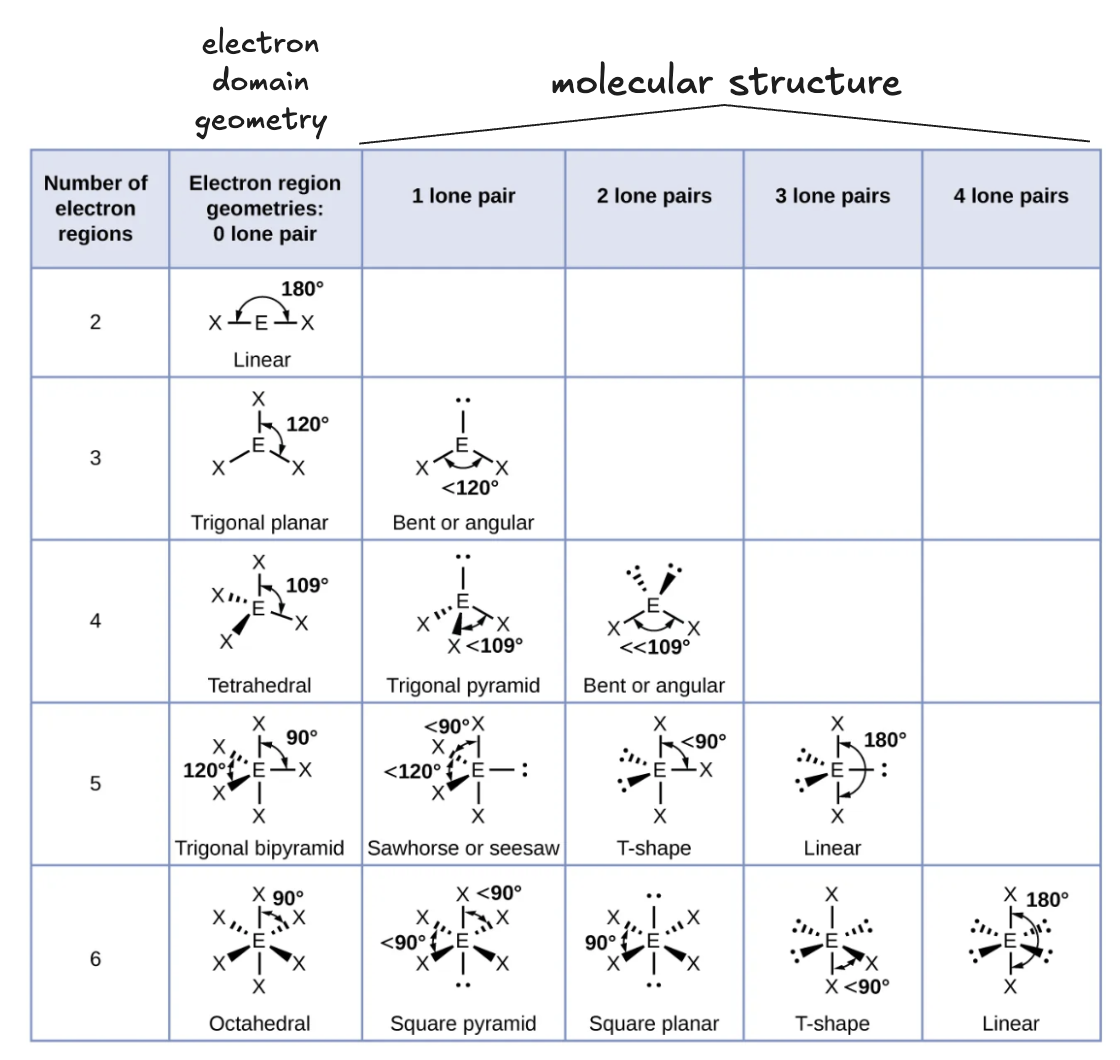
3d molecular structures (VSEPR)
Electron-pair geometries (electron domain geometry) = describes all regions where electrons are located, bonds as well
lone pairs.
Two bonds and no lone pairs of electrons on the central atom = linear; bond angle = 180
Three bonds and no lone pairs of electrons on the central atom = trigonal planar; bond angle = 120
Four bonds and no lone pairs of electrons on the central atom = tetrahedral; all bond angles = 109.5°
Five bonds and no lone pairs of electrons on the central atom = trigonal bipyramidal; bond angles = 120 (between equatorials) or 90 (between axial and equatorial) or 180 (between two axials)
Equatorial: In the plane of the triangle (3)
Axial: Above or below the plane of the triangle (2)
Six bonds and no lone pairs of electrons on the central atom = octahedral; Bond angle = 90
Molecular structure = structure that includes only the placement of the atoms in the molecule
know that the bond angles will usually smaller than in the electron pair geometry above
for the sake of the exam just write them as “<(bond angle of electron domain geometry)”
three domains
lone pair =bent
four domains
lone pair = trigonal pyramid
lone pair = bent
five domains
lone pair = sawhorse/seasaw
lone pair = equatorial, 2 bond equatorial, 2 bond axial
lone pair = T-shape
2 lone pairs = equatorial, 1 bond equatorial, 2 bond axial
lone pair = linear (bond angle = 180)
3 lone pairs = equatorial, 2 bonds axial
six domains
lone pair = square pyramid
4 bonds equatorial, 1 bond axial, 1 lone pair axial
lone pair = square planar (bond angle = 90)
4 bonds equatorial, 2 bonds axial
lone pair = T-shape
3 lone pairs equatorial, 1 bond equatorial, 2 bonds axial
lone pair = linear (bond angle = 180)
4 lone pairs equatorial, 2 bonds axial
wedge & dash notation: solid lines are bonds in the plane of the page, solid wedges are bonds coming up out of the plane, dashed lines are bonds going down into the plane
valence bond thoery + orbital hybridization
bonds are formed by the overlap of atomic orbitals
This causes the orbitals to combine into a new orbital, which is called hybridization.
However this is still a simplification. In molecules electron orbitals are actually not bound to particular nuclei, they are "delocalized" as it is called, meaning they are actually bound to the molecule as a whole. So what Molecular Orbital Theory does is replace atomic orbitals with molecular orbitals.
two electrons of opposite spin can be accommodated in the overlapping orbitals
the bonding electrons have a higher probability of being found in the region of space between the nuclei. Both electrons are simultaneously attracted to both nuclei
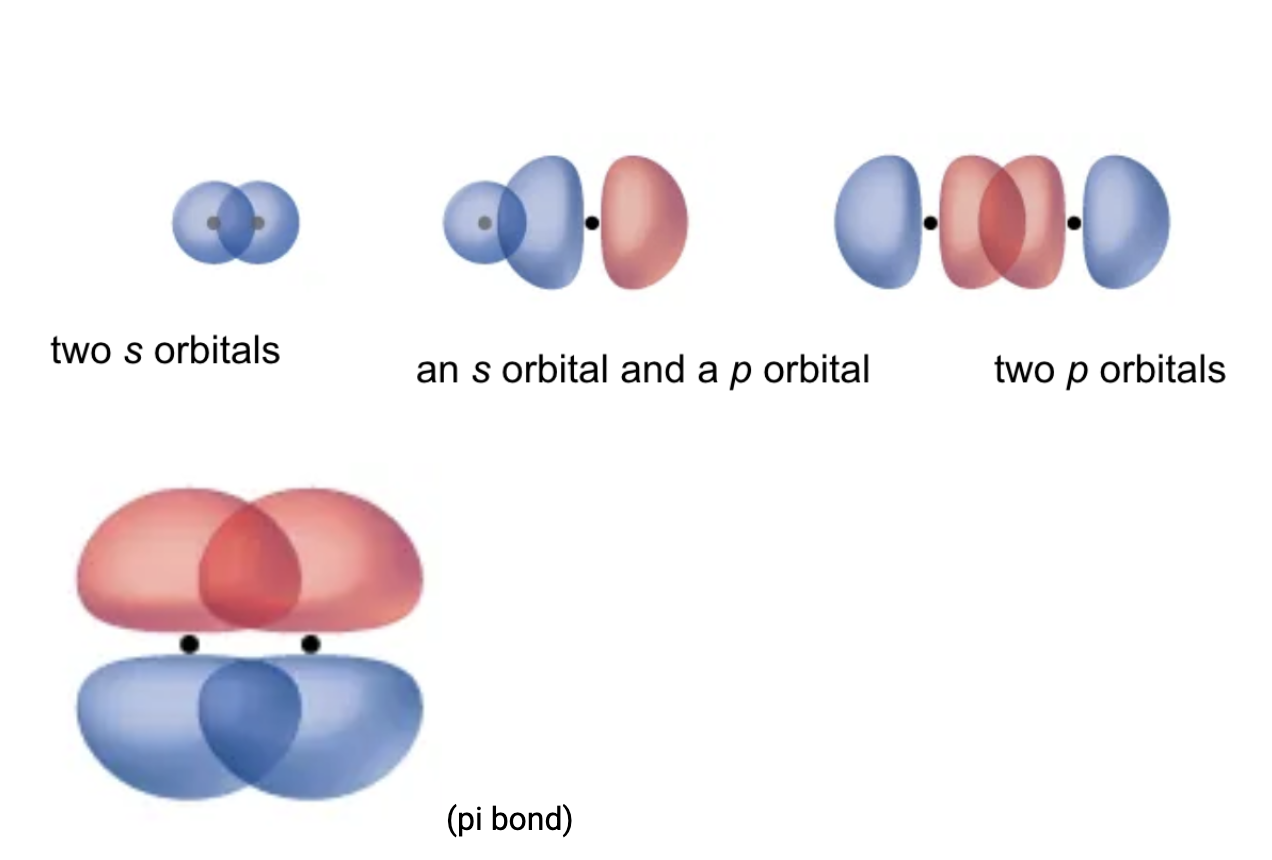
Sigma (σ) bonds = covalent bond in which the electron density is concentrated in the region along the internuclear axis
Sigma (σ) bonds form from the overlap of:
2 s-orbitals
an s-orbital and p-orbital
2 p-orbitals
Single bonds in Lewis structures are described as σ bonds in valence bond theory
Pi (𝛑) bonds = A covalent bond that results from the side-by-side overlap of two p orbitals.
Regions of orbital overlap lie on opposite sides of the internuclear axis.
While all single bonds are σ bonds, multiple bonds consist of both σ and π bonds.
The first bond formed will always be a σ bond. For multiple bonds, there will be one σ bond, and the remaining one or two bonds will be π bonds.
Quantum mechanics predicts specific regions around an atom where electrons are likely to be located ex. s, p and d orbitals (atomic orbitals
However, our pictures of the atomic orbitals only describe the orbitals around free atoms → Atomic orbitals (ex. s, p, d ) are not adequate to describe the regions where electrons will be located in a molecule.
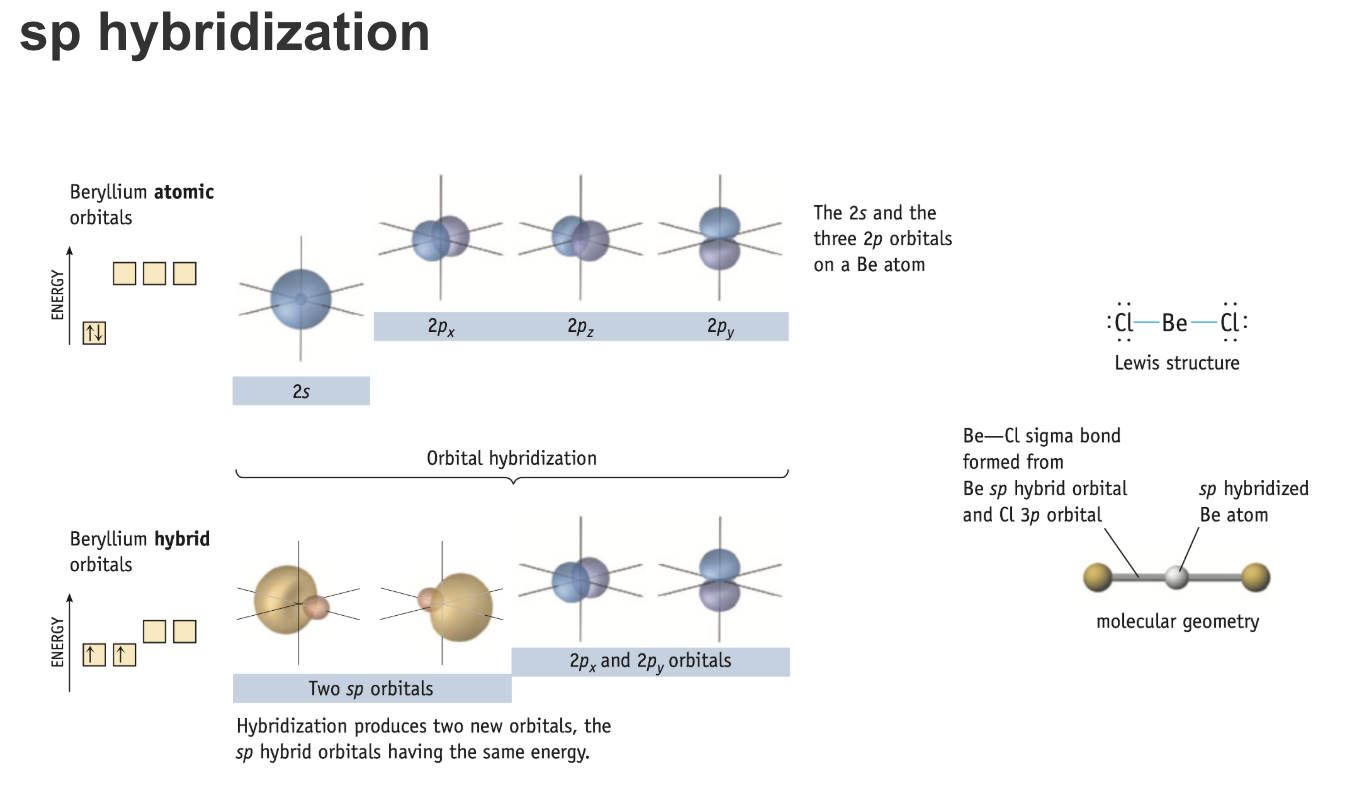
ORBITAL HYBRIDIZATION
Describes the rearrangement of e- in an atom in order to make bonds in molecules.
Hybrid orbitals do not exist in isolated atoms— only in covalently bonded atoms.
created by mixing s and p orbitals
Hybrid orbitals are degenerate (they have the same energy)
Hybrid orbitals directed toward the terminal atoms to increase orbital overlap and create stronger bonds
to determine the hybridization of an atom, count the # of electron-dense domains; that # is equivalent to the # of orbitals hybridized
2 = sp
3 = sp2
4 = sp3
sp hybridization
2: sp (e.g., linear geometry, 180°)
sp3 hybridization
3: sp² (e.g., trigonal planar geometry, 120°)

sp3 orbital hybridization
4: sp³ (e.g., tetrahedral, trigonal pyramidal, or bent geometry)

hybridization and bonding
explains the sigma + pi thing in the double bond
also shows:
Why \(\pi \) bonds are weaker and more reactive than \(\sigma \) bonds: Diagram (a) shows \(\sigma \) electrons sitting directly between the two nuclei, holding them tightly. Diagram (b) shows \(\pi \) electrons sitting farther away (above and below the plane), making \(\pi \) bonds easier to break during chemical reactions.
Why double bonds lock molecules in place: Because the two unhybridized \(p\) orbitals must stay parallel to overlap side-by-side, the molecule cannot twist around the \(\text{C}=\text{C}\) bond without breaking the \(\pi \) bond. This explains why molecules with double bonds are rigid and flat around those atoms.


rotation about bonds
molecules can rotate freely around single bonds
rotation around double bonds is restricted because the 𝜋-bond would have to be broken (the 2p orbitals out of plane) - see cover pic
Restricted rotation around double bonds → cis-trans isomerism

bond dipole moment in polar covalent bonds
Polar covalent bonds connect two atoms with differing electronegativities
Bond dipole moment results from the separation of charge in a polar covalent bond. The magnitude of a bond dipole moment is represented by the Greek letter mu (µ).
Vector notation for bond dipole moments
molecular orbital theory
The behavior of an electron in a molecule is described by a wave function, Ψ, analogous to the behavior of an electron in an isolated atom.
Electrons around atoms in molecules are limited to discrete (quantized) energies.
The region of space in which a valence electron in a molecule is likely to be found is called a molecular orbital (Ψ2)
A wave function (Ѱ) describes the wavelike properties of an electron in an AO
Molecular orbitals (MO)s are combinations of atomic orbital (AOs) Ѱs
Combining waves can lead to constructive interference (bonding orbitals), in which peaks line up with peaks, or destructive interference (antibonding orbitals), in which peaks line up with troughs
in the case of p-orbitals, there is 1 sigma and 2 pi for both bonding and antibonding orbitals
Each atom has three mutually perpendicular p orbitals (px, py, pz) When two atoms bond along a single internuclear axis, those three directions create one head-on (sigma) interaction and two side-on (pi) interactions
The bonding MO is lower in energy than the parent orbitals and the antibonding orbital (*) is higher
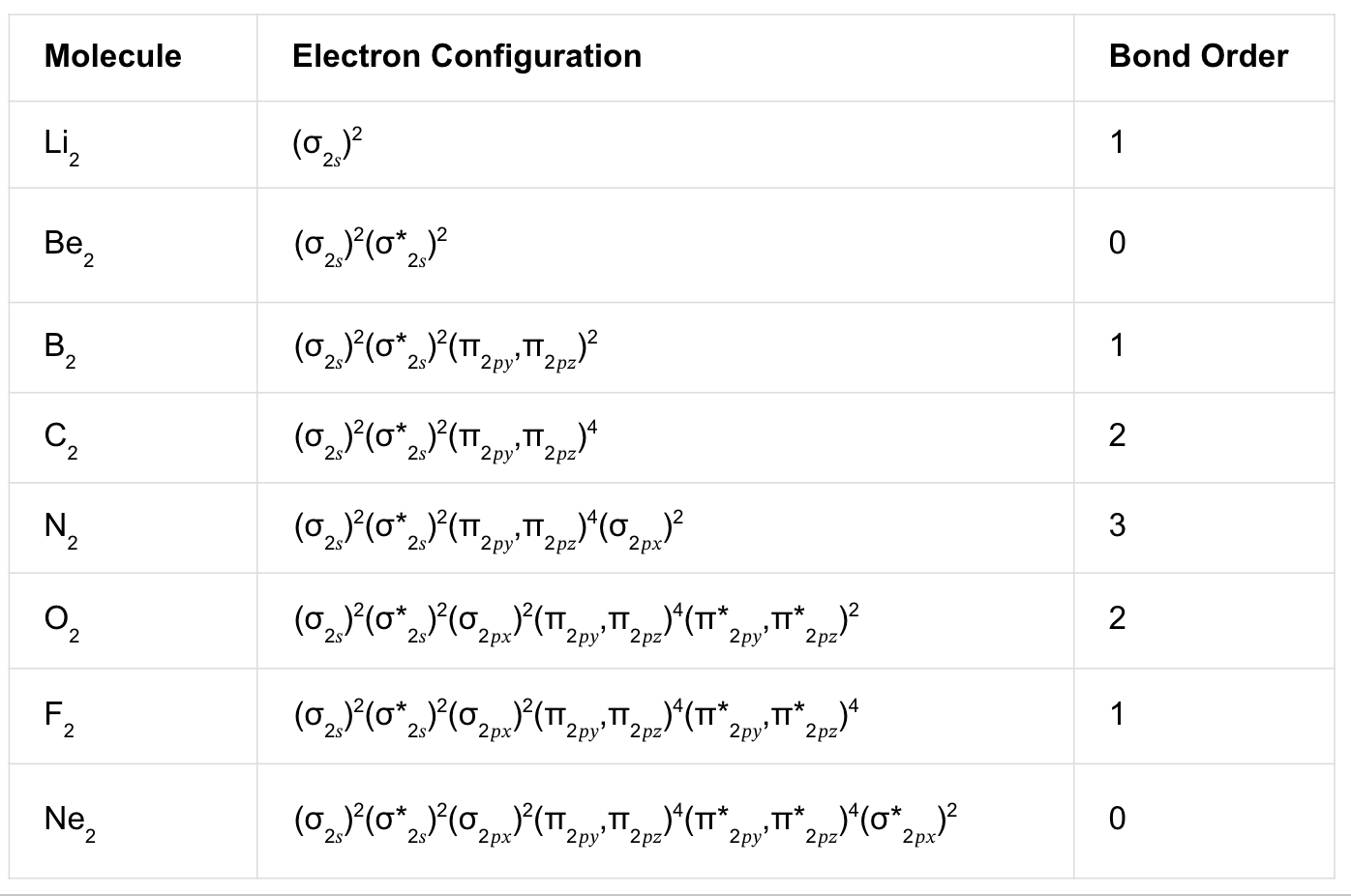
bond order = (# of electrons in bonding orbitals - # of electrons in antibonding orbitals)/2
If the bond order > 0, then the electrons are more stable in the MOs relative to the AOs. The higher the bond order, the more stable the interaction
O22+ = 3.0 O2+ = 2.5 O2 = 2.0 O2- = 1.5
paramagnetic = molecules that have unpaired electrons in the MOs (ex. O2)
diamagnetic = Materials in which all of the electrons are paired; weakly repel a magnetic field.
The apparent weight of most molecules decreases slightly in the presence of an inhomogeneous magnetic field.
Attraction to a magnetic field is called paramagnetism, and it arises in molecules that have unpaired electrons.
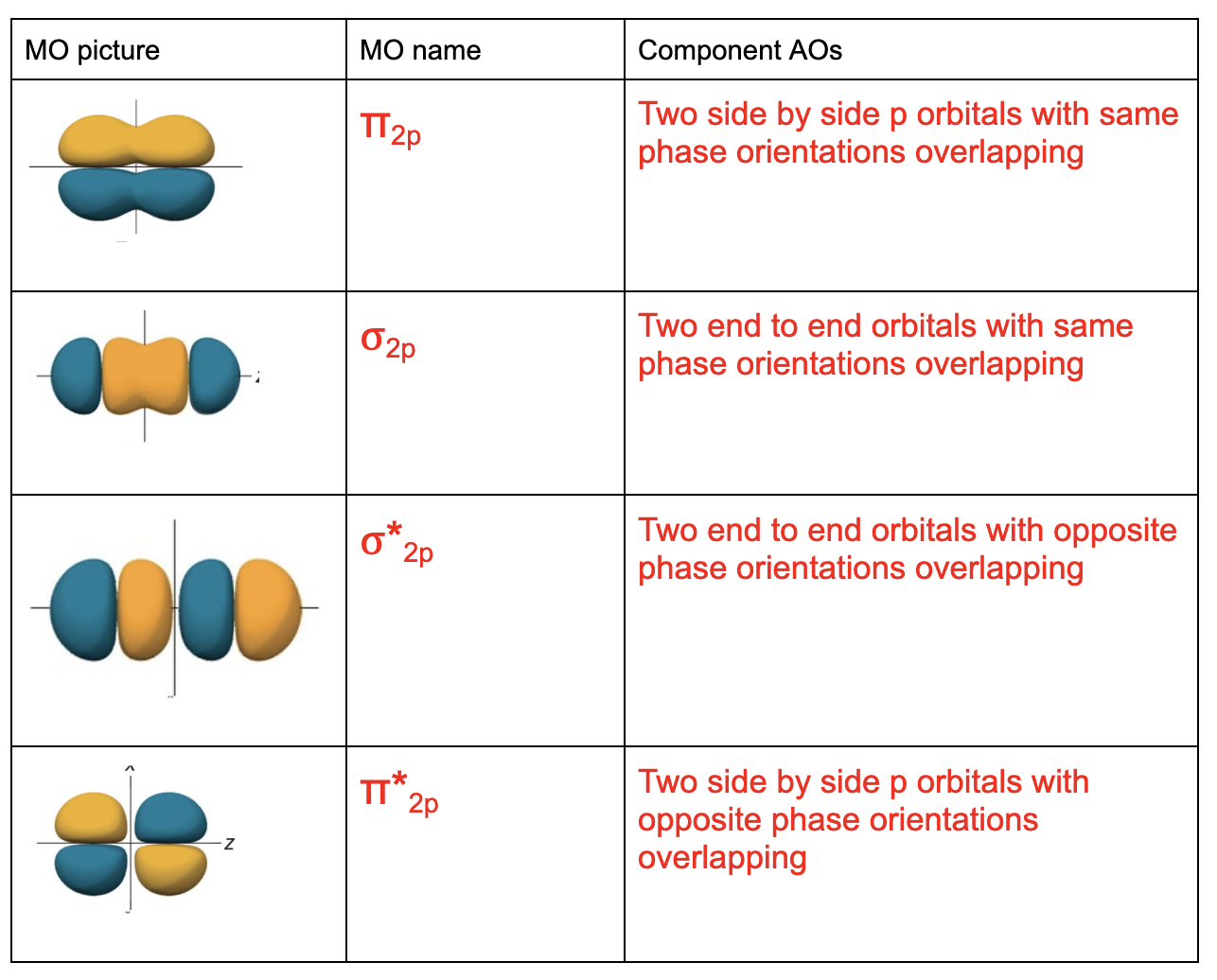
identifying molecular orbitals
# of MOs produced = the # of AOs going in
for p-orbitals
sigma bonds: Overlap of p orbitals along the internuclear axis (if there’s “stuff” to the left and right of the nucleus) → combining the orbitals knocks them together
pi bonds: Side-by-side overlap of two p orbitals (if there’s “stuff” above and below the nucleus) → still nothing touches the nucleus even if they’re combined
MO bonding diagram
Fill molecular orbitals analogously to filling atomic orbitals (Aufbau principle, Pauli exclusion principle and Hund's rule.
Lower-energy orbitals fill first. Electrons spread out among degenerate orbitals before pairing, and each orbital can hold a maximum of two electrons with opposite spins
you can write the electron configuration as such (in this case, all are filled)
(𝜎2s)2(𝜎*2s)2(𝜎2px)2(π2py)2(π2pz)2(π*2py)2(π*2pz)2(𝜎*2px)2

NUANCE: not all molecular diagrams are the same
Orbital energies decrease across the row as the effective nuclear charge increases; Between N2 and O2, the order of the orbitals changes.
typically, σ orbitals are more stable than π orbitals. However, this is not always the case.
When the energies of the component AOs, become close (impact of Zeff), the σs combines with the σp → the σs orbital becomes more stable
The σp orbital becomes less stable
(O2 on left, N2 on right)
O2 and beyond = 1 2 2 1, others = 2121
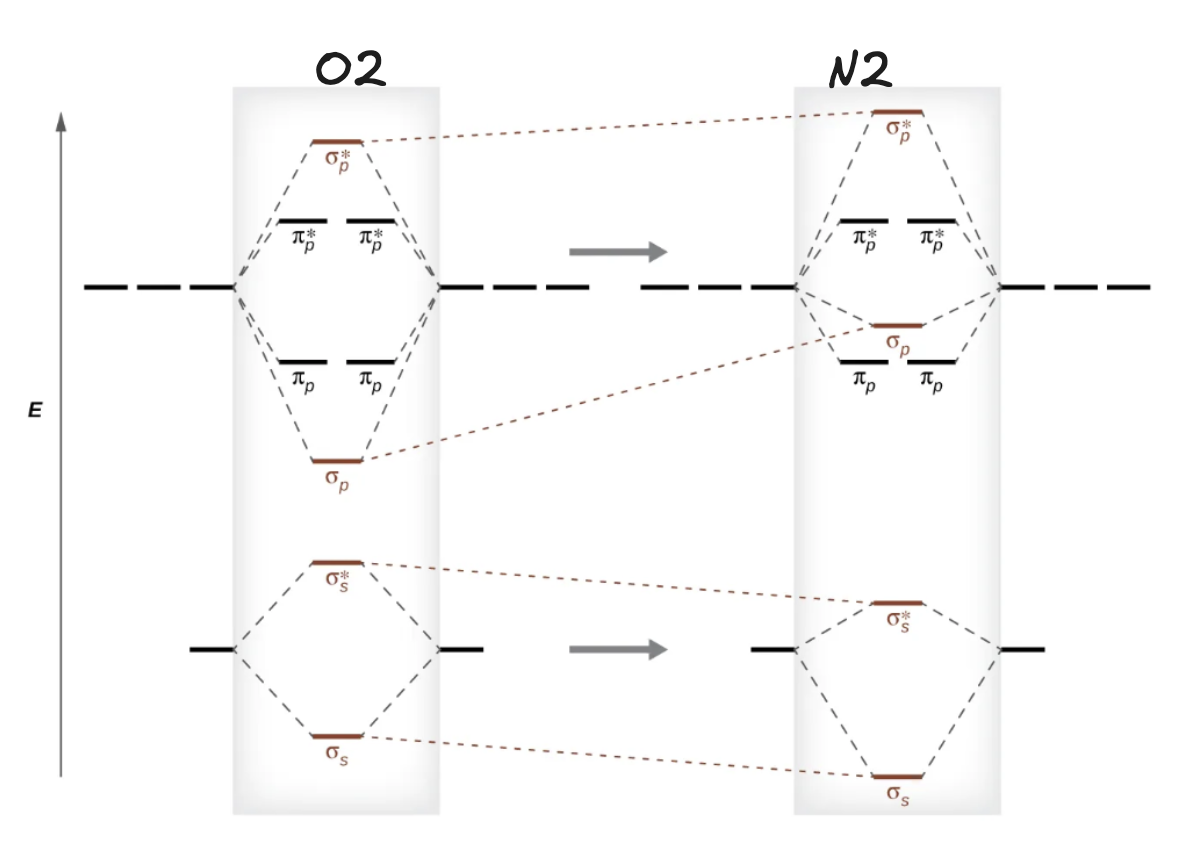
electron configurations for period 2 diatomic molecules