Week 4, Lecture 1: Mirror Neurons
 Call Kai
 Learn
 Practice Test
 Spaced Repetition
 Match
 Flashcards
 Knowt Play
1/46

There's no tags or description
Looks like no tags are added yet.
47 Terms
QUestions about Mirror Nuerons
How were they discovered?
Do hamsn have them? Bc they were discovered in monkeys, hwo would we knwo that they do
What is the role of mirror neurons in midnreadign?
One account is mentalizing, of how we make sense of ppls minds
Critiques of the motor resonance account
The role of Mirror neurons in imitation
Def = ability to Learn from others just by watching them
Modeling
what are the three regions of the mirror neuron system?
Ventral Premotor Cortex / Inferior Frontal Gyrus (IFG): This frontal region (including the lower part of the precentral gyrus and Broca's area) handles the execution and observation of motor actions, particularly involving the hands and mouth. [1, 2]
Inferior Parietal Lobule (IPL): This region integrates visual and somatosensory information, helping to plan movements and map the physical actions observed in others onto your own motor system. [1]
The anterior Intra-Parietal Sulcus (aIPS) is essentially a specialized sub-region or extension of the inferior parietal lobule (IPL) within the mirror neuron system.
It plays a crucial role in processing how we interact with objects. Here is how it functions within the network:
Object and Goal Tracking: While the core mirror system tracks the overall action, the aIPS specifically codes the kinematics of grasping and the properties of objects (like shape and size).
The "How-To" Hub: It translates the visual shape of an object into the exact hand shape, grip, and finger coordination needed to interact with it.
Mirroring Manipulations: When you watch someone else grip a coffee mug, your aIPS fires to map the exact geometry of that hand-to-object interaction onto your own motor brain.
Superior Temporal Sulcus (STS): This region surrounds the temporal-parietal junction and processes biological motion, visual inputs, and the visual appearance of actions before they are translated into motor commands by the frontoparietal network. [1, 2, 3]
1. How Mirror Neurons Were Discovered
Mirror neurons were discovered by accident in the early 1990s by a team of Italian neurophysiologists (Giacomo Rizzolatti, Vittorio Gallese, Leonardo Fogassi, and colleagues).
The Setup: The researchers were studying motor control in macaque monkeys. They placed electrodes in area F5 of the ventral premotor cortex to record individual neurons while the monkey reached for food (like a raisin or peanut).
The Serendipitous Moment: One day, while a monkey was sitting still waiting for the next trial, a researcher walked into the lab and picked up a piece of food.
The Finding: The monkey's brain monitor began firing intensely, exactly as if the monkey itself were reaching for the food, even though it was completely motionless. The same cells fired both during action execution (doing) and action observation (seeing).
2. Do Humans Have Them? How Do We Know?
Yes, humans have mirror neurons. Because invasive single-cell electrode recording is generally unethical in healthy humans, scientists had to find other ways to prove their existence.
We know humans have them through two primary lines of evidence:
Direct Evidence (Single-Cell Recording): In 2010, neuroscientist Mukamel and colleagues recorded brain activity in epilepsy patients undergoing brain surgery (where electrodes are temporarily implanted to locate seizures). They found individual neurons in the human medial frontal cortex and temporal lobe that fired during both the execution and observation of hand grasping and facial expressions.
Indirect Evidence (Neuroimaging): Functional MRI (fMRI), Transcranial Magnetic Simulation (TMS), and Electroencephalography (EEG) consistently show that when humans watch someone perform an action, the human "action-observation network" (including the premotor cortex, inferior parietal lobule, and aIPS) lights up.
3. The Role of Mirror Neurons in Mindreading (Mentalizing)
"Mindreading" or Theory of Mind (ToM) is our ability to infer other people's hidden mental states, beliefs, desires, and intentions. There are two primary competing accounts of how we do this:
The Motor Resonance / Simulation Account
This account argues that mirror neurons allow us to understand others from the bottom-up.
When you see someone look at a glass of water and reach out their hand, your mirror neurons simulate that movement in your own brain.
This "motor resonance" gives you an immediate, intuitive, and experiential understanding of what they are doing and why (e.g., "They are thirsty"). You read their mind by simulating their actions inside your own motor system.
The Mentalizing Account
This account argues that mindreading is a top-down, conceptual process rather than a purely motor simulation.
It relies on a completely different brain network (the Default Mode Network, including the temporoparietal junction [TPJ] and medial prefrontal cortex).
According to this view, mirror neurons only decode the physical movement ("hand closing on glass"). Your conceptual mentalizing system then takes over to infer the actual mental state ("They are drinking because they think the water is safe, but it's actually poisoned").
Most cognitive scientists today believe the two systems interact: mirror neurons handle the immediate, physical "what," while the mentalizing network handles the abstract, psychological "why."
4. Critiques of the Motor Resonance Account
While popular in the media, the idea that mirror neurons are the sole foundation of human empathy and mindreading faces severe critiques from cognitive neuroscientists (such as Gregory Hickok, author of The Myth of Mirror Neurons):
Action Understanding Without Motor Ability: People with severe motor deficits or paralysis can still perfectly understand actions they cannot physically perform. For example, a person born without arms can easily understand someone else opening a jar. This proves motor simulation is not required for comprehension.
The "What vs. Why" Problem: A mirror neuron can fire when it sees a hand pick up a sponge, but it cannot tell you why the person picked it up (Are they cleaning? Are they throwing it away? Are they painting?).
Overextended Claims: Critics argue that mapping mirror neurons to complex human traits like art appreciation, language evolution, and global empathy is speculative and lacks rigorous empirical support.
5. The Role of Mirror Neurons in Imitation and Modeling
Imitation is the ability to learn from others just by watching them, translating a visual input into a motor output. Mirror neurons provide the vital neural bridge that makes modeling possible.
The Mapping Problem: If you want to copy someone dancing, your brain has to take a visual image (what your eyes see) and translate it into motor commands (what your muscles do).
The Mirror Solution: Mirror neurons solve this because they speak both "languages"—they are activated by visual sight and motor action.
The Imitation Circuit: When modeling a behavior, information flows from the visual cortex \(\rightarrow \) to the aIPS/parietal mirror areas (which code the exact structure of the movement) \(\rightarrow \) to the premotor mirror areas (which prepare the motor commands) \(\rightarrow \) to the frontal cortex(which decides whether to inhibit the movement or physically execute the imitation).
Without this automatic translation system, learning complex physical skills, cultural traditions, or social gestures purely through observation would be incredibly slow and inefficient.
TOM and autism
The Theory of Mind (ToM) Network handles high-level, conceptual cognitive empathy. It is the system responsible for realizing that other people have independent minds with their own unique beliefs, hidden motives, knowledge, and deceptive thoughts.
When trying to figure out why someone is acting a certain way, the TPJ acts like a switchboard that distinguishes between "my thoughts" and "your thoughts," while the mPFC processes the abstract social meaning behind those thoughts. This network allows a person to effortlessly understand a complex social scenario, like sarcasm, white lies, or a surprise party.
What is different in autistic individuals?
Autistic individuals process mentalizing tasks differently, leaning heavily on atypical functional connectivitywithin this network.
Altered Connectivity: Rather than a localized "deficit," fMRI studies show hypo-connectivity (weaker communication) between the TPJ and the mPFC, but often hyper-connectivity (over-communication) within local regions. The regions struggle to sync up efficiently over long distances in the brain.
Cognitive vs. Intuitive Processing: Because the automatic, intuitive ToM network doesn't compute social scenarios seamlessly, many autistic individuals use alternative, highly taxing cognitive strategies to "mindread." They might use the prefrontal cortex to logically deduce what a person is thinking based on rules, scripts, and past data, rather than intuitively "feeling" it.
The Intention-Outcome Gap: Neuroimaging shows that during moral reasoning tasks (e.g., judging whether someone who accidentally hurts someone else is "bad"), the TPJ in autistic individuals shows altered activation. They may place greater cognitive weight on the objective outcome of an action rather than the hidden intention behind it, because tracking invisible intent is much more computationally demanding for their network.
mirror neuron
a nueron that is active (in macaques) both when performing a particular action and when observing the action being performed by another. these neurons represent the goal (eg, reaching for) of an action, not the simple movements and not just wahts visilble.
repetition suppression
the reduction in neural response (and BOLD signal) observed when a stimulus is presented a second tiem. the initial presentation recruits a broad selection of Ns, while the repetition of poorly tuned Ns drop out, leaving a more selective and effiecnt rep. the total signal shrinks bc the remaing representation is mroe precise.
what did kilners study find about repetition suppression and if there are two separate pops of neurons or just mirror neurons?
its the same neurons doing both the observing and the perofrming, so you see rep suprression, proving humans have mirro rnuerons
what did robert gordon, philosopher, say about TOM and mirror neurons?
To understand another mind, you dont consult theory of mind, — you recenter imaginatively onto the other persons sit. And let your own cognitive and affective machinery (brian ) just run in that environment, reading off what you would think the other person would think, feel, decide, based on what comes out of your own simulation, when you put yourself into that scenario.
airplane wing math (theory of mind) and simulation (mirror neurns)
ToM vs simulation
TOM
reasoning about others using if-then logic
quality of logical inference
target is modeled on the tpical person
simulation (mirror Ns)
mentally putting yourself into the others situation
accuracy and completeness of the simulation
target is modeled after me
motor resonance as simulation
the fundamental mechanism that allows us to direct experiential grasp of the mind of ohters is not conceptual reaosning but direct simulation of the observed events thru the mirror mechanism
ToM reasoning is too slow to explain how fast social understanding actually is. motor resonance doesnt have that prob
light swithc
what is the motor resonance account?

critiques of motor resonance as simulation
lack of evidence for
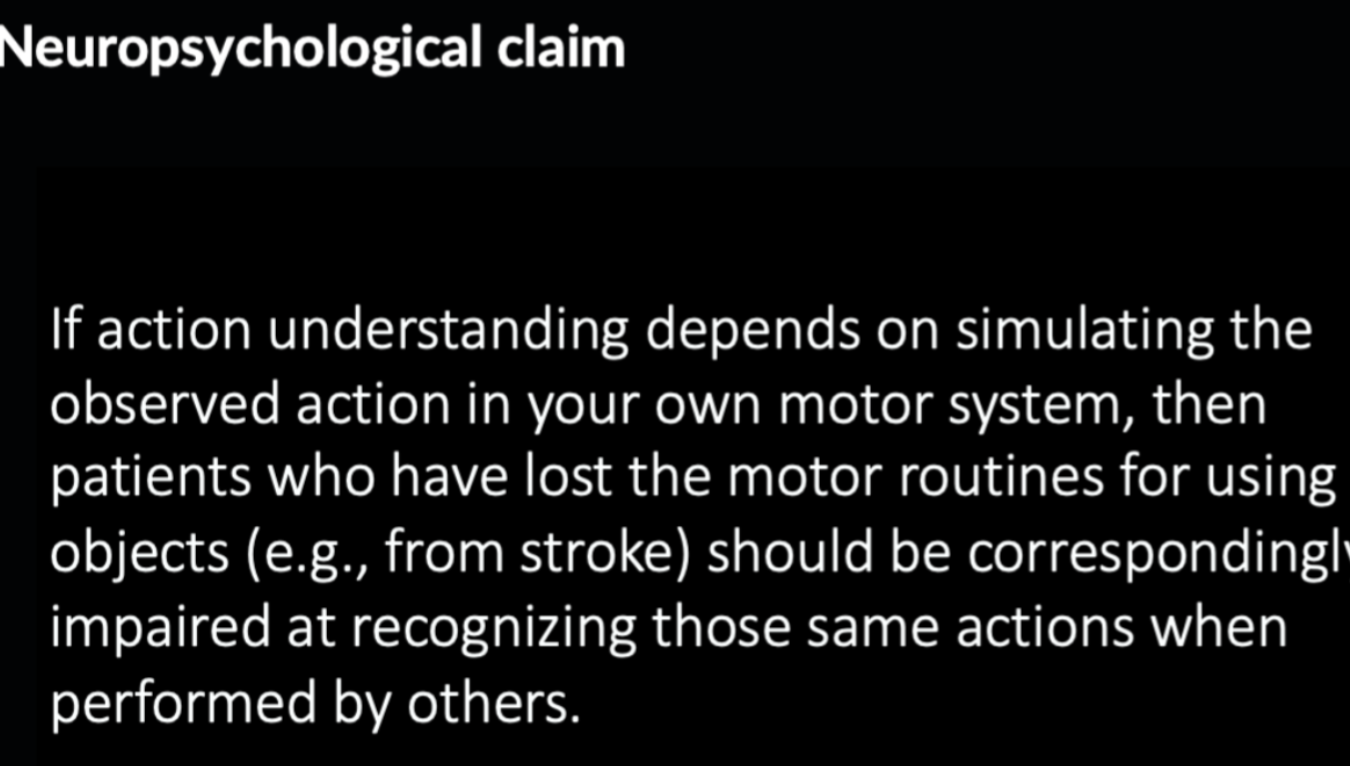
neuropsychological evidence against
alternative account of mirror neurons

cecilia hayes - repeated co-occurene links seeing an action with performing it
dance dance revolution study
Study 2 = dance dance revolton, emily cross,
Scanner, watched 18 dance sequences
Went home nad strained for 5 days, 6 dances 3 categories
18
For 6 - practced
6 - observed videos
6 - control did nothing
Surprise task = dance soem of the sequences from the 3 categories
Showed all the expected brian activity findings
Performance at the end = best for the ones you practiced
Watched for imitation= in the middle
Control = the worst for the surprise test
Watching = helped, benefits correlated with the mirror N activaty
Evidence = watch gets you ready to do that thing more effectively
Mirror Ns play a critical role in primates ability to learn thru imitation not just logical and theory
The imitation story/theory
youre observing another person who you understand and that later enhances your ability to later perform the action
Muhc more of the real accurate story
There is a role in the mirror neurons in undersatnng other ppls actions and mental states, not hte orgianl hyp, the first lect aafte the midterm,