Earth system questions
 Call Kai
 Learn
 Practice Test
 Spaced Repetition
 Match
 Flashcards
 Knowt Play
1/15

There's no tags or description
Looks like no tags are added yet.
16 Terms
What is the difference between weather and climate?
Weather is the atmospheric state in near-future, based on the state now (initial conditions). Climate is the long-term trend in how the atmospheric state will evolve using boundary conditions.
Which positive and negative climate feedbacks exist?
Positive:
Ice-albedo
Water vapor
Lapse rate at high latitudes
Permafrost carbon feedback
Fire feedback- increased temperatures –> more drought-> more fires with release of CO2 and CH4-> warmer temperatures
Cloud feedbacks (high clouds)
Aerosol-cloud interaction: increases the reflectivity of the clouds due to increased aerosol particles, which increases the droplet amount and decreases the size of each droplet
Ocean current ice sheet instability feedback
Negative:
Planck-feedback (Stefan-Boltzmanns T^4 black-body law. Radiation ~ T^4)
Lapse rate in the tropics
CO2-fertilization : increases plant growth and uptake of CO2
Cloud feedbacks
Low clouds
Which model resolution is available in AR6?
Horizontal: 1 - 2 degrees, 30-90 vertical layers with more layers close to the surface
What is CMIP and which CMIPs exist for IPCC AR6?
Coupled Model Intercomparison Project is a project combining multiple ESMs and all are required to do the same DECK-experiments (ssp, historic etc.) to be comparable to each other.
CMIP 6, CMIP5 (unpublished) and CMIP3 (historical) are all used in the AR6
What is a Shared Socioeconomic Pathways (SSP) scenario?
Possible futures, depending on how we as humans act for the climate
What is a climate forcing, response, feedback, sensitivity, equilibrium?
Climate forcing: A change (external forcing) in the radiative balance in the energy budget of the Earth
Climate response: The earth systems’ reaction to a climate forcing
Climate feedback: A process which changes the climate from an initial forcing
Climate sensitivity: Defined as the warming resulting from a doubling of CO2-concentration
Climate equilibrium: When the climate system has reached balance
How do you expect the albedo to change through ice melt? Deforestation?
Ice melt → Decrease in albedo
Deforestation → Increase in albedo. Since trees often have a lower albedo than the ground, but it really depends on the surface. Also, without trees, the snow can stay longer on the surface, which can actually increase the albedo even more.
Why is so much excess energy stored in the ocean?
The ocean has a large heat capacity, which makes so that it can hold a lot of heat.
What can lead to radiative imbalance?
Solar cycles
Emission of gases and aerosols, subsequent chemical reactions modifying ozone and aerosols amount
Changing cloud properties affecting the radiative budget
Changes in vegetation or in land- surface properties, changing the albedo
What is the MOC?
Meridional Overturning Circulation, it is how water-masses are transported in the north-south direction.
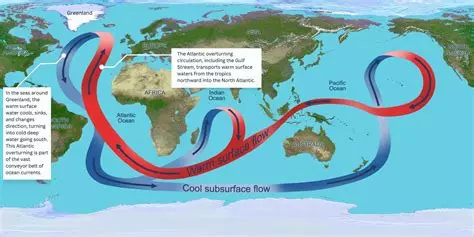
What is driving the MOC?
What is driving MOC is differences in buoyancy (salinity and temperature), winds (geostrophic winds)
What are the subtropical gyres? How are they driven?
These are ocean currents that are constrained by land masses, and are driven by the westerlies and the trade winds, which make them circulate clockwise in the northern hemisphere, and counterclockwise in the southern hemisphere.
What is the AMOC; is it different from the Gulf Stream? Will they shut down?
Atlantic Meridional Overturning Circulation is how the water is transported in the Atlantic Ocean. The gulf stream is just the high-velocity current moving north-east from America up to Europe. They willl not reach a point of shut down, but will cease in strength, according to the IPCC-report.
Which role does the ocean heat uptake play for the Energy Inventory; how is it changing over time?
The ocean is storing about 91% of the heat, while the atmosphere is 1%. This can maybe change over time, as the ocean comes to a balance, and can take up less heat.
How are Salinity and E- P connected? How are they changing?
Salinity is connected to Evaporation and Precipitation, since these are sources and sinks of salinity. Evaporation from the ocean, leaves more salt left in the ocean, which increases the salinity. Precipitation does the opposite.
Why is polar amplification stronger in the NH?
Land areas are warming more
No strong winds currents blocking warming
Sea ice melting faster
50% snow coverage on land -> declining