Astro Exam 3
 Call Kai
 Learn
 Practice Test
 Spaced Repetition
 Match
 Flashcards
 Knowt Play
1/85

There's no tags or description
Looks like no tags are added yet.
86 Terms
Milky Way
Our homme galaxy containing billions of stars, including the Sun
What do we see from Earth?
We see the spiral arm we live inside!
Barred spiral galaxy
A galaxy with a bar-shaped region across its center and spiral arms
DIsk
the flat part containing most of the galaxy’s stars, gas, dust, and spiral arms.

Bulge
The crowded, rounded region near the center of the galaxy
Stellar halo
A large, roughly spherical region surrounding the disk and bulge
Consider the vast distances between stars compared to their sizes. Is it likely that two stars will collide?
. No, the stars are very small compared to the distances between them.
Galaxies contain
all stages of star birth, life, and death
including nebulae
Stars
Supernova Remnants
Molecular Clouds
Molecular cloud
A cold, dense cloud of gas and dust where stars form.
Supernova
A powerful explosion that happens when a massive star dies.
Superbubble
A huge bubble of hot gas created by multiple supernovae.
Galactic fountain
Hot gas rises out of the disk, cools in the halo, and returns.
Star-gas-star cycle
Gas forms stars, stellar material returns to space, and new stars form.
When a star dies and leaves behind a white dwarf or a neutron star, is that core technically made of gas from the galactic recycling cycle?
A. Yes
Where will the galaxy's gas be in 1 trillion years?
C. Locked into white dwarfs and low-mass stars
21 cm radio waves
21-cm radio waves emitted by atomic hydrogen show where gas has cooled and settled into disk
Radio emission used by astronomers to map atomic hydrogen gas.
CO radio waves
Radio waves from carbon monoxide that help locate molecular clouds. coldest gas clouds
Radio waves from carbon monoxide (CO) show the locations of molecular clouds.
Infrared light
Wavelengths that reveal dust and stars hidden behind dust clouds.
Infrared light reveals stars whose visible light is blocked by gas clouds
X-rays
High-energy radiation used to reveal very hot gas in the halo.
X-rays are observed from hot gas above and below the Milky Way's disk.
hot gas fills the halo
Gamma rays
Radiation showing where cosmic rays collide with gas atoms.
Gamma rays show where cosmic rays from supernovae collide with atomic nuclei in gas clouds.
What are spiral arms?
The apparent spiral windmill arms are called spiral arms
They are not solid structures
They are density waves
Regions where stars and gas spend more time in their orbits
Means you end up with a higher density of stars in that area than in surrounding areas
Stars move in and out of these areas
Massive stars are born and die before having enough time to move out of these arms
Density wave
A crowded region of stars and gas that forms spiral arms.
Satellite galaxy
A smaller galaxy orbiting a larger galaxy, like the Magellanic Clouds.
Galaxy merger
The process of two galaxies interacting and combining.
Milky Way is in the process of merging!
Sagittarius Dwarf Galaxy
Stream Lots of other streams of previous mergers!
Disk star orbits
Organized, circular orbits in the same general direction.
Halo and bulge star orbits
Varied orbits with random orientations taking them far from the disk.
Cosmology
the study of the structure and evolution of the universe
A galaxy's age, its distance, and the age of the universe are all closely related.
The study of galaxies is thus intimately connected with cosmology.
The study of the structure, origin, and evolution of the universe
Galaxies can be divided into three categories
Spiral
Elliptical
Irregular.
Spiral Galaxies
Face-on: Looking directly at the front of the galaxy. You can see the spiral arms.
Tilted: Looking at the galaxy at an angle.
Edge-on: Looking at the galaxy from the side. It looks thin, and you can see a dark dust line.
Here, the central bulge and halo can be seen prominently
In this barred spiral galaxy, seen face on, the young, bluish-white stars associated with ongoing star formation in the disk can be seen
Why does ongoing star formation lead to a blue-white appearance?
Short-lived blue stars outshine the others.
Lenticular galaxy:
A galaxy with a disk like a spiral but much less dusty gas.
has a disk like a spiral galaxy
but much less dusty gas
intermediate between spiral and elliptical
Elliptical galaxy
All spheroidal component
Virtually no disk component
Red-yellow color indicates an older stellar population
An oval-shaped galaxy with virtually no disk and older, red-yellow stars.
Some are dwarf ellipticals.
Can contain 1 billion to tens of billions of stars.
Similar to globular clusters but 1000 times bigger
Irregular Galaxies
A galaxy with no organized shape and ongoing star formation.
They can contain:
Young stars.
Older stars.
Gas and dust.
Areas of active star formation.
The slide mentions that their white or bluish-white appearance indicates ongoing star formation.
Hubble Tuning Fork
A classification diagram organizing galaxies by shape, not an evolutionary life cycle.

Galaxy Group vs. Cluster
Groups contain up to a dozen galaxies; clusters contain hundreds to thousands.
Spiral galaxies are often found in groups of galaxies (up to a few dozen galaxies).
Clusters!
Local Group
The galaxy group containing the Milky Way, Andromeda, and about 80 other galaxies.
Galaxy Clusters
Elliptical galaxies are much more common in huge clusters of galaxies (hundreds to thousands of galaxies).
Galaxy Colors
Galaxies tend to fall into two groups, the blue cloud and red sequence.
blue cloud
A grouping of actively star-forming, mostly spiral and irregular galaxies. Blue galaxies usually have young, hot stars and ongoing star formation.
Blue cloud:
Mostly actively star-forming galaxies.
Often spiral and irregular galaxies.
Contain young, hot, blue stars.
Red Sequence
A grouping of mostly elliptical galaxies with older stars and little star formation.
Red galaxies generally have older stars and less ongoing star formation.
Red sequence:
Mostly galaxies with older star populations.
Often elliptical galaxies.
Have little ongoing star formation.
Standard Candle
An object whose actual luminosity is known or can be determined without measuring distance.
Step 1 Determining Distance: Radar
Determine size of the solar system using radar.

Step 2 Determining Distance: Parralax
Determine the distances of stars out to a few hundred light-years using parallax.
The apparent shift in a star's position as Earth orbits the Sun, used to measure distance.
Large parallax shift = closer star.
Small parallax shift = farther star.
Luminosity passing through each sphere is the same.
Area of sphere: 4pier²
Divide luminosity by area to get brightness.

Thought Question 2 Which kind of stars are best for measuring large distances?
A. High-luminosity stars
Cepheid Variable Star
A luminous star that regularly changes brightness, used as a cosmic standard candle.

Leavitt's Law
The relationship stating that Cepheid variable stars with longer periods have greater luminosities.
Standard Candle
An object whose actual luminosity is known or can be determined without measuring distance.
White-Dwarf Supernova
White-dwarf supernovae can also be used as standard candles.
Type Ia explosion with predictable peak luminosity used to measure vast cosmic distances.
Determining Distance
Step 3
Because the period of Cepheid variable stars tells us their luminosities, we can use them as standard candles with Leavitt’s Law
Determining Distance
Step 4
The apparent brightness of a white dwarf supernova tells us the distance to its galaxy (up to 10 billion light-years).
The Great Debate
Before Hubble. some scientists argued that “spiral nebulae” were entire galaxies like our Milky Way, while others maintained they were smaller collections of stars within the Milky Way.
The debate remained unsettled until Edwin Hubble finally measured their distances.
The historical argument over whether spiral nebulae were inside or outside the Milky Way.
Redshift
The shifting of light waves toward longer wavelengths as galaxies move away from us.
Hubble-Lemaître Law
The rule stating that a galaxy's recession velocity equals Hubble's constant times its distance.
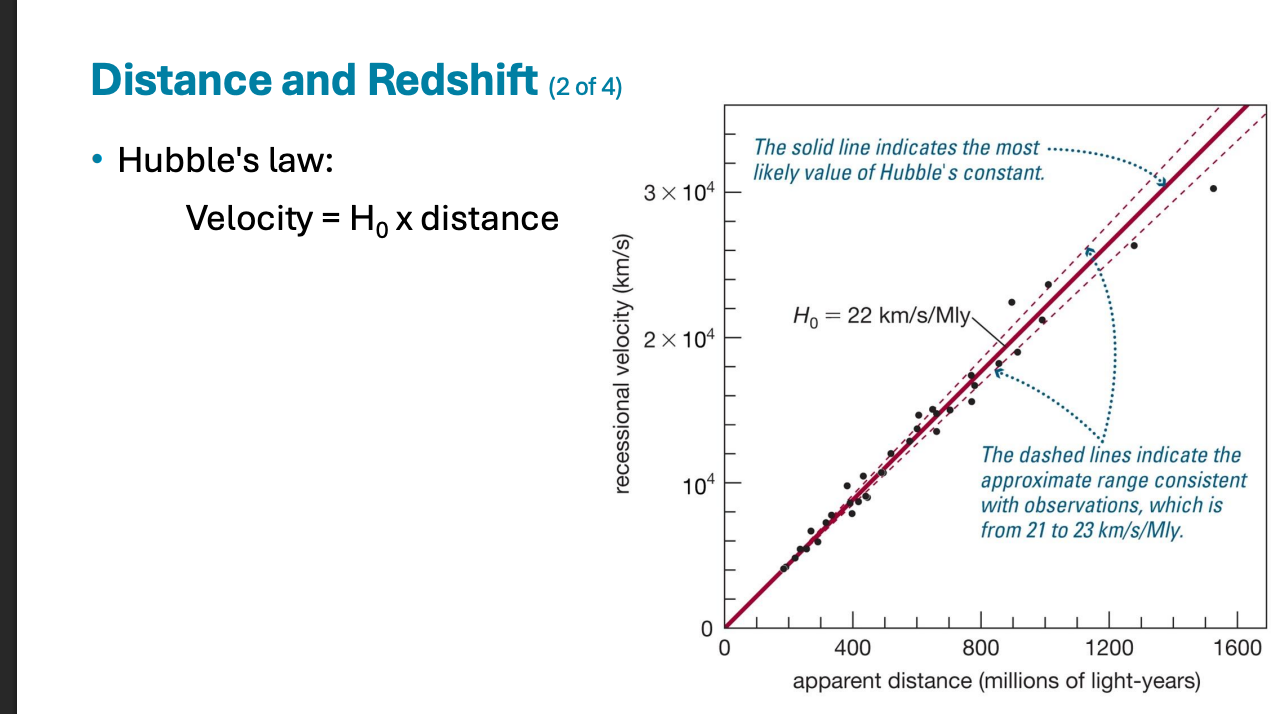
Distance and Redshift
Redshift of a galaxy tells us its distance through Hubble's law:
Distances of the furthest galaxies are measured from their redshifts.

Distance Ladder
A chain of interdependent techniques used by astronomers to measure increasingly larger distances in space. we measure galaxy distances using a chain of interdependent techniques
Cosmological Principle
The principle that the universe looks roughly the same everywhere on very large scales.
Thought Question 3
Your friend leaves your house. She later calls you on her cell phone, saying she’s been driving at 60 miles an hour directly away from you the whole time and is now 60 miles away. How long has she been gone?
C. 60 minutes
Expansion of the Universe
The expansion rate appears to be the same everywhere in space.
The universe has no center and no edge (as far as we can tell)
One example of something that expands but has no center or edge is the surface of a balloon.
Cosmological Principle
The universe looks about the same no matter where you are within it.
Matter is evenly distributed on very large scales in the universe.
It has no center or edges.
The cosmological principle has not been proven beyond a doubt, but it is consistent with all observations to date.
The principle that the universe looks roughly the same everywhere on very large scales.
Thought Question 4
You observe a galaxy moving away from you at 0.1 light-years per year, and it is now 1.4 billion light-years away from you. How long has it taken to get there?
D. 14 billion years
Age of the Universe
Hubble’s constant tells us the age of the universe because it relates the velocity and distances of all galaxies.
Age = distance/velocity, about 1/H0

Lookback Time
The time light took to travel from a distant object, showing us the past.
Expansion stretches photon wavelengths, causing a cosmological redshift directly related to lookback time.
Cosmological Horizon
The time-based boundary marking the limits of our observable universe. The Cosmological Horizon marks the limits of the observable universe.
It is a horizon in time rather than space. Since looking far away means looking back in time, there must be a limit – the beginning of the universe!
How does expansion affect distance measurements?
A supernova occurs long ago in a distant galaxy.
As time passes, the universe expands and the distance to that galaxy increases.
The galaxy’s distance is therefore much greater when the supernova’s light reaches us in the Milky Way Galaxy.
Distances between faraway galaxies change while light travels.
Astronomers think in terms of lookback time rather than distance.
A supernova occurs long ago in a distant galaxy.
As time passess, the universe expands and the distance to that galaxy increases.
The galaxy’s distance is therefore much greater when the supernova’s light reaches us in the Milky Way Galaxy.
What does the light from a distant galaxy show us?
B. It shows us what the galaxy looked like when the light left the distant source
Shows what the galaxy looked like when light left.
Observations Through Time
JWST Deep Field
Very distant galaxies appear as they were much earlier in time
Old light
From when galaxies were very young
Life Histories of Galaxies
Observing galaxies at different distances shows us how they age
Far away = young (aka early in Universe)
Close = older (current age of Universe)
We still can't directly observe the earliest galaxies
Far away equals young; close equals older.
Galaxy Formation
Based off of observations
Think large scale structure of the Universe looks approximately like this
Each point of light is a cluster of galaxies
How can we match this?
Our best models for galaxy formation assume:
Matter originally filled all of space almost uniformly.
Gravity of slightly denser regions pulled in surrounding matter.
Denser regions contracted -> protogalactic clouds
H and He gas formed the first stars
Elliptical, spiral, or irregular?
Protogalactic cloud spin effect
Spin: The initial angular momentum of the protogalactic cloud determines the size of the resulting disk.
Low spin = elliptical galaxy
Higher spin = spiral galaxy
Protogalactic cloud density effect
Density:
Higher density clouds may have formed stars faster and ended as elliptical galaxies
Lower density clouds may have formed stars slower, allowing time for much of the gas to settle into a disk
Why do galaxies end up looking so different (e.g., some spiral and some elliptical)?
A. It is probably related to the conditions of the cloud system from which the galaxy formed.
B. It is probably related to interactions between galaxies as they evolve.
Distant Red Ellipticals
Observations of some distant red elliptical galaxies support the idea that most of their stars formed very early in the history of the universe.
Life Histories of Galaxies
Collisions were much more likely early in time
galaxies were closer together
Galaxy Interactions
Many of the galaxies we see at great distances look violently disturbed.
Collisions between galaxies are common
Galaxies are not as widely separated compared to their size
The nearby collisions we observe show bursts of star formation
Collision simulations shows that two spiral galaxies can merge to make an elliptical
The final shape and appearance of galaxies is likely largely influenced by collisions and mergers
Evidence of past collisions:
Shells of stars observed around some elliptical galaxies are probably the remains of past collisions
Collisions may explain why elliptical galaxies tend to be found where galaxies are closer together.
Giant elliptical galaxies at the centers of clusters seem to have consumed a number of smaller galaxies.
Gas Cycles
Galaxies start as star forming systems, appearing blue in color.
Galaxy mergers create larger, more luminous galaxies with less star formation, appearing red in color.
Star-forming galaxies appear blue.
Starburst galaxies
produce new stars at very high rates as much as 100 times that of our galaxy
Gas Cycles in Galaxies
Intensity of supernova explosions in starburst galaxies can drive galactic winds
A galactic wind in a small galaxy can drive away most of its gas
Driven by intense supernova explosions in starburst galaxies.
Active Galactic Nucleus (AGN)
If the center of a galaxy is unusually bright, we call it an active galactic nucleus (AGN). Super bright due to black hole actively accreting material
An unusually bright galaxy center powered by an accreting black hole.
Quasars
are the most luminous examples.
The host galaxy of this quasar is barely visible in the bright glare.
The most luminous AGNs with highly redshifted spectra indicating vast distances.
The highly redshifted spectra of quasars indicate large distances.
Luminosities of some quasars are greater than 1012 LSun
Variability shows that all this energy comes from a region smaller than our solar system.
What can you conclude from the fact that quasars usually have very large redshifts?
A. They are generally very distant.
B. They were more common early in time.
C. Galaxy collisions might turn them on.
D. Nearby galaxies might hold dead quasars.
E. All of the above.
Supermassive Black Hole
Orbital evidence
model matches data for galaxy M106
suggests a black hole of 36 million MSun
M87
SMBH imaged by Event Horizon Telescope (EHT)
Mass ~6 billion Msun
Curved streaks
polarization of the microwaves
magnetic fields in the accretion disk
Energy from a Black Hole
Gravitational potential energy of matter falling into black hole turns into kinetic energy. Friction in an accretion disk turns kinetic energy into thermal energy (heat).
Heat produces thermal radiation (photons).
This process can convert 10 to 40% of E=mc2 into radiation
Gravitational potential turns to kinetic, then thermal energy producing radiation.
Black Holes in Galaxies
Many nearby galaxies — perhaps all of them— have supermassive black holes at their centers.
Many of these black holes seem to be dormant AGN.
All galaxies may have passed through a quasar-like active stage earlier in time
Galaxies and Black Holes
The mass of a galaxy's central black hole is closely related to the mass of its bulge.
The development of the central black hole must be related to galaxy evolution
galaxies with larger bulges have larger black holes.
galaxies with small bulges have small black holes.
Radio galaxies
AGN
Plasma jets emitting in radio
from electrons moving at/near speed of light
The lobes of radio galaxies can extend over hundreds of thousands of light-years
An AGN can shoot out blobs of plasma moving at nearly the speed of light.
This suggests a profound influence on the hot gas surrounding a galaxy.
Here the lobes of radio galaxy NGC 1265 are swept back (upward in the image) because of the motion of the galaxy through intergalactic gas.
Gas Outside of Galaxies
Gas clouds between a quasar and Earth absorb some of the quasar's light.
We can learn about protogalactic clouds by studying the absorption lines they produce in quasar spectra.
As the light from a distant source travels through multiple clouds, the spectra can get very complicated very fast.
This figure shows multiple sources at different distances.
each line in the quasar spectrum that reaches Earth tells us about a unique cloud