NEW cerebrum
 Call Kai
 Learn
 Practice Test
 Spaced Repetition
 Match
 Flashcards
 Knowt Play
1/88

There's no tags or description
Looks like no tags are added yet.
89 Terms
Cerebrum includes
- Diencephalon
- Cerebral hemispheres
- Cerebral cortex
Diencephalon
- Includes all structures with the term __ in their names.
- Thalamus receives information from?
- Includes all structures with the term thalamus in their names.
- Thalamus receives information from the basal ganglia, cerebellum, and all sensory systems except olfactory.
- Other areas in the diencephalon are named for their locations relative to the thalamus, not similarities of function.
Thalamic nuclei are classified into three main functional groups:
Relay, association, nonspecific
Relay nuclei
Relay nuclei convey information from the sensory systems (except olfactory), the basal ganglia, or the cerebellum to the cerebral cortex. Find them in VPL, VPM, LGN, etc
Association nuclei
Association nuclei process emotional and some memory info or integrate different types of sensation. Info goes to association cortices
Nonspecific nuclei
Nonspecific nuclei regulate consciousness, arousal, and attention.
Include intralaminar (arousal) and reticular (adjust thalamic activity)- go to cortex
Function of
Intralaminar-
Reticular -
intralaminar (arousal)
reticular (adjust thalamic activity)- go to cortex
Lesion to thalamus
Can interrupt ascending pathway
Loss of contralateral sensation
Proprioception most significantly affected
Thalamic pain syndrome
severe contralateral pain without provoking stimuli. Uncommon
If neuronal loss occurs in the intralaminar nuclei, may produce?
moderate to severe disability or vegetative state (due to their role in cortical arousal)
Contraversive Pusher’s Syndrome
Lesion location?
What is it?
- Due to a lesion of the posterior thalamus or medullary infarct affecting the vestibular nuclei.
- Marked by powerful pushing AWAY from nonparetic side by extending nonparetic arm and leg
Main hypothalamus function
Homeostasis
o Maintaining homeostasis- stores set points- influences ANS
o Eating, reproductive, sexual, and defensive behaviors
o Emotional expression of pleasure, rage, fear, and aversion
o Regulation of circadian rhythms in concert with other brain regions
Endocrine regulation of growth, metabolism, and reproductive organs (from pituitary gland to adrenal cortex, thyroid, ovaries, and testes)
Is essential for individual and species survival because it integrates behaviors with visceral functions.
Hypothalamus
Bilateral destruction of the areas associated with eating behaviors in hypothalamus results?
in the refusal of food, causing starvation even when food is readily available.
Hypothalamus communicates with and regulates?
Pituitary gland - produces vital hormones and directs other glands in the endocrine system to control growth, metabolism, and reproduction
Pituitary tumors
Tend to be?
Symptoms?
Pituitary Tumors
- Account for 10 percent of intracranial neoplasms
- Tend to be benign and slow growing
- Can cause hormonal dysfunction (Irregular menses or lactation, blood pressure and blood glucose issues, growth hormone issues)
- Often also causes bitemporal hemianopsia due to location below optic chiasm
What is them major structure of the epithalamus?
Pineal gland
Function of pineal gland
Pineal gland is believed to help regulate circadian rhythms via production of melatonin a
Influence the secretions of the pituitary gland, adrenal and parathyroid glands, and the islets of Langerhans.
Subthalamus location
Is located superior to the substantia nigra of the midbrain.
Subthalamus is apart of? function? modulates?
Subthalamus
- Is located superior to the substantia nigra of the midbrain.
- Is part of the basal ganglia circuit, which is involved in regulating movement.
- Modulates basal ganglia output nuclei.
- Is where deep brain stimulation for Parkinson’s is often applied
Subcortical White Matter
All white matter consists of?
Located __ cortex
Classified into 3 categories?
Subcortical White Matter
- All white matter consists of myelinated axons.
- Located below cortex
- Subcortical white matter fibers are classified into three categories:
o Projection
o Commissural
o Association
From subcortical structures to cerebral cortex and from cerebral cortex to spinal cord, brainstem, basal ganglia, and thalamus
Projection fibers
Projection fiber tracts?
Almost all projection fibers travel through?
Projection Fibers
- From subcortical structures to cerebral cortex and from cerebral cortex to spinal cord, brainstem, basal ganglia, and thalamus
o Corticospinal tract
o Corticobrainstem tract
o Thalamocortical
- Almost all projection fibers travel through the internal capsule
Subcortical White Matter
__ lesion common
Prevents what tracts form reaching destination?
Subcortical White Matter
- Internal capsule lesion is common
- Prevents corticospinal tracts and thalamocortical tracts from reaching destination
- Would result in contralateral decrease of voluntary movement and conscious proprioception
- Lesion of posterior internal capsule also disrupts vision from contralateral field
Internal capsule lesion
Would result in contralateral decrease of voluntary movement and conscious proprioception
Lesion to posterior internal capsule
Vision from contralateral field
Callostomy
Cerebral Systems- Callostomy
- Corpus callosum is surgically severed due to intractable epilepsy (limits seizures to one hemisphere)
- Initially two sides of body may interfere with one another’s activities, but eventually compensation occurs
- Info presented to right visual field or hand projects to language dominant left hemisphere- patient can describe/name but can’t use
o Left hand/visual field- can use object but can’t name it
After collostomy, patient can’t name object if it is put in which hand?
o Left hand/visual field- can use object but can’t name it
Basal ganglia function
- Are vital for normal motor function.
- Regulate muscle tone and muscle force
- Select and inhibit specific movements
- Have a role in motor learning, executive functions and behaviors, and emotions
Cerebral cortex is a vast collection of cell bodies, axons, and dendrites covering?
surface of the cerebral hemispheres
What is the most common cell type of neuron in Cerebral Cortex?
pyramidal
Cerebral cortex
Most common cell type of neuron is pyramidal:
Main __ type
Almost all travel through ___ as projection, commissural, or association fibers
Most common cell type of neuron is pyramidal:
Main excitatory type
Almost all travel through white matter as projection, commissural, or association fibers
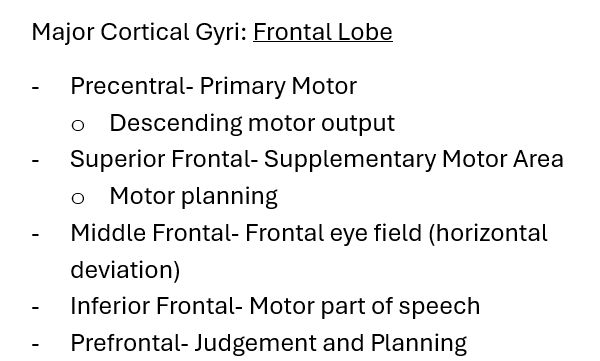
Major Cortical Gyri: Frontal Lobe
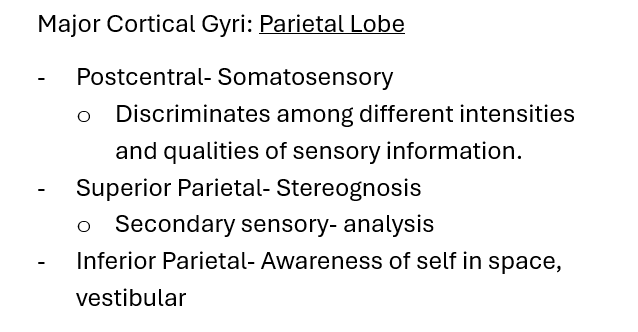
Major Cortical Gyri: Parietal Lobe
Major Cortical Gyri: Temporal Lobe

Major Cortical Gyri: Occipital Lobe

Primary Somatosensory Cortex receives info from? via?
Receives information from tactile and proprioceptive receptors via a three-neuron pathway:
o Peripheral afferent/dorsal column neuron
o Medial lemniscus neuron
o Thalamocortical neuron
Primary auditory cortices (PAC)
Receive info from?
Travels to?
Primary auditory cortices (PAC) receive information from the cochlea. Travels to inferior colliculus and medial geniculate body before reaching the cortex.
Primary vestibular cortices (PVC)
Receive info about?
By what pathway?
Primary vestibular cortices (PVC) receive information regarding head movement and head position relative to gravity by a vestibulothalamocortical pathway.
Primary Visual Cortex
Visual info travels to cortex via pathway from ___ to ___ then to primary visual cortex
Visual information travels to the cortex via a pathway from the retina to the lateral geniculate body of the thalamus, then to the primary visual cortex.
Individual neurons are specialized to distinguish between light and dark, various shapes, location of objects, and movement of objects.
Secondary sensory areas analyze sensory info from?
- Analyze sensory input from both thalamus and primary sensory cortex
Secondary sensory areas - Somatosensory
integrates tactile and proprioceptive info obtained by manipulating an object (stereognosis) and allows recognition
Secondary sensory areas - Visual
Visual: colors and motions; directs visual fixation
o Broken into action and perception stream
Secondary sensory areas - Auditory
- Auditory: compares sounds with memories; categorizes as language, music, or noise
Use of visual information
Is processed by the secondary visual cortex and flows in two directions:
Dorsally:
Ventrally:
Dorsally: in an action stream to the frontal lobe via the posterior parietal cortex (actions based on visual input)
Ventrally: in a perceptual stream to the temporal lobe. Ventral stream- (perception and identification of visual objects)
The two streams operate independently.
Primary motor cortex is the source of most neurons in which tract?
Corticospinal tract
Primary motor cortex controls?
Primary Motor Cortex
- Primary motor cortex is the source of most neurons in the corticospinal tract.
- Controls contralateral voluntary movements, particularly the fine movements of the hand and face.
- Much greater proportion of primary motor cortex is devoted to neurons that control face and hand than is devoted to the trunk and proximal limbs, where gross motor is required.
Motor planning areas
Located where?
Consist of?
Cortex anterior to the primary motor cortex consists of:
Supplemental motor area
Premotor area
Broca’s area
Inferior frontal gyrus
Is important for the initiation of movement, orientation of the eyes and head, and planning bimanual and sequential movements.
Supplementary motor area
Controls trunk and girdle muscles via the medial UMN
Premotor area
Usually in left hemisphere. Is responsible for planning movements of the mouth during speech and the grammatical aspects of language.
Broca’s area
nonverbal communication
Inferior frontal gyrus:
Inferior frontal gyrus corresponds with __ on the opp side
Broca’s
Premotor and supplementary motor areas and Broca’s receive info from?
Secondary sensory areas
Primary motor cortex and motor planning areas receive info from?
basal ganglia and cerebellum, relayed by thalamus
Primary motor cortex receives somatosensory info from? and motor instructions from?
Primary somatosensory cortex
Motor planning area
Lesion to Primary sensory area?
loss of discriminative info
Lesion of primary somatosensory cortex
loss of localization or tactile info and proprio
What is preserved in a lesion of primary somatosensory cortex?
Crude awareness still present as it is processed by the thalamus
Localization of pain is preserved- pain is processed in secondary somatosensory cortex, insula, and anterior cingulate cortex
Lesion of
Primary auditory cortex?
Primary vestibular cortex?
Primary Visual cortex?
o Lesion of primary auditory cortex- can not localize sounds
o Lesion of primary vestibular cortex- lose conscious awareness of head position and movement
o Lesion of primary visual cortex- homonymous hemianopsia
can not identify objects by manipulation and touch
Astereognosia
Lesions in secondary somatosensory, visual, or auditory areas cause?
Agnosias
- Astereognosia- can not identify objects by manipulation and touch
- Visual agnosia- can not recognize objects in contralateral visual field despite vision being intact
- Auditory agnosia- Can hear sound but not interpret (left- speech; right- environment)
Prosopagnosia- unable to recognize faces but can recognize other objects
inability to identify objects using a specific sense
agnosias
Auditory agnosias - L vs R
- Can hear sound but not interpret
- (left- speech; right- environment)
Lesion to primary motor cortex
Contralateral loss of movement fractionation and paresis
Worse distally
Can also cause dysarthria- results from spasticity or paresis or muscles used for speaking (CN V, VII, IX, X, XII)
form of motor agnosia. Knowledge of how to perform skilled movement is lost. Strength/coordination/sensation may be intact
Apraxia
Lesion to Motor Planning Areas
Apraxia
Motor preservation
Brocas Aphasia
Apraxia occurs due to damage where?
Premotor
Supplementary motor areas
Inferior parietal lobe
uncontrollable repetition of a movement
Motor preservation
AMOUNT of neural damage
difficulty expressing oneself using language or symbols
Brocas aphasia
Language disorders
Spoken:
Ability to write:
Understanding written language:
Aphasia
Agraphia
Alexia
can not express self with language. Aware of it and easily frustrated.
Brocas
language comprehension is impaired. Easily make sounds but words are meaningless (nonsense or incorrect).
Listening to others speak is also meaningless.
Wernickes
inability to use language in any form
Global aphasia
May cause person to speak in monotone, be unable to communicate nonverbally, lack facial expressions and gestures- “flat affect”
- Damage to right cortex corresponding with Broca’s area
Difficulty understanding nonverbal communication
Also affects body image and understanding relationship of self and environment- may cause neglect
- Damage to right cortex corresponding with Wernicke’s area
Cognitive intelligence
Parietotemporal Association Cortex
Parietotemporal Association Cortex 4 functions
Cognitive intelligence
Problem solving
Comprehension of communication
Spatial relationships
spatial coordination system
Spatial Coordination system
Essential for what 2 things?
Location
Constructing an image of one’s own body and for planning movements.
Parietotemporal Association Cortex
Lesion of Parietotemporal Association Areas
Problems with communication, understanding space, and directing attention
Lesion on L Parietotemporal Association Areas
Wernicke’s aphasia
Lesion on R Parietotemporal Association Areas
- deficits in directing attention, comprehending space, and understanding nonverbal communication. NEGLECT can result.
Can have inability to handle new info effectively, trouble thinking concretely, difficulty distinguishing relevant from irrelevant info, trouble with change in routine
Parietotemporal Association Areas Lesion
Location of Spatial perceptions/relationship?
R cortex corresponding to Wernickes
Is the mental representation of how the body is anatomically arranged?
Enables individuals to locate objects in space and to navigate accurately?
Is the ability to plan a route from one site to another?
Body
Body in relation to its surroundings
External World
Tendency to behave as if one side of the body and/or one side of space does not exist
Neglect
Neglect occurs from damage to what areas?
R parietal area (directs attention)
AND
Area corresponding to Wernicke’s area (comprehends spatial relationships)
may cause problems navigating, constructing, dressing
Spatial neglect
patient denies inability to use paretic limb but feels that someone else has the deficit
Anosognosia