Chapter 2: Analog vs Digital Signals (copy)
 Call Kai
 Learn
 Practice Test
 Spaced Repetition
 Match
 Flashcards
 Knowt Play
1/67

There's no tags or description
Looks like no tags are added yet.
Name | Mastery | Learn | Test | Matching | Spaced | Call with Kai | Chat |
|---|
No analytics yet
Send a link to your students to track their progress
68 Terms
What is a signal?
A physical quantity that changes over time to carry information through a transmission medium.
This physical quantity may include:
Voltage
Light intensity
Electromagnetic properties…etc.
What is an analog signal?
A continuously varying electric or physical wave that represents changing data over time, usually in the form of a sine wave.
It does not have a discrete number of defined signal levels.

What is a digital signal?
A sequence of discrete, finite voltage or current pulses, typically representing binary 0s and 1s.

Does a “periodic” signal have anything inherently to do with analog or digital signals?
No, “Periodic” has nothing inherently to do with analog or digital. Both analog and digital signals can be periodic or non periodic. It only has to do with whether or not the signal repeats at a regular interval over time.
What is a periodic signal?
A signal that repeats the same pattern after a fixed amount of time. One repetition is called a cycle.
What is a Period?
Period = How long a single cycle takes to complete in a periodic signal. Measured in seconds.
What is a Cycle?
Cycle = The repeating pattern of a periodic signal itself.
What is a Non Periodic signal?
A signal that does not continuously repeat the same pattern at regular intervals.
In data communication, do we use Periodic or Non Periodic signals?
We often use both!
What is a sine wave?
It is a smooth, periodic, analog signal.
It has a cycle and a period.

Why is the Sine Wave so important?
It is important because it represents the simplest analog signal that cannot be broken down into simpler sinusoidal components. It is important because it’s the fundamental building block of composite analog signals.
What is each of these referring to?
Simple Periodic Analog Signal
Composite Periodic Analog Signal
Simple Periodic Analog Signal = A single sine wave
Composite Periodic Analog Signal = Multiple sine waves
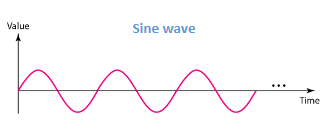
Describe the properties of the following sine wave:
Amplitude/Peak Amplitude = The maximum intensity reached by a signal (typically measured in V)
Period = The time taken to complete a single cycle
Frequency = The number of complete cycles that occur in one second (measured in Hz (Hertz)), otherwise known as the rate of change with respect to time.
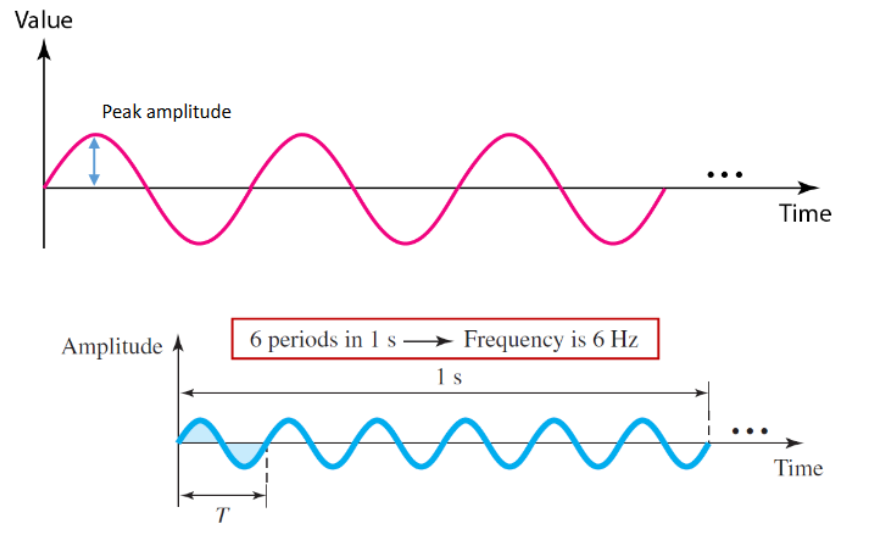
What does 1 Hz mean?
1 Hertz = 1 cycle/second
What is the formula for frequency and period?
frequency = 1 / T
T = 1 / frequency
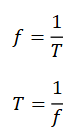
Why are the formulas for frequency and period inverses?
The are inverses because they both describe the same thing, just from opposite perspectives.
What is the conversion table you need to memorize for all of these problems?
Bit Rate:
1 Kbps = 103 bps (bits per second)
1 Mbps = 106 bps
1 Gbps = 109 bps

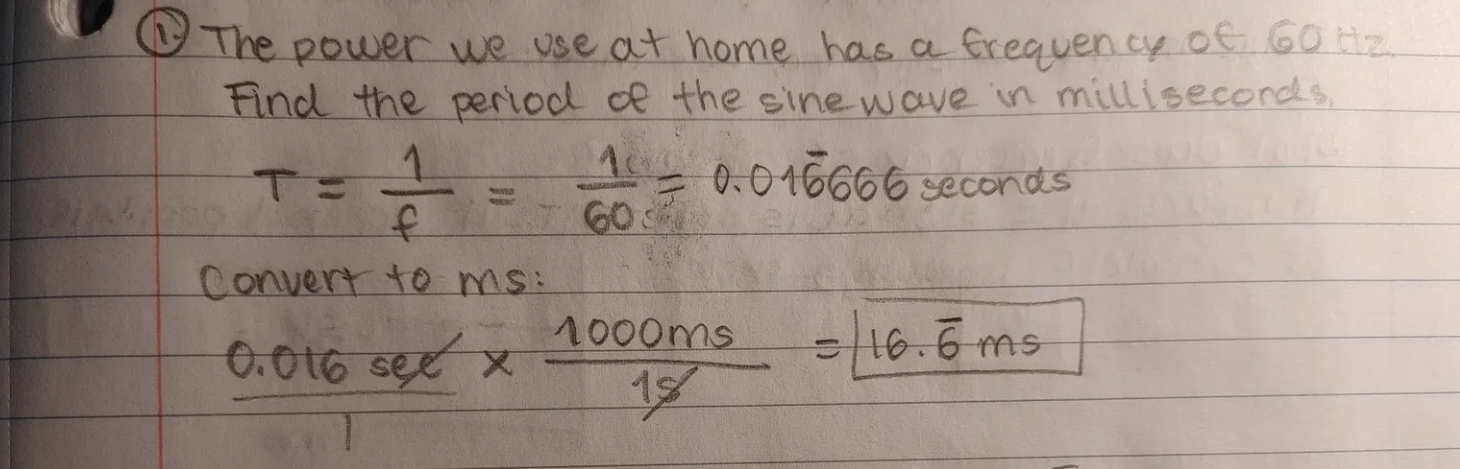
The power we use at home has a frequency of 60 Hz. Find the period of this sine wave in milliseconds (ms)?
What is the frequency (in kHz) of a sine wave if the period is 200 μs?

What really is frequency?
Frequency is the rate of change with respect to time.
What does a lower frequency mean? A higher frequency?
Lower Frequency = means the signal changes relatively slowly, and each cycle takes a very long time. Therefore we have a Large T (period) and a Small F (frequency).
High Frequency = means the signal changes very quickly, so many cycles occur within the same amount of time. This means the time taken to complete each cycle is much shorter: Smaller T, Larger F.

What does a frequency of 0 mean?
It means the signal is constant. It doesn’t oscillate or complete repeating cycles, it just stagnates.

What does infinite frequency mean?
It refers to a mathematical ideal, not something that a real signal actually does or can achieve.
For example:
T = 1s f = 1 Hz
T = 0.1s f = 10 Hz
T = 0.0001s f = 1000 Hz
As the period (the time needed to complete one cycle) gets closer and closer to 0 (closer to being instant), the frequency gets larger and larger, getting infinitely close to infinity.
What is the mathematical equation for a sine wave?
s(t) = instantaneous amplitude (the amplitude at a particular time)
t = time (in seconds)
A = peak amplitude
f = frequency (in Hz)
2πf = angular frequency

What is w in the following equation? What does it represent?
w stands for omega. It’s a shorthand way of expressing 2 pi f.
s(t) = Asin(2πft) → s(t) = Asin(wt)
If w = 20π, then what does 2πf equal? Solve for the frequency.

What is the Phase Shift?
Phase shift is when we move the entire sine wave horizontally. It refers to the horizontal displacement of a sine wave.
When the Phase Shift changes, what else about the wave changes?
Nothing else about the wave changes, because all you’ve done is effectively shifted the wave over by a bit.
The amplitude hasn’t changed
The frequency hasn’t changed
The shape hasn’t changed.
How can we represent phase shift in our equation:
Asin(2πft)?
Asin(2πft)
= Asin(wt)
= Asin(wt + theta) OR Asin(wt - theta)
How do we measure phase shift?
In radians or degrees.
How much is one cycle, half a cycle, and a quarter of a cycle in both radians and degrees for Phase Shift?
One cycle = 2π = 360 degrees
Half a cycle = π = 180 degrees
A quarter of a cycle = π/2 = 90 degrees
Is it possible for all three of the following equations to have the same amplitude and frequency?
What phase shift does the first equation have?
sin(wt)
sin(wt + 90 degrees)
sin(wt + 180 degrees)
Yes, it is entirely possible, because the only thing that has changed is their horizontal shift.
The first equation has a phase shift of 0 degrees.
A sine wave is offset 1/9th of a cycle with respect to time, 0. What is the phase in degrees and in radians?

What is wavelength?
How much physical distance a wave travels during one complete cycle or one second. It is measured in meters (m) or micrometers (um)
What is the formula for wavelength?
Wavelength = v (propagation speed) / frequency (f)
Why is frequency related to wavelength?
Answer this question given that: f = 5 Hz and the wave travels 100m during that 1 second.
If a wave travels 100 m in 1 second, then those 5 cycles must collectively occupy the 100m (because frequency is per second).
So the wavelength = 100/5 = 20m.
How does a higher or lower frequency impact wavelength?
Higher Frequency = Smaller Wavelength
Lower Frequency = Greater Wavelength
The higher the frequency is, the more cycles take place during a single second, and the smaller the wavelength is. This is because a higher frequency signal fits more cycles into each second, so each cycle must occupy less physical distance.
The lower the frequency is, the fewer cycles there are in a single second, and the larger the wavelength is.
This also makes sense considering the fact that we are dividing total distance by frequency to get wavelength.

What is the wavelength of red light if its frequency is 4×10⁴ Hz?
Assume the propagation speed is 3×10⁸ m/s.

What is time domain?
A graph that shows how the amplitude of a signal changes over time.

What does a time domain graph allow us to see?
It allows us to see how the physical shape of the signal changes over time. This includes: peak amplitude, period, etc.
What is frequency domain?
A graph that shows which frequencies are present in a signal and the amplitude associated with each frequency.
For example, the graph to the right tells us that a 6Hz Frequency has an amplitude of 5 V.

Why do we need two domains?
Because real communication signals aren’t a single sine wave. They may contain multiple different frequency components simultaneously.
Why isn’t one sine wave enough for data communication?
Because if you just had a single sine wave, you would be continuously transmitting exactly 1000 Hz with the same amplitude, frequency, and phase shift every single time. This would mean the receiver would only be receiving the same repeating waveform. Nothing about the signal would change, so all you would hear is a constant buzz.
A single sine wave with an unchanging single frequency carries no changing message.
What is a composite signal?
A signal composed of multiple sine wave components with different frequencies, amplitudes, and phases.

What would the frequency domain of a composite signal look like?
It would look like multiple spikes on the frequency domain graph:
What does Fourier Analysis state?
It states that a composite signal can be represented as a combination of simple sine waves with distinct frequencies, amplitudes, and phases.
In other words: a complicated composite signal can be analyzed by decomposing the multiple sine waves that make up the whole.
What does the bandwidth of a composite signal tell us?
The bandwidth of a composite signal tells us how wide the range of frequencies is. It is the difference between the lowest and the highest frequency.
Are most digital signals periodic or non periodic? Why?
Most digital signals are non periodic. This is because with digital information such as: 10001000, the sequence does not necessarily repeat:
1001111
1101001
0010100
Therefore, there is no repeating cycle, and no periodic behavior.
What is bit rate? What does bit rate apply to?
Bit rate only applies to digital signals.
Bit rate is the number of bits transmitted per second, typically measured in bps (bits per second).
What is the conversion table for bit rate?
Bit Rate:
1 Kbps = 103 bps (bits per second)
1 Mbps = 106 bps
1 Gbps = 109 bps
What is bit duration? What is the formula for bit duration?
Bit Duration is the amount of time required to transmit 1 bit.
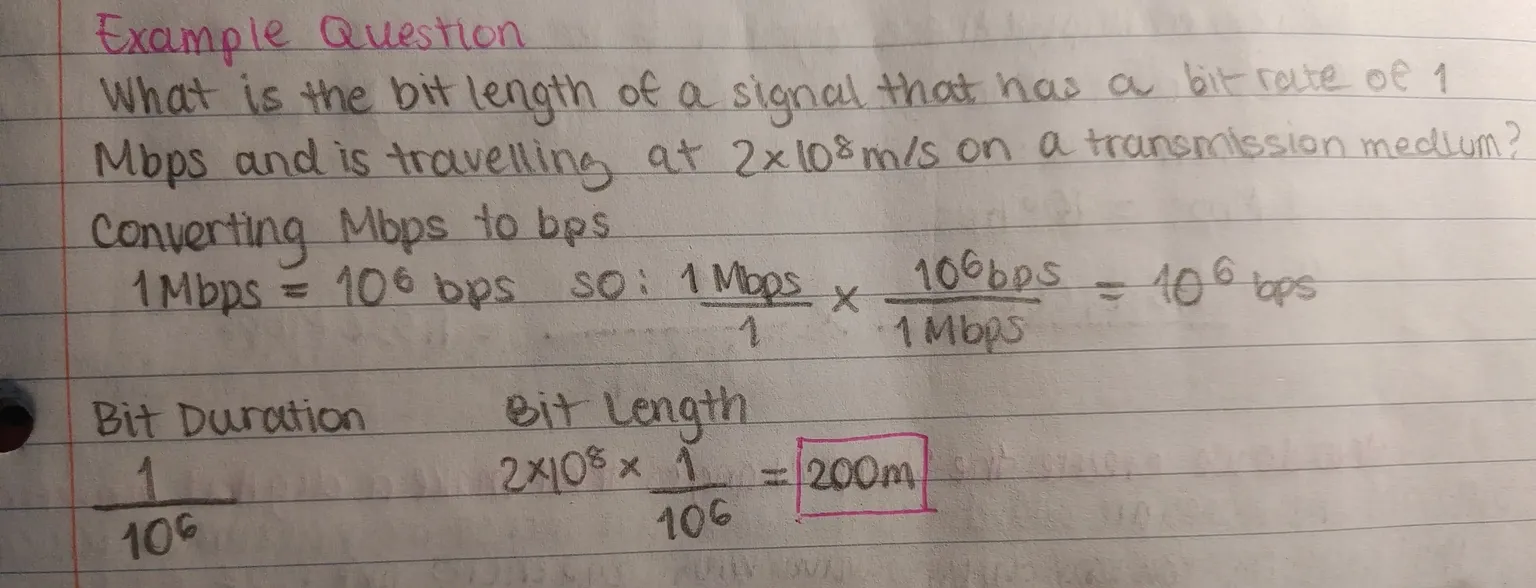
Bit Duration = 1 / bit rate
What is bit length? What is the formula for bit length?
Bit Length is the physical distance occupied by a single bit on the transmission medium. It is measured in m.
Bit Length = propagation speed * bit duration
What is the bit length of a signal that has a bit rate of 1 Mbps and is travelling at 2×10⁸ m/s on a transmission medium?
How are bits represented by a digital signal?
On a digital signal, bits rare represented as 2 extreme voltage levels:
Where:
High Voltage = 1
Low Voltage = 0
Why might we want 4 digital signal levels?
For example:
Level 1 → 00
Level 2 → 01
Level 3 → 10
Level 4 → 11
Because now each level can represent 2 bits.
If each digital level is capable of storing 2 bits, what is the formula for calculating the number of possible combinations?
2the number of bits encoded in each level = L possible levels
or
log2L, where L is the number of levels
If there are 11 levels, how many bits can we represent?
log 2 11 = 2^? = 11
22 = 4
23 = 8
24 = 16
We would be able to represent 4 bits on each level.
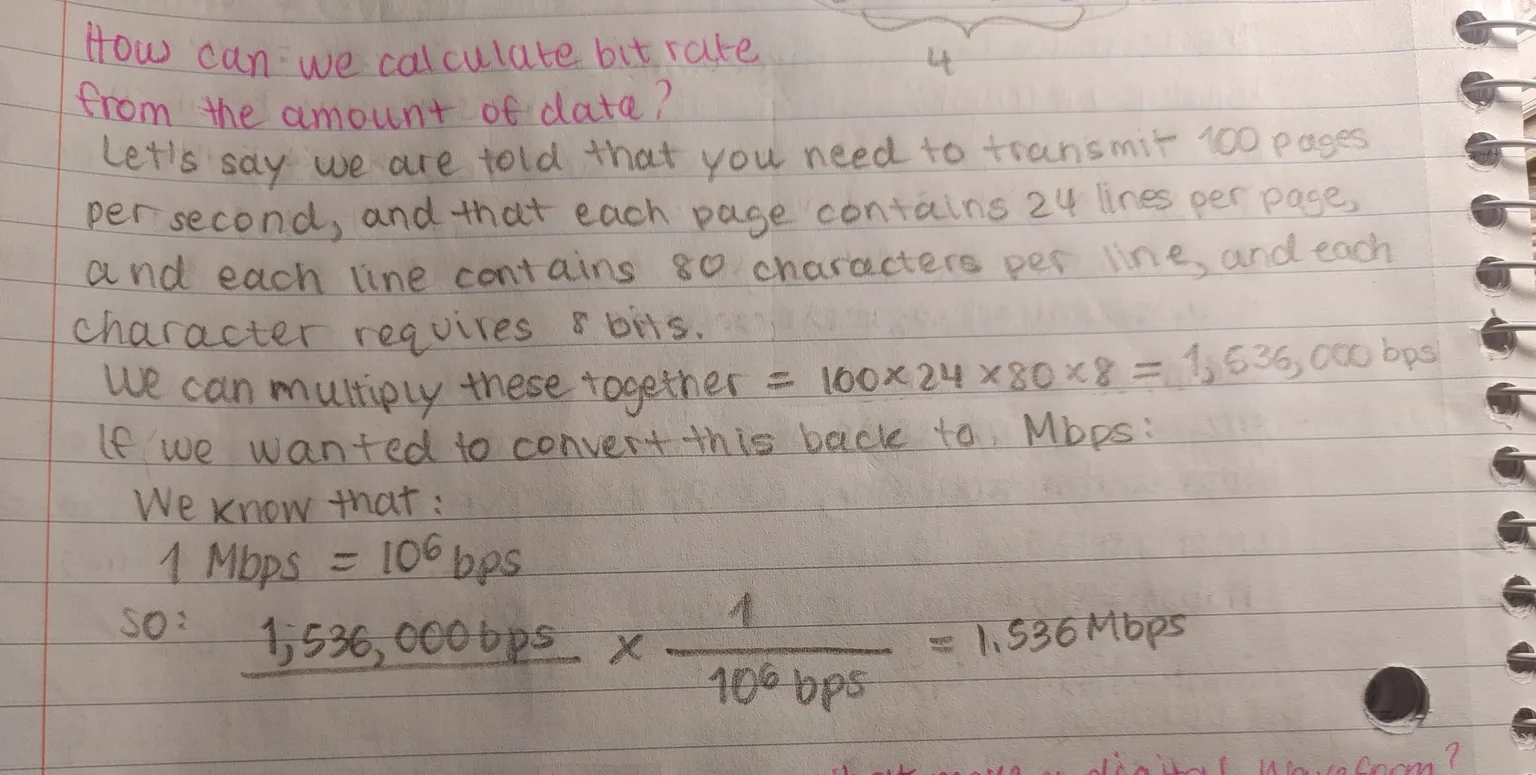
You need to transmit 100 page per second. Each page contains 24 lines per page, and each line contains 80 characters per line, and each character requires 8 bits.
Calculate the bit rate in Mbps.
We can multiply all of these together to get bps:
(100 pages/second × 24 lines × 80 characters × 8 bits)/1 second = 1,536,000 total bits per second
If we wanted to convert this back to Mbps:
We know 1 Mbps = 106 bps.
In a digital signal, how do we create the sharp changes that make the digital waveform?
We add different sine waves together to create increasingly more accurate versions of the waveform. This is typically done by combining frequencies like f, 3f, 5f, etc.
What is a periodic digital signal?
A periodic digital signal is a signal that repeats the same bit pattern indefinitely.
But its frequency components occur at specific, separated frequencies, so we say it uses discrete frequencies.
Example: 1010 1010 1010 1010 1010
What is this graph showing?
A periodic digital signal.
As you can see, the pattern repeats at specific intervals, and it has discrete frequencies.

What is a nonperiodic digital signal?
A digital signal that does not repeat the same bit pattern at regular intervals.
Example:
0110110
0000011
11111111
What is the formula for the middle frequency?
fm = fh + fl / 2
Note: fh is the highest frequency, and the lowest frequency is lh


A device is sending out data at the rate of 1000 bps.
a) How long does it take to send out 10 bits?

A device is sending out data at the rate of 1000 bps.
b) How long does it take to send a file of 100,000 characters? Assume each character is 8 bits.
