Exam 3
 Call Kai
 Learn
 Practice Test
 Spaced Repetition
 Match
 Flashcards
 Knowt Play
1/138

There's no tags or description
Looks like no tags are added yet.
139 Terms
Evolution of Sex
Asexual reproduction= repro by cell division (mitosis), commonly found across taxa
Sex reproduction= the contribution of genomes from 2 individuals (Recombo) through the production of sex cells (like gametes) via meiosis
Other strategies can involve meiosis but not recombo
Parthogenesis= females produce only daughters from diploid cells
Hermaphrodites= bisex species produce gametes can contribute gametes to themselves (don't cross breed)
Why Sex, If Asex Results In Higher Repro Success
Esp if we consider costs= metabolic costs of mate searching, reduced relatedness to offspring, increased exposure to disease, increased exposure to predation
Parthogenesis evolved independently in arthropods 100's of times yet remains rare (.09% of arthropods, probably fewer verts)
Asex can result in= increases accumulation of deleterious mutations, reduced ability to generate benefital genetic variation in offspring
Parasitic infection drives the evolution of sex repro in snails
Variation in immunity
Why Sex, If Asex Results In Higher Repro Success
Sex repro is advantageous when genetic variation in offspring is advantageous
Genetic variation in immunity gives hosts an advantage in coevolutionary arms race with hosts and parasites
Genetic variation in offspring increases fitness by increasing the probability of at least 1 offspring surviving infection
Sexual Dimorphism
Sexual dimorphism= a difference in morphological features b/w males and females
Male collared lizards tend to be more brightly colored than females, which could be costly (it is)
Sexual Selection
How is sexual selection different than natural selection
Sexual selection= depends on the advantage which certain individuals have over other individuals of the same sex and species in exclusive relation to repro (not just males); any selection that arises from fitness differences in association w/ non-random success in competition for access to gametes used in fertilization
Sexual Selection
Why do we mostly see extravagant traits in males
The strength of sex selection can be much greater in males b/c variation in repro success is higher for males than females
Asymmetries in repro success result in greater pressures from sex selection on males
Sexual Selection
High varience in lifetime repro success for male elephant seals
0-100 offspring: bigger the body= more likely to repro
Low variance in lifetime repro success for female elephant seals (0-10)
Parental Investment
Asymmetries in parental investment leads to behavioral differences b/w males and females in sex repro
Females invest much more energy in gamete production than males
Bateman's Principle
When parental investment is asymmetrical
Behavior consequences
When parental investment is asymmetrical
The heavily investing parent is limited by # of resources and time
The less heavily invested parent is limited by # of mates
Behavior consequences
Females tend to invest in offspring to increase repro. Success
Males tend to invest in gaining access to females to increase repro success
Bateman's Principle
Patterns of variation in repro success (usually high in m, low in f) depend on parental investment
Sex selection pressures are highest on the sex that have the highest potential for repro success, usually males
The impact of behavioral consequences of symmetrical parental investment on sexual selection
Males optimize fitness through access to the most mates possible and therefore tend to be competitive
Females optimize fitness through high-quality mates and therefore tend to be choosy
Intrasexual Selection
Competition (m-m competition, ex) for access to mates by fighting for
Control of mates, control of resources important to mates
Direct m-m interactions (comp) favors phenotypic traits that give an advantage in combat such as large body size, weapons, tools
Alternate mating strategies= snaky male
Dung beetles: pretend to be female/similar to female to get close
What Are 2 Possible Mechanisms That Result In The Development of Alternative Mating Strategies
Phenotypic plasticity= making the best of bad situations
Selection= multiple male phenotypes can be favored if they result in equal repro success
Freq-dep sex selection (fish cuckolding)
M-M Competition Doesn't Stop After Copulation
Sperm competition is favored if a female mates multiple (ex: w/ 2/+ males in breeding event)
Males w/ fastest/most sperm have higher repro success
Traits are favored by sperm competition= large tests allow for increased production of sperm, sperm removing morphology, mate guarding (behavior and morphology)
Lions killing cubs, dragonfly scoop penis
Intersexual Selection
When individuals cannot monopolize access to mates, they often compete for mates by advertising (female choice)
Emales chose among advertising males for mating
Female perfences lead to the evolution of elaborate courtship displays

Intersexual Selection
Empirical evidence: evolution of long tails in male red-collared widowbirds
Hypothesis 1: female choice explains the evolution of long-tailed plumes in male red-collared widowbirds
Prediction: hating long tails is not favored by natural selection, rule out natural selection
Experiment: manipulate tail length and measure change in body condition across breeding season
Data: graph, regression/correlation, results are opposite of natural selection (control would increase)
Intersexual Selection
Empirical evidence: evolution of long tails in male red-collared widowbirds
Hypothesis 2: female chose explains the evolution of long-tailed plumes in male red-collared widow birds
Predication: having long tails is not favored by intrasexual selection (rule out intra-ss)
Experiment: observe territorial est for manipulated males
Results: 48 experimental shorted males est territories vs 43 control birds
Conclusion: longer tails doesn't offer an advantage in territory est thus isn't favored by intrasexual selection
Intersexual Selection
Empirical evidence: evolution of long tails in male red-collared widowbirds
Hypothesis 3: female choice explains the evolution of long tail plumes in male re-collared widow birds
Prediction: females prefer males w/ longer tails
Experiment: observe the # of females nesting in territories of manipulated males
Conclusion: females actively discriminate among males and select males w/ long tails, female choice is a likely mechanism of the evolution of long tails in male widowbirds
Female mating Preferences
Female Choice Is A Strong Selective Agent For The Evolution of Male Advertisement Displays
Why should females bear the burden of costly female mating preferences? What are the benefits of female mating preferences?
Evolution of Female Mating Preferences
Females can increase fitness in 2 ways through female mating preferences
Indirect (genetic) benefits through good genes for offspring
Direct benefits through increased access to resources for herself and her offspring
Traits used in female preferences are often signals of potential benefits
Evolution of Female Mating Preferences
Traits can signal fitness if
Traits can't be faked (only the highest quality males can afford to advertise at the hgiest level)
They are costly
Selection acts on females to judge males based on advertisement traits when
Traits actual reflect quality of male
Female gains fitness benefits by attending to the signal
Evolution of Female Mating Preferences
Sensory bias hypothesis: female mating preferences evolve b/f the male mating display
Prediction: we should see evidence of the preference in ancestral species in which males don't possess traits
Empirical evidence: fish
Took platyfish and added swords (cocktail sword, one transparent and one not), put in tank
t-test: showed evidence of
Sexual Conflict
When mates aren't monogamous there can be a conflict of interest in repro strategies that max fitness
Males increase fitness through quantity
Females increase fitness through quality
A conflict of interest b/w the Sexes can result in the evolution of traits that benefit the fitness of 1 sex at the expense of another
Sexual Conflict
When mates aren't monogamous there can be a conflict of interest in repro strategies that max fitness
Intense competition in Drosophila results in males producing chemicals that induce females to lay more eggs but are toxic to females
Females evolve resistance to toxins and males evolve more toxin
Chase away sexual selection is an evolutionary arms race b/w sexes
Experimental enforcement of monogamy removed toxin
Sexual Conflict
When mates aren't monogamous there can be a conflict of interest in repro strategies that max fitness
Sexual selection theory can be applied to flowering plants
Flowers often observed to be sexually dimorphic
Sexual dimorphic suggests different selection pressures acing on males and females that is consistent w/ sexual selection
Males may evolve showier displays than female when
Male repo success is limited by access to pollinators (causing males to compete for pollinators)
Females don't
Pollinators prefer yellow flowers over white flowers (wild radish)
Hypothesis: if sexual selection is stronger on male flowers, we should see stronger effects of pollinators on males than females
Prediction: males w/ yellow flowers should have higher RS but there should be no effect of flower color on RS of females
Sexual Selection Summary
Evolution of extravagant displays explained by sex selection
The evolution of female mating preferences is favored by sexual selection and drives the evolution of these traits
Sexual conflict can result in chase-away sexual selection
Sexual dimorphism in flowering plants is the result of sexual selection through pollinator preference
Sexual Selection Summary
Asymmetries in parental investment leads to
2 categories of sexual selection (2 ways males compete)
symmetries in parental investment leads to
Sexual selection to be stronger in males
Competitive males and choosy females
2 categories of sexual selection (2 ways males compete)
Intrasexual selection= favors traits that offer advantages in m-m competition
Intersexual selection: favors traits that offer advantages in indirect competition (advertisement)
What are the ways that organism reproduce?
Asexual reproduction= repro by cell division (mitosis), commonly found across taxa
Sex reproduction= the contribution of genomes from 2 individuals (Recombo) through the production of sex cells (like gametes) via meiosis
Other strategies can involve meiosis but not recombo
Parthogenesis= females produce only daughters from diploid cells
Hermaphrodites= bisex species produce gametes can contribute gametes to themselves (don't cross breed)
Explain the main drivers of the evolution of sexual reproduction using examples?
Sex repro is advantageous when genetic variation in offspring is advantageous
Genetic variation in immunity gives hosts an advantage in coevolutionary arms race with hosts and parasites
Genetic variation in offspring increases fitness by increasing the probability of at least 1 offspring surviving infection
Asex can result in= increases accumulation of deleterious mutations, reduced ability to generate benefital genetic variation in offspring
Parasitic infection drives the evolution of sex repro in snails
Variation in immunity
What is sexual dimorphism? When does it happen?
Sexual dimorphism= a difference in morphological features b/w males and females
Male collared lizards tend to be more brightly colored than females, which could be costly (it is)
Why was Darwin bothered by the appearance of extravagant male traits and how does he resolve the issue?
natural vs sexual selection
Experiment with finches
What is the difference between Darwin’s definition of sexual selection (1859) and Shuker and Kvarmeno (2021)?
Sexual selection= depends on the advantage which certain individuals have over other individuals of the same sex and species in exclusive relation to repro (not just males); any selection that arises from fitness differences in association w/ non-random success in competition for access to gametes used in fertilization;
Explain why the potential for sexual selection stronger for males than for females
Bateman's Principle
When parental investment is asymmetrical
The heavily investing parent is limited by # of resources and time
The less heavily invested parent is limited by # of mates
Behavior consequences
Females tend to invest in offspring to increase repro. Success
Males tend to invest in gaining access to females to increase repro success
When might we see a reversal in sexual dimorphism?
Reversal in Bateman’s principle
When parental investment is asymmetrical
The heavily investing parent is limited by # of resources and time
The less heavily invested parent is limited by # of mates
Behavior consequences
Females tend to invest in offspring to increase repro. Success
Males tend to invest in gaining access to females to increase repro success
What are the consequences of asymmetries in reproductive success?
The heavily investing parent is limited by # of resources and time
The less heavily invested parent is limited by # of mates
Behavior consequences
Females tend to invest in offspring to increase repro. Success
Males tend to invest in gaining access to females to increase repro success
What is Bateman’s Principal? How is important to our understanding of sexual selection
When parental investment is asymmetrical
The heavily investing parent is limited by # of resources and time
The less heavily invested parent is limited by # of mates
Patterns of variation in repro success (usually high in m, low in f) depend on parental investment
Sex selection pressures are highest on the sex that have the highest potential for repro success, usually males
What are the behavioral consequences for asymmetries in parental investment?
Behavior consequences
Females tend to invest in offspring to increase repro. Success
Males tend to invest in gaining access to females to increase repro success
The impact of behavioral consequences of symmetrical parental investment on sexual selection
Males optimize fitness through access to the most mates possible and therefore tend to be competitive
Females optimize fitness through high-quality mates and therefore tend to be choosy
What are the two types of sexual selection? Be sure to be able to give some examples of each.
Intrasexual Selection
Competition (m-m competition, ex) for access to mates by fighting for
Control of mates, control of resources important to mates
Intersexual Selection
When individuals cannot monopolize access to mates, they often compete for mates by advertising (female choice)
Females chose among advertising males for mating
Female perfences lead to the evolution of elaborate courtship displays
What kind of traits are typically the result of intrasexual selection? What advantages do those traits confer? Be able to discuss the empirical evidence that supports intrasexual selection hypotheses
Direct m-m interactions (comp) favors phenotypic traits that give an advantage in combat such as large body size, weapons, tools
Dung beetles:
Lions killing cubs, dragonfly scoop penis
How is intrasexual selection different from intersexual selection? How is it similar
Intrasexual Selection
Competition (m-m competition, ex) for access to mates by fighting for
Control of mates, control of resources important to mates
Intersexual Selection
When individuals cannot monopolize access to mates, they often compete for mates by advertising (female choice)
Females chose among advertising males for mating
Female perfences lead to the evolution of elaborate courtship displays
What is a sneaky strategy? What type of selection favors sneaky strategies? How would you be able to tell the difference between males making the best of bad situation or an evolutionarily stable strategy (maintenance of multiple male phenotypes in the population)?
Alternate mating strategies= snaky male
Dung beetles: pretend to be female/similar to female to get close
What Are 2 Possible Mechanisms That Result In The Development of Alternative Mating Strategies
Phenotypic plasticity= making the best of bad situations
Selection= multiple male phenotypes can be favored if they result in equal repro success
Freq-dep sex selection (fish cuckolding)
Why do females bear the burden of female mating preferences? What are the costs? What are the benefits?
Females can increase fitness in 2 ways through female mating preferences
Indirect (genetic) benefits through good genes for offspring
Direct benefits through increased access to resources for herself and her offspring
Traits used in female preferences are often signals of potential benefits
Traits can signal fitness if
Traits can't be faked (only the highest quality males can afford to advertise at the hgiest level)
They are costly
Selection acts on females to judge males based on advertisement traits when
Traits actual reflect quality of male
Female gains fitness benefits by attending to the signal
What is some evidence for indirect/direct benefits for female mating preferences?
Indirect (genetic) benefits through good genes for offspring
Direct benefits through increased access to resources for herself and her offspring
What evidence suggests that sexual selection happens in plants? What are the similarities and differences in sexual selection between plants and animals?
Flowers often observed to be sexually dimorphic
Sexual dimorphic suggests different selection pressures acing on males and females that is consistent w/ sexual selection
Males may evolve showier displays than female when
Male repo success is limited by access to pollinators (causing males to compete for pollinators)
Females don't
Pollinators prefer yellow flowers over white flowers (wild radish)
Hypothesis: if sexual selection is stronger on male flowers, we should see stronger effects of pollinators on males than females
Prediction: males w/ yellow flowers should have higher RS but there should be no effect of flower color on RS of females
Read Box 11.1 in your textbook and discuss how Bdelloid rotifers can better afford the costs of asexual reproduction than other multicellular organisms. How can you apply your understanding of asexual reproduction in rotifers to the observation of asexual reproduction in other organisms like bacteria? Use examples of empirical studies discussed during lectures to support your answer
Do
Read Box 11.1 in your textbook and discuss how Bdelloid rotifers can better afford the costs of asexual reproduction than other multicellular organisms. How can you apply your understanding of asexual reproduction in rotifers to the observation of asexual reproduction in other organisms like bacteria? Use examples of empirical studies discussed during lectures to support your answer
Under what conditions will sexual selection produce sexual dimorphism? Why is one sex often choosy and the other competitive?
Do
Read Box 11.1 in your textbook and discuss how Bdelloid rotifers can better afford the costs of asexual reproduction than other multicellular organisms. How can you apply your understanding of asexual reproduction in rotifers to the observation of asexual reproduction in other organisms like bacteria? Use examples of empirical studies discussed during lectures to support your answer
Which sex would you expect to make the most mistakes when choosing mates (i.e. mating with the wrong species)? Defend your answer.
Do
Examine 11.17 in your textbook.
• Explain how the empirical evidence supports the hypothesis that female katydids gain direct benefits from males
Do
Examine 11.17 in your textbook.
Male but not female katydids use acoustic communication. What do you think explains the evolution of sexual dimorphism in the use of acoustic communication in katydids?
Do
Examine 11.17 in your textbook.
Develop a reasonable hypothesis about how acoustic communication may function as a signal in katydids
Do
Examine 11.17 in your textbook.
How would you test your hypothesis? Propose a study using an observational approach and a follow-up study using an experimental approach. Be sure to think about how the data you plan to collect will support your hypothesis.
Do
Examine Box Figure 11.2 and the associated figure 11.2.1 in the text book. Make predictions about the degree of sexual dimorphism you would expect in each scenario. If there is sexual dimorphism, in which sex to you expect to find the most elaborate traits.
Do
Explain how Figure 11.12 from your textbook provides evidence to suggest that sexual selection is responsible for sexual dimorphism in elephant seals. Propose a study to provide support for the hypothesis that sexual dimorphism (i.e. large body size in males) is the result of intrasexual selection
Do
Examine 11.14 in the textbook. If antler size (number of points) is used in intrasexual selection, suggest a hypothesis for how antler size should be related fighting ability. How does the data shown in Fig. 11.14 support your hypothesis. Propose a study to test your hypothesis.
Do
Discuss the evidence for the evolution of long tails in mail red-collared widow birds. What is the hypothesis the researchers are testing? How does the evidence support the hypothesis? What are possible alternative explanations for the results? How could a follow-up study(ies) help provide additional support for the hypothesis or alternative hypothesis?
Do
Why would you expect that females mating preferences tend to be for traits in males that are correlated with male quality? Use empirical evidence to support your argument (hint: fig. 11.24 from lecture and the text book, Fig. 11.42 from lecture, Table 11.2 in the textbook)
Do

Why would you expect that females mating preferences tend to be for traits in males that are correlated with male quality? Use empirical evidence to support your argument (hint: fig. 11.24 from lecture and the text book, Fig. 11.42 from lecture, Table 11.2 in the textbook)
Discuss the hypothesis and evidence for the origin of female mating preferences for extravagant traits in males
Do
Discuss the evidence that sexual selection acts in flowering plants. How does intersexual selection in flowering plants differ from sexual selection in animals? Do you think there is intrasexual selection? Why or why not?
Do
We discussed how traits can be used as signals in communication. In what context did we discuss honest signals used in communication? What are the variety of messages that can be sent via these Signals?
Traits can signal fitness if
Traits can't be faked (only the highest quality males can afford to advertise at the hgiest level)
They are costly
Selection acts on females to judge males based on advertisement traits when
Traits actual reflect quality of male
Female gains fitness benefits by attending to the signal
Intro: Social Behavior: Cooperation & Conflict
Group life leads to cooperation and conflict
Group living has cost and benefits
Competition for resources by safety in #'s
Traits that favor competitive advantages of group members are explained by natural selection
Traits that favor improved cooperation in group living seem to go against natural selection
Intro: Social Behavior: Cooperation & Conflict
Group life leads to cooperation and conflict
Explaining cooperative behavior is a challenge for the theory of evolution by natural selection
Natural selection should never favor an allele that results in benefits to another individual at the cost of carrier
Yet is common
Cooperation or altruism presented a special difficult which at 1st appeared to me insuperable and actually fatal to whole theory (Darwin)
Resolution= selection could favor traits like cooperation that result in decreased personal fitness if they increase fitness of close relative
William Hamilton (1964): Developed A Genetic Model to Explain How Natural Selection Can Favor Altruistic Behavior
Hamiltons rule: (B)r-c>0
r= coefficient of relatedness (0-1), B= benefits to recipient, C= costs to actor
Altruism is more likely to be favored when
Participants are closely related (r is high)
Benefits to recipient are great (B is high)
Cost to actor is low (c is low)
Led to kin selection
Kin Selection
Inclusive fitness can be portioned into 2 components
Direct= offspring produced by repro
Indirect= additional finesses through repro of relatives resulting from help
Kin Selection
Kin selection= natural selection favoring the spread of alleles/traits that increase indirect fitness
Favors traits that increase the indirect component of inclusive fitness
Kin Selection
Examples
Alarm calling/vigilant behavior
Kin recognition
Cooperative brood care
Eusociality

Alarm Calling
These data support the hypothesis that alarm calling behavior is the result of kin selection
Alarm calling likely to be low cost
Alarm calling in Beldings ground squirrel is directed at kin
Adult males are at least related to other group members
Adult males are less likely to give alarm calls than females
Individuals are more likely to give alarm calls when close to nearby relatives (not just offspring)

Spadefoot Toad
Spadefoot toad tadpoles have 2 morphologies: omnivores and carnivores
Carnivorous morphs can be cannibalistic
Does kin recognition prevent cannibalism morphs from eating siblings
Hypothesis: kin selection favors kin recognition in spadefoot toad tadpoles
Experiment: 29 cannibalistic tadpoles in a separate container, each w/ 2 omnivores tadpoles (1 sib and 1 non-kin)
Determine if feeding was random relative to kinship
6/28 ate sibling's (cannibals)

Cooperation
White-fronted bee eaters live in groups due to limited breeding sites
Some individuals forego breeding to help raise the offspring of other group members
Is helping behavior (cooperation) favored by skin selection
Helping (cooperation) is beneficial and directed more toward kin than non-kin
Eusociality
An extreme form of cooperative brood care in which some individuals never repro and only have indirect fitness
True eusociality has 3 characteristics
Overlap in generations b/w parents and their offspring
Cooperative brood care
Specialized castes of non-reproductive individuals
Eusociality
An extreme form of cooperative brood care in which some individuals never repro and only have indirect fitness
True eusociality can be found in
A variety of insect order, snapping shrimp, 1 family of rodents

Eusociality
An extreme form of cooperative brood care in which some individuals never repro and only have indirect fitness
Hamiliton suggested that the unusual genetic system of ants, bees, and wasps predisposes them to eusociality
Haplodiploidy= males are haploid and develop from unfertilized eggs, females are diploid and develop from fertilized eggs
Sisters share all genes they inherited from their father and 1/2 of their genes they inherited form their mother (colony queen)
Relatedness ® of female workers to sisters: .75, brother: .25, offspring: .50
Ancestral in hymenoptera yet isn't common in this clade, are only 3X
Associated w/ complex nest building behavior and extended parental care
Ecological conditions influence B and C to favor eusociality
Eusociality
An extreme form of cooperative brood care in which some individuals never repro and only have indirect fitness
Naked mole rates
Live underground in colonies of 70-80 members w/ a single queen and 2-3 repro males
All other individuals are workers that tend the young or protect colony
b/c of inbreeding, average related b/w colony member is .81
Reciprocal Altruism
Hamilitons rule (inclusive fitness) explains the cooperation among related individuals
But how can we use evolutionary theory to explain cooperation b/w non-kin
Reciprocal Altruism
Natural selection can favor altruism has 2 requirements
The cost of the act is smaller or =to the benefit to the recipient (Hamiltons rule but w/o relatedness)
Failure to reciprocate must be punished. Thus, we expect altruists to be able to detect cheaters
Reciprocal Altruism
Most likely to evolve it
Individual's repeatedly interacts w/ the same set of individuals
Many opportunities for altruism occur within an individuals lifetime
Individuals have good memories
Potential altruism interact in symmetrical situations
Reciprocal Altruism
Evolution is predicted in
Long lived, intelligent, live in stable social groups
Not predicted in sp w/ dominance hierarchies
Subordinate individual's don’t have the opportunity to reciprocate to dominant individuals

Reciprocal Altruism
Reciprocate by sharing blood meals
Usually share w/ close relatives or nonrelatives who are roost mates that may reciprocate
Trivers suggests that human morality and emotion are adaptions for reciprocity

Conflicts
Many social interactions b/w relatives aren't all peaceful
Individual behavior may change as costs and benefits relative to fitness change creating conflicts of interest
Trivers (1974) suggested that parents and offspring will experience conflict of interests
At the start of nursing, benefits to the offspring are high relative to cost to the parent
As offspring gets older, ratio declines
Costs to mama become higher relative to benefits (weaning= reduction in feeding)
Mamas pov= nursing should cease, offspring= nursing should continue
Conflicts
Conflicts arise b/w parents and offspring gets bigger (more expensive) there are dimishing returns for parents
Offspring= parental investment always beneficial
Parents= investments must balance costs and benefits
Parents will stop investing when costs are high for parents and benefits are low
Conflicts
White fronted bee eaters
Fathers coerce sons into helping raise their siblings by harassing sons
Harassment deters territory est by physically preventing the transfer of food during courtship feeding or repeatedly disrupting egg laying
Harassment is non-randomly targeted towards kin
Why don't sons resist? 1st time breeders have about .51 offspring w/o help, each helper is responsible for about an additional .47 offspring, for 1st time breeder fitness benefits are about the same for helping vs breeding w/o harassment costs
Conflicts
Parent-offspring conflict can have other consequences
Parents max their fitness by investing in all offspring equally
Offspring in contrast max their fitness by receiving more parental investment than their siblings= sibling rivalry
Conflicts
Sliblidie seen in fish, birds (eagles, egrets, boobies), mammals (hyena)
Masked booby
May be a form of parental favoritism
Parents are passive as siblings compete for parental investment sometimes resulting in the death of 1 offspring at the hands of sibling
Switch eggs b/w blue footed booby
Blue footed booby: low occurrence of siblicide, masked: high

Conflicts
Sliblidie seen in fish, birds (eagles, egrets, boobies), mammals (hyena)
Masked booby
How can parental favoritism be adaptive given that parents and offspring are related by an r of .5
Foot shortages are more likely in masked boobies and the 2nd chick will starve to death except under exceptional conditions (bet hedging)
Siblicide may increase the fitness of parents as will as the siblicide offspring if the offspring is likely to die anyway
Signals quality in young may evolve to help parents invest in the highest quality offspring
Summary: Social Behavior: Cooperation & Conflict
Natural selection can favor traits that result in decreased fitness of the actor and increased fitness of recipient (altruistic behaviors) in relatives and non-relatives
Indirect fitness= fitness achieved through helping relatives reproduce
Kin selection favors traits such as cooperation, kin recognition, alarm calling through advantages of indirect fitness
Eusociality is a special kind to kin selection in which most individuals only have indirect fitness opportunity
Reciprocal altruism explains evolution of cooperation among non-related individuals
Conflict may arise in social interactions of close relatives
Would natural selection ever favor altruistic (i.e. cooperative) behavior? Why or why not?
Cooperation or altruism presented a special difficult which at 1st appeared to me insuperable and actually fatal to whole theory (Darwin)
Resolution= selection could favor traits like cooperation that result in decreased personal fitness if they increase fitness of close relative
How did Hamilton resolve the issue of the evolution of altruistic/cooperative behavior?
William Hamilton (1964): Developed A Genetic Model to Explain How Natural Selection Can Favor Altruistic Behavior
Hamiltons rule: (B)r-c>0
r= coefficient of relatedness (0-1), B= benefits to recipient, C= costs to actor
Altruism is more likely to be favored when
Participants are closely related (r is high)
Benefits to recipient are great (B is high)
Cost to actor is low (c is low)
Led to kin selection
What is kin selection?
natural selection favoring the spread of alleles/traits that increase indirect fitness
Favors traits that increase the indirect component of inclusive fitness
Examples
Alarm calling/vigilant behavior
Kin recognition
Cooperative brood care
Eusociality
What kind of evidence was presented for supporting the kin recognition in spade foot toads is the result of kin selection? What other evidence could you provide to support a kin selection hypothesis for kin recognition in spade foot toads?
Spadefoot toad tadpoles have 2 morphologies: omnivores and carnivores
Carnivorous morphs can be cannibalistic
Does kin recognition prevent cannibalism morphs from eating siblings
Hypothesis: kin selection favors kin recognition in spadefoot toad tadpoles
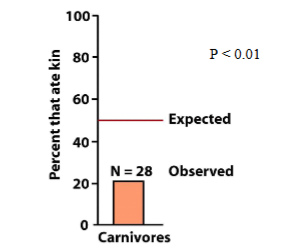
Experiment: 29 cannibalistic tadpoles in a separate container, each w/ 2 omnivores tadpoles (1 sib and 1 non-kin)
Determine if feeding was random relative to kinship
6/28 ate sibling's (cannibals)
What is eusociality? What are the requirements?
An extreme form of cooperative brood care in which some individuals never repro and only have indirect fitness
Overlap in generations b/w parents and their offspring
Cooperative brood care
Specialized castes of non-reproductive individuals
Explain how haplodiploidy predisposes some groups of insects to eusociality but is not the final influence on the evolution of eusociality
Hamiliton suggested that the unusual genetic system of ants, bees, and wasps predisposes them to eusociality
Haplodiploidy= males are haploid and develop from unfertilized eggs, females are diploid and develop from fertilized eggs
Sisters share all genes they inherited from their father and 1/2 of their genes they inherited form their mother (colony queen)
Relatedness ® of female workers to sisters: .75, brother: .25, offspring: .50
Ancestral in hymenoptera yet isn't common in this clade, are only 3X
Associated w/ complex nest building behavior and extended parental care
Ecological conditions influence B and C to favor eusociality

What evidence is there to support the conclusion that high levels of relatedness are necessary but not always sufficient for the evolution of eusociality?
Haplodiploidy and naked mole rats
Based on the understanding of eusociality in insects, why is it unexpected in mammals?
Inbreeding causes negative genetic problems like drift and increase in homozygotes
What is reciprocal altruism and how does it help explain the evolution of cooperation? That is, how is reciprocal altruism different from kin selection?
Hamilitons rule (inclusive fitness) explains the cooperation among related individuals
Organisms help another with the expectation of help back, kin selection is natural selection favoring the spread of alleles/traits that increase indirect fitness
Favors traits that increase the indirect component of inclusive fitness
Kin selection favors traits such as cooperation, kin recognition, alarm calling through advantages of indirect fitness
Reciprocal altruism explains evolution of cooperation among non-related individuals
Under what conditions might we expect reciprocal altruism to evolve?
Individual's repeatedly interacts w/ the same set of individuals
Many opportunities for altruism occur within an individuals lifetime
Individuals have good memories
Potential altruism interact in symmetrical situations
What are some examples of how conflicts arise between related individuals
Conflicts arise b/w parents and offspring gets bigger (more expensive) there are dimishing returns for parents
Offspring= parental investment always beneficial
Parents= investments must balance costs and benefits
Parents will stop investing when costs are high for parents and benefits are low
Sliblidie seen in fish, birds (eagles, egrets, boobies), mammals (hyena)
Masked booby
May be a form of parental favoritism
Parents are passive as siblings compete for parental investment sometimes resulting in the death of 1 offspring at the hands of sibling
What are the similarities between the evolution of alarm calling behavior and kin recognition?
Kin Selection
Inclusive fitness can be portioned into 2 components
Direct= offspring produced by repro
Indirect= additional finesses through repro of relatives resulting from help
Kin selection= natural selection favoring the spread of alleles/traits that increase indirect fitness
Favors traits that increase the indirect component of inclusive fitness
Examples
Alarm calling/vigilant behavior
Kin recognition
Cooperative brood care
Eusociality
Alarm Calling
These data support the hypothesis that alarm calling behavior is the result of kin selection
Alarm calling likely to be low cost
Alarm calling in Beldings ground squirrel is directed at kin
Adult males are at least related to other group members
Adult males are less likely to give alarm calls than females
Individuals are more likely to give alarm calls when close to nearby relatives (not just offspring)

What are the similarities between the evolution of alarm calling behavior and colorful plumage in male birds?
These data support the hypothesis that alarm calling behavior is the result of kin selection
Alarm calling likely to be low cost
however, causes potential threat to male like colorful plumage yet helps in mate attraction while alarm calling draws attention and is a potential threat to them
Thompson’s gazelle uses a bouncing display called stotting in the presence of a predator like a cheetah. One hypothesis for the evolution of stotting behavior is that is the result of kin selection.
a. What kind of data could you collect to support a kin selection hypothesis? What predictions would you make about your data if were to find support for the kin selection hypothesis?
b. If you do not find support for the kin selection hypothesis, what alternative hypothesis would suggest?
Do
Life History Strategies
Reproduction is favored by natural selection
However, reproductive strategies are enormously diverse w/ wildly varying schedules of life
Age at maturity, # of offspring, lifespan
Life history= patterns of maturity, repro, aging, death
Life History Strategies
The ideal organism would mature at birth, continuously produce high quality offspring, live forever
Trade-offs= organisms have fundamental trade-offs in their use of finite resources of energy and time
Ex= trade offs in repro and blue coloring in blue footed boobies (brighter= skip a yr, expensive

Life History Strategies
Organisms must optimize costs and benefits of reproduction that maximizes lifetime repro success
Blue footed boobies must manage trade-offs b/w investment in current and future repro success
Limited resources and time dictate what strategy is best for individuals in the envirroment