MATH 241 UIUC FINAL EXAM
 Call Kai
 Learn
 Practice Test
 Spaced Repetition
 Match
 Flashcards
 Knowt Play
1/25

Earn XP
Description and Tags
Equcation to remember and detail information about them
26 Terms
How do you find the dot product of two vectors a=⟨a1, a2, a3⟩ and b=⟨b1 ,b2, b3⟩?
a⋅b=a1b1+a2b2+a3b3
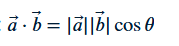
What is the geometric interpretation of the dot product?
where θ is the angle between the vectors. It can be used to find the angle between vectors and determine if they are orthogonal
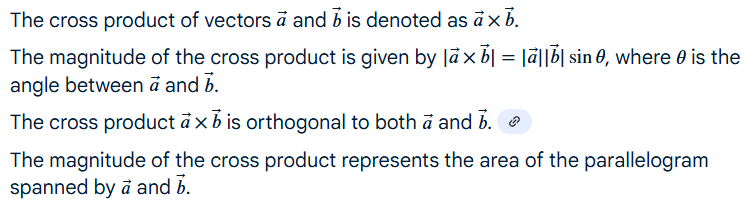
How do you find the cross product of two vectors a=⟨a1,a2,a3⟩ and b=⟨b1,b2,b3⟩?
Should end up with a vector

What is the geometric interpretation of the cross product?
How do you find the equation of a plane given a point P0(x0, y0, z0) and a normal vector n =⟨ a, b, c⟩?

How do you find the velocity and acceleration vectors given a position vector function r( t )?
The velocity vector can be found by taking the derivative of the position vector function with respect to time, while the acceleration vector is the derivative of the velocity vector.

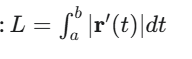
How do you calculate the arc length of a curve given by r(t) for a ≤ t ≤ b?

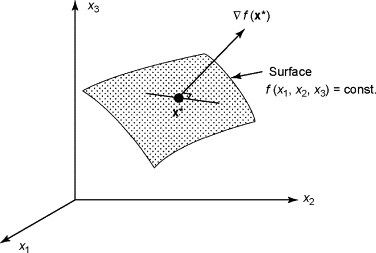
What does the gradient vector ∇f represent?
The gradient vector ∇f represents the direction and rate of fastest increase of the function f, indicating the steepest ascent in multidimensional space.
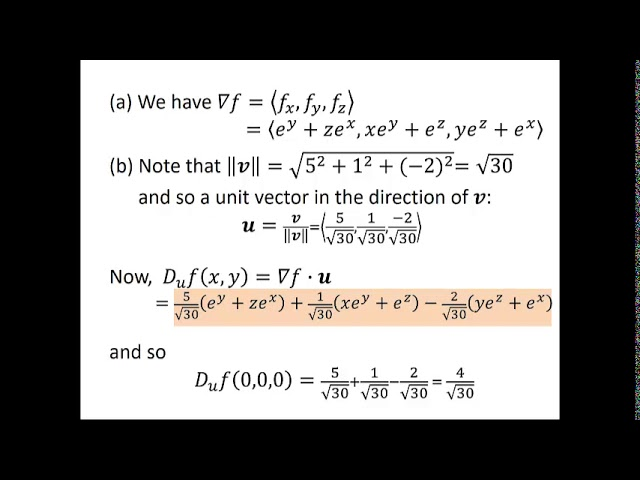
How do you calculate the directional derivative of f in the direction of a unit vector? u
The directional derivative of f in the direction of a unit vector u is calculated by taking the dot product of the gradient vector ∇f and the unit vector u, representing the rate of change of the function in that direction.
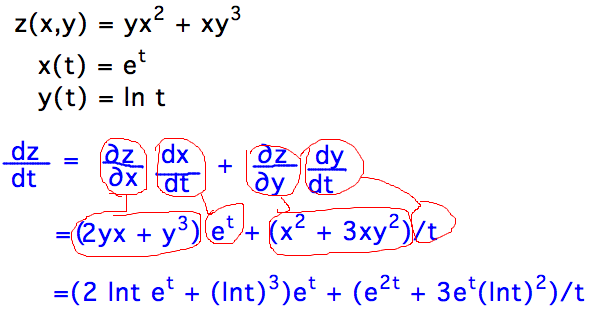
State the Chain Rule for a function z = f(x, y) where x = x(t) and y = y(t)
the effects of the partial derivatives of z with respect to x and y with the ordinary derivatives of x and y with respect to t to find the total rate of change of z with respect to t.
What are the conditions for a critical point (a,b) of a function f(x,y)?
fx(a,b)=0 and fy(a,b)= 0, or one of the partial derivatives does not exist.
How do you use the Second Derivative Test to classify a critical point (a,b)?
The Second Derivative Test involves evaluating the second partial derivatives of the function at the critical point (a,b).
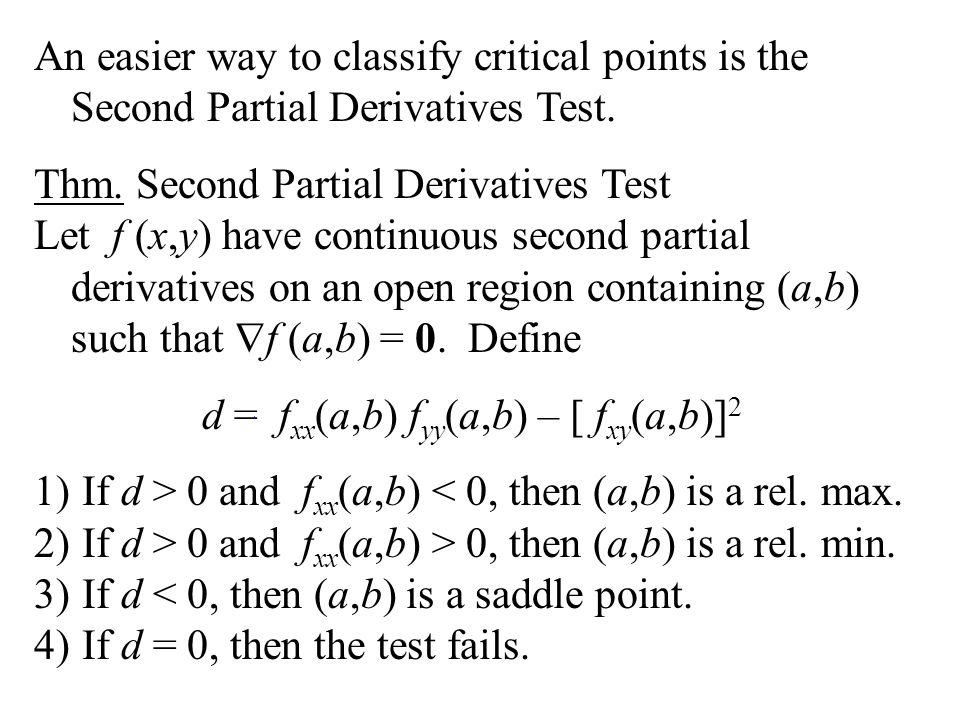
How do you convert from Cartesian coordinates (x,y) to polar coordinates (r,θ)?
x= rcosθ, y= rsinθ, x2+y2=r2 , dA= dr dθ.
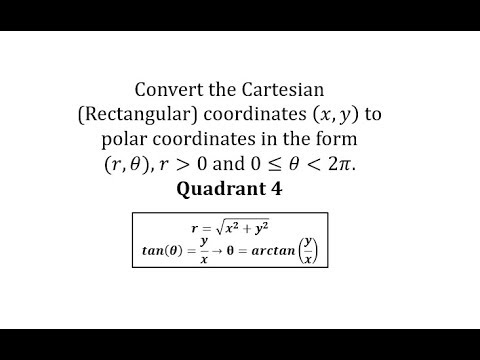
How do you convert from Cartesian coordinates (x,y,z) to cylindrical coordinates (r,θ,z)?
x= rcosθ, y= rsinθ , z= z, x2+y2=r2 , dV = rdzdrdθ.
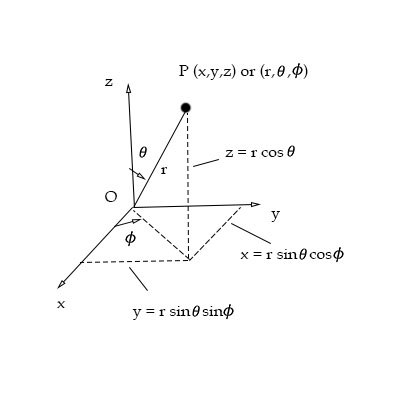
How do you convert from Cartesian coordinates (x,y,z) to spherical coordinates (ρ,θ,ϕ)?
x= ρsinϕcosθ, y= ρsinϕsinθ, z= ρcosϕ, ρ2=x2+y2+z2, dV= ρ2sinϕdρdθdϕ.
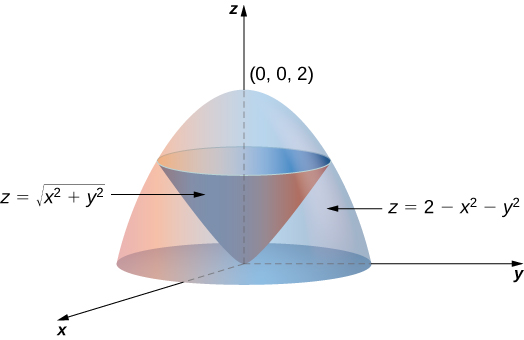
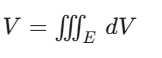
How do you find the volume of a solid region E using a triple integral?
To find the volume of a solid region E using a triple integral, you integrate the function f(x, y, z) = 1 over the region E, which is expressed as V(E) = ∭_E 1 dV
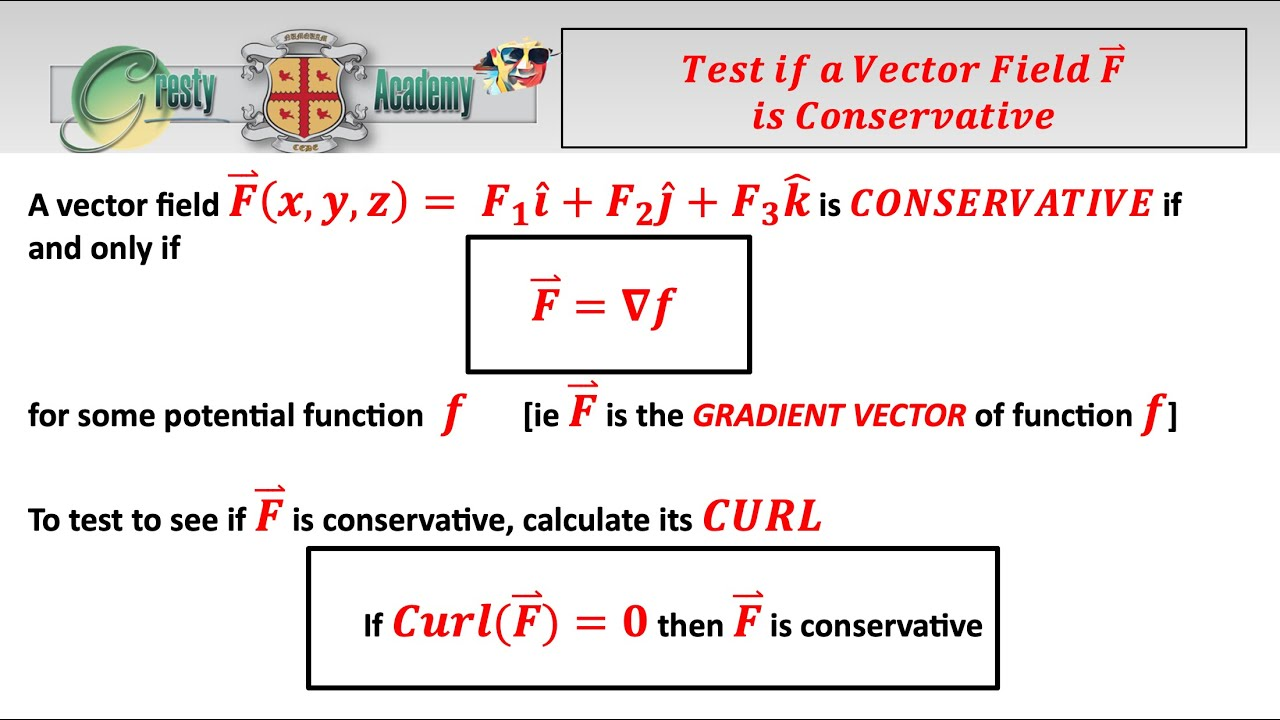
What is a conservative vector field?
A vector field F is conservative if there exists a scalar function f such that ∇f=F. This means the line integral of F is path-independent, and the work done by F around any closed curve is zero.
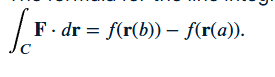
State the Fundamental Theorem of Line Integrals.
If F=∇f is a conservative vector field, then ∫CF⋅dr=f(r(b))−f(r(a)), where C is a smooth curve from r(a) to r(b).
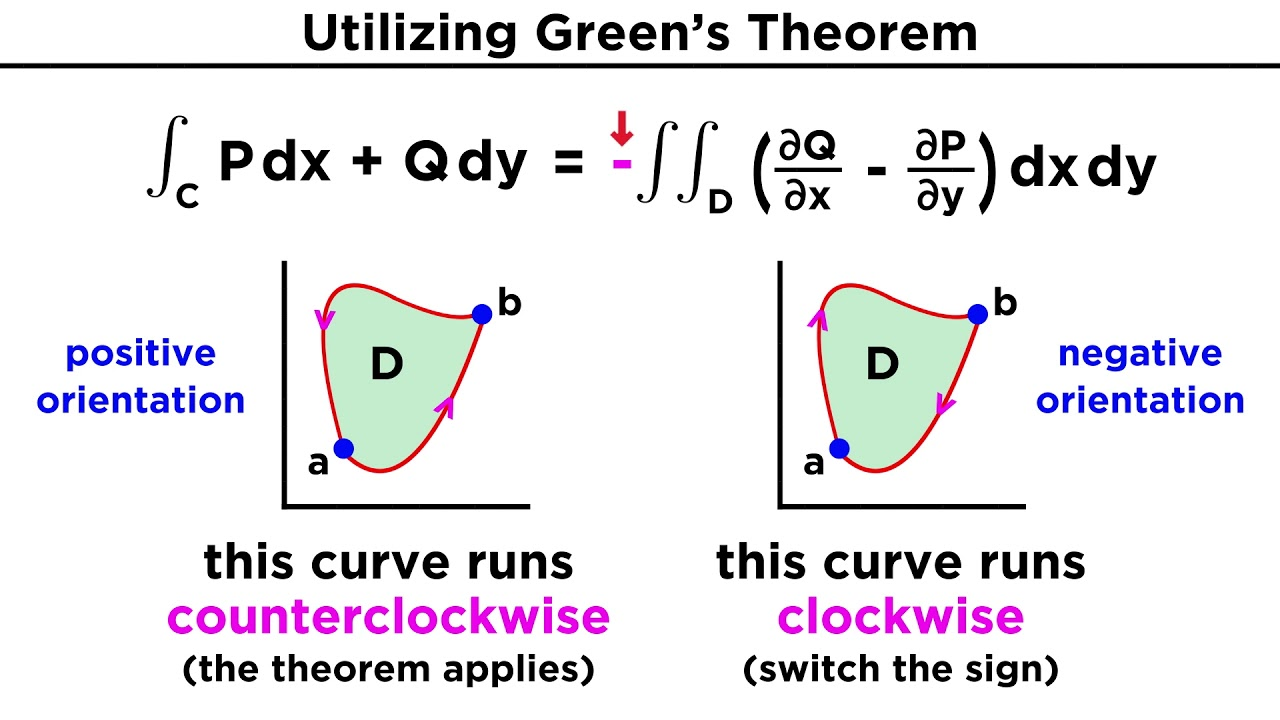
State Green's Theorem (circulation form).
relates a line integral over a closed curve to a double integral over the region enclosed by that curve
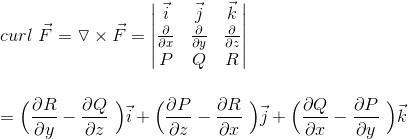
Define the curl of a vector field F=⟨ P, Q , R ⟩.
The curl of a vector field F measures the rotation or twisting of the field at a point and is defined as ∇×F = ⟨ ∂R/∂y - ∂Q/∂z, ∂P/∂z - ∂R/∂x, ∂Q/∂x - ∂P/∂y ⟩.
Define the divergence of a vector field F=⟨ P , Q , R ⟩.
The divergence of a vector field F measures the rate at which the field spreads out from a point and is defined as ∇•F = ∂P/∂x + ∂Q/∂y + ∂R/∂z.

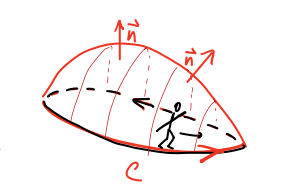
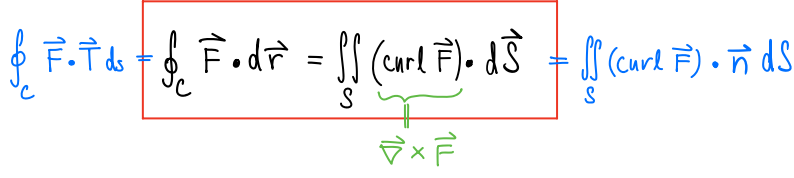
State Stokes' Theorem.
the line integral of a vector field along a closed curve is equal to the surface integral of the curl of the vector field over any surface bounded by that curve
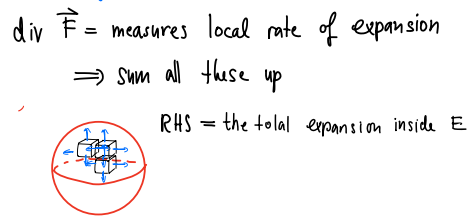
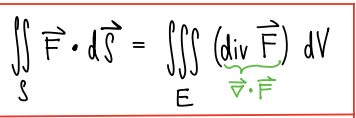
State the Divergence Theorem.
The divergence theorem states that the flux of a vector field through a closed surface is equal to the volume integral of the divergence of the field over the region enclosed by the surface.