MOlgen M2 population genetics
 Call Kai
 Learn
 Practice Test
 Spaced Repetition
 Match
 Flashcards
 Knowt Play
1/66

There's no tags or description
Looks like no tags are added yet.
67 Terms
population
group of interbreeding sexually repoducing individuals share common set of genes
what are evolutionary foces that change allelic frequencies
mutation
migratoni
genetic drift
natural selection
waht are f(AA) f(Aa) f(aa) for
genotypic frequencies (number of Aa/AA/aa)
what does hardy weignberg assume
no mutations
random mating
no gene flow/migration
large populatin size
no natural selection
equal female and male allele frequencies
what gets predicted if Hardy weinburg assumtions are met
allelic frequencies of population don’t change
genotypic frequencies don’t change after one generation of random mating
implications of hardy weinburg
reporudctions alone doesn’t alter allele/genotypic frequencies
allelic frequencies determine genotypic frequencies
when do we accept and reject the null
if p-value is greater than your significance level you fail to rject
if p-value is less than or equal to your significance level you reject
what is the null of HWE
observed data fits Hardyweinburg expecations
CCR5 locus what does the mutation do
mutation in CCR5 chemokine receptor makes CD4(+) class of T cells in the immune system resisitant to HIV infections
identiifed in uninfected people are were at high risk
adaptive role of CCR5
adding it has protected people from other diseases like west nile virus
outcrossing
avoidance of mating between related individuales
what does inbreeding cause
decreased heterzygotiity
sources of variation of increased gentic variation within populations
mutations,migrations, some natural selection
causes nof point mutations
erros in DNA replication or recombination
chemical damage to DNA
radiation
transitions
Transition is point mutation where purine is replaced by a dif purine or pyrimidine replaced by other pyramidine
ex) A becomes Gt
transversions
mutation where purine is replaced by pyrimidine or vice versa
ex) A to C
tandem duplications
new copies are adj to parental copies.
wat do double stranded breaks on tandem repeats do
lead to chromosomal rearrangementsw
wat causes tandem repeat slippage
recombination mispairing
transposable elements
DNA sequences that change positions in genome
major source of mutations
pick up at ;lect 12
gene flow
migration, movement of allelews beween populations
genetic drift
random change in allele frequnecy
nonrandom mating
changes genotype frequencies withojutu changing allele frequencies
mendelian popualtion
group of intervreeding individuals that share gene pool
gene pool
all genetic loci in populatin (all copies of A and a in population)
all genotypic and allelic frequnecies
genotypic freqency formula
numver of indivuals with genotype/ total indivuals f(AA), f(Aa), F(aa)
Allelic frequency formula
total number of one allele/ total alleles
gene with 2 alleles formula allele freuqncy HW
p+q=1
chi square formula
x²= sum of (observed-expected)²/Expected
how to tell if HW applies to a populatkoin
do chi square test, add it up for every genotypic frequency, and see if the x² is greater or less fthan p value
positive assortative mating
individuals with simalar traits are more likely to mate
decreases heterzygosity, increases homozygousity
negative assortative mating
individuals with dissimilar traits more likely to mate, increases heterozygousity
inbreeding
related indivuals mate and increases homzygosity
inbreeding coefficeint, what the numbers mean
F=0; no excess inbreeding
F>0= increased homozygosity relative to HW
invreeding coefficient for homo and hetero alleles (AA,aa, Aa)
f(AA)=p²+ Fpq
f(Aa)= 2pq(1-F)
f(aa)= q² + Fpq
inbreeding depression
reduction in average fitness associated iwth inbreedingc
consequences of inbreeding and increased homozygoosity
lower survival
reduced fertiity
lower reproductive success
greater susceptibiltiy to certain disease
outcrossing
mating between indivuals less closesly related than those involved in inbreeding
heterosis/hybrid vigor
offspring have greater fitness or performance than parents
silent mutation
doesn’t alter encoded aa
missense mutation
alters an amino acidn
nonsene mutation
pereamtuer stop codon
forward and reverse mutation rates after one genration and what they do
p'=p(1-u)+qv - counts A alleles that reamin A abd a alleles that mutate back to A
q'=q(1-v)+pu - counts a that remain a and A that mutate back to a
what is u
forard mutation rate
what is v
reverse mutation rate
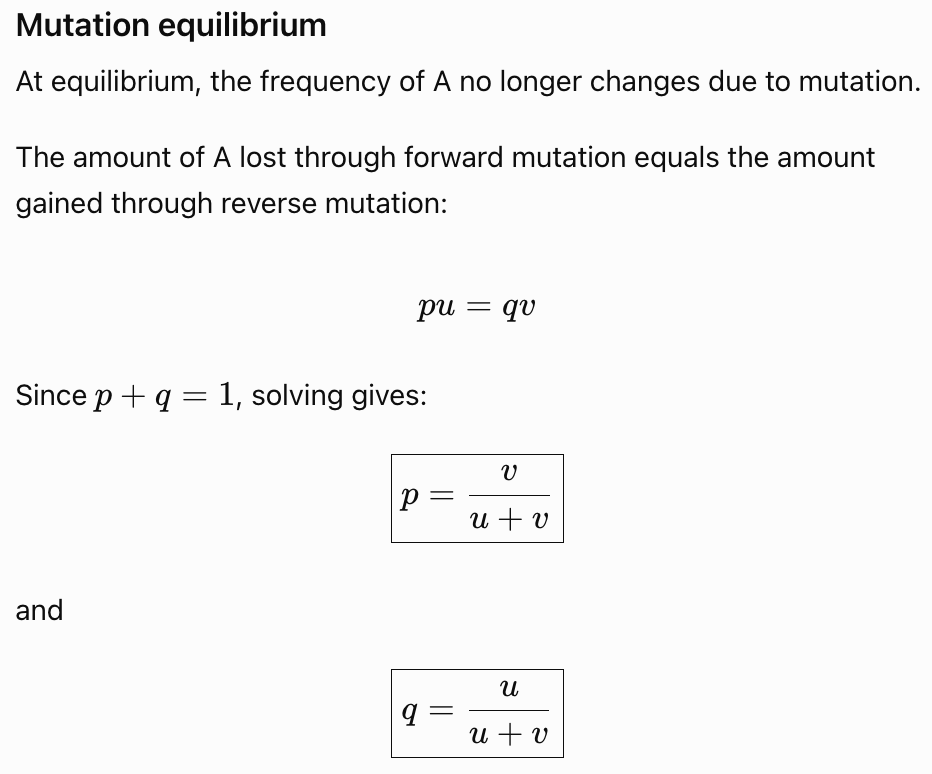
mutation equlibrium and equation
amount of A los through forward mutation equals amount gained through reverse pu=qv
idk j write it on notecard. assumes 2 allele system w constant mutation rates
Luria Delbruck fluctuation test background and results
investigated if bacterial mutations are induced by exposrue to selective agent or occur spontaneously
response to exposure would mean relatively similar distribution of bacteria
result: number or resistant bacteria vareid among cultures
luria delbruck experiemtn conclusion and why it happebed
why: mutation that occurs early is paassed on to many descendants, but if mutation occurs laterm its passed to fewer descendents
conclusion: resistant causing mutations can arise spontaneously before exposure to agent. slection favors resistant bacteria
replica plating
examines if mutations that allow bacteria to grow under particular conditions exist before conditions were encountered
ames erplica plating steps
bacteria culture grown onmaster plate and colony pattern is copied onto another plate
2nd plate has selective condition which only bacteria w certain ability grows
colonies that grow on selective plate are conpared to master plate
reveals existing varaints, doesn’t cause specific mutations
migration equatoin
p'=(1-m)p+mp_m
p= orignial resident population A allele frequency
Pm= migrants A allele frequnecy
m= proportion of new population gene pool contributed by migrants
p’= A allele frequency after migration
sampling error
random samples don’t always perfectly rerpesent population
genetic drift what can it do
increases or decrease freqwunecy of alele by chance
elim an allele fro pop
cause alle to be fixed
reduce or icnrease genetic variatoin between and within populations
effective population size
Ne: size of idealized population that experiences same level of genetic drift or inbreeding as populatin being studied
smaller Ne means stronger genetic drift and faster loss of genetic variationf
probilitity of fixation
P(fixation)= p0.
if a neatural allee begins w frequency .2 then P(Fixatio)=.2 so eventual fixation is 20%
f
fixation
allele raches frequency of q so no alternative allele remains
what are fouder affect and genetic bottle types of
genetic drift
selection coefficient
s=1-w
w= relative fitness
fitness
measures indivuals contribution to next gen
mean fitness
sum of genotype frequency times fitness
overdominance
heterzygote has higher fitness than either homozygoute so wAa=1
underdominance
heterzygote has lower fitness than either homozygotec
tishkoff human genetic diversity principles
human genetic variation reflects mutation, migrationm ngenetic driftm natural selection, populatin history and admixture
human pops aren’t genetically uniform
pops w long histories and large effective populations reatin substantial genetic diversity
foundr and bottle necks reduce variation
gene flow introduces variation
natural selection can change frequencies in response to environment
genetic variaiotn differences is often greate within populations than between populations
mendelian population
group of sexually reproducing indiviuals w a common gene pool