Glycogen and Pentose pathway!
 Call Kai
 Learn
 Practice Test
 Spaced Repetition
 Match
 Flashcards
 Knowt Play
1/48

There's no tags or description
Looks like no tags are added yet.
49 Terms
What is glycogen
How we store glucose
What are the possible ways glucose 6-phosphate gets used?
Glycolysis is where pyruvate + ATP are formed from glucose-6-phosphate, NADH is formed also and NADH eventually forms ATP
Glucose 6 phosphate is used in the pentose pathway and forms Ribose 5-phosphate with NADPH
Glucose 6-phosphate also (through enzyme glucose 6-phosphatase) creates glucose export to blood.
Gluconeogenesis makes glucose 6 phosphate to eventually form glucose
Glycogen (stored in the liver) can convert to glucose 1 phosphate which can eventually convert to glucose-6-phosphate
____ is a long chain of glucose molecules
glycogen!
Glycogen synthesis:
1. Phosphoglucomutase converts glucose 6-phosphate to glucose 1-phosphate. (moves phosphate from the 6th to the one position).
2. UDP-glucose pyrophosphorylase catalyzes the formation of the nucleotide
sugar uridine diphosphate glucose (UDP-glucose) from glucose 1-phosphate and uridine triphosphate (UTP).
Uses energy from UTP and adds Pi (phosphate) to glucose 1 phosphate and pyrophosphate is formed as a byproduct.
3. Glycogen synthase adds glucose residues from UDP-glucose to the nonreducing ends of the glycogen chain.

What is the most regulated step in glycogen synthesis:
glycogen synthase step because this is where you actually add glucose to a growing glycogen chain!
Step 1: The Activation Step (Where the phosphoanhydride energy is used)
Before glycogen synthase can do its job, the glucose must be "activated". An enzyme called UDP-glucose pyrophosphorylase reacts Glucose-1-phosphate with UTP (uridine triphosphate). This reaction releases a pyrophosphate (\(PP_{i}\)) molecule. An enzyme called pyrophosphatase immediately chops that \(PP_{i}\) in half, breaking a phosphoanhydride bond. This step releases a massive amount of energy, which acts as the thermodynamic "engine" that drives the overall pathway forward. [1, 2, 3]
Step 2: The Glycogen Synthase Step (What you are asking about)
The product of that activation step is UDP-glucose. When glycogen synthase binds UDP-glucose, it snaps the bond between the glucose and the UDP. This is a glycosidic/ester linkage, not a phosphoanhydride bond. Breaking this bond releases the energy needed to attach the glucose onto the growing glycogen chain
_______ converts glucose-6-phosphate to glucose 1-phosphate
Phosphoglucomutase. Responsible for moving phosphate from the 6th to the one position.
_______________ catalyzes the formation of the nucleotide
sugar uridine diphosphate glucose (UDP-glucose) from glucose 1-phosphate and uridine triphosphate (UTP).
UDP-glucose pyrophosphorylase
Uses energy from UTP and adds Pi (phosphate) to glucose 1 phosphate and pyrophosphate is formed as a byproduct.
__________: adds glucose residues from UDP-glucose to the nonreducing ends of the glycogen chain.
Glycogen synthase
______ is how we store glucose when we dont need it
glycogen
What is the mechanism of phosphoglucomutase?
phosphoglucomutase is an odd enzyme because it has a phosphate on its active site residue ALREADY! It doesn’t just take the phosphate from the 6th position and put it on the one position, it adds the phosphate to the position to form Glucose 1-6 bisphosphate first!
Then, it removes the phosphate from the 6th position after the Glucose 1-6 flips.
What does UDP-glucose pyrophosphorylase do?
It adds UMP to the glucose 1-phosphate (on the one position) to form UDP-glucose
UTP is split, transferring a UMP (uridine monophosphate) group to glucose 1-phosphate while releasing pyrophosphate (PPi).
The Result: This reaction forms UDP-glucose (uridine diphosphate glucose) and allows for glycogen synthesis to occur next!

Mechanism of UDP-glucose phosphorylase
you have to put the UTP on first to the enzyme and a magensium helps neutralize all the charge on the phosphates!
Then you bind the sugar with the phosphate and this positions the phosphate to attack the alpha phosphate on the UTP!
The pyrophosphate is removed in order for glucose-1 phosphate to bind and then pyrophosphate is broken down into 2 phosphates to help push reaction forward!
UDP is now attached to the sugar at the one position.
What is the process for glycogen synthase?
On the 4 position, the oxygen attacks the phosphate at the anomeric carbon and you remove the UDP!
Now there is a 1,4 linkage between the incoming glucose and the last glucose in the glycogen chain!
You attach the new glucose to the non-reducing end of the chain
You grow 1 to 4!
The main chain grows alpha (1→ 4).
Glycogen is branched as a way to make it more dense! The branching enzyme allows you to add glucose to the 6 position. You form Beta (1→6) linkages!
T/F: when building glycogen, it starts on a protein?
TRUE!
Glycogenin is what starts the glycogen chain
Steps leading to glycogen synthesis:
1) Glucose is attached to a Tyr of a protein called glycogenin
2) Glycogenin is an enzyme too, attaching up to 7 more glucose molecules
Glucose → Glucose-6-phosphate → Glucose-1 phosphate → UDP-glucose
3) Once the chain got started, Glucose is then added one glucose at a time by glycogen synthase
Steps leading to adding glucose onto the growing glycogen chain:
The UDP-glucose is then used by glycogen synthase to add the glucose to glycogen
2 chains are attached to each core glycogenin molecule.
Each chain has 8-14 residues and 2 branches.
A separate Branching Enzyme catalyzes the 1→6 linkages
How do you break down the glycogen when you need it?
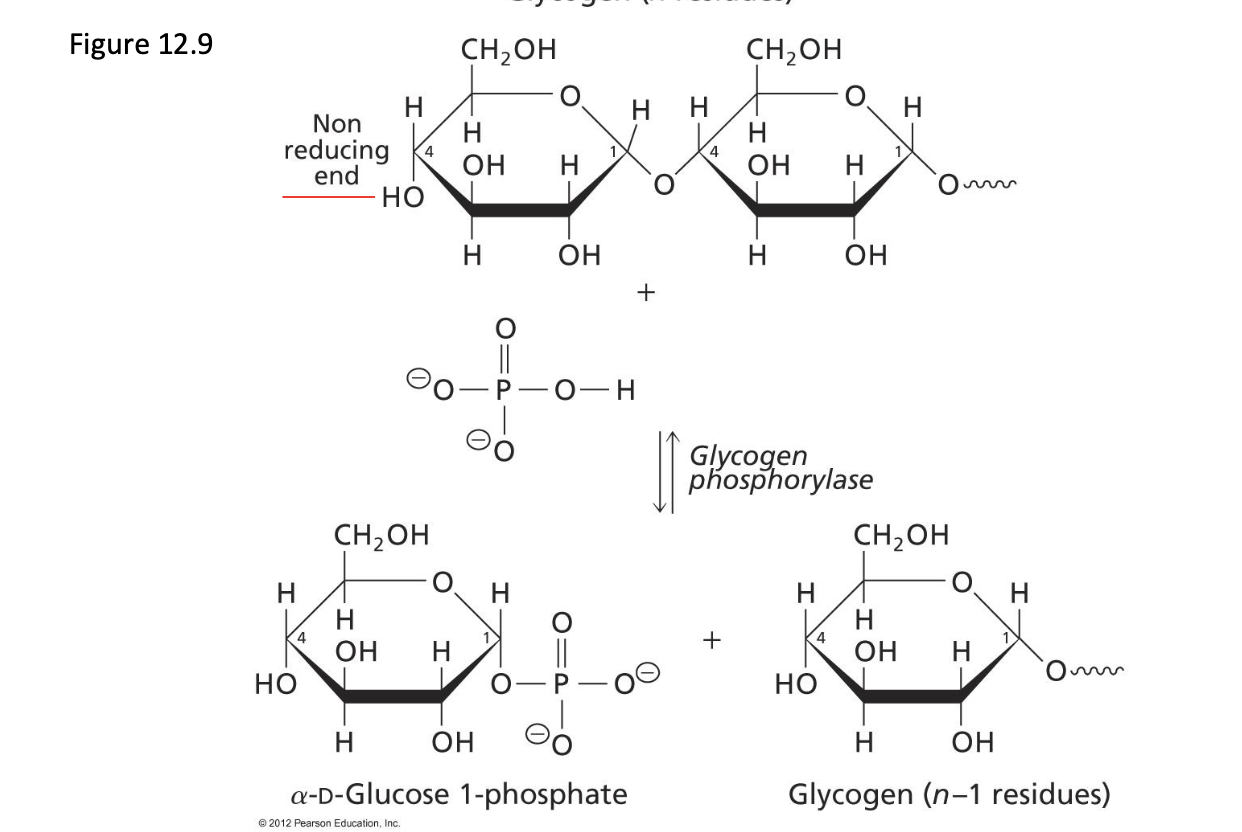
Degradation of glycogen by glycogen phosphorylase
Take the last glucose in the chain off! You do this with a phosphate!
The phosphate attacks the anomeric carbon on the last glucose and you get the phosphate attached at the one position.
You just formed glucose-1 phosphate!
What does dehydrogenase do?
Enzyme that catalyzes a hydride transfer, reducing an electron acceptor, typically NAD+ or FAD+ and releasing a proton.
Phosphoglucomutase makes what?
The glucose-1-phosphate from Glucose-6-phosphate!
Summary of Glycogenesis:
Phosphoglucomutase shifts the phosphate from carbon 6 to carbon 1, yielding Glucose-1-phosphate (G1P)
Then, UDP-glucose pyrophosphorylase is the enzyme that catalyzes this step, not the product. Feeding in UTP reacts with Glucose-1-phosphate to create UDP-glucose (the activated molecule) and PPi (pyrophosphate)
Now you can do glycogen synthesis and remove the UDP to get energy to build the glycogen chain 1→4. You attach onto the non-reducing end of the glycogen chain.
What is glycogenolysis:
When you break down the glycogen chain.
The phosphate comes and attacks the last bond.
Remove one glucose at a time. Now you have a Glucose-1-phosphate
Phosphoglucomutase can go either direction, do it can go from glucose 1-phosphate to glucose-6-phosphate and do glycolysis with G6P.
Regulation of Glycogen metabolism:
The pancreas creates both insulin and glucagon
When you just ate:
There is a lot of sugar and the pancreas will secrete insulin!
When insulin is high, this signals to the liver that you have a lot of glucose, so you need to make glycogen!
When you are fasting and have low blood sugar…
the pancreas will secrete glucagon!
Glucagon tells the liver that you need to break down glycogen!
Need the glucose in the glycogen to increase the blood glucose conc!
Tyrosine kinase receptor:
The tyrosine kinase functions as the receptor, transducer, and effector in a single membrane protein.
The ligand binds and creates a conformational change, bringing 2 proteins together to form a dimer.
When the kinases are close together inside the cell, they phosphorylate each other, autophosphorylation, activating the kinase.
Ligand binding = receptor
Dimerization = signal transduction (requires lateral movement through the membrane).
Autophosphorylation = effector enzyme!
_____ receptor is a receptor tyrosine kinase
insulin
______ is a hormone synthesized in the pancreas that regulates glucose uptake into many cells including muscles and fat
insulin
T/F: The insulin receptor dimerizes without insulin bound, forming a disulfide bond
true
Is insulin receptor a little odd?
YES! It is odd because it is already dimimerized. When the insulin binds, there is a conformational change and you get this tyrosine autophosphorylation which turns the receptor on.
Insulin signals to
liver, skeletal muscle cells, and fat that they need to take up glucose!
Insulin signaling
Promotes glucose uptake in cells and glycogen synthesis, when blood glucose is high!

What is the process of insulin signaling?
The insulin binds to the tyrosine kinase receptor
The activated receptor autophosphorylates itself and then tyrosine-phosphorylates Insulin Receptor Substrate (IRS) proteins (like IRS-1 or IRS-2), creating docking sites for downstream signaling molecules
The IRS then recruits PI3K which phosphorylates PIP2 and then that phosphorylates PIP3 (second messenger) and then that activates AKT that is able to cause the intake of glucose and stimulates glycogen synthase (want to make glycogen).
Insulin eventually activates glycogen synthase in order to build glycogen!

_____ and ______ are associated with the membrane
PIP2 (what is getting phosphorylated) and PIP3
Phosphatidylinositol 4,5-bisphosphate and Phosphatidylinositol 3,4,5-trisphosphate
Important for downstream pathway

T/F: glucagon is the G-protein coupled receptor pathway
true

What are all the parts of the G-protein coupled receptor pathway
Primary messenger = hormone
The glucagon binds to the receptor and the signal is transmitted into the cell.
The transducer is the g-protein and that activates the effector enzyme of adenylate cyclase. Adenylate cyclase creates the second messenger of cAMP out of ATP
Then you have the phosphorylation cascade!
When you make cAMP
The ribose ring is attached to the 5’ and the 3’ end with phosphate
In order to turn of G-protein signal —> phosphodiesterase breaks it up into 5’ AMP
What does cAMP do?
It activates Protein Kinase A (PKA)
PKA is the first enzyme in the kinase cascade
PKA is composed of a regulatory subunit and a catalytic subunit.
After 4 cAMP bind, the regualtory subunit gets removed, and NOW the catalytic subunit can start phosphorylating things.
Then, Protein kinase A will phosphorylate phosphorylase b kinase which phosphosphorylates more and eventually it will cause breakdown of glycogen stored in the liver!
Functions between meals when blood glucose is low
Promotes gluconeogenesis in liver, and glycogen breakdown, when blood glucose is low.
T/F: the pentose pathway is always happening to some of the glucose?
true!!!
What is important for anabolic pathways
NADPH
_____ a series of metabolic or enzymatic steps which provide an alternative route within a pathway.
shunt
Function of Pentose phosphate pathway
First thing it does is make NADPH! NADPH is important for biosynthesis, and anabolic pathways!
This pathway is also a source of pentoses for nucleotides
Interconversion of sugars, eg erythrose 4-phosphate used to synthesize aromatic amino acids
Used to digest dietary pentose sugars from nucleic acids
Active in rapidly dividing cells that need to replicate DNA or need NADPH.
Occurs in the cytoplasm, like glycolysis (because it needs the glucose-6-phosphate)
Metabolite input: Glucose-6-phosphate or dietary pentoses from nucleic acids (breaking down nucleotides from the diet).
T/F: even if you are getting energy out of glucose and you want to use it for biosynthesis, you need NADPH
TRUE! This is why pentose pathway is important
T/F: the pentose pathway is the source of the pentoses for nucleotides
true
What are the two phases of the pentose pathway?
The oxidative phase:
Make NADPH
Oxidize Glucose 6-phosphate and get NADPH out!
You still have carbons left over and that is what goes into the non-oxidative phase
Non-oxidative phase:
the energy state of the cell dictates how you use those carbobs
If times are good and you are gonna grow and divide, then you need the ribose sugar to make the nucleotides
If you are low energy, then you can use those carbons and convert them into 6 carbon sugars and you can use them for energy or to make more NADPH
What phase of the pentose pathway are you making NADPH
oxidative
T/F: all the pathways do this oxidative step (pentose pathway)?
TRUE! You are trying to get this NADPH OUT! LOTs of NADP still stimulate this pathway!
The first step in the pathway (committed step) is galled Glucose-6-phosphate dehydrogenase
What is the committed step of the pentose phosphate pathway?
The first step, diverts glucose 6-phosphate from glycolysis to 6-phosphogluconolactone
You formed NADPH
The enzyme responsible is Glucose-6-phosphate dehydrogenase!