Chapter 9.3: Genetic Diversity + 9.4: Types of selection
 Call Kai
 Learn
 Practice Test
 Spaced Repetition
 Match
 Flashcards
 Knowt Play
1/17

Earn XP
18 Terms
Population
A group of individuals from the same species that live in the same place at the same time
Genetic diversity
the total number of different alleles in a population.
The greater the number of different alleles in a species, the greater the genetic diversity and the wider the range of characteristics
How do organisms differ
In their alleles
Why is genetic diversity important
The greater the genetic diversity, the more likely that species will be able to adapt to environmental changes
Natural selection
Some alleles are likely to be passed on to the next generation because certain individuals have more reproductive success
Gene pool
all the different alleles in a population
Allele frequency
The portion of a certain allele in the gene pool
What are the steps of natural selection
Random mutations → survival advantage → Reproductive success → advantageous allele is passed on → Frequency of advantageous allele will increase
What are the most common misconceptions
It is not the environmental change that causes the mutation leading to the new allele. Mutations happen at random and frequently.
What is “Advantageous” depends on the environment and it can change as we have seen
What are the types of selection
Direcional selection and stabilising selection
Which type of selection favours average individuals
Stabilising selection
Which type of selection favours those who differ from the mean population
Directional selection
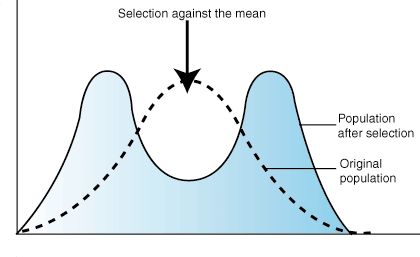
What type of selection is represented by this graph
Directional selection
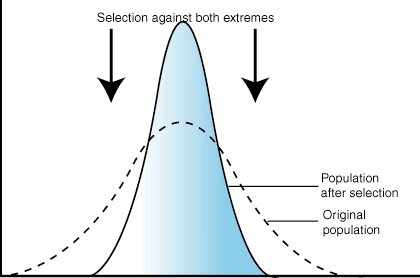
What type of selection is represented by this graph
Stabilising selection
What is a normal distribution curve
A bell shaped curve produced when a certain distribution is plotted on a graph
What are the steps to calculate SD (Standard Deviation)
Menu
Statistics
Variable
Enter Numbers
OPTN
Option 3
σx = Standard deviation
x= mean
What is an example of stabilising selection
Birth Weight
What is an example of Directional selection
The Use of antibiotics, it puts pressure on directional selection on the bacterial population