Tree Dev Midterm
 Call Kai
 Learn
Learn Practice Test
 Spaced Repetition
 Match
Match Flashcards
 Knowt Play
1/28

There's no tags or description
Looks like no tags are added yet.
Name | Mastery | Learn | Test | Matching | Spaced | Call with Kai | Chat |
|---|
No analytics yet
Send a link to your students to track their progress
29 Terms

central cylinder meristem
contributes to the outer vascular tissues

cortex mother cells
part of the main dividing cells, contribute to the formation of the root meristem

central mother cells
part of the main dividing cells and production, contribute to the formation of the meristem, root cells, and vascular tissues and innermost tissue
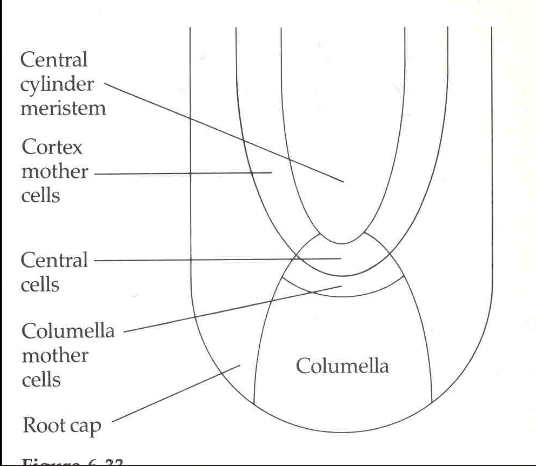
columella mother cells
dividing cells located near the root tip that lead to the development of the columella system and outer cells and formation of the root cap, extends the root

columella
contains specialised cells that sense gravity

root cap
acts as a protector to the root internal parts and produces mucilage to help push through soil
differentiation
The process where newly generated cells from the root apical meristem specialize in structure and function and form mature primary and secondary tissues of the root system. Differentiation involves cells dividing, elongating and expanding. The zone of differentiation is in the root tip.
factors that impact root growth
root initiation (lateral or adventitious), root growth (elongation), root growth periodicity (seasonal and episodic) and dormancy, internal and external control, root growth potential
root initiation: lateral - 1st root growth factor
formed by following a pattern related to the pattern of primary xylem and phloem. factors including sugars, vitamins and plant growth regulators leak radially from vascular tissues to feed development of new lateral roots. can be inhibited with abscisic acid - ABA - which is a plant growth regulator that acts as an inhibitor. ABA forms at the root tips in response to stress, esp water stress
root initiation: adventitious - 1st root growth factor
form after wounding occurs to the main roots - root pruning or undercutting. begins by a callus tissue forming over the wound from surrounding parenchyma cells followed by lateral meristemoids forming within the callus
auxins
main plant growth regulator
root growth - elongation - 2nd root growth factor
auxins at low concentrations promote root growth. stress increases ABA production which decreases or inhibits root growth. carbs from crown activity promotes root growth. restricted light or liquid inhibits root growth. factors impacting shoot growth also impacts root growth.
root growth periodicity - seasonal and episodic - 3rd root growth factor
1st peak: spring, associated with bud growth and soil moisture. 2nd peak: autumn, associated with export of carbs from crown to root system
individual root growth cycle
independent of each other, elongation 2-3 weeks, acropetal browning, browning of apex, necrosis of outer cells, dormancy, swelling and emergence of new white apices through brown layer
elongating root - white root
white, no root hairs, 10cm elongation in one growth cycle, root diameter proportional to elongation, root cap
absorbing root - white root
initiate root hairs, 3 cm elongation, root cap
brown roots
enveloped by necrotic layer, root cap reduced and rounded, occurs between periods of elongation
dormancy
cessation of elongation occurs and the stele and secondary endodermis differentiate to within a few cells of the central zone
external control factors - 4th root growth factor
temperature, aeration, moisture, mineral availability, soil composition, competition
internal control factors - 4th root growth factor
photoperiod, shading (light intensity), air temperature, defoliation, flowering and fruit set, branch elongation, vigor and crown size, root shoot radio, thermoperiod
root growth potential - 5th root growth factor
the ability of a seedling to initiate and elongate roots when placed in an environment favorable for root growth. can predict field performance with physiological test of seedling quality when planting site conditions are similar