Intro to Enzymes
 Call Kai
 Learn
 Practice Test
 Spaced Repetition
 Match
 Flashcards
 Knowt Play
1/39

There's no tags or description
Looks like no tags are added yet.
Name | Mastery | Learn | Test | Matching | Spaced | Call with Kai | Chat |
|---|
No analytics yet
Send a link to your students to track their progress
40 Terms
Intro to Enzymes (Definition and Properties)
What are they
naming
what do they do
behavior
Enzymes are proteins or RNAs that act as catalysts to increase the rate of reactions.
enzyme names can be identified by ending -ase
Enzymes allow reactions to proceed at high rates under mild conditions like those in cells and organisms.
Enzymes exhibit high substrate specificity, which is important for control of which specific molecules undergo the reaction.
Enzymes can be reused many times to catalyze reactions.
Enzymes can be highly regulated by many different methods, which allows precise control of when and where reactions occur in cells and organisms.
What are enzymes
Enzymes are proteins or RNAs that act as catalysts to increase the rate of reactions.
enzyme names
enzyme names can be identified by ending -ase
What do enzymes allow
Enzymes allow reactions to proceed at high rates under mild conditions like those in cells and organisms.
Enzyme characteristics
Enzymes exhibit high substrate specificity, which is important for control of which specific molecules undergo the reaction.
Enzymes can be reused many times to catalyze reactions.
Enzyme regulation
Enzymes can be highly regulated by many different methods, which allows precise control of when and where reactions occur in cells and organisms.
Thermodynamics of Reactions
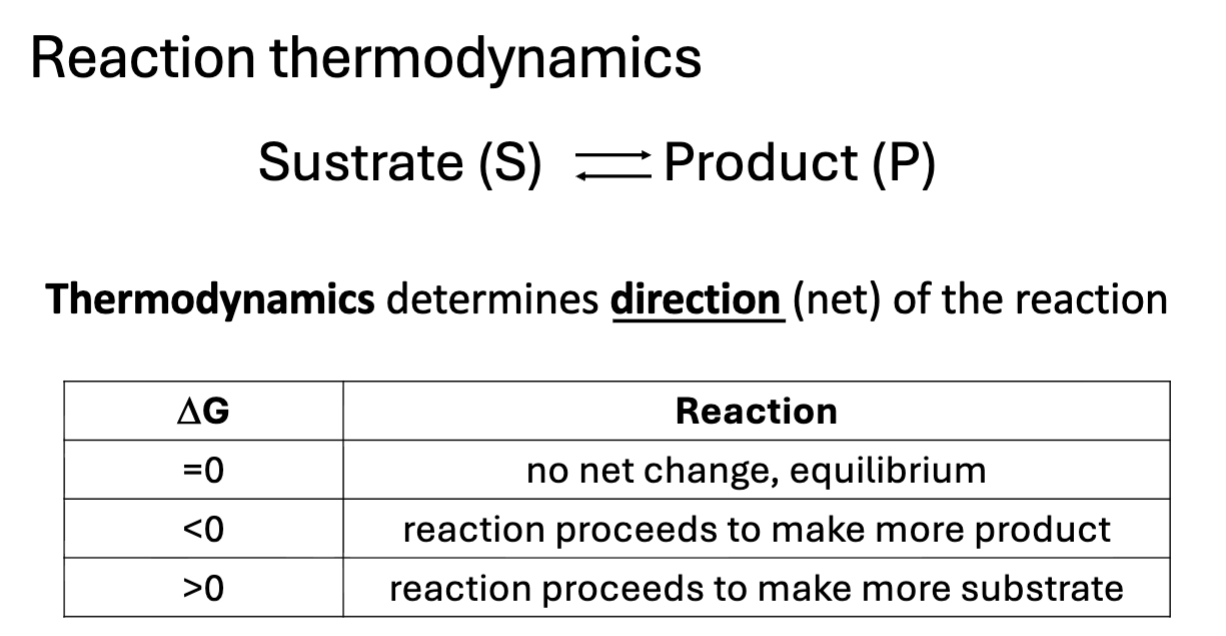
Consider a reaction that converts substrate to product in the forward direction, and product to substrate in the reverse direction. The net direction of the reaction is determined by thermodynamics.
If delta G of the reaction is equal to zero, then there is no net change in the amount of substrate and product, and the reaction is at equilibrium.
If delta G of the reaction is less than zero, the reaction moves towards equilibrium by proceeding in the net forward direction to generate more product.
If the delta G of the reaction is greater than zero, the reaction moves towards equilibrium by proceeding in the net reverse direction to generate more substrate.
Enzymes do not affect the reaction thermodynamics.

Enzymes do not
Enzymes do not affect the reaction thermodynamics.
Reaction Kinetics and Equilibrium
equation for equilibrium
Reaction kinetics involved the forward and reverse reaction rate constants, which are referred to as k_forward and k_reverse.
forward reaction rate equal to forward reaction rate constant multiplied by concentration of substrate, k_forward*[substrate].
reverse reaction rate equal to reverse rate constant multiplied by concentration of product k_reverse*[product].
When a reaction is at equilibrium, the amount of substrate and product remains constant because the forward rate is equal to the reverse rate.
The equilibrium constant K_eq is equal to the concentration of product divided by the concentration of substrate at equilibrium. The K_eq is also equal to the ratio of the forward rate constant to the reverse rate constant.

Reaction kinetics involve
which variables
forward and reverse reaction rate constants, which are referred to as k_forward and k_reverse.
forward reaction rate
forward reaction rate = to forward reaction rate constant * concentration of substrate, k_forward*[substrate].
reverse reaction rate
reverse reaction rate = reverse rate constant * concentration of product k_reverse*[product].
The equilibrium constant
K_eq is equal to the concentration of product divided by the concentration of substrate at equilibrium. The K_eq is also equal to the ratio of the forward rate constant to the reverse rate constant.
Activation Energy and Transition State
rate constants …
how do enzymes do what they do
what is transition state
The rate constants, which are fundamental to the rate of the reaction, are related to the activation energy or transition state energy of a reaction.
Enzymes increase reaction rates by lowering the activation or transition state energy.
The transition state is a high energy state that exists during a reaction. The conversion of a substrate to product or product to substrate requires that the molecule passes through a transition state.
Let's look at a graph of the Gibbs free energy of a reaction showing relative free energy values for the substrate, product and transition state. Often a line is drawn connecting the substrate and product and going through the transition state to represent the reaction. The delta G of the entire overall reaction is the difference between the free energy of the substrate and the free energy of the product. The difference in energy between the substrate and the transition state is called the activation energy, or delta g of the transition state, indicated by a double dagger symbol or the letters TS.

rate constants
what are they related to
The rate constants, which are fundamental to the rate of the re

action, are related to the activation energy or transition state energy of a reaction.
Enzymes effect
Enzymes increase reaction rates by lowering the activation or transition state energy.
graph of the Gibbs free energy of a reaction showing relative free energy values for the substrate, product and transition state
what is delta G of the entire overall reaction
the difference between the free energy of the substrate and the free energy of the product.
what is GTS or G double dagger
what is it also called
The difference in energy between the substrate and the transition state
called the activation energy/delta G of the transition state
transition state
high energy state that exists during a reaction.
conversion of substrate to product or product to substrate requires that the molecule passes through a transition state.
delta g double dagger meaning
magnitude of value meaning
activation energy
difference in energy between the substrate and the transition state
higher means slower reaction rate
lower means faster rxn rate
Enzyme Catalysis Mechanism
Enzymes work to increase the reaction rate by decreasing the transition state energy of a reaction.
On this energy diagram, the solid black line indicates an uncatalyzed reaction and the dotted black line indicates a catalyzed reaction. Note that the free energy of the substrate and product remain the same, but the transition state energy and delta G double dagger are lower for the catalyzed reaction than the uncatalyzed reaction.
detailed model for thinking about enzyme catalysis
The reaction starts with an enzyme and a substrate. The enzyme binds to the substrate, forming an enzyme substrate complex. The substrate may unwind from the enzyme, reforming the separate substrate and enzyme. Alternatively, the substrate may be converted to the transition state, forming the enzyme transition state complex. If the transition state leads to a product, the enzyme product complex is formed. The product can then unbind from the enzyme, releasing separate product and free enzyme that can be used again for another reaction.
Often this model is simplified to thinking about E and S binding to form ES complex and then ES transitioning to E plus P, which includes the formation of the enzyme transition state complex, conversion of the transition state to product, and unbinding of the product from the enzyme, leaving you with a separate product and enzyme.
how do enzymes work
Enzymes work to increase the reaction rate by decreasing the transition state energy of a reaction.
enxyme vs no enzyme
On this energy diagram, the solid black line indicates an uncatalyzed reaction and the dotted black line indicates a catalyzed reaction.
Note that the free energy of the substrate and product remain the same, but the transition state energy and delta G double dagger are lower for the catalyzed reaction than the uncatalyzed reaction
detailed model for thinking about enzyme catalysis
reaction starts with an enzyme and a substrate.
The enzyme binds to the substrate, forming an enzyme substrate complex. The substrate may unwind from the enzyme, reforming the separate substrate and enzyme.
Alternatively, the substrate may be converted to the transition state, forming the enzyme transition state complex. If the transition state leads to a product, the enzyme product complex is formed.
The product can then unbind from the enzyme, releasing separate product and free enzyme that can be used again for another reaction.
Often this model is simplified to thinking about
E and S binding to form ES complex
ES transitioning to E plus P, which includes formation of the enzyme transition state complex
conversion of the transition state to product
unbinding of the product from the enzyme, leaving you with a separate product and enzyme.
Rate Enhancement by Enzymes (Examples)
Let's now look at some examples of rate enhancement by enzymes.
In the first column are the names of two enzymes. Note that both enzymes and in -ase.
The second column lists the half life of a subject and the absence of an enzyme. This is 78 million years for OMP decarboxylase and 1.9 days for triose phosphate isomerase. neither of these times are particularly biologically relevant.
The middle columns show the UNcatalyzed rate and the catalyzed rate of the reactions.
The rate enhancement achieved by the enzyme is described by dividing the UNcatalyze rate by the catalyzed rate.
The enzyme OMP decarboxylase has a higher rate enhancement and is able to speed up the reaction more than the enzyme triose phosphate isomerase.
Since rates are related to delta G double dagger or delta g of the transition state, the delta G of the transition state for each reaction can be calculated. The Delta G transition state for OMP decarboxylase is about 85 kilojoules per mole, which is equivalent in energy to about 4 or 5 hydrogen bonds. The delta G transition state for the triose phosphate isomerase is equivalent in energy to about 2 or 3 hydrogen bonds.
rate enhancement calculation
divide the catalyzed reaction rate (or rate constant) by the UNcatalyzed reaction rate (or rate constant)

rate enhancement interpretation
The enzyme OMP decarboxylase has a higher rate enhancement and is able to speed up the reaction more than the enzyme triose phosphate isomerase.

rates and delta G
Since rates are related to delta G double dagger or delta G of the transition state, the delta G of the transition state for each reaction can be calculated.
The Delta G transition state for OMP decarboxylase is about 85 kilojoules per mole, which is equivalent in energy to about 4 or 5 hydrogen bonds.
The delta G transition state for the triose phosphate isomerase is equivalent in energy to about 2 or 3 hydrogen bonds.

Summary of Enzymes
In summary, enzymes affect reaction kinetics to increase the rate of the reaction by lowering the transition to state energy or g double dagger.
The relative rate enhancement of an enzyme is proportional to the difference between the transition state energy of the UN catalyzed reaction and the enzyme catalyzed reaction.
interactions between the enzyme and transition state that are energetically equivalent to just a few hydrogen bonds substantially increase the rate of reaction
Enzyme characteristics
• mostly proteins, but some RNAs
• act as catalysts to increase the rate of reactions
• names end in “-ase”
• enable reactions to proceed under mild conditions
• exhibit high substrate specificity
• can be reused many times to catalyze reactions
• activity can be highly regulated
Reaction thermodynamics
catalyst does not change reaction thermodynamics
Reaction kinetics

what determines rate of rxn
Kinetics determines the rate of the reaction
at equilibrium

Activation or transition state energy draw the graph and label it

reversible arrows for all of them
delta G double dagger value what does it tell you
delta G‡ higher= slower reaction
delta G‡ lower= faster reaction
Enzymes how do they do what they do
increase reaction rate by decreasing the transition state energy of a reaction

Model of enzyme catalysis diagram

all rxn arrows reversible
Summary
Enzymes affect reaction kinetics to increase the rate of the reaction by lowering the transition state energy (delta G‡).
The relative rate enhancement is proportional to the difference between the transition state energy of the uncatalyzed reaction and the enzyme-catalyzed reaction.
Interactions between the enzyme and transition state that are energetically equivalent to just a few hydrogen bonds substantially increase the rate of reaction.