20 - Lipid Structure and Function
 Call Kai
 Learn
 Practice Test
 Spaced Repetition
 Match
 Flashcards
 Knowt Play
1/61

There's no tags or description
Looks like no tags are added yet.
62 Terms
LIPIDS
no definite functional group so can only be identified by its solubility
a group of heterogenous biomolecules that are insoluble in water and soluble in non-polar solvents
energy source
insulation of vital organs
covering of nerve fibers
components of cell membrane
chemical messengers (hormones)
LIPIDS
Biological functions:
_______________________
_______________________
_______________________
_______________________
_______________________
triacylglycerol
sphingomyelin
glycerophospholipids; cholesterol
LIPIDS
Biological functions:
In starvation, _________________ is used as an energy source
Used as a covering of nerve fibers: ________________
as components of the cell membrane: _____________________ and _______________
saponifiable; non-saponifiable
When _____________ lipids undergo base hydrolysis they form fatty acid salts while ______________ lipids they do not form fatty acid salts.


monocarboxylic
FATTY ACIDS
______________ acids that contain long, unbranched hydrocarbon chains, usually 12 to 25 carbons in length
butanoic
FATTY ACIDS
smallest fatty acid – __________ acid (4 carbons)
saturated
monounsaturated
polyunsaturated
FATTY ACIDS
___________ FA – no double bonds
______________ FA – has one double bond
_________________ FA – has two or more double bonds


FATTY ACID FORMULA
condensed and line-bond formula;
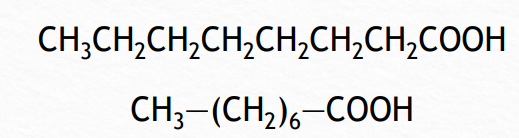

shorthand notation
________:_________






What is the mnemonic for naturally occurring saturated fatty acids that were highlighted in the ppt?


If given this condensed form of a monounsaturated FA, what would be the line formula, iupac name, and the shorthand notation of the FA?

Palmitoleic acid - 16:1(Δ9)
Unsaturated fatty acids
No. of C atoms - Common name - Shorthand notation
16 - _______________ - __________________

Oleic acid - 18:1(Δ9)
Unsaturated fatty acids
No. of C atoms - Common name - Shorthand notation
18 - _______________ - __________________

Linoleic acid - 18:3(Δ9,12)
Unsaturated fatty acids
No. of C atoms - Common name - Shorthand notation
18* - _______________ - __________________ (2 double bonds)

Linolenic acid - 18:3(Δ9,12,15)
Unsaturated fatty acids
No. of C atoms - Common name - Shorthand notation
18* - _______________ - __________________ (3 double boonds)

Arachidonic acid - 20:4(Δ5,8,11,14)
Unsaturated fatty acids
No. of C atoms - Common name - Shorthand notation
20 - _______________ - __________________


increases
The reason for this is the higher surface area of contact between the molecules of your fatty acid, requiring more energy to separate
decreases
The presence of a double bond creates a kink or bend in the FA, reducing surface area.
As the number of carbon atoms in the FA increases, the melting point also ______________.
Why?
As the number of carbon-carbon double bonds increases, the melting point ____________.
Why?
SAPONIFIABLE LIPIDS
glyceryl esters
non-glyceryl esters
______________________
produce fatty acid salts upon treatment with base
________________
triglycerides, glycerophospholipids
_________________
sphingophospholipids, waxes, glycolipids
fatty acid salts
triglycerides; glycerophospholipids
sphingophospholipids; waxes; glycolipids
SAPONIFIABLE LIPIDS
produce ______________ upon treatment with base
glyceryl esters
____________, _____________________
non-glyceryl esters
_____________________, _________, ______________
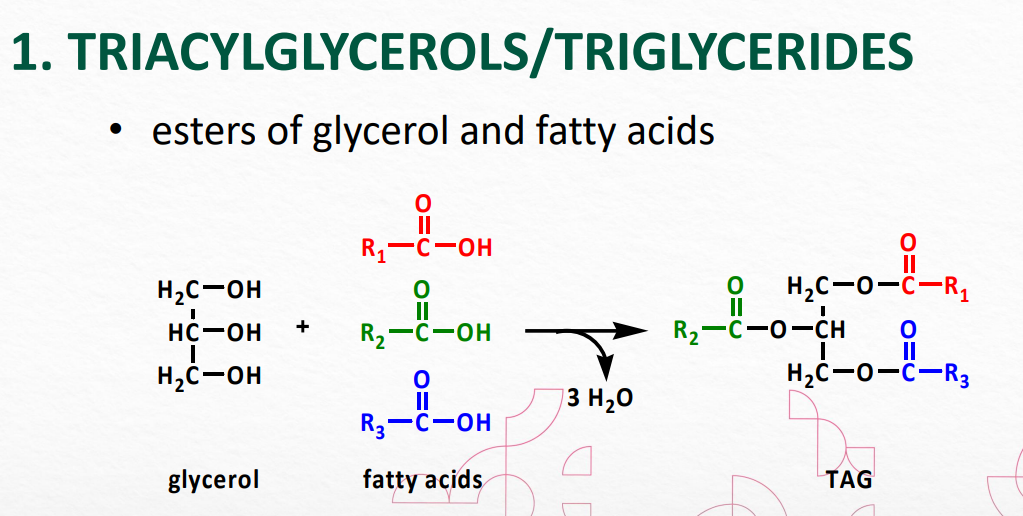

SAPONIFIABLE LIPIDS


FATS
SAPONIFIABLE LIPIDS
TAGs that contain high percentage of saturated fatty acids
FATS
SAPONIFIABLE LIPIDS
TAGs
solid at RT
usually coming from animal sources
OILS
SAPONIFIABLE LIPIDS
TAGs that contain high percentage of unsaturated fatty acids
OILS
SAPONIFIABLE LIPIDS
TAGs
liquid at RT
usually coming from plant sources
GLYCEROPHOSPHOLIPIDS
SAPONIFIABLE LIPIDS
glyceryl esters - ______________________
common constituents of cell membranes
fatty acids
phosphate

SAPONIFIABLE LIPIDS
GLYCEROPHOSPHOLIPIDS
a triester in which
first two (2) ―OH groups of glycerol are esterified with ______________ (need not to be identical)
third ―OH group esterified with a ___________ group that is in turn esterified to an alcohol

amphiphatic compounds
SAPONIFIABLE LIPIDS
GLYCEROPHOSPHOLIPIDS
_____________________ - have hydrophilic heads and hydrophobic tails
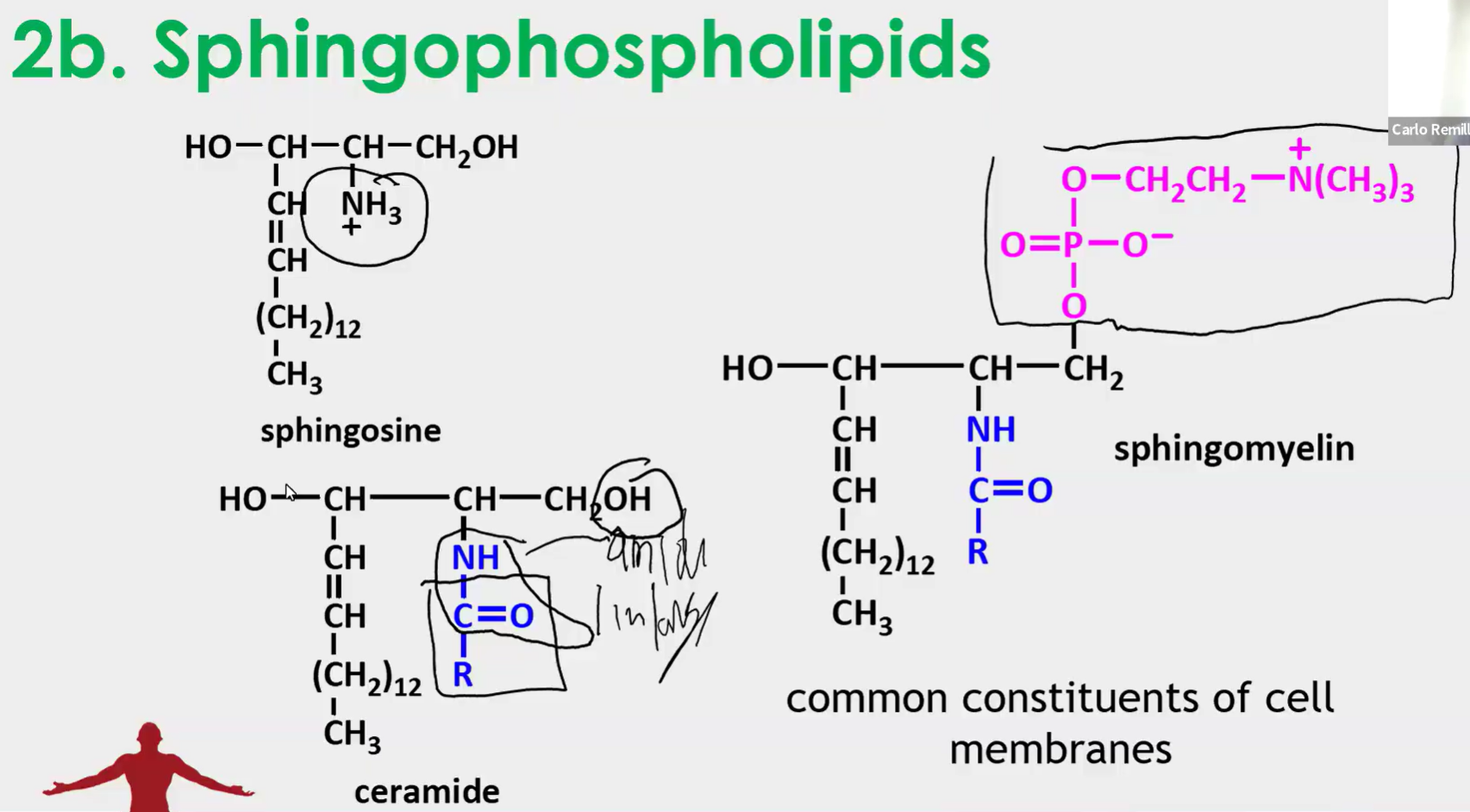
ceramide
amide
―OH
SAPONIFIABLE LIPIDS
SPHINGOPHOSPHOLIPIDS
derivatives of __________ (sphingosine + fatty acid)
fatty acid is connected with the ―NH3 + group via an _______ linkage
a polar group is usually esterified with the _____ group on the terminal carbon
SPHINGOPHOSPHOLIPIDS
sphingosine + fatty acid

SAPONIFIABLE LIPIDS
______________________
derivatives of ceramide (____________ + ___________)
Sphingomyelin
SAPONIFIABLE LIPIDS
What is a common constituent of cell membranes that is classified as a SPHINGOPHOSPHOLIPID?
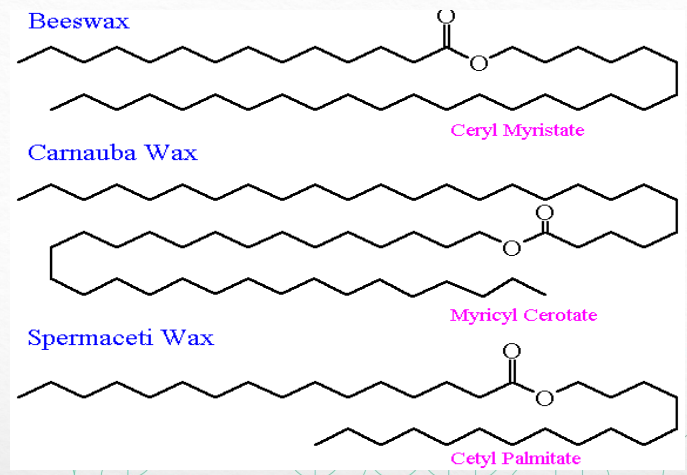
fatty acids; monohydric alcohols
leaf surfaces
feathers
hair
12
SAPONIFIABLE LIPIDS
WAXES
esters formed from ____________ and long-chain __________________
can be found on:
________________ – prevent excessive water loss and water absorption that can lead to leaf dissolution
__________ of birds
________
The R groups of the esters in waxes must have at least __ carbon atoms to be considered as a wax.
WAXES
SAPONIFIABLE LIPIDS
esters formed from fatty acids and long-chain monohydric alcohols
monosaccharide; glycosidic
SAPONIFIABLE LIPIDS
GLYCOLIPIDS
contain ______________ bonded to the ―OH group of ceramide through a ___________ bond
cerebrosides
galactose; glucose

SAPONIFIABLE LIPIDS
GLYCOLIPIDS
______________
glycolipid present in the brain and myelin sheath of the nerves
sugar is either __________ or ____________
ganglioside

SAPONIFIABLE LIPIDS
GLYCOLIPIDS
______________
sugar moiety can be more than one monosaccharides, disaccharides or trisaccharides
TRIACYLGLYCEROLS/TRIGLYCERIDES
GLYCEROPHOSPHOLIPIDS
SPHINGOPHOSPHOLIPIDS
WAXES
GLYCOLIPIDS
What are all the mentioned saponifiable lipids?
_______________________________
_______________________________
_______________________________
_______________________________
_______________________________
steroid nucleus
cholesterol
bile salts
hormones
dvitamin D

NON-SAPONIFIABLE LIPIDS
1. STEROIDS
lipids containing the _______________ which is a fused structure of four rings
__________________
__________________
__________________
__________________
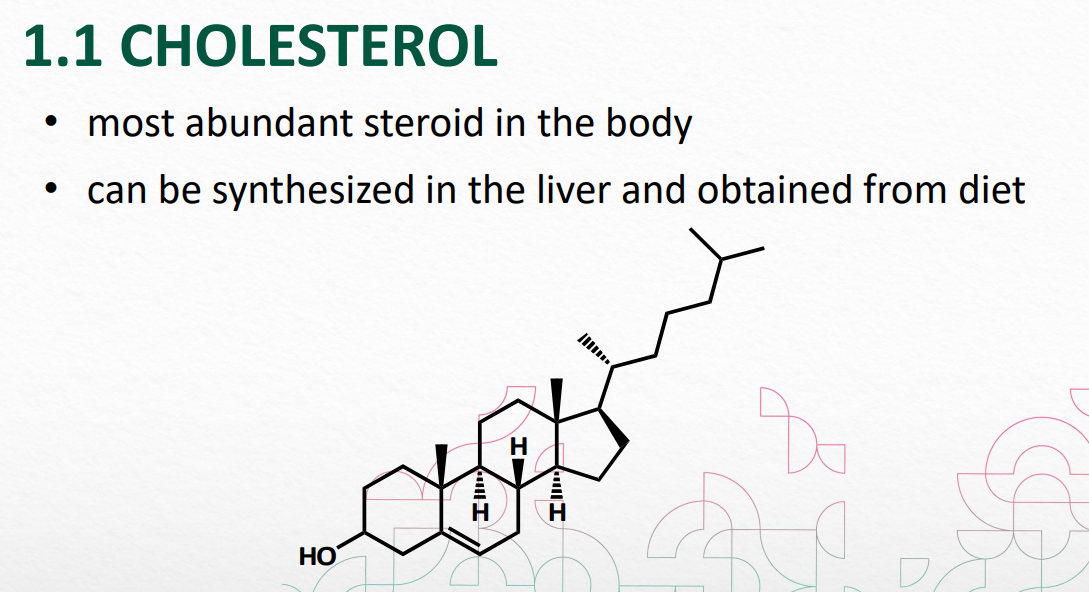
NON-SAPONIFIABLE LIPIDS - STEROIDS
most abundant steroid in the body
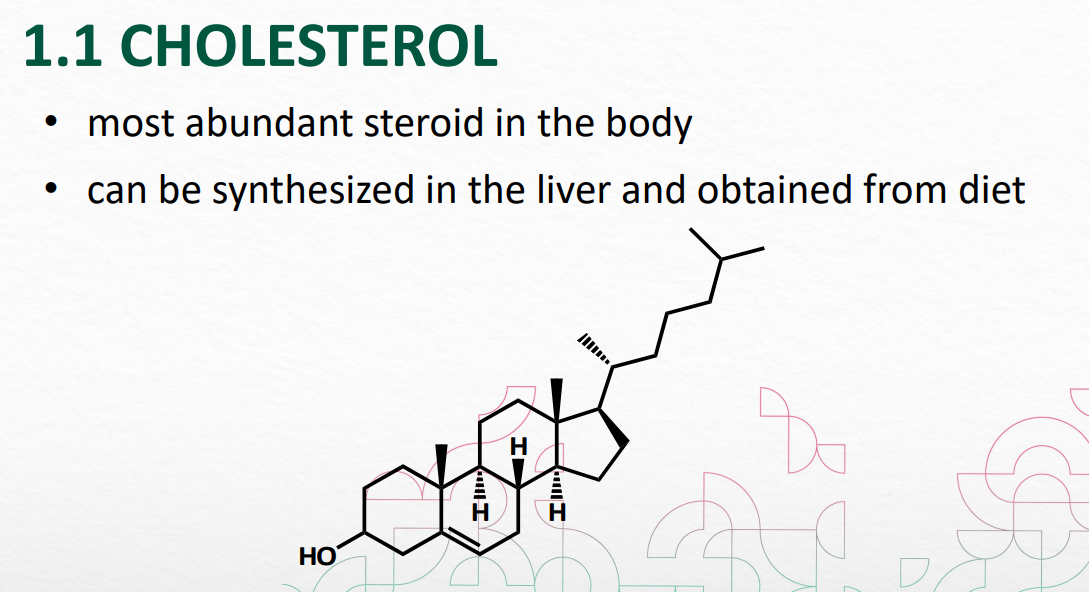
NON-SAPONIFIABLE LIPIDS - STEROIDS
can be synthesized in the liver and obtained from diet

NON-SAPONIFIABLE LIPIDS - STEROIDS
synthesized from cholesterol and released by the gall bladder

NON-SAPONIFIABLE LIPIDS - STEROIDS
emulsify fats and oils to give a greater surface area for lipid digesting enzymes
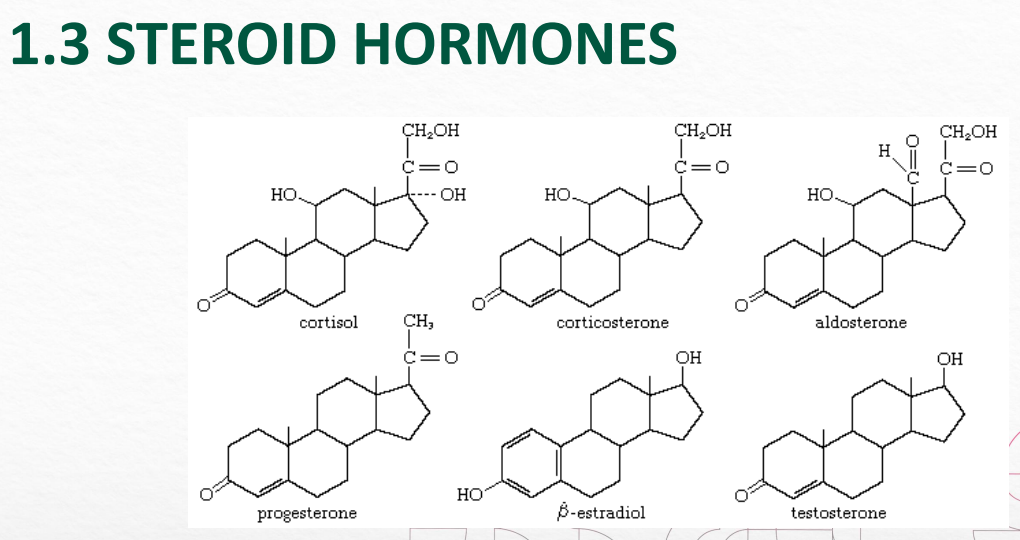
NON-SAPONIFIABLE LIPIDS - STEROIDS

EICOSANOIDS; arachidonic
prostaglandins
thromboxanes
leukotrienes
NON-SAPONIFIABLE LIPIDS
___________________
signaling molecules derived from ______________ acid
act a messengers in the central nervous system
_______________
_______________
_______________

NON-SAPONIFIABLE LIPIDS - EICOSANOIDS
function in the regulation of contraction and relaxation of smooth muscle tissues
NON-SAPONIFIABLE LIPIDS - EICOSANOIDS
contains a 5-carbon ring (cyclopentane ring)
Has 20 carbons within the whole molecule.
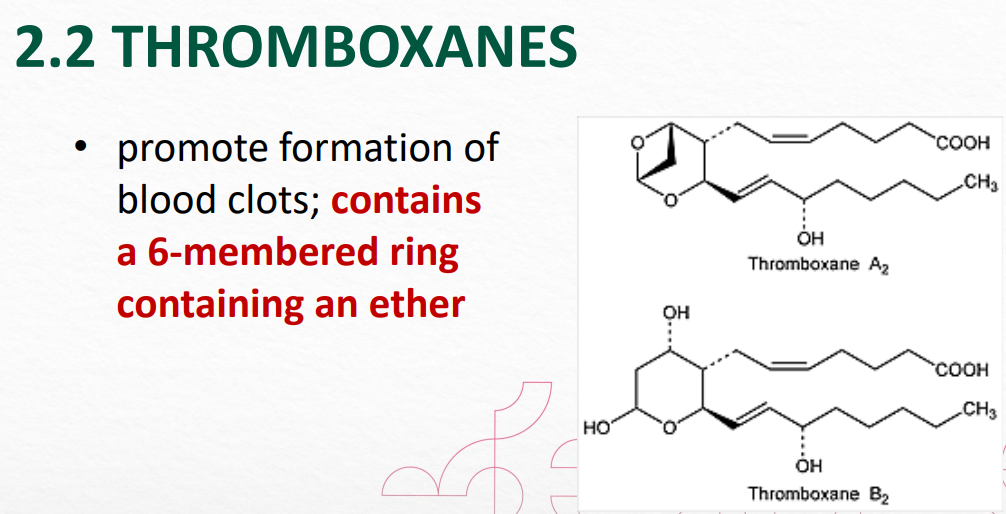
NON-SAPONIFIABLE LIPIDS - EICOSANOIDS
promote formation of blood clots
NON-SAPONIFIABLE LIPIDS - EICOSANOIDS
contains a 6-membered ring containing an ether
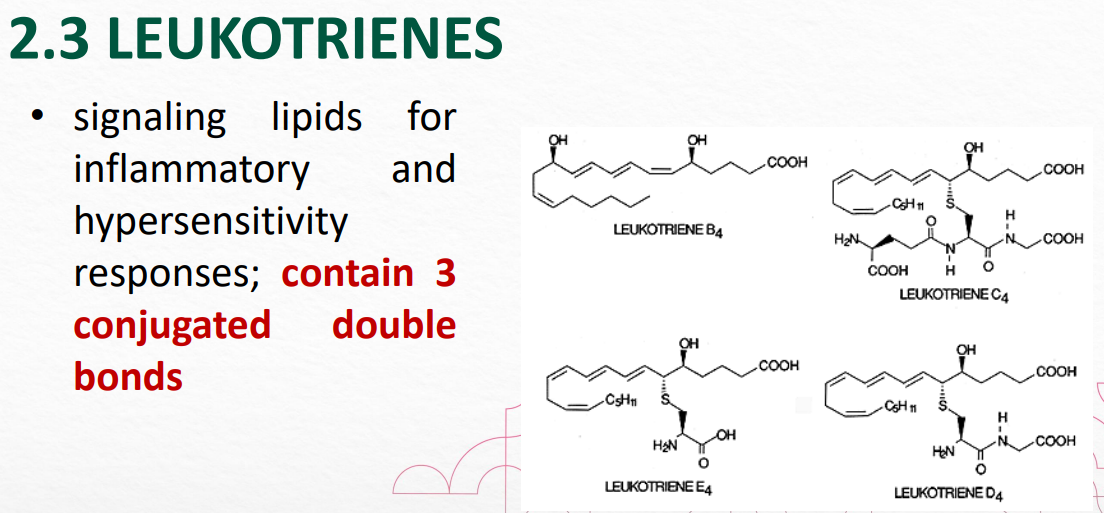
NON-SAPONIFIABLE LIPIDS - EICOSANOIDS
signaling lipids for inflammatory and hypersensitivity responses
NON-SAPONIFIABLE LIPIDS - EICOSANOIDS
contain 3 conjugated double bonds

isoprene
NON-SAPONIFIABLE LIPIDS
3. _________________
hydrocarbons or hydrocarbon derivatives constructed from recurring ____________ units
NON-SAPONIFIABLE LIPIDS
3. _________________
responsible for the scents and tastes of plant products
4. PHEROMONES
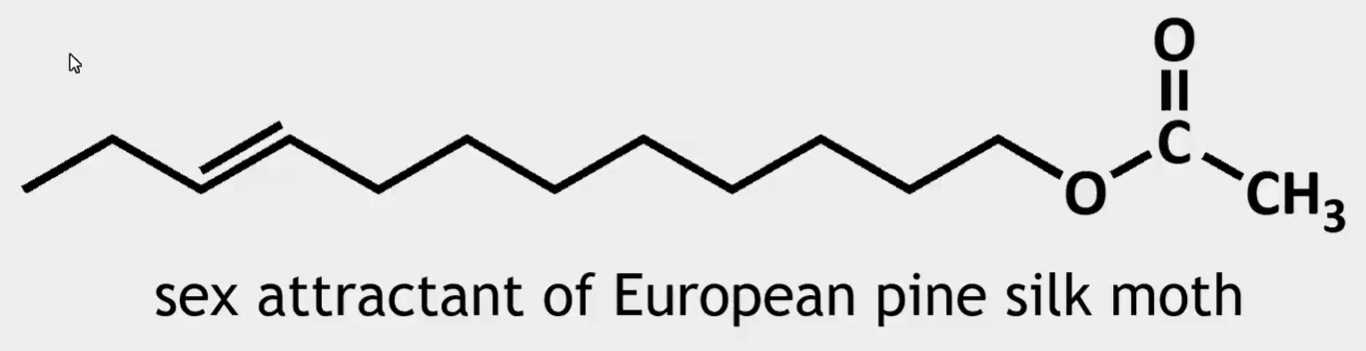
NON-SAPONIFIABLE LIPIDS
4. ________________
chemicals secreted by insects and animals to transmit messages to other members of the species
4. PHEROMONES
NON-SAPONIFIABLE LIPIDS
4. ________________
long chain alkenes with oxygen-containing functional group
ADEK

NON-SAPONIFIABLE LIPIDS
4. FAT SOLUBLE VITAMINS
Vitamin ___
purpose: ______________________
Vitamin ___
purpose: ______________________
Vitamin ___
purpose: ______________________
Vitamin ___
purpose: ______________________
COX-1; COX-2
COX-2; aspirin
COX-1
ASPIRIN, PAIN RELIEF AND STOMACH PAIN
cyclooxygenase exists as two isozymes: ________ and _________
therapeutic effects is due to inhibition of ________ by ________
unwanted side effects (stomach pain) is due to inhibition of _______
reason why some painkillers are only specific for COX-2 (e.g. celecoxib)
reason also why some heart disease patients take aspirin