Lossless Transmission Lines [Part-I]
 Call Kai
 Learn
Learn Practice Test
 Spaced Repetition
 Match
Match Flashcards
 Knowt Play
1/34

There's no tags or description
Looks like no tags are added yet.
Name | Mastery | Learn | Test | Matching | Spaced | Call with Kai | Chat |
|---|
No analytics yet
Send a link to your students to track their progress
35 Terms
Lossless Transmission Line
A transmission line for which the resistance per unit length R’, and conductance G’ are negligible compared to ωL’ and ωC’, respectively; approximated by R’ and G’ are approximately zero.
γ = jβ = jω((L’C’)^1/2)
Lossless-Line Propagation Constant (The propagation constant of a lossless line)
α = 0
Attenuation Constant of a Lossless Line
β = ω((L’C’)^1/2)
Phase Constant of a Lossless Line
Z0 = (L’/C’)^1/2
Characteristic Impedance of a Lossless Line:
The real-valued characteristic impedance of a lossless transmission line
λ = (2π)/β
Guide Wavelength: The wavelength of a wave propagating on a transmission line
u_p = ω/β
Phase Velocity: The speed at which a constant phase point propagates along the line
β = ω((με)^1/2)
Phase Constant in Terms of Material Parameters: Expression relating phase constant to permeability and permittivity
u_p = 1/((με)^1/2)
Phase Velocity in Terms of Material Parameters
ε_r = ε/ε_0
Relative Permittivity: Ratio of a material’s permittivity to free-space permittivity
c = 1/(((μ0)(ε0))^1/2)
Speed of Light in Free Space — Electromagnetic wave velocity in vacuum
u_p = c/(ε_r^1/2)
Phase Velocity in Terms of Relative Permittivity (Phase velocity for common TEM lines)
λ = λ0/(ε_r^1/2)
Guide Wavelength in Terms of Relative Permittivity (Wavelength on a transmission line)
λ0 = c/f
Free-Space Wavelength
Wavelength in air or vacuum
Nondispersive Transmission Line
A transmission line in which all frequency components propagate with the same phase velocity
Incident Wave
The wave traveling from the generator toward the load, represented by the factor of e^-jβz
Reflected Wave
The wave traveling from the load toward the generator, represented by the factor of e^jβz
Lossless-Line Voltage Expression

Lossless-Line Current Expression

Z_L = (Ṽ_L)/(Ĩ_L)
Load Impedance
Load Voltage
Total voltage evaluated at the load position z = 0
Ṽ_L = ((V_0)^+) + ((V_0)^-)
Load Current
Total current evaluated at the load position z = 0
Ĩ_L = ((V_0)^+)/Z0 - ((V_0)^-)/Z0
Γ = ((V_0)^-)/((V_0)^+)
Voltage Reflection Coefficient: Ratio of reflected voltage amplitude to incident voltage amplitude
Γ = (Z_L - Z0)/(Z_L + Z0)
Reflection Coefficient in Terms of Impedances: Expression relating reflection coefficient to load and characteristic impedance
z_L = (Z_L)/Z0
Normalized Load Impedance: Load impedance normalized to the characteristic impedance
Γ = (z_L - 1)/(z_L )
Reflection Coefficient Using Normalized Impedance
-Γ = ((I_0)^-)/((I_0)^+)
Current Reflection Coefficient: Ratio of reflected current amplitude to incident current amplitude
Γ = |Γ|(e^j(θ_r))
Polar Form of Reflection Coefficient: Complex representation of the reflection coefficient
Matched Load
Condition in which the load impedance equals the characteristic impedance: Z_L = Z0 resulting in Γ = 0
For Z_L = ∞: Γ = 1
Open-Circuit Load Reflection Coefficient
For Z_L = 0: Γ = -1
Short-Circuit Load Reflection Coefficient
Standing Wave Voltage Expression
Voltage on a line containing incident and reflected waves

Standing Wave Current Expression
Current on a line containing incident and reflected waves
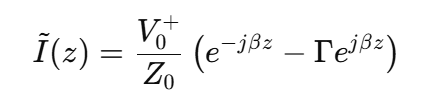
Magnitude of Standing-Wave Voltage

e^jx + e^-jx = 2(cos(x))
Euler Cosine Identity