BSC2005 Exam 3 Study Guide
 Call Kai
 Learn
 Practice Test
 Spaced Repetition
 Match
 Flashcards
 Knowt Play
1/94

There's no tags or description
Looks like no tags are added yet.
95 Terms
Why is evolution considered a scientific theory?
Evolutionary theory is the framework that allows us to generate testable hypotheses about observed patterns in biological populations; Our understanding of the mechanisms that result in geneticchanges in populations through generations.
scientific theory characteristics
» supported by multiple lines of evidence and explain a wide range of phenomena
» compatible with other theories
» parsimonious: the simplest explanation of observations, with no unnecessary or unfounded assumptions
» falsifiable: make testable predictions (most important)
what kinds of phenomena are predicted by evolution?
» Spatial and temporal patterns in the fossil record, (for example, ancestral populations have features not found in modern taxa)
» Genetic variation is found in most traits in natural populations.
» Living things should be organized in a hierarchy of relatedness.
» Evolutionary processes should be demonstrable in nature.
evolution
the change in genetic composition of populations over time
What are the three ways that evolutionary change can be observed?
1. laboratory experiments
2. natural populations
3. fossil records
Which three things must be true in order for natural selection to occur?
1. a population must have variation in a trait
2. that variation must be heritable
3. some variants must be better able to survive and reproduce than others (i.e. have higher fitness)
evolution by natural selection
if the three requirements for natural selection are true, then there will be an increase in the frequency of that trait in the next generation
Charles Darwin
» developed an explanatory theory for evolutionary change
» 5 year voyage around the world
» traveled to Galapagos and observed finches; thus, "Darwin's finches"
» noted that natural variation could be favored for many different reasons and favored variants could be selected by breeders
» described natural selection
» On the Origin of Species (1859)
Jean-Baptiste Lamarck
» recognized that organisms must change through time
» presented a potential mechanism of evolution in 1809: the use and disuse leads to developmental change and acquired characteristics are inherited
» decorate war veteran, botanist, malacologist (snails), naturalist, one of the first to consider himself a biologist.
Charles Lyell
» Principles of Geology- Geologic uniformitarianism and old earth
» responsible for the general acceptance of the view that all features of the Earth's surface are produced by physical, chemical, and biological processes through long periods of geological time (uniformitarianism)
Thomas Malthus
» An Essay on the Principle of Population (1789)
» Populations have the potential for rapid (exponential) increase
» Resources can not increase faster than arithmetically
» Demand can quickly outstrip supply
» Catastrophe results: war, famine, etc. until population is brought in line with resource supply
» "struggle for existence"
Darwins definition of natural selection
differences among individuals that affect their chances to survive and reproduce, will affect the frequency of those traits in the next generation
Where did natural selection come from?
» far more individuals are born than survive to reproduce (Malthus)
» offspring tend to resemble their parents, but are not identical to their parents or to one another (numerous experiments)
population
a group of individuals of a single species that live and interbreed in a particular geographic area at the same time
Defend the statement "individuals do not evolve, populations evolve"
in biology, "evolution" refers specifically to changes in the genetic makeup of populations over time
how do organisms have variation in a trait? (1st requirement for natural selection to occur)
» the ultimate origin of genetic variation is mutation, in other words, they are the raw material of evolution
» mutations occur randomly to an organism's needs
» natural selection, acting on this random variation, results in adaptation
what are some misconceptions of evolution?
» evolutionary theory implies that life evolved (and continues to evolve) randomly, or by chance
» natural selection involved organisms trying to adapt
» natural selection gives organisms what they need
» the fittest organisms in a population are those that are strongest, healthiest, tastes, and/or largest
» natural selection is about survival of the very fittest individuals in a population
explain the importance of the 2nd requirement for natural selection to occur, which is that variation must be heritable
» heritability is the relative contribution of genetic versus environmental factors to variation in a character in a population
» heritability is measured by the slope of a parent-offspring regression; the closer the slope is to 1, the greater heritability of a trait; the closer the slope is to 0, the less heritability of a trait.
fitness
the relative ability of an organism to survive and reproduce in a particular environment
Recognize and distinguish directional, stabilizing, and disruptive selection
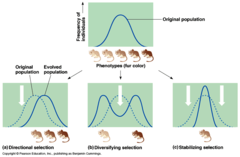
stabilizing selection
reduced variance without changing the mean value of a trait; favors average individuals
directional selection
forces the mean value of a trait in one direction. it does not necessarily change the variance. favors individuals that vary in one direction from the mean.
disruptive selection
» increases variance, and may or may not change the mean value of a trait
» individuals at the extremes of a character distribution have the highest fitnesses
» favors individuals that vary in both directions from the mean
sexual selection
» works the same as natural selection, but the "fittest" individuals are those who are best able to get mating partners
» may take the form of male competition for access to mates (direct combat, ritualized fighting, mate guarding, or sneaker males)
» or female choice of male phenotypes (females ma choose males with traits that show they provide resources, parental care, or males that are attractive or in good health)
Breeders' Equation
R = h^2s
» R= difference between the starting populations mean trait value and the offspring population's mean trait value, or "response"
» h^2= heritability (0-1)
» s= difference between the offspring population and the mean of the breeding individuals in the starting population, or "selection differential"
genotype frequency
number of individuals with genotype in population/total number of individuals in population
» frequency of genotype AA= N subscript AA/N
» frequency of genotype Aa= N subscript Aa/N
» frequency of genotype aa= N subscript aa/N
allele frequency
number of copies of allele in population/total number of copies of all alleles in population
» p= frequency of A
» p= 2N subscript AA + N subscript Aa/2N
» q= frequency of a
» q= 2N subscript aa + N subscript Aa/2N
5 conditions for Hardy-Weinberg Equilibrium
1. No mutations - the gene pool is modified if mutations alter alleles or if entire genes are deleted or duplicated; mutations create new alleles, so frequency changes.
2. Random mating - if individuals mate preferentially within a subset of the population, such as their close relatives (inbreeding) random mixing of gametes does not occur, and genotype frequencies change.
3. No natural selection - differences in the survival and reproductive success of individuals carrying different genotypes can alter allele frequencies; natural selection results in adaptations
4. Extremely large population size - the smaller the population the more likely itis that allele frequencies will fluctuate by chance from one generation to the next ( process is called genetic drift); real populations will experience fast or slow drift
5. No gene flow - by moving alleles into or out of populations, gene flow can alter allele frequencies; adds new alleles and changes frequencies.
Hardy-Weinberg Equation

genetic drift
a change in allele frequencies between generations that occurs purely by chance; random changes in allele frequencies of a population between generations
» can only happen when a subset of population reproduces
» that subset of alleles overrepresented in next generation
» this decreases genetic diversity of a population
founder effect
a type of genetic drift in which a small number of individuals leaves one population and establishes a new one. if, by chance, alleles from the original population are absent from the founders, they will also be absent from the new population. this will result in the founding population being less diverse than the original.
bottleneck effect
Occurs when a population loses a large proportion of its members. if the original population is large, the reduced population is likely to retain the same alleles presents in the original population. but in a small starting population, the loss of individuals is more likely to result in the loss of alleles form the population.
gene flow
the movement of alleles from one population to another
» increase genetic diversity
» tends to equalize allele frequencies between populations
inbreeding
mating between closely related individuals
» does not change the allele frequency within a population
» increases the proportion of homozygous individuals to heterozygous
fixation
occurs when there is only one allele present (and so its frequency is 1.0)
genetic drift effects on large populations
» natural selection is very efficient (i.e. slightly beneficial alleles can increase rapidly in frequency)
» but genetic drift will still influence allele frequencies of neutral loci (those not under selection)
genetic drift effect of small populations
» genetic drift can quickly change allele frequencies and overcome natural selection
» harmful alleles may increase in frequency, or rare advantageous alleles may be lost
» fixation
why is genetic diversity important?
» diverse gene pool gives a population more flexibility to survive in a changing environment
» the more genetically diverse a population, the more ways it has to adapt
inbreeding depression
» closely related individuals are more likely to share the same alleles
» negative reproductive consequences for a population
» associated with high frequency of homozygous individuals possessing harmful recessive alleles
biological species concept
» a population of individuals whose members can interbreed and produce fertile offspring.
» a group of actually or potentially interbreeding organisms reproductively isolated from other such groups
what situations could the biological species concept not apply or be useful?
This concept cannot apply to those that encounter prezygotic and postzygotic barriers.
» Prezygotic barriers prevent members of different species from mating to product a zygote; these barriers include all of the different types of isolation discussed in this lesson.
» Postzygotic barriers keep hybrid zygotes—one-celled embryos with parents of two different species—from developing into healthy, fertile adults. Postzygotic barriers are often related to the hybrid embryo's mixed set of chromosomes, which may not match up correctly or carry a complete set of information.
what is the common factor required for speciation to happen?
For speciation to occur, two new populations must be formed from one original population, and they must evolve in such. way that it become impossible for individuals from the two new populations to interbreed.
speciation
genetic divergence of populations, leading over time to reproductive isolation and the formation of new species
allopatric speciation
when populations are separated by a physical or geographic barrier
» these barriers can form when continents drift, sea levels rise and fall, glaciers advance and retreat, or climates change
» the populations evolve through genetic drift and adaptation to different environments in the two areas
sister species
species that are each other's closest relatives; may exist on opposite sides of a geographic barrier (i.e. isolated fish populations in the Ozark and Ouachita mountains and Darwin's finches)
sympatric speciation
groups from one ancestral population evolve into separate species without any geographical separation
» one of the best examples is disruptive selection and assertive mating (mating between similar individuals)
ecological isolation
species live in different environments (i.e. the desert fox and the arctic fox)
temporal isolation
species have different mating or fertility timeframes (i.e. the leopard frog mates in early spring and the bullfrog mates in early summer)
behavioral isolation
species display different mating activities
mechanical isolation
species have incompatible mating organs
gametic isolation
species have incompatible gametes (i.e. the egg and sperm from a dog and a cat cannot unite to form a zygote)
hybrid inviability
species' gametes unite bu viable offspring cannot form. (i.e. the goat and sheep can mate, but the zygote formed does not survive)
hybrid infertility
offspring are viable but cannot reproduce (i.e. zebras and horses are different (i.e. mix of zebra and horse is a zebroid that is infertile, cannot reproduce)
fossil record
an assemblage of fossils arranged in order of age, providing evidence of changes in species over time
what information do fossils provide?
they give information about the kinds of organisms that lived, what they looked like, and where and how they lived
What are the best conditions for organisms to fossilize
being buried in dry or anoxic aquatic (no oxygen) environments are best
» hard parts and large bones are great at being preserved
» fossils only form in sedimentary rocks
» avoid being tramples, scavenged or decomposed
igneous rock
new rock, from lava or magma
sedimentary rock
hardened layers of sediment
» fossils are only found in this type of rock
metamorphic rock
igneous or sedimentary rock that has been changed due to extreme pressure and heat
relative dating: the Principle of Superposition
the oldest layer of sedimentary rock is at the bottom and the news layer is at the top
» these layers are called "strata"
relative dating: the Principle of Faunal Succession
the same types of fossils appear in the same order in different deposits
radiometric dating
an isotope of an element has the same number of protons but different numbers of neutrons. some isotopes are radioactive-- they "decay" (lose protons, and convert to other elements).
half-life
the time it takes for half of the original isotopes to decay
Explain how you would use layers of volcanic ash bedded within fossil-bearing sedimentary rock to estimate the age of the fossil.
» different isotopes can be used to date different materials/ages. potassium-argon dating used to date igneous rock
» by dating igneous rock layers above/below a sedimentary rock layer, we can determine the age of fossils in the sedimentary rock
distinguish between ordinary extinction and mass extinction
» extinction refers to the normal extinction rate. these are species that go extinct simply because not all life can be sustained on Each and some species simply cannot survive.
» mass extinction is a widespread event that wipes out the major (50%-90%) of living plants and animals.
explain why human-caused extinctions are on track to qualify as mass extinction
anthropogenic extinctions
» Many (most?) large mammal species went extinct in Australia and the Americas shortly after Homo sapiens arrived.
» 875 documented extinctions in just the past 500 years; actual numbers are likely much higher.
» land development, overexploitation, species translocations and introductions, and pollution.
what are some types of changes that lead to mass extinction?
» large volcanic eruptions
» cooling which leads to increased glaciation and sea level drpos
» declining atmospheric O2
» meteorite hit, resulting dust and steam ascribe sunlight which stops photosynthesis
The Cambrian Explosion
(~540 mya) the first appearance of representatives of the major animal phyla- vertebrates, mollusks, etc. also some bizarre organisms with no living relatives
Precambrain Era
» first evidence of prokaryote cells
» prokaryotes dominate the oceans
» first eukaryotes appear in water. soft bodies invertebrates develop in water
Paleozoic Aera
» Cambrian: expansion fo ocean animal diversity
» Ordovician: first coral reed and primitive fish appear. ocean plants diversify. first fungi appear in water.
MASS EXTINCTION
» Silurian: seedless plants, primitive insects and soft-bodies animals appear on land
» Devonian: fish species diversify, first insects and seed-bearing plants appear on land; Age of Fishes; earliest insect, spider, and amphibian fossils
MASS EXTINCTION
» Carboniferous: amphibians appear and begin to diversify
» Permian: coral species abundant in oceans. reptiles appear on land; continents came together to form the super-continent Pangaea; amniotes plot into reptilian and mammalian lineages
MASS EXTINCTION
Mesozoic Era
» Triassic: ocean life diversifies in recovery from Permian extinction. dinosaurs and mammals appear on land
MASS EXTINCTION
» Jurassic: first flowering plants and bird species appear. large dinosaurs are plant-eaters
» Cretaceous: dinosaurs diversify. Cone-bearing and flowering plants dominate many habitats.
MASS EXTINCTION
Cenozoic Era
» Tertiary: mammals, birds and flowering plants diversify. Grasses appear. First primates and early humans appear
» Quaternary: many large mammals become extinct. appearance of modern species present day
Permian mass extinction
"The Great Dying"
The End-Permian Event (~250 mya)
» greatest mass extinction in Earth's history
» ~96% of all multicellular species become extinct
» thought to be due to volcanic activity that led to climate cooling, huge glaciers, and sea level drops and atmospheric O2 declined
The Cretaceous/Tertiary boundary
K/T boundary (~65 may)
» meteorite hit and the resulting dust and steam obscured sunlight, stopping photosynthesis
» on land, all animals larger than about 25 kg and many insect became extinct
descent with modification
» living species have common ancestors (run speciation backward)
» the differences between species emerged over time due to natural selection
» those differences that are the result of natural selection are adaptations
homology
similar due to common ancestry
homologous chromosomes
structure that are similar because they are inherited from the same ancestor
Explain the reason why Neil Shubin & collegues went to Ellsmere Island to dig for fossils there.
they discovered fossil remains of Tiktaalik, which was important part of evolution of vertebrate
what are the four concepts that living on land requires?
1. sturdier structure
2. prevention of water loss
3. a different way to take in oxygen
4. limbs
Tiktaalik
posses adaptations of both fish and tetrapods. the fish-like traits would have been useful in water, while the tetrapod-like traits would have been useful when this animal ventured on land. For all it amphibian-like characteristics, this animal is still technically a fish because tis limbs lack true jointed diners and toes, a defining feature of tetrapods.
» mobile neck
» long and flat head
» lungs and gills
» pectoral fins are weight bearing with distinct, jointed wrist and finer-like bones
» pelvic fins
» scales
convergent evolution
organisms that are not closely related evolve similar adaptations as a result of independent episodes of natural selection
evolutionary reversal
a character may revert from a new state back to previous state
» true evolutionary reversal of adaptations are hard to identify because complex traits by be hard to undo. generally, signs will remain in vestigial structures, etc.
» at the molecular level, reversal can happen routinely; at some site in a gene: a to g, later, g to a.
taxonomy
the science of identify organisms, naming them, and classifying them into groups (Carolus Linnaeus)
Linnaean Hierarchy of Classification
Kingdom, Phylum, Class, Order, Family, Genus, Species
(i.e. Animals, Chordata, Mammalia, Primates, Hominidae, Homo, Homo sapiens)
» largest category to very specific; categories are increasingly exclusive, until finally only one member is included
phylogeny
The evolutionary history of a species or group of related species
» it is now possible to use the pattern of homologous characters (especially from DNA sequences) among species to accurately reconstruct the history of branching in all lineages of life.
» the resulting tree is called the "Tree of Life"
branch
process of natural selection leading to new species; lineages leading from an ancestor
root
this is the common ancestor of all organisms on the tree
node
this is the last common ancestor between two species or species groups
clades
an ancestor and all of its descendants
sister groups
the two branches (& descendent species) that diverged from a common ancestor
» are each other's closest relatives, biologically
vestigial structures
A structure inherited from an ancestor that no longer serves a clear function in the organism that possesses it.
adaptive radiation
the spreading and diversification of organisms that occur when the organisms colonize a new habitat
punctuated equilibrium
periodic bursts of species change as a result of sudden environmental change
latitudinal species gradient
species richness, or biodiversity, increases from the poles to the tropics for a wide variety of terrestrial and marine organisms
Recognize the importance of the longleaf pine and fire in making the southeastern US a biodiversity hotspot
Though typically thought of as a sandhill species, longleaf pine once covered about 2/3 of the southeast. At a landscape level, longleaf pine forests cover a variety of different habitat types (mountains, rolling hills, sandhills and flatwoods). A longleaf pine stand maintained by fire is among the most biologically diverse habitats in North America. Well-managed longleaf pine forests provide quality habitat for a variety of desirable plant and animal species.